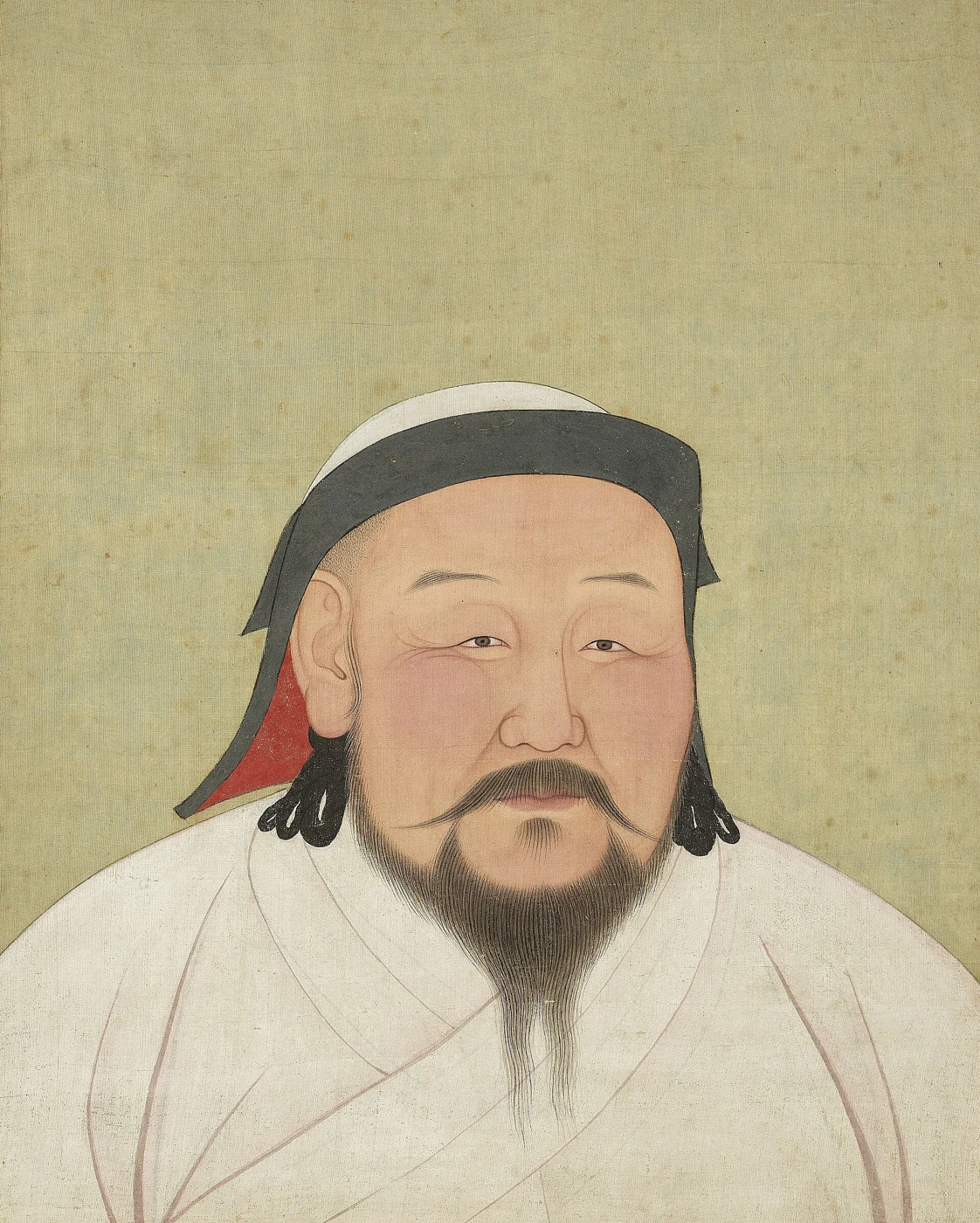
Biography
Imperial-Clan Background and Early Recruitment of Talent Kublai was a son of Tolui and his principal wife Sorghaghtani Beki. His elder brothers included Möngke, while his younger brothers included Hulagu Khan and Ariq Böke. Details of his early life are mainly preserved in later histories and biographies; what can be confirmed is that before becoming Great Khan he had already begun to engage with Chinese scholars and questions of governance. Zhao Bi explained the *Extended Meaning of the Great Learning* to him, while Wang E, Dou Mo, Yao Shu, Zhang Dehui, and others were successively summoned to his princely establishment. Liu Bingzhong was highly valued for his knowledge of the classics and histories, geography, and institutional planning. Through consultations, appointments, and attention to advisers from different backgrounds, Kublai gradually formed what later became known as the Jinlianchuan Secretariat. After Möngke became Great Khan in 1251(1st year of his reign), he appointed Kublai to overall charge of affairs in the Chinese territories south of the Gobi. Kublai initially exercised mainly military authority and, following Yao Shu's advice, did not simultaneously take full control of both military and civil administration, in order to reduce suspicion within the imperial clan. He later used his appanages and discretionary authority to handle affairs in Jingzhao, Henan, and other regions. He established military-administration, pacification, and agricultural-colony offices, appointed some scholars from the Central Plains, reorganized taxes and corvée, restored agriculture and schools, and addressed military killings and excessive exactions by local officials. In 1256(6th year of Möngke's reign), he ordered Liu Bingzhong to construct Kaiping near Huanzhou, creating a fixed political center south of the Gobi. ### Conquest of Dali and Möngke's Southern Campaign In 1252(2nd year of Möngke's reign), Kublai was ordered by Möngke to lead an army against Dali. Mongol forces advanced by several routes, passing through the former Western Xia territories, the Liupan Mountains, and the Dadu River area before crossing mountains and rivers into Dali. At the end of 1253(3rd year of Möngke's reign), Kublai's central column reached the city of Dali, where Gao Tai Xiang and others of the Duan regime organized resistance. After the city fell, Kublai ordered Yao Shu and others to collect books and registers. he initially became angry and considered large-scale killing and plunder because Mongol envoys had been killed, but stopped after advisers remonstrated with him and issued an order restraining the army from killing. Gao Tai Xiang was later captured and executed, and Duan Xingzhi surrendered the following year. Kublai left Uriyangkhadai to garrison the region, appointed Liu Shizhong as pacification commissioner, and arranged for members of the Duan family to continue participating in local administration. Möngke launched a war against the Southern Song in 1256(6th year of his reign), and Kublai led the central army south. In 1259(9th year of Möngke's reign), while he was advancing near Ezhou, he received news of Möngke's death. Faced with a succession crisis, Kublai initially maintained military pressure. He withdrew north after Southern Song chancellor Jia Sidao requested peace. Sources differ over the specific terms of the negotiations; what can be confirmed is that Kublai used the withdrawal to return north and seek the support of princes and armies. ### Struggle for the Khanship and Founding of the Yuan Dynasty On May 5, 1260(24th day of the 3rd lunar month, 1st year of Zhongtong), Kublai was proclaimed ruler at Kaiping by some princes and senior officials. His younger brother Ariq Böke was also enthroned in the northern steppe, and the two sides fought over the authority of the Great Khan. Kublai relied on the population, grain, and armies of the regions south of the Gobi and the Chinese territories, organizing defense and offensives around Kaiping, Dadu, and the Guanzhong-Gansu region. Ariq Böke relied on princes of the northern steppe. The conflict repeatedly shifted, and during the struggle Kublai also dealt with Li Tan's rebellion and adjusted the administration of hereditary warlord armies and local military-civil affairs. In 1264(1st year of Zhiyuan), Ariq Böke surrendered and the struggle for the khanship came to an end. The Kipchak, Chagatai, Ögedei, and other western khanates, however, increasingly developed into independent centers of power, and the Mongol Empire could no longer operate as a unified polity in its earlier form. After taking the imperial title, Kublai adopted the era-name system, used the Secretariat for civil administration, the Bureau of Military Affairs for military command, and the Censorate for supervision, and gradually regularized official ranks, salaries, and local institutions. In 1263(4th year of Zhongtong), Kaiping was elevated and renamed Shangdu. In 1264(1st year of Zhiyuan), Yanjing was renamed Zhongdu and made a secondary capital. Construction of a new capital began in 1267(4th year of Zhiyuan), and in 1272(9th year of Zhiyuan) Zhongdu was renamed Dadu. The Yuan court thereafter operated a two-capital system centered on Dadu and Shangdu. Kublai also established an Imperial Ancestral Temple, formulated a calendar, and revised institutional regulations, using the institutional language of Chinese dynasties to articulate a new ruling order. On December 18, 1271(15th day of the 11th lunar month, 8th year of Zhiyuan), he adopted “Great Yuan” as the dynastic name from the phrase *da zai qian yuan* in the *Book of Changes*. The government of the Mongol Great Khan thereby shifted toward a ruling system centered on the emperor of the Yuan Dynasty. Yuan institutions were not a simple copy of Chinese systems. The central government included the Secretariat, Bureau of Military Affairs, Censorate, and other organs, while branch secretariats gradually took shape in the provinces. Affairs concerning Ü-Tsang were placed under the General Administration, later renamed the Bureau of Buddhist and Tibetan Affairs, and postal stations linked the frontiers with major transport routes. At the same time, Mongol aristocratic appanages, the touxia appanage system, the keshig, and status distinctions were retained. After Li Tan's rebellion, Kublai became more wary of Han Chinese hereditary warlords, weakened their hereditary military powers, separated military from civil administration, and used officials of different ethnic backgrounds to check one another. Yuan state institutions thus strengthened central authority while preserving the privileges of the Mongol ruling group. ### War against the Southern Song and Governance of Jiangnan During his struggle with Ariq Böke, Kublai sent Hao Jing to negotiate peace with the Southern Song, but Hao Jing was detained and the negotiations did not continue. In 1268(5th year of Zhiyuan), Yuan forces adopted Liu Zheng's proposal to besiege Xiangyang and Fancheng, building warships and training naval forces. After Muslim Trebuchets were deployed in the siege, Fancheng fell in 1273(10th year of Zhiyuan), and the Xiangyang commander Lü Wenhuan surrendered. The campaign broke an important Southern Song defensive point on the Yangtze and opened the way for the Yuan advance downriver. In 1274(11th year of Zhiyuan), Kublai decided on a large-scale invasion of the Southern Song. He appointed Bayan to command the main force and ordered armies in western and eastern Huai regions to coordinate. Before the campaign, he instructed Bayan to follow the example of Cao Bin and minimize killing and plunder. Yuan forces advanced along the Yangtze, defeated the Song army led by Jia Sidao at Dingjiazhou, and then captured a series of river-defense towns. On February 4, 1276(18th day of the 1st lunar month, 13th year of Zhiyuan), Yuan troops entered Lin'an, and Emperor Gong of Song and Grand Empress Dowager Xie Daoqing surrendered, handing over the declaration of submission and the imperial seal. Kublai issued edicts to pacify newly surrendered areas, and Yuan forces retained some local officials in office. Southern Song imperial relatives and loyalists, however, continued resistance along the coast after enthroning new rulers. On March 19, 1279(6th day of the 2nd lunar month, 16th year of Zhiyuan), Yuan forces defeated the Southern Song maritime regime at the Battle of Yashan, bringing the Southern Song to an end. ### Governance, Economy, and Culture after Unification After unification, Kublai faced the tasks of rebuilding war-torn areas, restoring agriculture, and raising revenue for a large military and administrative apparatus. The court established offices such as the Directorate of Agriculture, compiled and printed the *Nongsang Jiyao*, promoted land reclamation, military agricultural colonies, waterworks, and the spread of agricultural techniques, and used granaries and relief measures in years of disaster. In 1260(1st year of Zhongtong), it issued Zhongtong Banknotes backed by silver reserves. After the conquest of Jiangnan, the court exchanged local paper currencies and expanded the circulation of its notes. As issuance increased, their value gradually became unstable. In 1287(24th year of Zhiyuan), the court also issued Zhiyuan banknotes. Paper currency facilitated long-distance trade and fiscal transfers, but its stability depended on issuance discipline and fiscal management. Kublai placed great importance on grain transport linking Dadu with Jiangnan. The Yuan court used maritime transport and excavated or repaired waterways in Shandong and the Beijing area. The Jizhou River was completed in 1283(20th year of Zhiyuan), the Huitong River opened in 1289(26th year of Zhiyuan), and Guo Shoujing supervised the Tonghui River project, completed in 1293(30th year of Zhiyuan). Grain ships could thereafter travel through Tongzhou into Jishuitan in Dadu. These water-transport projects shortened north-south supply routes, supported the provisioning of Dadu, and promoted trade along the routes. The early Yuan also promulgated a new Mongol script, the Phags-pa script. Central and local governments maintained various institutions for religious affairs, and Buddhist, Daoist, Islamic, and Christian communities were active across the empire. Kublai patronized religious figures including Phags-pa and also supported classical lectures, Confucian education, and historical compilation. In 1291(28th year of Zhiyuan), the court promulgated the *Zhiyuan Xinge*. The institutions of this period combined Chinese administrative forms, Mongol traditions, and the legal practices of different religious communities; they cannot be reduced to a simple process of complete “Sinicization” or a single institutional transformation. ### Finance, Warfare, and Late-Reign Politics Long-term military expenditure led Kublai to rely heavily on fiscal officials such as Ahmad Fanakati, Lu Shirong, and Sangha. They reorganized salt, tea, commercial taxes, and paper-currency policy and increased government revenue, but some measures involved retrospective collections, heavy exactions, and private profiteering by officials, provoking dissatisfaction among court officials and local society. Ahmad Fanakati was assassinated in 1282(19th year of Zhiyuan) by Wang Zhu and Gao Heshang. Lu Shirong and Sangha were later employed and punished in turn. Later historians including Tu Ji and Bi Yuan noted that although Kublai punished some fiscal officials after problems came to light, fiscal pressure and local burdens did not disappear. Kublai also continued to confront rebellions by Mongol princes. After the conflict with Ariq Böke, Kaidu and other northwestern forces fought the Yuan court for many years. In 1276(13th year of Zhiyuan), a mutiny broke out in the force under Nomughan that Kublai had sent to the northwest. In 1287(24th year of Zhiyuan), the eastern prince Nayan rebelled, and Kublai personally campaigned against him and defeated the rebels near the Liao River. In 1289(26th year of Zhiyuan), Kaidu's forces entered Karakorum; Kublai again campaigned north and recovered the city. Northwestern warfare continued into his final years, and the Yuan court never fully controlled the various khanates. In external warfare, Yuan forces launched two expeditions against Japan, in 1274(11th year of Zhiyuan) and 1281(18th year of Zhiyuan), neither of which established Yuan rule over Japan. The court also used force against Vietnam, Champa, Myanmar, Java, and other regions, with varying outcomes and repeated withdrawals. These expeditions required ships, troops, grain, and military levies and increased the fiscal burden and demands placed on coastal populations. The sources differ on troop numbers, losses, and details of some campaigns, and the text therefore does not adopt disputed extreme figures. Empress Chabi died in 1281(18th year of Zhiyuan), and Crown Prince Zhenjin died in 1286(23rd year of Zhiyuan). Kublai suffered from illness in his later years, and court affairs increasingly depended on close attendants and Empress Nambui to transmit reports, while his decision-making showed more hesitation than in earlier years. In 1293(30th year of Zhiyuan), he gave the crown prince's seal to his grandson Temür. Kublai died on February 18, 1294(22nd day of the 1st lunar month, 31st year of Zhiyuan of Yuan) in Zitan Hall at Dadu. He was later buried in Qinian Valley, and Temür succeeded him as Emperor Chengzong of Yuan.
Kublai was born on the twenty-eighth day of the eighth month of 1215, the second legitimate son of Tolui, fourth son of Genghis Khan, by his wife Sorkhagtani of the Kereit. Of Tolui's ten sons he was fourth. It is told that Genghis Khan looked long at the newborn and said that all his sons were ruddy while this child was dark and clearly took after his uncles, and told Sorkhagtani to give him to a good wet nurse; he was accordingly raised by Saruq, a secondary wife of Tolui of partly Kereit and Turkish blood. In the spring of 1224, when Genghis Khan returned from the west and halted at Alamakwei, the eleven-year-old Kublai and his nine-year-old brother Hulegu happened to be returning from their first hunt on the old Naiman frontier, Kublai having shot a hare and Hulegu a goat. By Mongol custom the blood of a boy's first kill was smeared on an elder's thumb: Hulegu gripped his grandfather's hand too hard and was told that he should be ashamed of such force, while Kublai took the hand and wiped it gently, at which Genghis Khan was much pleased.
Grown, Kublai was reckoned wise and acute and was known for his filial care of his mother. He delighted in the deeds of earlier emperors, above all in the story of Tang Taizong, who as prince of Qin gathered men of letters from every quarter to discuss the art of government and so built his great work, and he set himself to imitate it; he sought out old servants of his house and scholars from everywhere and questioned them tirelessly on the ways of governing. About him in the north there gathered the surviving scholars of the fallen Jin and men of talent versed in the classics. In 1242 Zhao Bi of Huairen came at his summons, learned Mongol, and translated the Extended Meaning of the Great Learning for him, which Kublai would hear explained on horseback and approved; through Zhao Bi the former Jin laureate Wang E and others entered his household and lectured him on Confucian politics and history until midnight. At the same time the monk Zicong, afterward known as Liu Bingzhong, whom he had met south of the Yunzhong mountains, read everything, was deeply versed in the Book of Changes and Shao Yong's book of the world, and knew astronomy, geography, calendrical science and divination, discussing the affairs of the empire as if pointing at his own palm, and Kublai valued him greatly; Liu Bingzhong in turn recommended Yao Shu, Xu Heng and Dou Mo, and this group became the staff with which he would later apply Chinese methods of government.
This gathering in his years as a prince was decisive later. It is recorded that the emperor, while still a prince, collected the finest men of the empire to inquire into the way of government, so that worthy scholars and officials gathered like clouds and pressed their views upon him, and that between the Zhongtong and Zhiyuan eras those who filled the bureaus and governed the provinces and became famous ministers of the age were beyond counting. When Möngke became great khan, in 1251 he gave Kublai charge of all military and civil affairs in the Chinese lands south of the desert, and there he found room for his ambitions: he set up offices of pacification and of provincial administration at Xingzhou and Henan to reform the administration, restore farming and found schools, governing the regions of Jingzhao and Henan by Chinese methods, and so gained both experience and the base of land and people from which he would afterward found the Yuan.
The conversations of his years as a prince best show how his attitude to Chinese methods and Confucian learning took shape. Summoning Zhang Dehui, he asked where Confucius' nature was now that he had long been dead, and was told that a sage is coeval with heaven and earth and present everywhere, so that if the prince practiced the sage's way the nature was there. Asked whether it was true that the Liao fell through Buddhism and the Jin through Confucianism, Zhang Dehui answered from what he had seen at the end of the Jin: a minister or two of Confucian training among the chief councillors, the rest hereditary men of arms, and no part for the Confucians in great military decisions, so that of those who rose by learning there was one in thirty, and the state's fall had its own authors — what blame had the Confucians? Kublai agreed. Pointing to a silver dish, Zhang Dehui likened the founder of a dynasty to the maker of such a vessel, choosing fine silver and a good craftsman to shape it and hand it down, so that only careful and honest men should be found to keep it if it were to remain a treasure and not be damaged or stolen — and Kublai, after a long silence, said that this was exactly what he never forgot. Asked why the farmer labored all year and still lacked food and clothing, he answered that farming and weaving were the root of the world and the source of food and clothing, and that since the officials closest to the people drained them away by extortion, few escaped cold and hunger; and asked whether soldiers or civil governors did more harm, he said undisciplined troops did much harm, but that governors who fleeced the people and made the founder's subjects live in fire and water did worse — at which Kublai fell silent and asked what was to be done. Such talk shaped his later attention to agriculture, to careful punishment and to the restraint of officials.
About the same time Dou Mo and Yao Shu were engaged. Dou Mo lectured him on the Great Learning and the way of government, putting the three bonds and five constants first, and when Kublai said that nothing was greater in the way of man he asked who now understood government; Dou Mo named Yao Shu and he was summoned at once. Yao Shu came with a writing of several thousand words beginning from the ways of the two emperors and three kings and reducing the great principles of ordering the world to eight heads; Kublai thought him remarkable, consulted him on every move and had him teach the classics to his heir. Under these men Kublai gained much knowledge and a preparation of mind for understanding the Chinese lands and governing them by Chinese methods, and he already showed a tendency to honor Confucius: in 1244, when Wang E came north with a portrait of Confucius at his summons, a sacrifice was held with Kublai's support and he ate of the sacrificial meat with those about him; in 1252 Yuan Haowen and Zhang Dehui hailed him as "great master of the Confucian teaching", which he gladly accepted.
In the sixth month of 1251 his elder brother Möngke became great khan with the support of the princes, and because Kublai was the eldest and most able of his full brothers he was soon given charge of all military and civil affairs in the Chinese lands south of the desert, moving south to Guahudu. About this time, building on his summons of scholars from every quarter, he formed the group of advisers known as the Jinshichuan staff: most of its Chinese members were the elite of the central plains and venerable scholars, remaining for long periods at the princely residence in the north or at Jinshichuan, while a few came and went as their age required, and there were many Mongols and men of religion besides. To these men of differing origins and purposes he was generally courteous, questioning them with an open mind and including all without marked favor, listening and asking much and taking what was useful; and even toward the unfriendly and uncooperative he was not rude — when the captured southerner Zhao Fu was asked to guide an attack on the Song and answered that the Song was his parent state and he would not lead others against it, Kublai did not blame him or force him into service. The formation of the Jinshichuan staff was the good beginning of his deliberate adoption of Chinese methods and of political alliance with the scholars of the central plains; it also tied him more closely to the Chinese local lords, and in the long run gave the empire its policies, its social support and its officials.
After Möngke's decree that all troops and people south of the Chilaowen mountains should be under Kublai's command, Kublai took Yao Shu's advice to hold only military and not civil power, avoiding suspicion between brothers: Yao Shu warned that no land was so wide, so populous or so rich as the Chinese lands, and that if he held both soldiers and people what would be left for the khan, and that courtiers would afterward slander him until the grant was taken back, whereas to hold the soldiers only and take supplies from the offices would be proper and safe — at which Kublai said he had not thought of it. Yao Shu further asked for a colonization and frontier office at Bian to prepare against the Song and a transport office at Wei to move grain to the river. Holding only military power, Kublai still attended to civil and criminal matters in the south: when Möngke's new judges at Yanjing, Yaluwachi and Buzhi'er, killed at random, twenty-eight men in a single day, one of them a horse thief who had been flogged and released and was then fetched back and beheaded by hand when a saber was presented, Kublai rebuked them, saying that every capital offense must be carefully reviewed before execution, that to kill twenty-eight in a day must include many innocent, and that to flog a man and then behead him was no judgment at all, and Buzhi'er had no answer. Most local officials who came to him sought protection or favors, but one, the cavalry commander Yuan Xiang, set out the distress of the military households of his province and remedies for it, and Kublai adopted and praised his words while rebuking the others for speaking for themselves rather than the public; a request from the commander of Gongchang to remit taxes and service at Xincheng and Yichang was also granted, and by his charge of the southern lands he won in Shaanxi and Gansu a name for compassion and impartiality. In 1253, when Möngke divided the appanages and let him choose between Bianliang and Jingzhao, he took Yao Shu's advice and chose Jingzhao; in 1256, finding Jingzhao's population small, Möngke added Huaiqing to his fief.
After the division of appanages Kublai governed Henan and the surrounding region at his own discretion and held his share at Jingzhao together with the command of Shaanxi. In his fief he continued his earlier policy, employing scholars of the central plains, founding military colonies, restoring the administration and agriculture and establishing schools, so that the government of the Long region markedly improved; his success in governing by Chinese methods won him further support among the northern Chinese landlord class, whose leading men recommended one another into his staff and called him the sage prince, and he also won over some of the Chinese local lords. In choosing a residence he first preferred the Uyghur region, closer to Mongol custom, but on the advice of Muqali's grandson he broke with nomadic habit and moved to the Jinshichuan region: in 1256 he had Liu Bingzhong divine a site at Longgang east of Huanzhou and north of the Luan, and built Kaiping, joining the desert in the north and commanding the central plains in the south, as his fixed seat in the south. He then held more than forty-five thousand taxpaying households, the largest appanage among the princes in the Chinese lands in Möngke's reign. In the year he received Jingzhao he asked for the salt ponds of Xiezhou in Hedong to feed his troops, set up an office at Jingzhao for convenient supply, colonized Fengxiang, sold salt to those who brought grain and shipped it up the Jialing, and had his household secretary Yao Shu establish a pacification office at Jingzhao with two commissioners, so that the Long region was well governed; he also set up a bureau for paper currency and printed notes to meet expenses.
In 1252, when Song troops attacked the Henan frontier, Kublai asked Möngke for a provincial office in Henan, which was granted with four commissioners and two advisers, ordering colonization at Tang and Deng with soldiers and oxen lent out, to defend when the enemy came and farm when he left, with a colonizing command at Deng and walls repaired for defense; in the sixth month he went to Möngke's camp and was ordered to lead a hundred thousand men against Yunnan. This was the first great campaign of his charge in the south: the army sacrificed its standard and left the north in the seventh month, the command of troops being in the hands of the general Uriyangkhadai with Kublai over him; it crossed the Yellow River in the twelfth month, passed the old Tangut lands in the spring and by the eighth month of 1253 reached Lintao and then Tela, where it divided into three columns, Uriyangkhadai by the west road and two princes by the east while Kublai took the center. Since most of central and southern Sichuan was still in Song hands, the columns had to go through eastern Tibet over almost uninhabited country; on the snow mountains the paths wound so that all had to go on foot, and Kublai, lame in the feet, had to be carried by his attendants. In the tenth month they crossed the Dadu river and marched two thousand li through the valleys, Kublai riding at the head; entering Dali they crossed the Jinsha on inflated skins and rafts and took many stockades. In the twelfth month Kublai's column invested Dali first and Uriyangkhadai's western column came up after taking other towns. Kublai sent three envoys to summon the city and they were killed; the Dali emperor came out and was beaten, the city was stormed with Kublai watching from a height, and that night the garrison broke and the ruler and his chief minister fled. On entering the city Kublai, enraged at the killing of his envoys, at first meant to massacre it, but on the persuasion of Zhang Wenqian, Liu Bingzhong and Yao Shu he spared it, and had Yao Shu tear cloth for banners reading "stop the killing" and proclaim it through the streets, so that the soldiers and people were quieted; Yao Shu also collected the books and archives of Dali, and the minister was pursued and taken and beheaded. In the first month of 1254 Kublai returned north, leaving Uriyangkhadai to hold Yunnan with a pacification commissioner to govern it; that autumn the Dali ruler surrendered and the state came to an end.
The success in Dali displayed his military talent and helped him win the support of Mongol princes and nobles in the later struggle for the throne; he set great store by the campaign himself, remembering it more than twenty years afterward and comparing it to Genghis Khan's western expedition. His "new policies" in his territories, effective and popular with the Chinese, inevitably injured the nobles accustomed to extorting what they pleased, and with his household growing steadily stronger Möngke grew suspicious; nobles and ministers sowed slander, deepening the quarrel between the brothers over Chinese policy and rights. In 1257 Möngke sent the Shaanxi official Alandar to audit the revenues of Jingzhao and Henan, who trumped up more than a hundred charges against the officials of the two offices to destroy the men Kublai trusted and weaken him. On Yao Shu's advice Kublai sent his family to Karakorum as hostages and went in person to Möngke in the twelfth month; pleased to see his brother obedient, Möngke poured wine for him twice with his own hand after the audience, Kublai bowed in due form, and the two wept together. Without even hearing Kublai's account, Möngke ordered the audit stopped, but abolished all the offices Kublai had set up and obliged him to hand over his power in Xingtai, Henan and Shaanxi.
In 1258 Möngke campaigned against the Song; Kublai, kept at home by his lameness, was afterward given command of the eastern army when the prince in charge of it failed before Xiang and Ying. He sacrificed his standard northeast of Kaiping and marched south: in the spring of 1259 he met the princes at Xingzhou, camped at Xiaopuzhou in the fifth month and questioned two scholars of Dongping on policy, moved to Runan in the seventh month and sent his generals ahead to prepare grain on the Han, ordering them not to kill at random, and appointed civil commissioners for the Huai and Yangtze; a soldier who broke the law was bound and handed to the judges, and after report was executed as an example, so that the armies were in fear and no one dared disobey the orders; in the eighth month he crossed the Huai and entered the Dasheng pass, the Song garrison fleeing. Möngke died in the seventh month of 1259 before the Diaoyu fortress, turning south toward Chongqing; news reached Kublai in the ninth month and his envoys pressed him to return north, but he said that having been sent south he could not go back without achievement, and pushed on to besiege Ezhou on the middle Yangtze and to meet the army coming north from Yunnan. A messenger then reported that the ministers at Karakorum meant to raise his younger brother Ariq Böke, who had already moved troops near Kaiping and set up an officer there to seize the succession, and urged Kublai to return at once; at the end of the year Hao Jing submitted his argument for withdrawing the army, which confirmed his resolve. Pretending to move on the Song capital he left a general to keep up the siege of Ezhou and the military pressure, and when the Song commander there sued for peace, offering territory and tribute, he withdrew that day and rode north to Yanjing.
At the beginning of 1260 he reached Yanjing and camped outside it, disbanding the militia Ariq Böke's officer had conscripted, to the people's delight. While matters were still delicate he had sent Lian Xixian to win over Tachar, eldest of the eastern princes, agreeing that at Kaiping he should be the first to acclaim him; Ariq Böke meanwhile tried to draw him back to the steppe to force his submission, but Kublai, aware that he had the advantage in controlling the Mongol and Chinese troops already in China, would not lightly leave the territories he had built up, and the embassies between them multiplied as the quarrel sharpened. On the twenty-fourth day of the third month he held an assembly at Kaiping, where Tachar was the first to urge him, followed by others of the eastern and western princes, and he took the throne as great khan. In his edict of accession the next month he called himself "we", spoke of Möngke as the late emperor, and set out a program of "following the ancestors yet adapting", of reverting to the great rules of the former sages and adopting the institutions of earlier dynasties, and of promoting government by culture: the substance being to change Mongol custom, adopt Chinese methods and build a centralized state suited to the economy of the central plains. On the nineteenth day of the fifth month he issued the edict establishing the era name Zhongtong, the first in the history of the Mongol state, stressing that the new regime was the legitimate center of the world and that all under heaven were one family. After his accession he set up a central secretariat and ten regional pacification offices, employing Chinese scholars or men long resident in China, and on Lian Xixian's advice made the Korean heir king of Goryeo and sent him home, gaining a kingdom without the use of troops.
The struggle with Ariq Böke was the most pressing matter after his accession. In the seventh month of 1260 he raised the Yanjing pacification office to a branch secretariat with two ministers of state at its head, an office that in fact served as the temporary center of government; at the same time he lost no time in calling up and organizing picked troops loyal to himself for the guard of the khan and the defense of the north, above all the vital line of Kaiping and Yanjing: since Möngke's kesig had mostly remained north of the desert when the coffin was taken home, he rebuilt and enlarged the khan's own guard from his household retainers and levied men in the several regions under his trusted commander Dong Wenbing. To guard against Ariq Böke, horses and grain were moved in quantity to the southern edge of the desert, completing the dispositions to hold that line and cross when opportunity offered, while he kept the peace with the Song to concentrate on his brother. When Ariq Böke learned that Kublai had held his assembly first, he hurriedly gathered the princes remaining in the north at his summer quarters in the Altai in the fifth month of 1260 and was raised as great khan, so that the Mongol empire had two khans at once. Kublai left a garrison at Karakorum and returned south, sending troops to the aid of Lian Xixian at Jingzhao, who killed the strong partisan of Ariq Böke in Shaanxi and Gansu and steadied the Long region.
In the early spring of 1261 he held an assembly at Kaiping to settle great affairs and adjust the center; that autumn Ariq Böke moved east, deceived Tachar by a stratagem, broke his force and took Karakorum. In the tenth month Kublai marched north again with the Chinese armies and the princes' forces and fought him at Ximutu nao'er: the prince Kadan killed his general and three thousand of his men, Tachar and others attacked in divisions and routed him, pursuing fifty li, while Kublai followed with the main army; his commander surrendered and Ariq Böke fled north. He then remitted the year's taxes, divided the Mongol troops to hold the Juyong and Gubei passes, led the Chinese and guard armies himself to the Chao river, bought twenty-five thousand horses for the Mongol troops who had none, and ordered the Chinese troops to colonize at Huailai and Jinshan. At the end of the year the army returned and he disbanded the garrisons and the newly levied men, and the situation eased. The next year famine struck the north and he closed the grain road to Karakorum; Ariq Böke, out of supplies, moved west against the Chaghadai khan Alghu, and Kublai recovered Karakorum without a battle. In 1264 Ariq Böke, his quarters famine-stricken and his men's loyalty gone, submitted, and the five-year quarrel over the succession ended. His defeat set back the conservative princes of the steppe and gave the party among the Mongol nobility that favored "following the ancestors with adaptations" and "remedying defects" the occasion to move the center of rule from north of the desert to the south, where adopting Chinese methods and governing China became easier.
While the war with Ariq Böke continued, Li Tan, who held the province of Yidu, rose in the spring of 1262 and was quickly suppressed. The revolt sharply increased Kublai's suspicion of some of his Chinese ministers and of the Chinese local lords: Wang Wentong, Li Tan's father-in-law and minister of state, was executed for complicity, and such old household servants as Lian Xixian, Shang Ting and Zhao Liangbi were implicated and questioned. He then took a series of measures: abolishing the hereditary holdings of the Chinese lords and reducing their military power, separating military and civil authority in the provinces, and creating a single office to command the guards and the Mongol and Chinese myriads, both to strengthen the center and to keep a close watch on the Chinese; and in every level of government he introduced men of the western regions to share authority with the Chinese officials and hold them in check. A dynasty built with such political intentions framed its laws and institutions always with a view, while preserving the ruling privileges of the Mongol nobility, to changing the old order as necessary, so that its organs should answer in the main to the needs of governing China and yet secure what the Mongol nobility had won.
Capital and dynastic name took shape over a few years: in the fifth month of 1263 Kaiping was raised to Shangdu; in the eighth month of 1264 Yanjing was renamed Zhongdu in preparation for a capital, the sixteenth day bringing the edict changing the era name to Zhiyuan after the words of the Book of Changes, with further decrees on salaries, assessment, ranks and the abolition of local divisions; and by the early Zhiyuan years the institutions of the new dynasty were in outline fixed. At the end of 1271 he changed the dynastic name from the Mongol state to Yuan, after the words "how great is the primal beginning", becoming emperor of the Great Yuan; in the second month of 1272 Zhongdu became Dadu, the seat of government, and the building of the new dynasty was complete.
The failures abroad and the shifting of burdens at home reinforced each other. To meet the needs of constant war heavy taxes and services were shifted onto the people, producing disorder: the requisition of southern men for shipbuilding and service in the Japanese campaigns provoked revolts against the Yuan, the largest in Fujian and minor "banditry" in no fewer than two hundred places. The history records the memorial of Cui Yu that the banditry in Jiangnan, rising on every side in more than two hundred places, came from the conscription of sailors and the building of sea-going ships, which left the people unable to live and provoked them to revolt; he asked that the Japanese campaign be suspended, that military needs in the four provinces be measured against the people's strength and not demand what the region did not produce, that prices paid to the people be honest and sailors recruited as they wished, and that in two or three years, when the people had recovered and the state's strength was ready, the eastern expedition would not be too late — to which the emperor answered that his advice was like archery, in which a fine draw of the bow was no use if the arrow flew wide. By 1289 the "banditry" had reached more than four hundred places, though the risings of that period were mostly small and were suppressed one by one. In 1292 he sent a force against Java and lost men and officers without gain the next year.
War with the princes and in the northwest filled the years after the unification. In the struggle for the throne most of the western princes had supported Ariq Böke, and to win their adherence Kublai acquiesced in the lawful rule of the heirs of the Jochi and Chaghadai uluses over their own lands; on founding the Yuan he took over the legitimacy of the Mongol empire as the Sechen khan, but Kaidu of the Ögedei ulus, whom he had himself proposed, soon turned against him. He set Barak of Chaghadai against Kaidu, winning first and losing after, with the result that the princes of the Jochi, Chaghadai and Ögedei lines decided at the Talas assembly of 1269 to oppose him jointly. To contain Kaidu he posted Prince Nomuqan at Almaliq in 1271 and sent Antong to reinforce him in 1275; in 1276 Nomuqan's officer Tuotiemuer rebelled and drew in Shiregi, son of Möngke, and Yaoquz, son of Ariq Böke, in a mutiny meant to join Kaidu against the court, and joined another rebel prince on the way back to the lands of the Tolui line. In 1287 Nayan, prince of the eastern line, rose; Kublai campaigned in person and in the sixth month the armies met in battle, where the Chinese troops broke the rebels and Nayan was taken and killed. Other eastern rebels continued to rise and twice raided Korea, and only in 1292 were the remnants of Nayan's party finally put down, the central government's rule in Liaodong thereby secured. In 1288 Kaidu reopened the war and pressed on Lingbei, and the next year the garrison there under a grandson of the emperor drove the enemy to the Altai, so that Lingbei was steadied. On the whole the Yuan's western campaigns achieved little and time after time provoked Kaidu to rise in defense of the western princes' spheres; to keep his standing as khan over all the uluses Kublai had to secure Lingbei, the ancestral homeland, but could not at the same time hold absolute control of the western regions, and was forced to draw back his line in the northwest, using Beshbaliq and the surrounding towns as his frontier.
In his household, by Mongol custom he kept four ordos for four empresses, the great ordo belonging to Chabi, his clever and best loved senior wife; she died in 1281 and he married her younger sister Nambui. Some years later the heir Zhenjin, worn down by fear over the affair of the supposed abdication, died young — a heavy blow to Kublai's last years and to the cause of Chinese methods he had promoted.
After Zhenjin's death Kublai gave the seal of crown prince to his third son Temür in 1293 and sent him to command the army on the northern frontier. From middle age, lame in the feet, he often worked from his bed and found government increasingly beyond him, with little of the boldness of twenty or thirty years before and a habit of hesitation; in his last years he relied chiefly on political experience and skill, balancing Mongol and Muslim ministers against Chinese and southern officials to keep the government in equilibrium. Being weak and often ill, he allowed few ministers to see him, business reaching him through the empress Nambui, who thus came to intervene in affairs of state. In the first month of 1294, gravely ill, he entrusted his grandson Temür to Bayan of the privy council, and on the twenty-second day of the first month he died in the Zitan hall at Dadu, having reigned thirty-five years and reached eighty. In the fifth month Temür gave him the posthumous name and the temple name Shizu, with the Mongol title of Sechen khan, "the wise". Like the Mongol khans before him he was buried at the Qinian valley with the other emperors.
In institutions, on taking the throne he largely followed the advice of Liu Bingzhong, Xu Heng and others in adopting Chinese methods, keeping in the main the old systems of Jin and Song while reforming Mongol custom. In 1267 he ordered the building of the ancestral temple with tablets for sacrifice and fixed the calendar of the state, an indispensable task for a ruler of an agricultural society; and finding that the empire's extent surpassed all earlier ages, so that a name taken from a place of origin or a first fief, as under Han and Tang, would not express its greatness, he took in 1271 the words of the Book of Changes, "how great is the primal beginning", and made the dynastic name Dayuan; with the era name and the dynastic title he adopted Liu Bingzhong's advice to suit the southward shift of his rule, renaming the Jin capital Zhongdu as Dadu and moving the capital there in 1274.
The central and local organs were fixed in the same years. On the advice of his Chinese ministers he adopted the centralized institutions of Tang and Song with improvements: at the center were the secretariat, the privy council and the censorate, the secretariat directing the empire's administration, with a department of state affairs briefly existing beside it to manage finance before being merged into it; in 1263 he set up the privy council for military affairs on the Song and Jin model — since the founding of the Mongol state there had been no single office commanding all troops, the armies being led by the khan and the princes separately, so that the privy council marks the gradual completion of the Yuan military system; and in 1268, to correct the state of affairs in which offices were held by unfit men and business neglected, he founded the censorate as the emperor's eyes and ears, to investigate the conduct of officials and advise on the merits of government. He also agreed to record the dynasty's history in the traditional manner, merging earlier offices into a Hanlin and national history academy of higher rank and greater scope with duties beyond history, and setting up a separate office for Mongol documents. In local government the Yuan inherited and remodelled the Jin system: where Jin ministers of state had gone out to command armies and administer as "acting secretariat officials", the Yuan sent secretariat ministers to the provinces as temporary agencies of the central secretariat, and "branch secretariat" thereafter became the name of a fixed supreme local authority and of an administrative division. The branch secretariats he established were those of Jianghuai (Jiangzhe), Jiangxi, Huguang, Yunnan, Sichuan, Shaanxi, Gansu, Liaoyang and Henan; the system was a major reform of Chinese political institutions and settled the scale of provincial administration from the Ming and Qing down to the present. For the minority and frontier regions he created appropriate organs, Tibet being governed directly by the central bureau of Buddhist and Tibetan affairs.