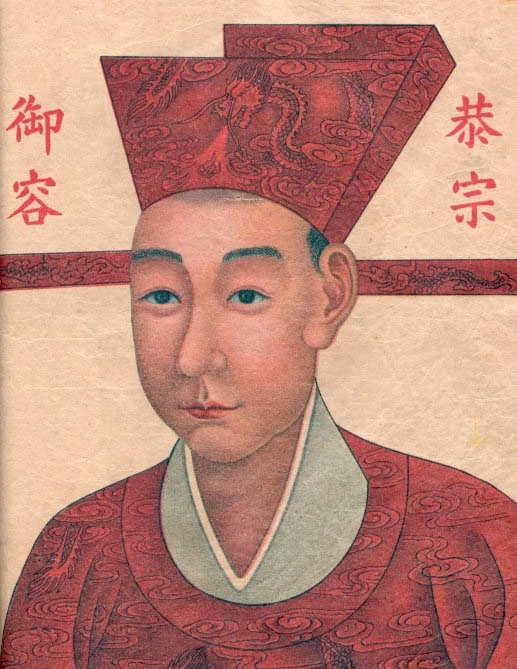
Biography
Accession as a Child
Zhao Xian was born on a jichou day in the ninth lunar month of 1271, the seventh year of the Xianchun era. He was the second son of Emperor Duzong of Song and Empress Quan. At his birth, the Southern Song was already in a precarious position. Duzong reigned for ten years, indulged in wine and sensual pleasures, and entrusted military and state affairs to the powerful chancellor Jia Sidao. In the seventh lunar month of 1274, the tenth year of the Xianchun era, Emperor Duzong died. At only four years old, Zhao Xian ascended the throne with Jia Sidao's support, and the following year was designated the first year of Deyou. His grandmother, Grand Empress Dowager Xie, and his mother, Empress Dowager Quan, governed from behind the curtain, but real control of military and state affairs remained in Jia Sidao's hands.
By then Yuan forces had already captured Xiangyang, securing the most important route for their southward advance. They subsequently crossed the Yangtze and moved toward Lin'an. Grand Empress Dowager Xie both issued calls throughout the realm for forces to come to the emperor's aid and sought peace from the Yuan. In 1275, the first year of Deyou, Jia Sidao, under public pressure, personally led an army of 130,000 against the Yuan at Wuhu and suffered a major defeat. Jia was demoted, but the fall of the Southern Song had become irreversible. By the middle of the year, Yuan forces had occupied most of Jiangdong.
Surrender at Lin'an
On the eighteenth day of the first lunar month in 1276, the second year of Deyou, the Yuan commander Bayan led his army to the walls of Lin'an. The Southern Song court sent Lu Xiufu to negotiate peace and offer a relationship of nephew to uncle, but this failed, leaving the court no choice but to surrender. Grand Empress Dowager Xie carried the five-year-old Emperor Gong out of the city and sent Investigating Censor Yang Yingkui to present the imperial seal to the Yuan forces. The Southern Song court at Lin'an formally surrendered. Remaining Southern Song forces withdrew toward Fujian and Guangdong and continued resistance until the Battle of Yamen in 1279, the second year of Xiangxing, after which the Southern Song was completely destroyed.
Removal North and Demotion
In the third lunar month of 1276, Emperor Gong left Lin'an for Shangdu. Grand Empress Dowager Xie remained in Lin'an because of illness. Empress Dowager Quan, Lady Huang of Longguo, Zhao Yurui, Prince Rong, Zhao Naiyou, Prince Yi, as well as court officials and palace attendants including Wang Yuanliang, accompanied him north. After crossing the Yangtze, Song generals Li Tingzhi, Miao Zaicheng, and others attempted to seize and rescue the emperor but failed. In the fifth lunar month, Emperor Gong and his party arrived at Shangdu and were received by Kublai Khan in An Hall. Kublai made Zhao Xian Duke of Ying, married him to a princess, and had him reside in Dadu. Zhao Yurui, Prince Fu, was made Commandery Duke of Pingyuan. In 1282, the nineteenth year of the Zhiyuan era, the Secretariat petitioned to relocate the Duke of Ying to Shangdu, and the request was approved.
Monastic Life in Tibet
To preserve members of the former Song imperial clan, Kublai Khan issued an edict in the tenth lunar month of 1288, the twenty-fifth year of the Zhiyuan era, ordering the Duke of Ying, Zhao Xian, to enter Tibet and study Sanskrit texts and Tibetan-script scriptures. He departed in the twelfth lunar month, passed through Amdo, in the area of present-day Hainan Tibetan Autonomous Prefecture in Qinghai, and entered Ü-Tsang, taking up residence at Sakya Monastery with the title of Mubo lecturer. At Sakya he became a monk and took the Tibetan Dharma name Chos kyi Rin chen, meaning “Dharma Jewel.” Tibetans respectfully called him Sman rce Lha btsun, rendered in Chinese as “Manzi Lazun” or “Hezun Fabao.” “Manzi” was a Mongol designation for people of the Song, while “Lazun” was a Tibetan honorific for a royal who had entered religious life. Zhao Xian later became an abbot of Sakya Monastery and compared Chinese and Tibetan Buddhist scriptures in translation, collating textual variants.
Ordered Death in Hexi
In the fourth lunar month of 1323, the third year of the Zhizhi era under Emperor Yingzong of Yuan, the Duke of Ying Zhao Xian was ordered to die in Hexi, in the Zhangye area of the present-day Hexi Corridor in Gansu. The early Ming monk Shi Wuyun recorded in *Shan'an zalu* that after the Duke of Ying became a monk, he once composed a poem during Yingzong's reign: “Send word to Lin Hejing: how many times have the plum blossoms opened? The guest upon the Golden Terrace can no longer return home.” An informer interpreted the poem as intended to stir the people of Jiangnan and reported it to the court, after which Zhao was arrested and executed. Tibetan historical writings instead state that he was accused of gathering followers under the pretext of preaching Buddhist teachings and plotting rebellion. Tao Zongyi's *Chuogeng lu* quotes a variant of the poem: “Send word to Lin Hejing: how many times have the plum blossoms opened? The guest beneath the Golden Terrace should never return,” and says that the young Song ruler composed it while in the capital. According to the *History of Yuan*, in the fifth lunar month of 1352, the twelfth year of the Zhizheng era, because bandits in Henan frequently invoked former Song titles as a pretext, the court ordered Zhao Wanpu, the monk son of the Duke of Ying, and his relatives relocated to Shazhou. This indicates that Zhao Xian's eldest son Zhao Wanpu had not been put to death and that he still had a number of family members.
His Birth and Accession
Zhao Xian was the eldest son of Emperor Duzong of Song, his mother being the empress Quan, and was born on the twenty-eighth day of the ninth month of the seventh year of Xianchun in the great interior of the palace at Lin'an. In the eleventh month of the ninth year of Xianchun he was given the office of general of the left guard and enfeoffed as duke of Jia. On the day guiwei of the seventh month of the tenth year of Xianchun Duzong died, and Zhao Xian received the testament and took the throne before the coffin at four, changing the next year to the first of Deyou, the empress dowager Xie holding the court and issuing decrees; he was the seventh emperor of the Southern Song and is known to posterity as Gongdi of Song, the emperor of Deyou. At the beginning of his reign the court soothed the officers of the three frontiers, ordered the commanderies to recommend men of retirement and worth, remitted the fines and rewards then being pursued by the Xi'an pacification office, the Liangzhe transport office and the Lin'an prefecture, and decreed that opinions on the state's affairs be sought. But at that time the Yuan armies were already attacking Song in force and the Yangtze defences fell one after another. On the tenth day of the eighth month of the tenth year of Xianchun heavy rain fell for days and Mount Tianmu broke apart, the waters rushing in so that the people of Lin'an and Yuhang drowned beyond counting; on the fifth day of the ninth month rice was issued to relieve the flood victims of Yuhang and Lin'an, Yuhang being worst hit and receiving two thousand shi more; on the fifteenth the land tax of the flooded commanderies and counties for that year was remitted; at the end of the month there was drought in Minzhong, and at the end of the tenth month an earthquake there. In the ninth month of the tenth year of Xianchun the Yuan armies began their general offensive against the Southern Song.
The Yuan Advance South and the Disorder of the Court
The Yuan armies, with the surrendered Song general Liu Zheng as their van, continued east down the river, and the commanders of the river cities being mostly old subordinates of the Lü family, they came over wherever the Yuan went. After Ezhou fell the Yangtze line was wide open and court and country were much shaken, and all classes in the capital placed their hopes on Jia Sidao, calling on the "minister-teacher" to go in person to the front. Jia Sidao knew Liu Zheng's ability only too well and, fearing him, long dared not send troops, and only in the first month of Deyou, hearing that Liu Zheng was dead, said with joy that Heaven had helped him and memorialised to set out. He drew off more than a hundred thousand picked troops of the several routes, laden with countless gold and silk and provisions and even taking his wives and concubines, and left the capital in a train a hundred li long; in the second month he came to Wuhu and joined Xia Gui, who took a paper from his sleeve and showed it to him, meaning that the Song had now lasted nearly three hundred and twenty years and its fortunes were spent, and that he should not lose his life for it; and Jia Sidao, taking the point, nodded assent. Coming to the front, Jia Sidao camped with the rear army at Lugang and had the great general Sun Huchen lead the van to camp at Dingjiazhou below Chizhou, with Xia Gui's three thousand five hundred warships in line on the river. Jia Sidao, knowing Sun Huchen's valour well, dared not fight him face to face and still dreamed of the old road of making peace with Kublai in the first year of Kaqing, and so ordered the Yuan prisoners released and sent lychees and the like to Bayan, hoping by acknowledging vassalage and paying tribute to buy peace; but the Yuan aim was now the destruction of the Southern Song and vassalage and tribute could not satisfy them, and the request was flatly refused. The two armies fought, and Bayan broke through Sun Huchen's and Xia Gui's lines in succession and came to Lugang, and the Song army was utterly beaten with countless dead and the river turned red, and Jia Sidao fled in confusion to Yangzhou; men of the time mocked him, saying that at a single stroke of the gong on Dingjiazhou the Jia the eighth brother of former years had been frightened away, and that all the flatterers of the court should be told that the duke of Zhou had now become the old woman of Zhou. After his defeat Jia Sidao became the target of all, and there was a strong cry through court and country for his death; but the empress dowager Xie held that he had laboured through three reigns and that for one reign's fault the courtesy due a great minister should not be lost, and only had him settled elsewhere and his property confiscated, and coming to Zhangzhou Jia Sidao was killed by those escorting him, ending a life of usurped power and misgovernment.
Through the battle of Lugang the Southern Song forces suffered heavy losses and their spirit was much broken. Bayan continued east down the river, and in the tenth month of Deyou the Yuan armies advanced on Lin'an in three columns from Jiankang. Changzhou, at the meeting of the roads and holding the gate of Lin'an, was of great importance, and Bayan threw two hundred thousand troops into it, and the prefect of Changzhou, Yao Yin, and the others resisted valiantly; and Bayan drove the people outside the city to carry earth to fill the moat, using even the earth-carrying peasants as building material, until a rampart encircled the city. On the eighteenth day of the eleventh month the Yuan made their general assault, and two days later Changzhou was broken and the Yuan massacred the city, the prefect Yao Yin, the assistant Chen Zhao and the commander Wang Anjie all dying and Liu Shiyong breaking out and fleeing to Pingjiang; and the massacre at Changzhou had the intimidating effect the Mongol invaders wanted, so that presently, when the Yuan pressed on Pingjiang, its commander surrendered the city without a fight.
Within Lin'an men's hearts were in a panic and great numbers tried to leave the capital, the officers of the court above all leading the flight to save their skins: the assistant director of the bureau of military affairs, Zeng Yuanzi, and several dozen other great ministers fled by night, and the signatory of the bureau Wen Jiweng and the joint signatory Ni Pu had the censors impeach them so that they might lay down office and flee, the memorial not yet sent up when the two had already gone. The empress dowager Xie sternly rebuked these disloyal ministers, decreeing that for more than three hundred years since the founding of Song the dynasty had always treated its scholar-officials with courtesy, and that now, when she and the new sovereign who had succeeded were beset with many troubles, of the great and small ministers not one had spoken a word to call for the saving of the state; that within the officials had turned away and without the governors and magistrates had abandoned their seals and cities, that the offices of the eye and ear could not impeach them and the few in the government could not lead the host, so that they had conspired within and without and fled one after another in the night; and that having read the books of the sages all their days, what had they promised, and with what face could they meet men living and how could they face the late emperors dead. But under the threat of the Mongol horsemen the empress dowager's rebuke seemed pitifully weak and could not rouse the officers within and without to fight for the Song house. After the brief truce in the first month of the second year of Deyou only six officers appeared in the court hall, and the flight of the officials broke the spirit of the army and the people so that the Song could not organize any effective resistance, and the imperial house was left without support. At this time the court made another grave error, appointing Chen Yizhong chancellor; and under his direction Song at last fell into an abyss without bottom. Chen Yizhong had been brought forward by Jia Sidao, and after Jia Sidao's defeat he was the first to propose his death to raise his own reputation; and when the commander of the palace guards, Han Zhen, proposed moving the capital, he privately lured him to his own house and killed him. In the spring and summer of the first year of Deyou, when the fighting was at its height, court and country called on him to go to the front and direct the battle, and he hesitated and shrank from leaving the city; in the seventh month he left Lin'an and fled to the southern coast far from the front, asking the court for a post there and refusing its summonses to return, so that the grand empress dowager had no choice but to write to his mother, at whose intervention he returned to office in the capital; and the students of the imperial college strongly attacked his flight, charging him with cowardice, with being a double-dealer whose words outran his deeds, a minister who ruined the state like Jia Sidao. Towards the end of the first year of Deyou, under his management, the situation grew steadily worse for Song, and beyond complete surrender there was no longer any room to turn.
His Surrender and Removal North
After Chen Yizhong fled the Mongol horsemen were already at the walls and nothing could be retrieved. The empress dowager Xie made Wen Tianxiang right chancellor and commissioner of the bureau of military affairs to go to the Mongol camp to negotiate; and Wen Tianxiang, full of righteous spirit, was detained by Bayan, and the empress dowager sent another in his place. On the fifth day of the first month of the second year of Deyou she sent the investigating censor Liu Shao with a memorial acknowledging vassalage and giving the Yuan emperor the honorific of the benevolent, enlightened, divine and martial emperor, with silver and silk two hundred and fifty thousand a year, asking to keep the territory to perform the sacrifices to the ancestors; and on the eighteenth she sent the investigating censor Yang Yingkui with the imperial seal to surrender; and on the fifth day of the second month she led the hundred officials in a memorial of homage in the Xiangxi hall and decreed the surrender of the commanderies and counties, and the Yuan envoys entered the Lin'an prefecture, sealed the treasuries, took the books of the history office and the ministry of rites and the seals, patents and commissions of the hundred offices, and abolished the government offices and the guards. On the second day of the fifth month Zhao Xian had audience with Kublai at Shangdu and was degraded to be master of the great horse of the court and duke of Ying; and in that month Chen Yizhong and the others set up Zhao Shi at Fuzhou, and two years later in the fourth month Zhao Shi died at Naozhou, and Lu Xiufu and the others set up the prince of Wei, Zhao Bing, and three years later it was pacified. Someone memorialised that the duke of Ying be moved to Shangdu, and Kublai approved it. In the tenth month of the twenty-fifth year of Zhiyuan, the duke of Ying, Zhao Xian, being then eighteen, Kublai decreed that he be sent into Tubo to study the Sanskrit scriptures; and the Yuan monk Shi Nianchang in his Buddha's Successive Records writes that the lord of Song came over with his royal rank and learned the Buddha's way, at which the emperor was greatly pleased and commanded that he be shaved as a monk and a jewel of the sangha. In the twelfth month Zhao Xian set out and entered the Tibetan region from Tuosima.
His Study of Buddhism in Tubo and His Last Years
The place where Zhao Xian became a monk and studied the Buddha's way was Tubo, that is Tibet; and at nineteen he became a monk in a Tibetan temple with the religious name Hezun, which was the title by custom used by members of royal houses who became monks in Tibet, so that Zhao Xian, last emperor of the Southern Song, naturally received it. After this, to forget his past sorrows, he applied himself to Tibetan and within a few years had begun to show himself in Tibetan Buddhist circles, becoming a translator of Chinese Buddhist texts into Tibetan and holding office at the great Sakya monastery, and a master of Buddhist learning in Tibet of his day, lecturing everywhere and studying deeply. The Sakya monastery was the seat of the Yuan local government of Tibet and its political and cultural centre, and Zhao Xian studied Tibetan and the Sakya doctrine there earnestly, staying more than thirty years, and the long years of study made him a man of great attainment in the doctrine. He translated the two Chinese Buddhist works, the Treatise on the Hundred Dharmas and the Introduction to the Logic of Valid Cognition, into Tibetan, and left an inscription on the title page of the Narthang edition calling himself the monk who had left home from the great Han king's house, Hezun Fabao. It is also recorded that while practising in Tibet he mastered both Chinese and Tibetan, and that his ability as a translator was recognized by scholars, the Tibetan historians listing him among the famous translators of the later diffusion. His master was the famous Dampa, who gave him the religious name Hezun Fabao; and in 1288 Hezun Fabao was sent to the Sakya monastery in Tubo to continue his studies. Of his end the Chinese sources say but one thing: that in the fourth month of the third year of Zhizhi the duke of Ying, Hezun, was given death at Hexi and that the monks and scholars were commanded to write out the scriptures in gold. In the third year of Zhizhi of Emperor Yingzong of Yuan, that is in 1323, Emperor Gong of Song ended his life as a lama and also ended his forty-seven years as a captive; and counting it, he lived in Tibet thirty-four years, and in all that time never again set foot in the central plains or in the Jiangnan of his longing.