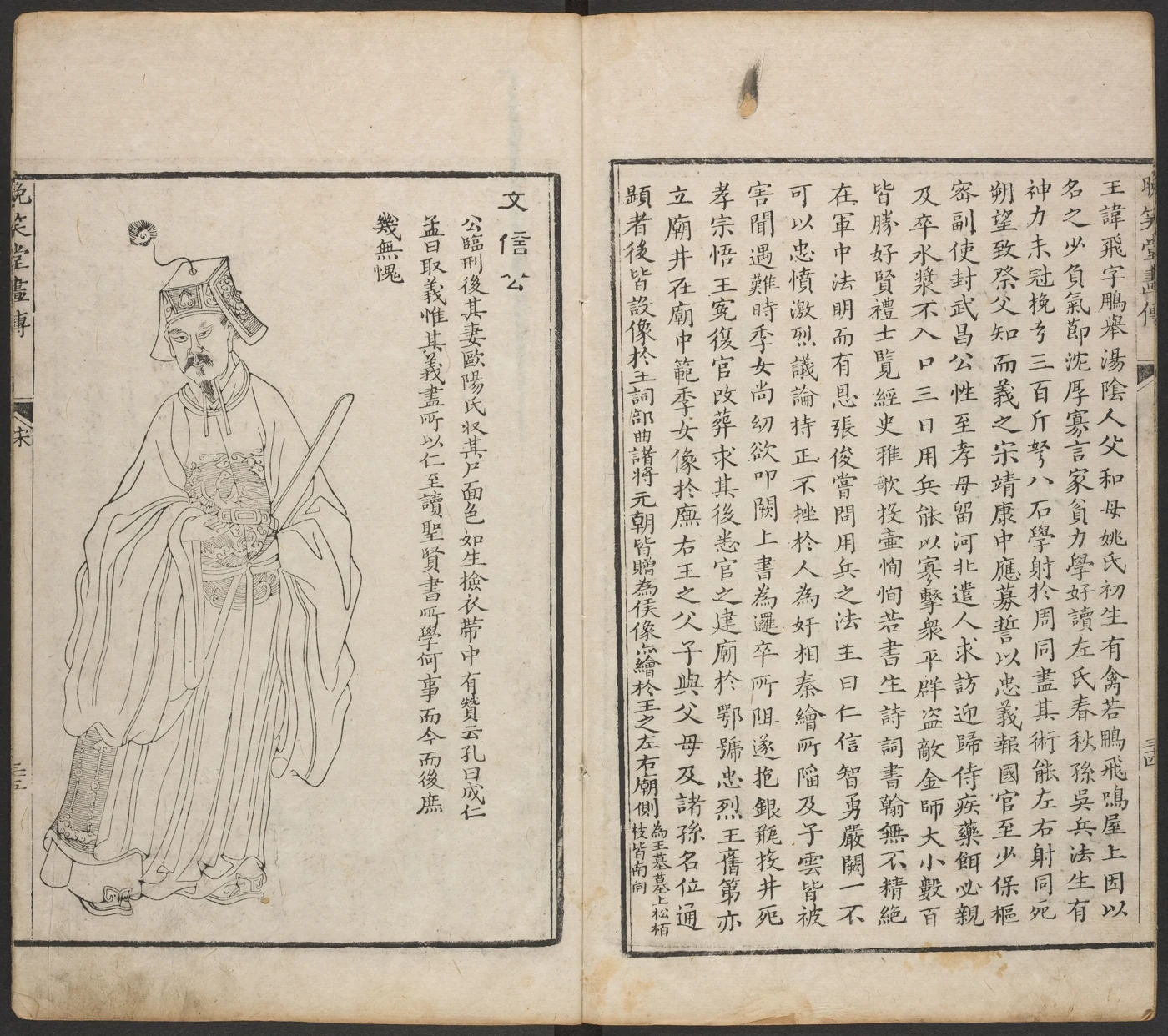
Biography
Family Background and Early Life
Wen Tianxiang was born on June 6, 1236, the second day of the fifth lunar month in the third year of Emperor Lizong's Duanping era. He was the eldest son of Wen Yi and Lady Zeng. The Wen family of Futian traced its origins to Chengdu in Sichuan and later moved to Luling. According to the *History of Song*, Wen Tianxiang was imposing in appearance, tall and strongly built, with skin described as white as jade, handsome brows and eyes, and a piercing gaze. As a child he saw portraits of the local worthies Ouyang Xiu, Yang Bangyi, and Hu Quan enshrined in the local school, each of whom had the character "loyal" in his posthumous title. He was delighted and deeply admired them, saying that if he did not become one of their kind, he would not be a true man.
In 1255, the third year of Baoyou, the twenty-year-old Wen Yunsun entered Bailuzhou Academy and studied under Ouyang Shoudao. In 1256, the fourth year of Baoyou, at age twenty-one, Wen Yunsun sat for the civil service examination and responded to the policy questions in the Jiying Hall. Emperor Lizong had by then reigned for many years and had grown weary of government. Wen wrote on the theme "emulating Heaven's unceasing activity," producing more than ten thousand characters in a single sitting without a draft. After reading it, Lizong personally selected him as the first-ranked jinshi. Examiner Wang Yinglin memorialized: "This paper takes the affairs of antiquity as a mirror, and its loyal heart is like iron and stone. I dare to congratulate Your Majesty on obtaining such a man." After becoming top graduate, Wen Yunsun changed his name to Wen Tianxiang and changed his courtesy name to Songrui, while also using Lüshan. Soon afterward his father died, and Wen returned home to observe mourning.
Rise and Fall in Official Life
In 1259, the first year of Kaiqing, Mongol forces launched a major three-pronged invasion of the south. The eunuch Dong Songchen advised Emperor Lizong to move the capital. No court official dared criticize the proposal except Wen Tianxiang, then adjudication officer of Ninghai Military Prefecture, who memorialized the throne asking that Dong be executed in order to unite public morale. When the proposal was rejected, Wen requested dismissal and returned home. He later rose gradually through the bureaucracy to Vice Minister of Justice. By then Dong Songchen had again been promoted, this time to chief eunuch. Wen submitted another memorial enumerating Dong's offenses, but received no response.
Wen was subsequently sent out to govern Rui Prefecture, present-day Gao'an in Jiangxi, transferred to serve as judicial commissioner of Jiangnan West Circuit, and later promoted to left-side director in the Department of State Affairs. He was repeatedly criticized by censorial officials and dismissed. He was later ordered to administer the Directorate for Armaments while acting as a drafter in the Hanlin Academy. Grand Councilor Jia Sidao claimed illness and requested retirement as a means of pressuring Emperor Lizong, but the emperor refused. Wen Tianxiang drafted the relevant edict in language containing considerable satire. According to established practice, internal drafters were supposed to submit drafts for review, but Wen did not do so. Jia Sidao was displeased and directed censor Zhang Zhili to impeach Wen, who was removed from office. Having by then suffered several dismissals, Wen cited the precedent of Northern Song official Qian Ruoshui and retired at only thirty-seven sui.
In 1273, the ninth year of Xianchun, Wen Tianxiang was recalled as judicial commissioner of Jinghu South Circuit and thereby met former grand councilor Jiang Wanli. Jiang had long been impressed by Wen's aspirations and integrity. Discussing affairs of state with him, Jiang said sadly: "I am old. Judging Heaven's timing and human affairs, change must be coming. I have seen many men; is not the responsibility for the Way of the age to fall upon you? I hope you will exert yourself." In 1274, the tenth year of Xianchun, Wen was appointed to govern Ganzhou, present-day Ganzhou in Jiangxi, where he was described as forceful in remonstrance and, in governing the prefecture, disciplined, incorruptible, perceptive, and commanding.
Raising Troops to Aid the Dynasty
In 1275, the first year of Deyou, the upper Yangzi region was in grave danger and the Song court ordered troops throughout the realm to come to the dynasty's aid. Wen Tianxiang held the edict in his hands and wept. He sent Chen Jizhou to rally local men of resolve and to establish contact with the peoples of the mountain valleys, while Fang Xing was sent to assemble troops in Ji Prefecture. Local heroes responded, and some ten thousand men gathered. On learning of this, the Song court ordered Wen, in his capacity as judicial and pacification commissioner of Jiangnan West Circuit, to lead the army to defend the capital Lin'an. A friend tried to stop him, saying: "The Yuan army is now advancing south in three columns. It has broken through the capital region and is pressing into the interior. To take more than ten thousand hastily assembled men to the capital is no different from driving a flock of sheep against a tiger." Wen replied: "I know this as well. But the state has nurtured its subjects for more than three hundred years. Now, in a moment of crisis, it summons troops from all under Heaven, yet not one man or horse comes to its defense. I deeply regret this. Therefore, without estimating my own strength, I offer myself for the state, hoping that loyal and righteous men throughout the realm will hear of this and rise. With benevolence and righteousness one can establish oneself; with sufficient numbers one can bring an undertaking to success. If we act in this way, the state may yet be preserved."
Wen Tianxiang was by temperament open and generous and had previously enjoyed rich food, fine clothing, music, and entertainers. At this point, distressed by the state of the realm, he sharply reduced his own comforts and devoted all of his family property to military expenses. Whenever he discussed state affairs with guests and subordinates, he wept, struck the table, and said: "Those who take joy in the joy of others must also grieve over what others grieve about. Those whose food and clothing come from others ought not refuse to die for their affairs."
In August 1275 Wen led his troops to Lin'an and was appointed prefect of Pingjiang Prefecture. Because Grand Councilor Chen Yizhong had not yet returned to court, Wen was not immediately dispatched. Chen arrived in October and then sent Wen to his post. At the same time, court discussion had just promoted Lü Shimeng to Minister of War and conferred the title Prince of Heyi on Lü Wende in the hope of seeking peace. Lü Shimeng consequently became even more arrogant and unrestrained.
Before leaving Emperor Gong of Song, Wen memorialized: "Within the court there are many ministers inclined to accommodation and peace, but few with the resolve to act and the decisiveness to handle affairs. I request that Lü Shimeng be executed as a sacrifice to the war effort, in order to inspire the soldiers." He also argued that the Song had learned from the fragmentation of the Five Dynasties by eliminating the military governors and organizing the realm into prefectures and counties. Although this had removed the immediate danger of overmighty regional commanders, it had gradually weakened the state. As a result, when the enemy reached a prefecture the prefecture fell, and when it reached a county the county fell; once the Central Plain had been lost, regret would be too late. Wen therefore proposed dividing the realm into four large commands, each under a commander: Guangnan West Circuit would be joined to Hunan with headquarters at Changsha; Guangnan East Circuit would be joined to Jiangxi with headquarters at Longxing, present-day Nanchang; Fujian Circuit would be joined to Jiangnan East Circuit with headquarters at Panyang, present-day Poyang County; and Huainan West Circuit would be joined to Huainan East Circuit with headquarters at Yangzhou. He further proposed that Changsha supervise Ezhou and other areas, Longxing supervise Qizhou and Huangzhou, Panyang supervise Jiangdong, and Yangzhou supervise both Huainan circuits, thereby enlarging each command and strengthening it enough to resist the Yuan army. The commands would then rise simultaneously on an agreed date, dispersing and exhausting the Yuan forces before striking at an opportunity. Court officials considered Wen's proposal too broad and impractical, however, and did not adopt it.
In October 1275 Wen reached Pingjiang. The Yuan army had already left Jinling and entered Changzhou. Wen sent his commanders Zhu Hua, Yin Yu, Ma Shilong, and Zhang Quan to aid Changzhou. At Yuqiao, Ma Shilong was killed in battle. Zhu Hua led troops from Guangnan and fought at Wumu, where he was defeated; Yin Yu was also defeated. Men rushing to cross the water seized boats from Zhang Quan's force, whose soldiers cut off their fingers, and many drowned. Yin Yu led five hundred surviving troops in a night attack, and by the next morning all had died fighting. Zhang Quan withdrew without loosing an arrow. The Yuan army entered Changzhou and seized Dusong Pass. Chen Yizhong and Liu Mengyan ordered Wen Tianxiang to abandon Pingjiang and fall back to Yuhang.
Mission to the Yuan Camp and Escape
In the first month of 1276, the second year of Deyou, Wen Tianxiang served as prefect of Lin'an. Soon afterward the Song capitulated, while Chen Yizhong and Zhang Shijie withdrew. Wen was promoted to Commissioner of Military Affairs and shortly afterward to Right Grand Councilor concurrently Commissioner of Military Affairs. As an envoy, he went to the Yuan camp to negotiate peace and argued with Yuan commander Bayan at Gaotingshan. Bayan became angry and detained him. Together with Left Grand Councilor Wu Jian, Right Grand Councilor Jia Yuqing, Xie Tang, who administered the Bureau of Military Affairs, Jia Xuanweng, a signatory official in the bureau, and Liu Shao, co-signatory official, Wen was escorted north to Zhenjiang. Wen Tianxiang and twelve attendants, including Du Hu, escaped at night into Zhenzhou.
Miao Zaicheng came out to meet him and wept with joy, saying: "The troops of the Huainan region are fully capable of restoring the Song. The only problem is that the two command commissioners are at odds and cannot act with one mind." Wen asked where the plan lay. Miao replied: "First arrange for the Huai West troops to move toward Jiankang. The enemy will certainly concentrate on defending against them. Order the eastern commanders to have troops from Tongzhou and Taizhou attack Wantou, troops from Gaoyou, Baoying, and Huai'an attack Yangzi Bridge, and the Yangzhou troops attack Guabu. I will lead the naval force directly against Zhenjiang, with all armies moving on the same day. Wantou and Yangzi Bridge are weak positions along the Yangzi, and their defenders expect our armies day and night; if we attack them, we will surely win quickly. We can then converge from three directions on Guabu, while I lead a small force in a feigned attack from the river. Even a wise man could not foresee such a maneuver. Once Guabu is taken, the eastern army can attack Jingkou and the western army Jinling, threatening the Yuan army's route of retreat toward Zhejiang. Their supreme commander could then be captured alive." Wen praised the plan highly, immediately wrote to the two command commissioners, and sent envoys in all directions to coordinate.
Before Wen arrived, however, soldiers who had fled back to Yangzhou reported that "the court has secretly sent a grand councilor into Zhenzhou to persuade us to surrender." Li Tingzhi, pacification and command commissioner of the Huainan region, believed the rumor and concluded that Wen had come to induce surrender. He ordered Miao Zaicheng to kill him at once. Miao could not bring himself to do so. He lured Wen outside the fortifications at Xiangcheng, showed him the command office's written order, and shut him outside the gate. Later he sent two separate groups to determine whether Wen truly had come to urge surrender, with instructions to kill him if that were the case. After speaking with Wen, both groups became convinced of his loyalty and righteousness and likewise could not bear to kill him. They assigned twenty soldiers to escort him toward Yangzhou. They reached the city before dawn, but overheard people waiting for the gates to open say that the command authorities had issued strict orders to guard against Wen Tianxiang. Wen and his companions exchanged looks of alarm and instead headed east toward the sea. They encountered Yuan troops and hid inside an earthen enclosure. Wen's attendants were captured, but Wen concealed himself behind the wall and escaped.
Campaigning in the Southeast
Wen then traveled by sea to Wenzhou and eventually reached Fuzhou. In May 1276, the first year of Jingyan, Prince Yi Zhao Shi ascended the throne in Fuzhou as Emperor Duanzong of Song. Wen was summoned to Fuzhou and appointed Commissioner of Military Affairs, concurrently commanding the armies of the various circuits. Because he disagreed with Chen Yizhong and Zhang Shijie, Wen left the temporary capital and, as co-commander, established a field headquarters at Nan Jian Prefecture, present-day Nanping in Fujian, from which he directed resistance to the Yuan. He sent agents to various regions to recruit troops and raise provisions for the continued war.
In 1277, the second year of Jingyan, Wen moved his army to Longyan and Meizhou and then invaded Jiangxi. He defeated Yuan troops at Yudu, present-day Yudu in Jiangxi, captured Xingguo, and recovered ten counties in Ganzhou and four in Ji Prefecture. Morale rose and the anti-Yuan situation improved. The success was brief. The main Yuan army attacked Wen's camp at Xingguo; heavily outnumbered, he withdrew north, retreated through Luling and Tingzhou, present-day Changting in Fujian, and suffered severe losses. His wife and children were also captured by Yuan troops.
In the summer of 1278, the first year of Xiangxing, Wen learned that the Southern Song court-in-exile had moved to Yashan. Seeking to escape his difficult position, he requested permission to lead his army there and join the court. Zhang Shijie firmly opposed the plan, and it failed. Wen then withdrew with his troops to Chaoyang County. In August that year the Southern Song court promoted him to Junior Guardian and Duke of Xin. That winter, the Yuan launched a major attack and Wen was again defeated and forced to flee.
Defeat, Captivity, and Execution
In the twelfth month of 1278, while withdrawing toward Haifeng, Wen's force was attacked by Yuan general Zhang Hongfan while preparing a meal at Wupoling, north of Haifeng in Guangdong, and was defeated. Wen swallowed a quantity of borneol that he carried with him in an attempt at suicide. He did not die but lost consciousness and was captured. Zhang Hongfan ordered him to write a letter persuading Zhang Shijie to surrender. Wen instead wrote *Crossing the Lingding Sea*, including the lines: "Since ancient times, who has not died? Let my loyal heart illuminate the annals of history." Zhang Hongfan laughed and set the matter aside.
In 1279 the Song fell. Wen was sent under guard to Dadu, present-day Beijing. He fasted for eight days on the journey but survived. He was imprisoned for four years in what later became the Beijing Imperial College area. In prison he wrote the third volume of *Zhinan Houlu* and *Song of Righteousness*. Kublai Khan valued his abilities and successively sent Ahmad Fanakati, then serving as a senior administrator, and the grand councilor Boluo to persuade him to submit. On January 8, 1283, the eighth day of the twelfth lunar month in the nineteenth year of Zhiyuan, Kublai personally summoned Wen and urged him to surrender. Wen refused, replying: "There is nothing left for me but death." The Yuan authorities then brought former Southern Song ministers who had already surrendered to persuade him, but Wen angrily denounced them. They also sent the captured former Emperor Gong of Song, Zhao Xian, to urge submission, but Wen ignored him.
On January 9, 1283, the ninth day of the twelfth lunar month, Wen Tianxiang was taken to the execution ground at Chaishi, in today's Dongcheng District of Beijing. He knelt and bowed in the direction of the two Song capitals, Kaifeng and Lin'an, and calmly went to his death at the age of forty-seven. Soon after the execution, an imperial messenger arrived with an order to halt it, but Wen was already dead. Kublai Khan reportedly lamented: "A fine man! It is truly a pity to kill him because he would not serve me." When Wen's wife, Lady Ouyang, collected his body, she found a final self-inscription hidden in his clothing, invoking Confucius on achieving benevolence and Mencius on attaining righteousness, and declaring that after a life spent studying the sages, he could now die without shame.
Early Character and an Official Career of Ups and Downs
The Song History describes Wen Tianxiang as "of full and stately figure, fair as jade, with fine brows and long eyes, and a glance that shone." As a boy, "seeing in the school shrine the images of the local worthies Ouyang Xiu, Yang Bangyi and Hu Quan, all with the posthumous name 'Loyal,' he rejoiced and admired them, saying, 'If when I die I am not among those offered sacrifice here, I am no man.'" At twenty he passed as a presented scholar and answered the questions in the Jiyang hall; the emperor Lizong having reigned long and grown slack in government, Wen answered on "imitating heaven without ceasing," his words more than ten thousand, "written at one stroke without a draft," and the emperor made him first; the examiner Wang Yinglin said: "This paper's ancient sense is like a mirror and its loyal heart like iron and stone; I dare congratulate you on gaining the man." Early in the Kaiping era, when the Yuan attacked Song and the eunuch Dong Songchen urged moving the capital, "none dared speak of his fault," and Wen, then a judge in the Ninghai command, memorialized against him without result. Afterwards, when Jia Sidao feigned illness and asked to retire in order to coerce the emperor and the edict refused, Wen drafted the rescript with words that mocked him; and since the practice was to submit drafts for review and Wen did not, Jia was displeased and had the censor Zhang Zhili impeach him, so that he was dismissed. Having been censured several times, he retired after the precedent of Qian Ruoshui, "being then thirty-seven." In 1273 he was made judicial commissioner of Hunan, and visiting the former chancellor Jiang Wanli, who had always thought his spirit remarkable, he heard him say with a sigh: "I am old, and I see that heaven's seasons and men's affairs must change; I have seen many men, and is not the charge of the age's way upon you? Do your utmost."
Raising Troops for the Throne, and the Mission to the Yuan Camp
Early in Deyou, when the alarm came from the river, an edict called the empire to arms; Wen Tianxiang, weeping as he received it, had Chen Jizhou raise the bold men of the commandery and win over the hill tribes, and Fang Xing summon the troops of Jizhou, "and all the bold men answered, and he had ten thousand." His friend tried to stop him, saying that "the great army now marches by three roads, breaking the outskirts of the capital and pressing into the interior; with a disorderly ten thousand to go against them is no different from driving sheep against a tiger," and Wen answered: "I know it is so. But the state has reared its subjects for more than three hundred years, and when a crisis comes and troops are called for throughout the empire, not one man or horse enters the passes — that I deeply resent; and so, not measuring myself, I would give my life for it, in the hope that loyal men and righteous knights throughout the empire will rise when they hear the wind. Where righteousness prevails, plans succeed; where numbers are many, the work is accomplished, and thus the altars of state may yet be preserved." He was by nature lavish and lived richly, "with singing girls before him," but now "bitterly reduced himself and gave the whole of his family property for military expenses," and whenever he spoke of the times with his guests and officers he wept, striking the table: "He who takes his pleasure in others' pleasure will grieve for what grieves them; he who eats of others' food will die in their cause." Taking leave of the throne he memorialized that "in the court there is much of the spirit of indulgence and holding back, and little of the will to rouse and decide," asking that Lü Shimeng be beheaded to smear the drums and raise the soldiers' spirit; and he argued that Song, to cure the disorder of the Five Dynasties, had cut down the military commands and set up prefectures, "which for a time was enough to correct the evil of a tail too great to wag, but the state was thereby gradually weakened," so that "the enemy breaks a prefecture at every prefecture he reaches, and a county at every county," and proposed dividing the empire into four garrisons with commanders — Changsha, Longxing, Poyang and Yangzhou — so that "the ground being wide and the numbers great, they may hold against the enemy," "fix a day and rise together, advancing and never retreating," whereupon "their defence being many and their strength divided, they will wear themselves out in marches." The court of the day thought his argument too broad and did nothing. The relief of Changzhou shows the difficulty of the moment: he sent Zhu Hua, Yin Yu, Ma Shilong and Zhang Quan; Ma Shilong died at Yuqiao, Zhu Hua was beaten at Wumu, Yin Yu too, and "in the scramble to cross the water they seized the boats of Zhang Quan's army, whose soldiers cut off their fingers, and all were drowned," while Yin Yu with five hundred survivors fought by night "and by dawn all were dead," and Zhang Quan "without loosing a single arrow, fled." In the first month of the next year Wen was made prefect of Lin'an; soon Song surrendered, and he was made privy counsellor and then right chancellor and privy counsellor, sent to the Yuan camp to sue for peace, where he "argued face to face with the Yuan chancellor Bayan at Gaoting hill" and was detained and taken north to Zhenjiang, whence he and his retainer Du Hu and twelve others "escaped by night into Zhenzhou."
Escape Southward and the Campaign in the Southeast
At Zhenzhou Miao Zaicheng came out to meet him, "rejoicing and weeping: 'The troops of the two Huai are enough to restore the dynasty, only the two military commissioners have a small quarrel and cannot act together,'" and offered a plan of attacking Guabu from three sides with the river fleet striking straight at Zhenjiang; Wen "greatly praised it," wrote to the two commissioners and sent envoys to make agreements on every side. But a deserter at Yangzhou reported that "a chancellor has been secretly sent into Zhenzhou to urge surrender," and the commissioner Li Tingzhi believed it and ordered Miao Zaicheng to kill Wen at once; unwilling, Miao tricked him out to the rampart at Xiangcheng, showed him the commissioner's order and shut the gate on him, and afterwards sent two parties to spy him out, both of whom, talking with him and "seeing his loyalty and righteousness, could not bear to kill him," and sent him to Yangzhou with twenty soldiers. Reaching the wall at the fourth watch they heard the gatekeepers say that "the commissioner has ordered strict guard against Chancellor Wen," at which they looked at one another and put out their tongues, and turned east into the sea road, where meeting troops they hid within a ruined wall and escaped. Too hungry to rise, they begged a little cold rice from woodcutters; coming to Banqiao the soldiers came again and they hid in the bamboo, where Du Hu and Jin Ying were taken and freed with the gold they carried, the guard Zhang Qing "was shot in the eye and wounded twice," and Wen twice was not found; at last they hired two woodcutters to carry him in a basket to Gaoyou and went by sea to Wenzhou. Afterwards he memorialized in favour of the prince, was summoned to Fuzhou and made right chancellor, and disagreeing with Chen Yizhong and the others, went out to Jiangxi as co-commander and gathered troops at Tingzhou. In the first month of 1277 the Yuan entered Tingzhou and he moved to Zhangzhou; the envoy Wu Jun, who had gone over, was bound and strangled, and the overbearing commanders Wang Fu and Qian Hanying beheaded as an example; in the fourth month he entered Meizhou, in the fifth went out into Jiangxi to Huichang, in the sixth to Xingguo, and in the seventh sent Zhang Bian and Zhao Shishang with a great force against Ganzhou, while Zou Shuo struck Yongfeng and half of the eight counties of Ji were recovered, "and all the commanderies of Linhong sent in their allegiance," local leaders rising to answer him on every side. But Li Heng came suddenly upon Xingguo; Wen withdrew toward Zou Shuo at Yongfeng, whose troops broke first, and Li Heng pursued him to Fangshiling, where his officer Gong Xin fought and died "with arrows in his body"; at Kongkeng the troops scattered, Wen's wife, concubines and children were taken, and Zhao Shishang, sitting in a sedan chair, answered the pursuers' question by saying "my surname is Wen," so that they took him for Wen Tianxiang and carried him off, and Wen escaped.
Capture at Wupoling and His Death
He then gathered his remnant at Xunzhou and camped at Nanling, where Li Guida plotted surrender and was seized and killed. In the third month of 1278 he advanced to Lijiangpu, in the sixth entered Chuan'ao; the prince of Yi died and the prince of Wei succeeded, and Wen memorialized against himself and asked to come to court, which was refused; in the eighth month he was made junior guardian and duke of Xin, and plague broke out in the army so that "several hundred soldiers died," and his only son and the boy's mother both died. In the eleventh month he advanced to Chaoyang and drove off the pirate Chen Yi and executed Liu Xing; in the twelfth he moved toward Nanling, and Chen Yi secretly guided the marshal Zhang Hongfan's troops across to Chaoyang. Wen was at dinner at Wupoling when "Zhang Hongfan's troops came suddenly, and the men had no time to fight but bowed their heads in the grass"; he fled in confusion and was taken by the chiliarch Wang Weiyi, having swallowed borneol without dying. Before Zhang Hongfan he would not bow, and was received with the courtesy due a guest; taken to Yashan, he was asked to write and summon Zhang Shijie to surrender, and answered: "I cannot defend my parents — shall I teach others to betray theirs?" and being pressed, wrote out the poem "Crossing Lingding Bay," ending "since ancient times, who has not died? Let me leave a loyal heart to shine in the records"; Zhang Hongfan "laughed and put it aside." After Yashan fell and the army feasted, Zhang said that "the state is gone and the chancellor's loyalty and filial duty are complete; if you would change your heart and serve our emperor as you served Song, you would not lose the chancellorship," and Wen, weeping, answered: "The state perished and I could not save it; as a subject I have more than enough guilt to die for — how should I flee death and be of two minds?" At Yanjing the lodging was richly provided, but he "did not lie down, sitting until dawn," and was moved to the gendarmerie under guard. Kublai sought talent among the southern officials, and Wang Jiweng said that "among southerners there is none like Tianxiang," and was sent to convey the imperial will; Wen answered: "The state is gone, and my share is death. If through indulgence I might return home as a Daoist and one day serve as a consultant from outside the world, that would be possible; but to be given high office at once — not only may a minister of a fallen state not seek to live so, but I should be casting away my whole life's purpose; what use would I be?" Wang Jiweng wished to join Xie Changyuan and nine other Song officials in asking that Wen be released as a Daoist, but Liu Mengyan objected, saying that "if Tianxiang goes out and raises Jiangnan again, where shall we ten stand?" and the matter dropped. He was at Yanjing three years in all; Kublai, knowing he would never submit, discussed releasing him with his chancellor, but someone raised the matter of his raising troops in Jiangxi and it came to nothing. In prison he received a letter from his daughter Liu Niang and learned that his wife and two daughters were slaves in the palace; he wrote to his sister: "Receiving Liu's letter cuts my heart and bowels. Who has not the love of wife and children? But the matter has come to this, and by righteousness I must die — it is fate. What is to be done? What is to be done?... Let Liu and Huan be good women; their father cannot look after them. My tears choke me." In 1282 a Fujian monk said that Saturn had trespassed on the imperial seat, a madman at Zhongshan called himself "lord of Song" with a thousand men hoping to rescue the chancellor, and an anonymous letter in the capital spoke of burning the reed city and raising troops; "the one suspected as chancellor was Tianxiang," and he was put to death.