692 CE–756 CE
Loyalist MartyrCommanderPrefect of Changshan
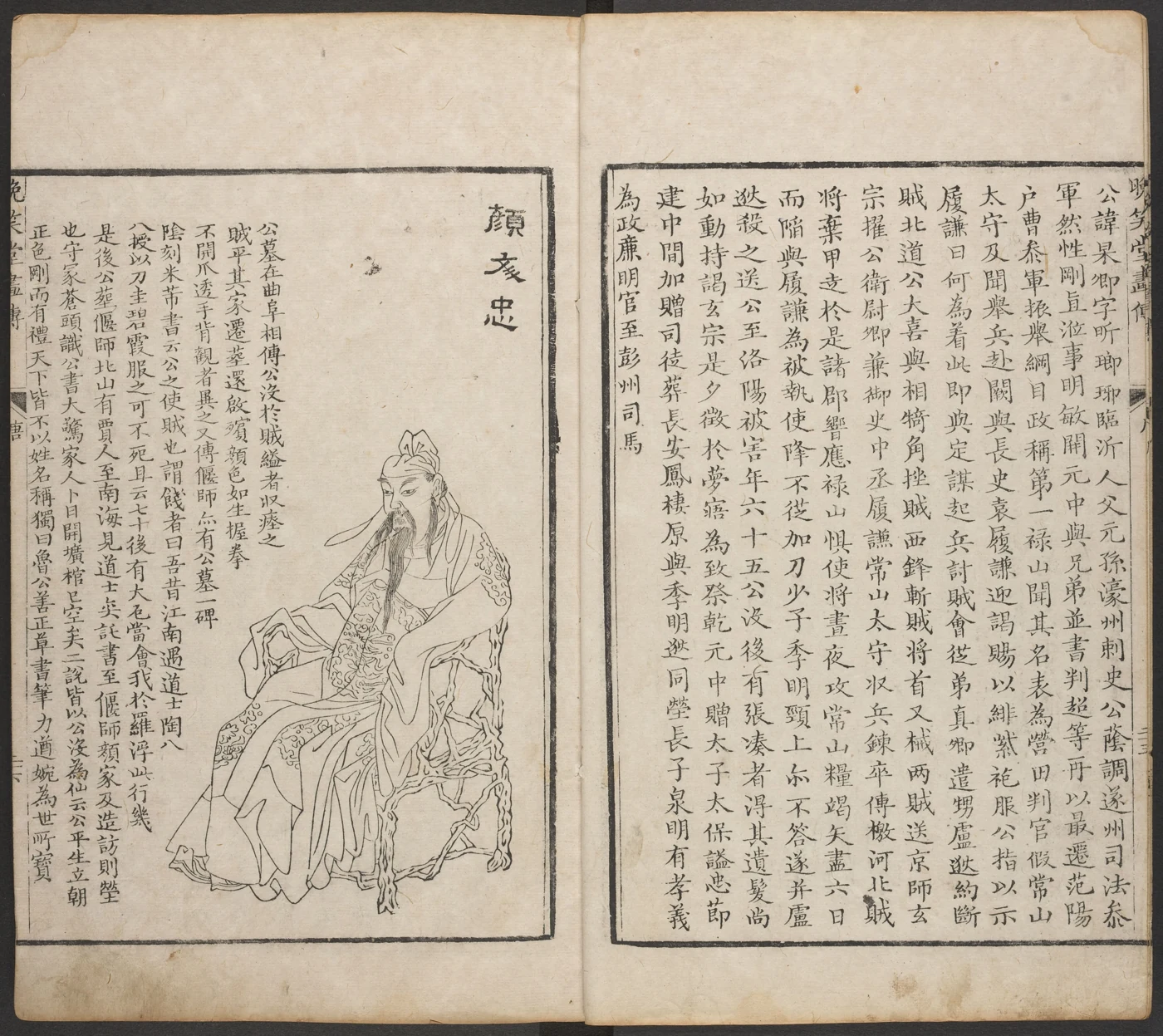
Yan Gaoqing
颜杲卿
Birthplace qualification: locations retained below as native place, ancestral origin, or family background do not establish a confirmed birthplace. Yan Gaoqing (692–756 AD), courtesy name Xin, hailing from Wannian in Jingzhao (ancestral home Linyi in Langya), was a preeminent loyalist official, martial hero, and iconic martyr of the Tang dynasty who was the fifth-generation descendant of Master Yan Zhitui and the son of…
692 CE–756 CETang Dynasty
PROFILE
Birthplace qualification: locations retained below as native place, ancestral origin, or family background do not establish a confirmed birthplace. Yan Gaoqing (692–756 AD), courtesy name Xin, hailing from Wannian in Jingzhao (ancestral home Linyi in Langya), was a preeminent loyalist official, martial hero, and iconic martyr of the Tang dynasty who was the fifth-generation descendant of Master Yan Zhitui and the son of Prefect Yan Yuansun. Renowned for unyielding rectitude and administrative excellence, he served as Acting Prefect of Changshan Commandery when the catastrophic An Lushan Rebellion erupted in 755 AD. In the enemy's heartland, Yan Gaoqing and his cousin Yan Zhenqing (Prefect of Pingyuan) raised the righteous banner of imperial resistance, brilliantly executing rebel commander Li Qincou, capturing vanguard generals Gao Miao and He Qiannian, and recapturing the strategic Tumen Pass (Jingxing), inspiring seventeen commanderies across Hebei to pledge allegiance to the Tang dynasty. In early 756 AD, besieged at Changshan by Shi Siming with twenty thousand elite cavalry, Yan Gaoqing held the citadel for eight days until starvation and betrayal broke the defenses. Conveyed in chains to Luoyang, Yan Gaoqing glared fiercely at An Lushan, denouncing the usurper until the tyrant severed his tongue, dying as an immortal martyr at age sixty-five. Posthumously honored as Chancellor (Situ) with the posthumous title Zhongjie (Loyal and Principled), his sacrifice inspired the cultural idiom 'the tongue of Yan of Changshan' commemorated in Wen Tianxiang's *Song of Righteous Spirit*.
- Historical Era
- Middle Tang dynasty (High Tang to An Lushan Rebellion)
- Dynasty / Regime
- Tang dynasty
- Identity
- Loyalist Martyr, Commander, Prefect of Changshan
- Date of Birth
- 692 CE(1st year of the Wuzetianchangshou era, Tang)
- Ethnicity
- Huaxia (Han Chinese)
- Native Place
- Wannian, Jingzhao (present-day Xi'an, Shaanxi Province; ancestral home Linyi, Shandong)
- Place of Birth
- Unconfirmed; native place or family origin is not treated as an explicitly recorded birthplace
- Place of Death
- Luoyang (present-day Luoyang, Henan Province)
- Age at Death
- 65
- Highest Office
- Prefect of Changshan (Acting); Posthumous Grand Master, Chancellor (Situ)
- Posthumous Honors
- Grand Tutor to the Crown Prince (758 AD), Chancellor (Situ, 782 AD)
LIFE TIMELINE
Aristocratic Birth | Born in Wannian into the illustrious Langya Yan lOpen
Aristocratic Birth | Born in Wannian into the illustrious Langya Yan lineage; fifth-generation descendant of Master Yan Zhitui; father Yan Yuansun was Prefect of Haozhou.
Yan Gaoqing (692–756 AD) | Yan Gaoqing (692–756 AD), courtesy name XinOpen
Yan Gaoqing (692–756 AD) | Yan Gaoqing (692–756 AD), courtesy name Xin, hailing from Wannian in Jingzhao (ancestral home Linyi in Langya), was a preeminent loyalist official, martial hero, and iconic martyr of the Tang dynasty who was the fifth-generation descendant of Master Yan Zhitui and the son of Prefect Yan Yuansun.
Early Office | Entered civil service through ancestral privilege as JuOpen
Early Office | Entered civil service through ancestral privilege as Judicial Officer of Suizhou, renowned for inflexible integrity.
Top Administrative Performance | Appointed Military Counselor of WeizhOpen
Top Administrative Performance | Appointed Military Counselor of Weizhou, earning first rank across the commandery for judicial rectitude.
Superior Exam Distinction | Placed first alongside his brothers in theOpen
Superior Exam Distinction | Placed first alongside his brothers in the advanced judicial examinations, appointed Census Officer of Fanyang.
Acting Prefect of Changshan | Appointed Acting Prefect of Changshan; iOpen
Acting Prefect of Changshan | Appointed Acting Prefect of Changshan; in November, An Lushan launched his rebellion, sacking Luoyang in December.
Uprising at Changshan | Formed a secret pact with Staff Officer Yuan LOpen
Uprising at Changshan | Formed a secret pact with Staff Officer Yuan Lüqian and cousin Yan Zhenqing, raising loyalist troops at Changshan.
When An Lushan assumed command over the three northern frontier circuiOpen
When An Lushan assumed command over the three northern frontier circuits | When An Lushan assumed command over the three northern frontier circuits, he noted Yan Gaoqing's towering administrative renown and appointed him Field Reclamation Judge, subsequently promoting him in 755 AD to Acting Prefect of Changshan Commandery (modern Zhengding, Hebei).
When An Lushan assumed command over the three northern frontier circuiOpen
When An Lushan assumed command over the three northern frontier circuits | When An Lushan assumed command over the three northern frontier circuits, he noted Yan Gaoqing's towering administrative renown and appointed him Field Reclamation Judge, subsequently promoting him in 755 AD to Acting Prefect of Changshan Commandery (modern Zhengding, Hebei).
Recovering Tumen Pass | Ambushed and decapitated rebel general Li QincOpen
Recovering Tumen Pass | Ambushed and decapitated rebel general Li Qincou, captured generals Gao Miao and He Qiannian, and recaptured the Tumen Pass, rallying seventeen Hebei commanderies.
Siege of Changshan | Besieged by Shi Siming with twenty thousand cavalOpen
Siege of Changshan | Besieged by Shi Siming with twenty thousand cavalry; dispatched son Yan Quanming for aid, but Taiyuan Military Commissioner Wang Chengye withheld reinforcements.
Martyrdom at Luoyang | Changshan fell after eight days; son Yan JimingOpen
Martyrdom at Luoyang | Changshan fell after eight days; son Yan Jiming was beheaded; conveyed to Luoyang, Yan Gaoqing denounced An Lushan until his tongue was severed, dying an immortal martyr at age sixty-five.
In January 756 AD | In January 756 AD, Shi Siming's horsemen completelOpen
In January 756 AD | In January 756 AD, Shi Siming's horsemen completely encircled Changshan.
Posthumous honours | He was posthumously granted the office of Junior Open
Posthumous honours | He was posthumously granted the office of Junior Guardian of the Heir Apparent with the posthumous name Zhongjie.
Posthumous honours #3 | He was posthumously granted the office of JuniOpen
Posthumous honours #3 | He was posthumously granted the office of Junior Guardian of the Heir Apparent with the posthumous name Zhongjie.
Elevation to Chancellor | Emperor Dezong elevated him posthumously to Open
Elevation to Chancellor | Emperor Dezong elevated him posthumously to Chancellor (Situ), enshrining his name in imperial temples.
In 782 AD | In 782 AD, Emperor Dezong elevated Yan Gaoqing to ChancellOpen
In 782 AD | In 782 AD, Emperor Dezong elevated Yan Gaoqing to Chancellor (Situ).
BIOGRAPHY
Major Activities
The Changshan Uprising In late 755 AD, Yan Gaoqing launched the first loyalist counteroffensive in the enemy rear at Changshan, breaking the myth of rebel invincibility and initiating nationwide resistance. ### Decapitating Li Qincou and Liberating Tumen Pass Through brilliant deception, he executed Li Qincou and captured Gao Miao and He Qiannian, recapturing Tumen Pass and severing An Lushan's logistics along the Taihang Mountains. ### Rallying Seventeen Hebei Commanderies Coordinating with Yan Zhenqing at Pingyuan, he inspired seventeen Hebei commanderies to revolt against An Lushan, mobilizing two hundred thousand loyalists and buying indispensable strategic time for Tang central armies. ### Sacrifice of Kin at the Changshan Siege Confronting twenty thousand elite cavalry under Shi Siming without external relief, he witnessed his son Yan Jiming beheaded beneath the battlements, steadfastly choosing dynastic loyalty over familial survival. ### The Defiance of Tianjin Bridge Tied to the pillar of Tianjin Bridge, he endured slicing and the severance of his tongue, denouncing An Lushan to his dying breath and establishing the cultural archetype 'the tongue of Yan of Changshan'.
Personal Relations
- Great-Grandfather: Yan Shigu, early Tang grand scholar and commentator on the *Book of Han*.
- Father: Yan Yuansun, Prefect of Haozhou and author of *Ganlu Zishu*.
- First Cousin: Yan Zhenqing, legendary calligrapher and statesman, Prefect of Pingyuan, Duke of Lu.
- Eldest Son: Yan Quanming, recovered the remains of his father and brother.
- Younger Son: Yan Jiming, beheaded by Shi Siming beneath Changshan walls.
- Nephew: Lu Ti, died heroically defending Changshan. ### Sovereigns and Monarchy - Emperor Xuanzong of Tang: Praised Yan Gaoqing as an unrivaled hero of loyalty.
- Emperor Suzong of Tang: Conferred Grand Tutor and the posthumous title Zhongjie.
- Emperor Dezong of Tang: Posthumously elevated him to Chancellor (Situ). ### Comrades and Adversaries - Yuan Lüqian: Staff Officer of Changshan who died alongside Yan Gaoqing.
- An Lushan: Traitorous usurper who ordered Yan Gaoqing's torture.
- Shi Siming: Rebel general who besieged Changshan and murdered Yan Jiming.
- Wang Chengye: Taiyuan Military Commissioner whose cowardly treachery sealed Changshan's doom.
Historical Assessment
Dynastic and Historiographical Tributes - Emperor Xuanzong of Tang: "With a heart of pure loyalty, you raised the righteous banner, slew the generals, and secured the passes; you are an unrivaled champion of heroic virtue!"
- Yan Zhenqing (*Draft of a Requiem to My Nephew*): "Treacherous ministers withheld aid; the isolated fortress was encircled. Father captured, son perished; the nest overturned, the eggs shattered. Remembering your tragic destruction, a hundred bodies cannot redeem you! Alas, how profound is the sorrow!"
- Liu Xu et al. (*Old Book of Tang*): "Yan Gaoqing stood unbent, facing death like a return home. Viewing barbarians as dogs and swine, spitting blood from a severed tongue, his heroic spirit illuminates ten thousand generations!"
- Ouyang Xiu et al. (*New Book of Tang*): "When the Central Plains dissolved and ministerial virtue vanished, the two Yan brothers arose in Hebei. Tearing his flesh upon the pillar of Tianjin, his righteousness rivaled the brilliance of the sun and moon!" ### Classical Cultural Legacy - Wen Tianxiang (*Song of Righteous Spirit*): "For Zhang Suiyang, it was his teeth; for Yan of Changshan, it was his tongue."
- Wang Fuzhi (*On the Comprehensive Mirror for Aid in Government*): "When An Lushan rebelled, all collapsed. Alone, Yan Gaoqing arose in Changshan and Yan Zhenqing in Pingyuan, rallying eighteen commanderies. That Tang did not perish is due entirely to the two Yans!"
- Cai Dongfan (*Romance of the Tang Dynasty*): "Changshan fell, yet Gaoqing cursed the traitors unto death, unbent even with his tongue severed. His loyalty shines alongside Zhang Xunacross eternity!"
CONTEMPORARIES
Bibliography
- Liu Xu et al., *Old Book of Tang*, Vol. 187B, "Biographies 137: Loyalists Part 2: Biography of Yan Gaoqing", Beijing: Zhonghua Book Company, 1975.
- Ouyang Xiu, Song Qi, *New Book of Tang*, Vol. 192, "Biographies 117: Loyalists Part 2: Biography of Yan Gaoqing", Beijing: Zhonghua Book Company, 1975.
- Sima Guang, *Zizhi Tongjian*, Vols. 217–219, "Tang Records", Beijing: Zhonghua Book Company, 1956.
- Wen Tianxiang, *Complete Works of Master Wenshan: Song of Righteous Spirit*, Beijing: Zhonghua Book Company, 1985.
- Wang Fuzhi, *Du Tongjian Lun*, Vol. 24, "Tang", Beijing: Zhonghua Book Company, 1975.