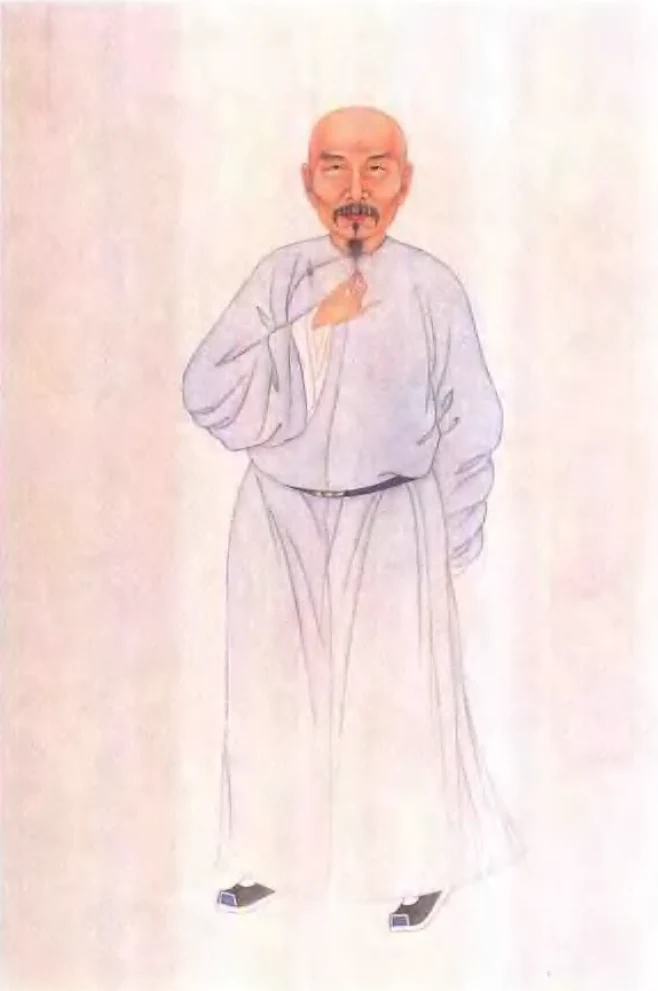
Biography
Family Background and Early Life Wei Yuan was born on the twenty-fourth day of the third lunar month of the fifty-ninth year of Qianlong, corresponding to April 23, 1794, at Jintan in Shaoyang County, Hunan. He was intelligent and studious from childhood. At about seven he studied classics and history under Liu Zhigang and Wei Fubang and frequently read late into the night. A story from his childhood recounts that during a local examination an examiner pointed to a teacup painted with a Taiji diagram and gave the first half of a couplet, “Within the cup is contained the Taiji.” Wei touched two wheat cakes in his clothing and replied, “Within the belly are nurtured Heaven and Earth,” an anecdote later widely repeated. His education took several turns. He first studied at Ailian Academy in Shaoyang, traditionally associated with Zhou Dunyi. In 1810 he returned to his home region to open a school and teach; his reputation as a teacher grew. In 1813 he went to Changsha and entered Yuelu Academy. There he met teachers and fellow students including academy head Yuan Mingyao, Tang Jinzhao, Li Ketian, and He Qingyuan. Tang Jinzhao valued Wei highly and selected him in the Hunan tribute examination for further study in Beijing. Wei did not cultivate political connections there but immersed himself in old texts; Tang personally visited this much younger scholar. The source presents Wei's Yuelu years and the Hunan tradition of practical statecraft as important influences on his later thought. ### Examinations and Staff Service In 1820 Wei's family moved to the new city of Yangzhou in Jiangsu. In 1822 he placed second in the Shuntian provincial examination. His examination paper received imperial praise, but he repeatedly failed the metropolitan examination thereafter. In 1829 he and Gong Zizhen both failed. Examiner Liu Fenglu composed *Song of the Two Scholars* lamenting the outcome, and “Gong and Wei” became a familiar pairing. Wei purchased eligibility as a waiting Secretariat Drafter, giving him access to the holdings of the Grand Secretariat and to private writings of officials and scholars. In 1825 He Changling, Provincial Administration Commissioner of Jiangsu, invited Wei to compile the 120-juan *Collected Writings on Statecraft of the Qing Dynasty*. Wei also assisted Jiangsu governor Tao Shu with grain transport and water-control affairs and wrote essays on grain transport, salt administration, and Huguang water management. The source treats this staff experience as crucial practical training for his later reform proposals. ### The Opium War and Intellectual Turning Point The outbreak of the Opium War in 1840 had a major effect on Wei. In 1841 he joined the staff of Yuxian, Viceroy of Liangjiang, participated directly in anti-British military efforts, and personally questioned captured British soldiers, using their statements to compile a short account of Britain. In the seventh month he met Lin Zexu at Zhenjiang. The two discussed current affairs and future strategy. Lin gave Wei foreign geographical materials, including the *Gazetteer of the Four Continents*, which he had organized for translation in Guangzhou, and asked him to continue compiling a more comprehensive geography of the world. Disillusioned by vacillation within the Qing government and by officials who favored surrender, Wei withdrew to write. In 1842 he completed *Record of the Sacred Military Achievements*, recounting Qing military history and institutions from the dynasty's early period through the Daoguang era. In 1843 he used Lin Zexu's *Gazetteer of the Four Continents*, historical works, earlier maritime gazetteers, foreign maps, and translated materials to compile the first fifty-juan edition of the *Illustrated Treatise on the Maritime Kingdoms*. ### Official Career and Later Years In 1844 Wei again took the metropolitan examination and, according to the source chronology, obtained the jinshi degree, placing ninety-third in the third class of the palace examination. He was assigned to Jiangsu for appointment as a department magistrate and also served in Dongtai and Xinghua county posts. The source credits him with reforms to salt administration, embankment construction, and water control. In 1847 Wei traveled to Guangzhou and Macao, met the scholar Chen Li and a Portuguese official, and went to Hong Kong to purchase foreign books. He used the new materials to expand the *Illustrated Treatise on the Maritime Kingdoms* to sixty juan. In 1851 Wei was appointed prefect of Gaoyou and continued organizing his writings in his spare time. In 1852 the *Illustrated Treatise on the Maritime Kingdoms* was expanded to one hundred juan, covering world geography, history, political institutions, economy, religion, calendars, culture, products, and other topics. In 1853 Wei completed *New Compilation of Yuan History*. He was later dismissed for “delaying an express dispatch” and “neglecting military business,” soon restored, but then resigned because of age, repeated setbacks, and political disorder. In his final years Wei devoted himself to Buddhism under the Dharma name Chengguan and compiled the *Four Pure Land Sutras*. He died on the first day of the third lunar month of the seventh year of Xianfeng, March 26, 1857, at Dongyuan Monastery in Hangzhou, aged sixty-three, and was buried at Fangjiayu on Nanping Mountain.
Wei Yuan was born in 1794 at Jintan in Shaoyang, Hunan. He studied the classics and histories under tutors from the age of seven, often reading late into the night; at nine, at the county examination, the examiner pointed to a cup bearing the diagram of the Supreme Ultimate and set the couplet "the cup holds the Supreme Ultimate," to which Wei Yuan, feeling the two wheat cakes in his bosom, answered "the belly carries heaven and earth," a reply long repeated. He passed the provincial examination in the Jiaqing years and afterward served long in local office and on official staffs.
He was a leading scholar of practical statecraft in the middle Qing. His *Collected Writings on Statecraft of the Dynasty* gathered political essays from the early Qing to the Daoguang years, becoming an important source for the study of Qing government and society; his *Record of Sacred Martiality* treats the military and frontier affairs of the early dynasty. After the Opium War he compiled, at Lin Zexu's request, the *Illustrated Treatise on the Maritime Kingdoms*, systematically introducing the geography, history and institutions of the world and proposing to learn the foreigners' techniques in order to check them — a work influencing both the late Qing self-strengthening movement and reform thought in Japan.
He lived in retirement in his later years, devoting himself to Buddhist study and writing, and died in 1857. His scholarship and thought are an important link in the turn from textual criticism to statecraft in Qing learning.