Biography
Family Background and Early Years
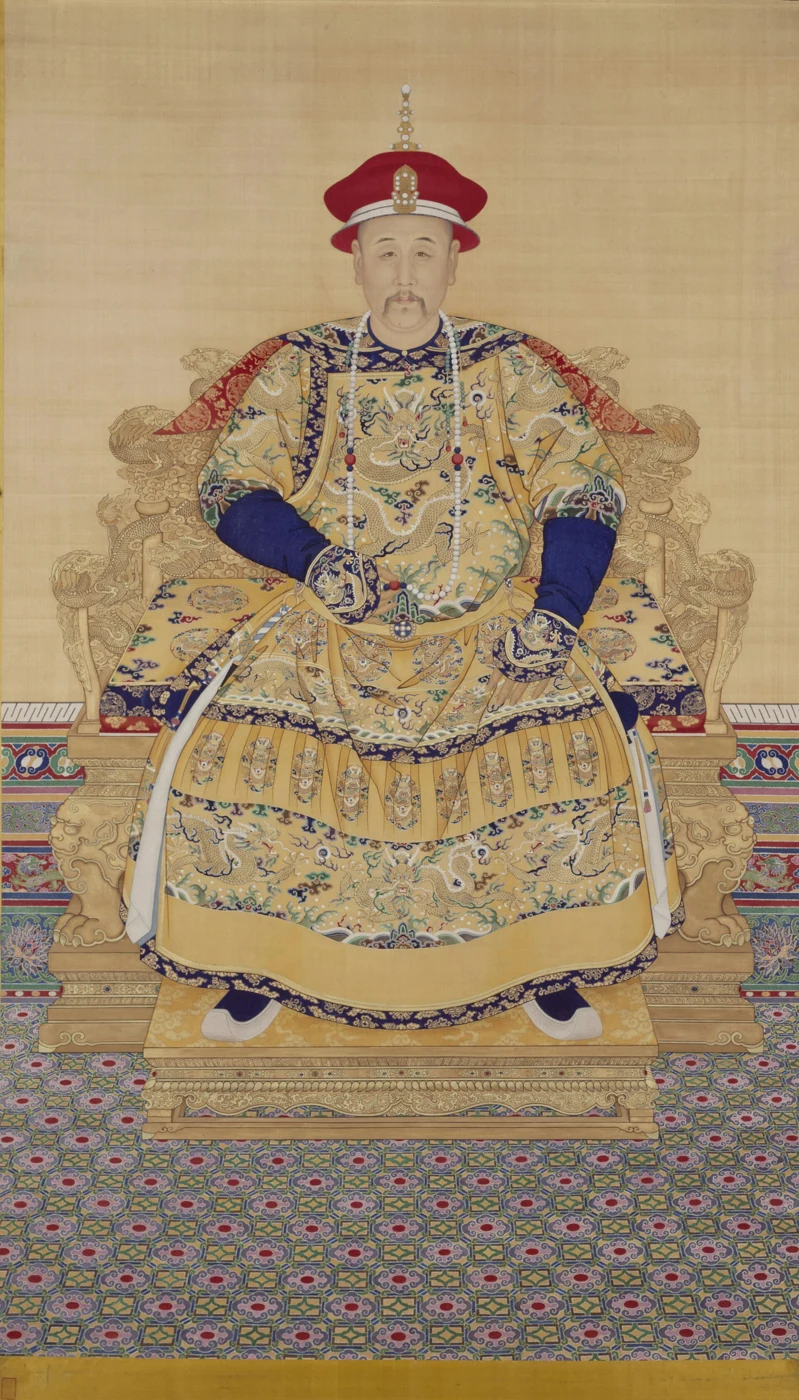
Yinzhen was born at the hour of the tiger on December 13, 1678, the thirtieth day of the tenth lunar month in the seventeenth year of Kangxi, in Yonghe Palace of the Forbidden City in Beijing. His birth mother, Lady Uya, came from the booi of the Bordered Yellow Banner. She first served as a palace woman and was later promoted to Consort De. After Yinzhen became emperor in 1722, she was honored as Empress Dowager, later known as Empress Xiaogongren. Under early Qing palace practice, a birth mother did not necessarily raise her own son, and after his first month Yinzhen was raised by Empress Xiaoyiren of the Tonggiya clan. She was a daughter of Tong Guowei, a duke of the first rank, and a niece of Empress Xiaokangzhang. As she had no surviving son, she raised the son of Consort De.
In 1683, the twenty-second year of Kangxi, Yinzhen entered the imperial school. He studied the Four Books and Five Classics under Zhang Ying and Manchu under Xu Yuanmeng. Among his tutors, he was closest to Gu Badai, whom Yinzhen later praised as upright in character and sound in learning. As a youth he was strictly supervised by his father and teachers, with the Four Books and Five Classics forming the core of his studies. During this period he wrote poems including “Reading in Spring” and “Reading in Summer.” The Kangxi Emperor once described the young Yinzhen as “uncertain in joy and anger,” but at Yinzhen's request this assessment was removed in 1702, the forty-first year of Kangxi. Because Yinzhen was quick-tempered and forceful, the Kangxi Emperor admonished him with the phrase “guard against haste and practice forbearance.”
As he grew older, Yinzhen accompanied the Kangxi Emperor on inspection tours and was entrusted with government assignments. In 1693, the thirty-second year of Kangxi, he accompanied the third imperial son Yinzhi to offer sacrifices at the Temple of Confucius in Qufu. In 1696, the thirty-fifth year of Kangxi, he joined the Kangxi Emperor's campaign against Galdan and took charge of the Plain Red Banner camp. Although he did not personally enter battle, he wrote poems praising his father's achievements. He later went to the temporary enshrinement hall at Zunhua to offer sacrifices to Empress Xiaozhuangwen. In 1698, the thirty-seventh year of Kangxi, the twenty-one-year-old Yinzhen was made a beile. In 1700, the thirty-ninth year of Kangxi, he accompanied the Kangxi Emperor to inspect the Yongding River works and verify construction quality. He later accompanied his father to Mount Wutai and on southern tours to Jiangsu and Zhejiang, inspecting Yellow River and Huai River projects. These tours and assignments exposed him to regional economies, water conservancy, local customs, and the realities of official administration, providing practical experience for his later rule.
Yinzhen was born on the thirtieth day of the tenth month of the seventeenth year of Kangxi, that is 13 December 1678, the fourth son of the Kangxi emperor, his mother being the empress Xiaogongren, née Uya, then a consort of the first rank, and he was born in the Yonghe palace of the Forbidden City in Beijing. He was made a beile in 1698 and raised to the rank of prince of the first degree with the title Yong in 1709. As a prince he repeatedly accompanied the Kangxi emperor on his progresses and was sent out to transact government business, his travels covering the chief regions of the country, so that he had occasion to learn the economic products, the rivers, mountains and waterworks, and the customs of each place; he also returned to the capital to take part in reviewing the examination papers of the tribute scholars, at the winter solstice performed the sacrifice to heaven in the southern suburb on the emperor's behalf, and the following year inspected the granaries of the capital and of Tongzhou and again sacrificed at the winter solstice. These experiences made him familiar with the concrete details of government and gave him direct knowledge for his later rule.
In his years as a prince he styled himself the layman Who Has Broken the Dust and master of the Garden of Perfect Brightness. In the preface to his collection of poems written in the princely residence he wrote that he had then counted himself the idlest man in the empire; not idle in the manner of one who withdraws from the world among bamboos and trees, but idle in circumstance, since he lived when the state was at its height, the three rebellions had been put down and all quarters were at peace, and he was cherished by the emperor his father, served him with joy, and, though ranked among the imperial princes, had nothing to do after attending at his parents' door; and idle in feeling, since by nature he disliked ostentation, had no need to be anxious for wealth and honor nor to grieve over poverty, and asked only to melt away cleverness and so be content wherever he was; and that it was through his father's deep kindness in educating him that he had been able to live at ease as an idle man for forty years. The passage is the most direct record of his frame of mind in those years: to call himself idle was at once to show his father that he sought nothing and to express a temperament that genuinely disliked display.
From youth he also liked to read Buddhist books and associated with monks, wrote a work of a hundred questions on Buddhist doctrine, and took the names of the layman Who Has Broken the Dust and the layman of Perfect Brightness; early in his reign he even compared himself to a master of the Buddhist law and used the monk Wenjue in secret counsel. At the same time he took an early interest in Daoist alchemy and pursued it while still a prince, writing a poem on refining cinnabar which speaks of lead ore mixed with drugs, pines and cypresses about the altar, the fire of yin and yang worked in the furnace, and the elixir both within and without. He was also adept at divining his father's wishes: he had court painters prepare a set of pictures of plowing and weaving, modeled on the woodblock set printed in the Kangxi period, and presented it to the emperor, in which the chief figures, the farmer and the silkworm woman, were given the features of Yinzhen himself and his consorts, something unique among such sets in earlier dynasties. The emperor was delighted and his regard for his fourth son grew. To present himself as an idler and a layman and at the same time to court his father's pleasure: both sides belonged to his years as a prince.
There is also a story of his going about in disguise, recorded in a Qing collection of anecdotes. As a prince he is said to have traveled incognito to Hangzhou, where outside the Yongjin gate he saw a scholar selling his calligraphy, whose brushwork was rather fine, and had him write a couplet. Among the characters was one for autumn, in which the scholar put the fire element on the left; the prince asked whether that was not a mistake, and the scholar, unperturbed, said it was not and brought out a book of model calligraphy for comparison. The prince asked why, being so learned, he did not seek a degree instead of selling calligraphy for a living, and the scholar said his family was poor and could not feed his wife and children, so he sold his writing and never dreamed of wealth or rank. The prince then generously took out several ingots of gold from his purse and said that as his own trading had prospered he might as well help the man to a degree, asking only that he not be forgotten when his ambition was achieved. The scholar thanked him and took it, sat for the examinations and rose to the Hanlin academy. By then the prince had ascended the throne, and one day, seeing the scholar's name on a roster, he recalled the visit to Hangzhou and summoned him. He wrote on impulse a character meaning harmony, deliberately putting the mouth element on the left, and had it shown to the scholar, who, not knowing why, said it was wrongly written; the emperor smiled and said nothing. The next day he sent the scholar with an edict to the governor of Zhejiang, and when it was opened it ordered him to go back and sell calligraphy at the Yongjin gate for three more years before taking office. Only then did the scholar understand.
Role in the Succession Struggle
In the summer of 1708, the forty-seventh year of Kangxi, the Kangxi Emperor deposed Crown Prince Yinreng for the first time. During the subsequent discussion over a new heir, Yinzhen supported restoring Yinreng while maintaining good relations with the eighth imperial son Yinsi. Yinreng was restored in 1709, the forty-eighth year of Kangxi, and in the same year Yinzhen was created Prince Yong. The imperial princes meanwhile formed factions in pursuit of the succession, and rivalry became intense.
After Yinreng's restoration, his conduct again led to his deposition in 1711, the fiftieth year of Kangxi. Competition among the imperial sons then intensified. The eighth imperial son Yinsi continued his political activity and was repeatedly reprimanded by his father. The fourteenth imperial son Yinti cultivated men of talent and built connections, and in 1718, the fifty-seventh year of Kangxi, was appointed General-in-Chief for the campaign in the northwest, greatly increasing his reputation. The third imperial son Yinzhi was placed in charge of the Mengyang Studio, where a circle of scholars gathered around him, and he too hoped for the succession.
Yinzhen was adept at keeping a low profile in this struggle. He showed respect for Buddhism and Daoist learning, called himself “the foremost idle man under Heaven,” maintained outward harmony with his brothers, and at the same time cultivated close relations with Nian Gengyao and Longkodo. He also displayed filial devotion toward the Kangxi Emperor and won his father's trust. His subordinate Dai Duo praised him to Grand Secretary Li Guangdi as possessing both talent and virtue and as combining favor with authority, with the capacity for great achievement. In the succession contest, Yinzhen advocated correcting entrenched abuses and pursuing energetic government, in contrast to Yinsi's emphasis on benevolence and righteousness, in order to win support. He was skilled at presenting different faces to different opponents so that rivals did not regard him as their principal threat, and he ultimately prevailed.
In 1721, the sixtieth year of Kangxi, Yinzhen was ordered to Shengjing to report at the ancestral tombs. After returning to Beijing he took part in reviewing the examination papers of successful metropolitan examination candidates. At the winter solstice he was ordered to sacrifice to Heaven at the southern altar on the Kangxi Emperor's behalf. The following year he inspected the Beijing and Tongzhou granaries and again represented the emperor at the winter-solstice sacrifice. These assignments gradually made him the prince who performed major rites and government business on behalf of the aging Kangxi Emperor and helped prepare the way for his accession.
Accession and Consolidation of the Throne
On the thirteenth day of the eleventh lunar month in 1722, the sixty-first year of Kangxi, the Kangxi Emperor died at Changchun Garden north of Beijing. On the twentieth day of the eleventh lunar month, Yinzhen ascended the imperial throne in the Hall of Supreme Harmony under the Kangxi Emperor's testament and adopted the era name Yongzheng. He was the first Qing emperor to ascend the throne under a testament associated with the secret succession system.
After accession, the Yongzheng Emperor first ordered Yinsi, Yinxiang, Maci, Longkodo, and others to supervise government affairs in order to stabilize the situation. He then summoned Yinti, General-in-Chief in the northwest, back to Beijing and removed his military authority, while sending Yintang to Xidatong in Qinghai. Because the Qing had lacked an effective and stable succession system and disputes over the throne had repeatedly arisen, the Yongzheng Emperor formalized the secret succession system, sealing the testament naming his heir and placing it behind the “Upright and Bright” plaque in the Palace of Heavenly Purity.
After Qinghai was pacified in March 1724, the second year of Yongzheng, the emperor's position strengthened and he moved more forcefully against the Yinsi faction. In April he publicly condemned Yinsi, stripped him of imperial clan status, confined him, and renamed him Akina. Yintang was likewise stripped of clan status, confined, and renamed Seshe. The tenth imperial son Yin'e was confined, while the fourteenth imperial son Yinti was first sent to guard an imperial mausoleum and later confined. The twelfth imperial son Yintao was demoted, and the third imperial son Yinzhi was also stripped of rank and confined. In May, Beile Sunu was stripped of his title, and in July the emperor composed the *Discourse on Factions*, further attacking supporters of Yinsi. In 1726, the fourth year of Yongzheng, Yintang and Yinsi died in confinement, Yinti was moved to Jingshan in Beijing, and other members of the Yinsi faction were punished, bringing the group that had operated for more than twenty years to an end.
In 1725, the third year of Yongzheng, the emperor accused Nian Gengyao of arrogance and factional conduct and ordered him to commit suicide. He also stripped Longkodo of the title of Grand Preceptor and later confined him until death. These actions also led to the Wang Jingqi *Notes from the Western Campaign* case and the Zha Siting examination-question case.
Government and Reform
From the beginning of his reign, the Yongzheng Emperor made clear his determination to correct accumulated abuses. In the month of his accession he instructed grand secretaries, ministers, and vice ministers that if they clearly understood policies that should be implemented or abolished for the benefit of state finance and the livelihood of the people, they should submit secret memorials. On New Year's Day of 1723, the first year of Yongzheng, he issued an edict to civil and military officials at all local levels calling for reforms to promote benefits and eliminate abuses for the sake of state finances and popular livelihood.
The emperor's political program contained several core elements. First, he opposed passivity and perfunctory government. He believed that when he came to the throne, official habits had long grown lax and abuses were everywhere, and he advocated deliberate investigation and correction rather than the Kangxi-era preference for avoiding unnecessary action. Second, he sought to reorganize the bureaucracy for the benefit of the people. In his edicts he criticized officials who pursued reputation in name while enriching their households in fact and announced a campaign to rectify official administration. Third, he opposed factionalism. From personal experience he considered political factions highly destructive and declared his intention to wash away habits accumulated through the Tang, Song, Yuan, and Ming and reverse centuries of political decline at its root.
In specific policy, in 1723, the first year of Yongzheng, he accepted the proposal of Shanxi governor Nomin and implemented the return of surcharge revenues to the public treasury together with integrity stipends, increasing central fiscal income while limiting arbitrary local exactions. In 1724, the second year of Yongzheng, in response to serious arrears in provincial tax remittances dating from the late Kangxi period, he ordered strict investigations and confiscation of corrupt officials' property to recover deficits. In the same year he promoted the fusion of the poll tax with the field tax, reducing the burden on peasants with little or no land and encouraging population growth. He also abolished hereditary degraded-status registers. From the first through the seventh years of Yongzheng, groups such as entertainers in Shanxi, so-called degraded households in Zhejiang, and boat people in Guangdong were successively registered as ordinary commoners and permitted to own property, settle permanently, and take examinations.
In the southwest, beginning in 1726, the fourth year of Yongzheng, the emperor employed Ortai to carry out transforming chieftainships into district administration on a large scale, abolishing hereditary native chieftain offices and replacing them with appointed officials, thereby strengthening Qing control over minority regions. In 1727, the fifth year of Yongzheng, the office of the Amban in Tibet was established. In 1724, the second year of Yongzheng, the Xining Amban was established to administer Qinghai affairs.
The Yongzheng emperor's reform of officialdom began with public reproofs at the very start of his reign. In the fifth month of 1723, his first year, he issued eleven edicts cataloguing the abuses of officialdom and charging the officials of every rank with greed, incompetence and hollow display, repeatedly calling for clean government; the corruption of the last Kangxi years had by then become a grave threat to Qing rule, and in the years that followed he purged it with dispatch. He first dismissed among the provincial governors those who were corrupt or too weak for their posts, personally ordering the removal of the governor of Jiangxi Wang Qiqing, of Huguang Zhang Liandeng, of Zhili Zhao Zhiyuan, of Shanxi Sukji and of the river commissioner Zhao Shixian among others; he then required the governors and governors-general to discipline their subordinates, impeaching the rapacious and dismissing the incompetent. They did not dare disobey: the governor-general of Zhejiang and Fujian, Manbao, reported that he had already impeached many officials under him and that further impeachments would leave no one to do the work, and the governor of Hunan, Wei Tingzhen, reported that more than half his subordinates had been impeached and asked leave to continue the inquiry. In the fourth month of 1725 he told the governors that weak and incapable ones, when they did impeach anyone, would explain to everyone that unless they impeached it would not accord with the imperial wish and others might impeach them to their hurt, as if impeachment were a way of courting his favor, and he admonished them to judge every matter by principle and never to harbor a thought of courting favor. In the eleventh month of 1726 he reduced the staffs of the ministries, saying that among the Chinese secretaries of each ministry only one or two were really capable and the rest were idle and useless, a mere superfluity; the heads of each ministry were to sift their secretaries carefully and report all those of ordinary ability, useless now and unlikely ever to be promoted, together with those who should be kept, for his decision.
With the personnel measures went three prohibitions. First, the abolition of departmental fees: in the first month of 1723 he forbade the taking of such fees and set up the board for auditing accounts to clear those of the revenue ministry, saying that the great abuse lay in provincial accounts, since without a fee even a clear and orderly set of documents would be rejected on one pretext or another, while with a fee even a million in wasted grain and money would be approved, so that he had no choice but to set the matter straight. Second, the abolition of seasonal gifts: he held that the practice must never be allowed and that the bribes of subordinates must not be accepted, and forbade all such gifts. The reports of local officials show good results: Nian Xiyao, on becoming governor of Guangdong, refused all the customary gifts of his subordinates, the governor of Guangxi Kong Yuxun on taking office likewise refused all gifts at his office, and the Guangxi provincial treasurer Liu Tingchen did not accept a single item from those under him. Third, the prohibition of contributions from salaries for public works: salaries being small, some officials, to win a good name, would lead their subordinates in contributing salary toward construction, which merely shifted money from one place to another and in the end fell on the common people, so he ordered that the practice of requesting such contributions cease forever. When the governor of Gansu, Shi Wenzhuo, reported that contributions were unavoidable and could not be stopped, the emperor called him utterly shameless.
For information he developed a denser system of secret memorials than any before. He required the censors and remonstrating officials at court to submit a secret memorial every day, each dealing with one matter only and reporting the facts whatever their weight; local officials from provincial treasurers and brigade commanders upward could likewise memorialize in secret. All local conditions, the diligence or idleness of a province's officials, whether a superior was public-spirited or private, which subordinate was good and which bad, whether the troops were in order, even weather, flood and drought and the people's livelihood could be reported, and anything startling might be sent in on hearsay without waiting for certain knowledge. Secret memorials were not to be discussed with others or disclosed, and had to be written by the official's own hand and sent straight to the capital: those of governors went to the memorial office in the palace, and those of Manchu and Chinese officials below them were forwarded to the emperor by Prince Yi Yunxiang and the Chinese ministers Zhang Tingyu and Jiang Tingxi for his reading and endorsement. From the memorials he learned conditions in every region, and he also employed secret agents to watch officials' words and conduct, reporting even the small affairs of daily life, so that in some cases an official's own servants were the emperor's agents. Officials stood in fear and did not dare act at will — a system of mutual checking and surveillance that put his stern style into administrative practice.
Clearing the arrears of revenue was another major task the Yongzheng emperor took up on his accession. Financial arrears had grown severe in the last Kangxi years; less than a month after taking the throne he put the matter on the agenda and opened a sweeping audit. He formed a capable body, the board for auditing accounts, to examine the submission of revenue accounts, with Prince Yi, Yunxiang, in charge of its affairs, and he also put Yunxiang over the three treasuries of the revenue ministry in order to set the finances straight. In his view the arrears arose chiefly from the extortion of superiors and the embezzlement of the officials themselves, and he accordingly warned officials at every level not to extort from the people, to settle the arrears within the time fixed, and to expect severe punishment otherwise. The audit began in the central government and was carried out generally in the provinces as well.
In 1724, in view of the severity of the arrears in the last years of Kangxi, he ordered a strict investigation: corrupt officials were to have their property confiscated to make good the loss, while for arrears owed by the people at large annual installments were set for repayment over a short term. The policy was that wherever a locality had arrears they must be made good in full within three years, with heavy punishment if the term expired with the sum unpaid. He also increased the penalties on officials in arrears: all were to be dismissed, and each was personally liable to repay. In the eighth month of 1724, holding the sentences in the relevant cases too light, he made the penalties heavier: transfer of ten thousand to twenty thousand taels was punished by service in the frontier guards, and above twenty thousand, even if only a transfer, was punished as theft of revenue with death. Against officials who had caused arrears by extortion or embezzlement he showed no mercy: any who offended were dismissed and their property confiscated to make good the loss, and he set up a special sealed treasury in which all confiscated sums and surplus silver were kept, so that by the end of the reign it held more than thirty million and the state's funds were ample.
Through years of effort the arrears inherited from the Kangxi reign were largely recovered, and officials were so deterred that they did not lightly defy the law. The treasury changed accordingly: from eight million taels of silver at the beginning of his reign it rose to more than sixty million, with funds sufficient and granaries full, enough to last more than twenty years. This accumulation was not merely a figure on the books; it gave him the material means to send troops into Qinghai, to manage Tibet, to replace hereditary native chiefs with appointed officials, and to campaign against the Zunghars. With confiscation as the instrument, the audit board and the sealed treasury as the machinery, and the three-year limit with dismissal and repayment as the rule, the financial gap inherited from the Kangxi years was filled piece by piece and the habit of perfunctory accounting among local officials overturned with it.
The Yongzheng reign may be called the high tide of Confucius worship in the Qing. Two chief motives lay behind it: the crisis of legitimacy he faced on accession, and his claim to be continuing the work of the Kangxi emperor. To carry on his father's undertaking and to dissolve the political crisis, he multiplied the means of honoring Confucius to a degree that nearly touched the limit: funds were specially allotted to repair the temple and the cemetery at Qufu, the five generations of Confucius's forebears were ennobled as princes, the use of his name in writing was forbidden, his birthday was sacrificed to, the ritual for his worship was raised, and tablets and ritual vessels were granted by imperial gift — measures far beyond those of earlier emperors. Above all, his large-scale restoration and expansion of the list of scholars admitted to the sacrifices in the Confucian temple showed his concern to construct a genealogy of the Confucian orthodoxy. When the temple at Qufu was rebuilt he forbade officials to contribute to the cost, wishing to keep the credit for repairing the sage's temple to himself; yet when the building of temples in remote regions was discussed, he refused on the ground of preserving the Manchu inheritance to build one in Jilin, the cradle of the dynasty, while approving them elsewhere. The same act of veneration could be handled in opposite ways at Qufu and at Jilin, which shows that the criterion was not edification but the balance of rule.
In his principles of government he followed his father's and grandfather's policy of revering Confucianism and honoring the Way: he honored Confucius, held daily lectures and the classics colloquium, and valued the role of traditional learning, especially the Cheng-Zhu school of principle, in political rule. At the same time he held that the three teachings should be given equal weight, and by substituting sincerity for principle he modified the Cheng-Zhu orthodoxy. This took two forms: first, attention to the edifying function of traditional learning, above all of the school of principle; second, the use of heaven-and-man correspondence and of the "divine way" as instruments of political rule. From youth he had also liked Buddhist books and associated with monks, early in his reign comparing himself to a master of the Buddhist law and using the monk Wenjue in secret counsel, which drew objections from his ministers; he denied that monks were taking part in government but kept the Buddhist establishment within bounds, and in his later years held assemblies in the palace, took disciples himself, restored famous monasteries, granted titles to monks, supported one faction within Chan Buddhism and wrote a treatise on distinguishing the true doctrine from the false, intervening in disputes inside the Buddhist order. Equal weight to the three teachings and veneration of Confucius were the two wings of his cultural policy.
More deeply, the series of measures he initiated to honor Confucius was meant to use the cultural authority symbolized by Confucius to consolidate his own political authority — that is, to sustain the "rule of governance" of the throne by the "orthodoxy" of the Confucian way. These measures were therefore at once an important means of resolving the crisis of legitimacy of his own rule and a key link in the efforts of the early and middle Qing emperors to construct the legitimacy of Qing rule as such: by the posture of revering the orthodox tradition he displayed a rule conforming to the Chinese line of succession, thereby dissolving among the higher scholar-officials the doubts about his accession. This is where his veneration of Confucius differs in purpose from that of merely learned emperors before him.
In military and frontier affairs the Yongzheng emperor worked on two fronts at once. In the northwest he sent troops into Qinghai in 1723 and the following year put down the rebellion of Lobsang Danjin, bringing Qinghai under more direct control; the struggle with the Zunghars continued at intervals, ending in the Qing's direct exercise of sovereignty over Tibet. In the southwest he replaced the hereditary native chieftainships with appointed officials, extending Qing political control into wide territories that had nominally accepted the court's rule while in fact being governed by non-Chinese tribal leaders. The measure helped to lighten the oppression and exploitation suffered by the peoples of minority regions and was of great importance for unified rule and national unity, but in carrying it out the Qing relied too heavily on force and crushed resistance in some regions with such cruelty as to bring disaster on some of the peoples of the southwest. The southwestern frontier that the Qianlong reign faced was formed in the Yongzheng years.
The affairs of the Miao regions were the heaviest burden. In the fifth month of 1735, when the Miao of Guzhou and Taigong in Guizhou rose, he appointed Ha Yuansheng general of awe-inspiring power to lead troops from four provinces against them, and put Prince Guo, the fourth and fifth imperial sons and the grand secretaries Ortai and Zhang Tingyu in charge of Miao frontier affairs; the minister of works, Batai, was dismissed over it, and the minister of justice Zhang Zhao and the deputy censor Deshishou were sent to investigate. In the same month Ha Yuansheng reported that the rising Miao had been dealt with and that Huangping and Shibing were wholly pacified. In Tibet the post of resident minister was increased and reduced from time to time, and at first the three-year rotation proposed by Yue Zhongqi was not followed, the court not having laid down any clear rule of rotation; later the resident ministers entered a new rotation, and fearing that newcomers would not be familiar with Tibetan affairs the court had Mala return first while Sengge remained to assist. In the long view the most enduringly important of all the policies of the Yongzheng reign were the military operations that began in the mid-1720s: they should not be seen as parts of a coordinated plan of expansion and had no consistent objective, yet Qing territory was extended along two frontiers at once, one in the northwest and one in the southwest, and the results were the exercise of sovereignty over Tibet and the extension of political control over lands under native chieftains.
In religion, Yinzhen's involvement with Buddhism and Daoism ran through his whole life. From youth he liked to read Buddhist books and associated with monks, wrote a work of a hundred questions on Buddhist doctrine, and took the names of the layman Who Has Broken the Dust and the layman of Perfect Brightness; early in his reign he compared himself to a master of the Buddhist law and used the monk Wenjue in secret counsel, which drew objections from his ministers. He denied that monks took part in government and held the Buddhist establishment in bounds, but in his later years he held assemblies in the palace and took disciples himself, restored famous monasteries, granted titles to monks, supported one faction within Chan Buddhism, and wrote a treatise on distinguishing the true doctrine from the false, intervening in disputes within the Buddhist order. He was also much interested in Daoism, and particularly favored Lou Jinyuan, a Daoist priest from Mount Longhu resident in Beijing, granting him the fourth rank as superintendent of Mount Longhu and abbot of the Qin'an hall and adding the title of Perfected Man of Wondrous Rectitude. He had taken a keen interest in alchemy while still a prince, chiefly in order to show his father that he sought no throne and thought only of refining cinnabar, and had written a poem on the subject which speaks of lead ore mixed with drugs, pines and cypresses about the altar, the fire of yin and yang worked in the furnace, and the elixir both within and without. In his devotion to elixirs he may be called the last emperor in Chinese history to favor Daoist priests and dote on cinnabar.
In Western objects, his taste contrasted oddly with his prohibition of foreign religion. In his leisure he most liked to drink grape wine. Many Western missionaries came to China to preach, and like other emperors he opposed the missions in order to keep his rule secure, yet unlike others he greatly enjoyed the Western goods they brought in, wine among them. One Western physician at court is recorded to have given him three kinds of grape wine — a rosemary medicinal wine, a cinnamon wine and a peach-kernel wine — which he treasured and was reluctant to drink. Spectacles reached China late and were still a rarity in the Yongzheng period; he is said to have set up a department in the palace to make spectacles for him alone, making many suggestions to those who made them and demanding the best both in material and in design. His liking for them was no affectation, for his eyes had indeed failed and he needed them. According to incomplete counts, the imperial workshops made him no fewer than thirty-five pairs of spectacles, of crystal, tea-crystal, ink-crystal, glass and other kinds; he kept them everywhere, so that wherever he went he could take one up, in the palaces where he usually lived and in the Garden of Perfect Brightness, and even in his sedan chair; and he issued spectacles to the workmen of the lime-kiln office as a practical welfare benefit.
Later Years and Death
In 1729, the seventh year of Yongzheng, the emperor established the Grand Council to assist with military affairs in connection with the campaign against the Dzungars. The Grand Council initially had no permanent statutory officials or formal yamen. It included grand councillors and military secretaries drawn from grand secretaries, ministers, vice ministers, and imperial nobles, including Prince Yi Yinxiang, Grand Secretary Zhang Tingyu, Minister of Revenue Jiang Tingxi, and Ortai. It was located inside Longzong Gate near the emperor's residence at the Hall of Mental Cultivation, enabling rapid consultation whenever the emperor summoned its members.
The Yongzheng Emperor also strengthened ideological control and expanded literary inquisitions. In 1729, the seventh year of Yongzheng, Lu Shengnan, a former secretary in the Ministry of Works who had been sent to serve in a northwestern military camp, wrote seventeen essays titled *Discussions on the Comprehensive Mirror*, dealing with matters such as enfeoffment, succession, and military institutions. The Yongzheng Emperor accused him of using ancient affairs and statements as a pretext for venting personal resentment and ordered his execution at the army front. Supervising Censor Xie Jishi, who had been accused of attacking Cheng-Zhu learning in notes on the *Great Learning*, was ordered to be placed beside Lu at the execution as a warning.
At midnight on the twenty-third day of the eighth lunar month in 1735, the thirteenth year of Yongzheng, the Yongzheng Emperor died at the Old Summer Palace at the age of fifty-eight. He received the temple name Shizong and the posthumous title Emperor Jingtian Changyun Jianzhong Biaozheng Wenwu Yingming Kuanren Xinyi Ruisheng Daxiao Zhicheng Xian. He was buried in the Tailing Mausoleum of the Western Qing Tombs.
The assessment in the Draft History of the Qing was that where the Kangxi emperor governed with magnanimity the Yongzheng emperor succeeded him with strictness, and that writers compared the two to the emperors Wen and Jing of the Han; only in brotherly feeling was he thought wanting, though the lord of Huainan was insolent and brought it on himself, so that it was not wholly the emperor Wen's lack of kindness. It also records that he studied the art of government and was especially concerned at the hardship of subordinate officials, and that when a close minister told him the prefectures and counties took in much and their intake should be trimmed, he retorted that the man had never been a prefect or magistrate and could not know their difficulties — a saying later writers thought showed a grasp of the essentials of government. Later judgment falls broadly into several lines. One looks at his manner and the temper of the age: that he was firm and penetrating, a politician to the core, ruling by law and prizing honesty, so that officialdom was clean, the treasury full and the world at peace; that had his years been prolonged he might have given Chinese politics a positive character and swept away centuries of muddled inactivity, so that society would not have stagnated, but that, never at leisure and too eager for good government, he could hardly win society's understanding, which gave rise to the tales of his sudden death. The same line adds that his early government was thorough and did not flag, so that the Yongzheng period had a character of its own; that though he reproved much he did not lightly kill or disgrace, nor did he regard all court officials as his inferiors and take all wisdom for his own, so that he was far superior to the Qianlong emperor. Another line looks at his temperament: that he was hard, truly hard, but not without kindness; cold, truly cold, but not without feeling; that the saying no official in the Yongzheng reign was not clean may be exaggerated but is a fair judgment of his government; and that he was undeniably a man of strong character and an outstanding figure, rich in feeling, strong of will, firm in temper, sharp of eye and full of enterprise.
Another line of judgment concentrates on his harshness toward his own flesh and blood and his political enemies. One writer says that Yinsi and Yintang had merely plotted for the succession in Kangxi's lifetime, yet the Yongzheng emperor, having won the throne by stratagem, regarded them as thorns in his eye: first temporizing with them, then constantly rebuking them, not only rebuking but imprisoning them, not only imprisoning but secretly killing them, and changing their names to Acina and Seshe; that to disgrace one's brothers is no different from disgracing oneself, or from disgracing one's ancestors, and that however glib the arguments, they only reveal a cruel and unnatural heart. Another weighs his merits and faults together: that the legitimacy of his accession is not beyond doubt and his treatment of opponents excessively cruel, extending even to his brothers by the same father, the eighth, ninth, tenth and fourteenth sons, whom he maltreated, secretly killed or stripped of rank and imprisoned, so that his reputation suffered and his opponents fastened on him ten great crimes, of plotting against his father, hounding his mother, murdering his brother, slaughtering his brothers, delighting in killing and destroying the loyal; that in his thirteen years he made many mistakes and some of his harmful measures were widely resented; but that on the whole he remains an outstanding ruler, bold in advance, removing abuses and of notable achievement. He had great ambitions and real courage for reform, wishing to shake off the decadence of centuries and wash away the habits accumulated through the Tang, Song, Yuan and Ming, so as to achieve clean government, a settled people and lasting peace.
A further line argues from his manner of rule. One writer holds him a man of strong sense of mission, seeking efficiency and solving problems, whose officials shared those qualities; that he encouraged innovation and perfected the memorial system to bypass the inherent conservatism of the outer court, which explains what the reign achieved; but that the great irony of his rule was that, distrusting the bureaucracy, he failed to build institutions able to guarantee steadily stronger government and economy, and that a system depending on the emperor's hand in everything could not meet the challenges China faced a century after his death. Another writer says that with Kangxi indulgent and Qianlong lax, but for Yongzheng's discipline the Qing might long since have declined; that his thirteen years of unremitting toil in public business are a fact, as is his contribution to government; but that his reign was too short and his death too sudden, leaving tasks unfinished, and that even of what was carried out, since the man died and his measures died with him, some produced abuses instead of benefits — as his own testament said, his aspirations were unfulfilled and he could not but feel regret; that had he lived as long as his father, eleven years more, the political scene would have differed, and had he lived as long as his son, thirty-one years more, the political changes would have been great indeed. Two observations by missionaries then in China may be added: that though the Yongzheng emperor seldom appeared a supporter of Catholicism, he was tireless in his devotion to public business, working day and night to reform abuses for the welfare of all his people, and that the greatest pleasure one could give him was to propose a measure improving the people's welfare and easing their burdens, which he would at any cost put into practice as soon as possible; and that the new emperor loved law and the public good more than his father had, and that among emperors none did more to encourage agriculture. Qing sources also record that he issued regulations all tending to instill respect for the farmer, and that besides plowing and sowing with his own hands as an example he ordered the governors of every city each year to select the diligent, honest and capable farmers of their districts and raise them to the eighth rank, with high repute and corresponding privileges.