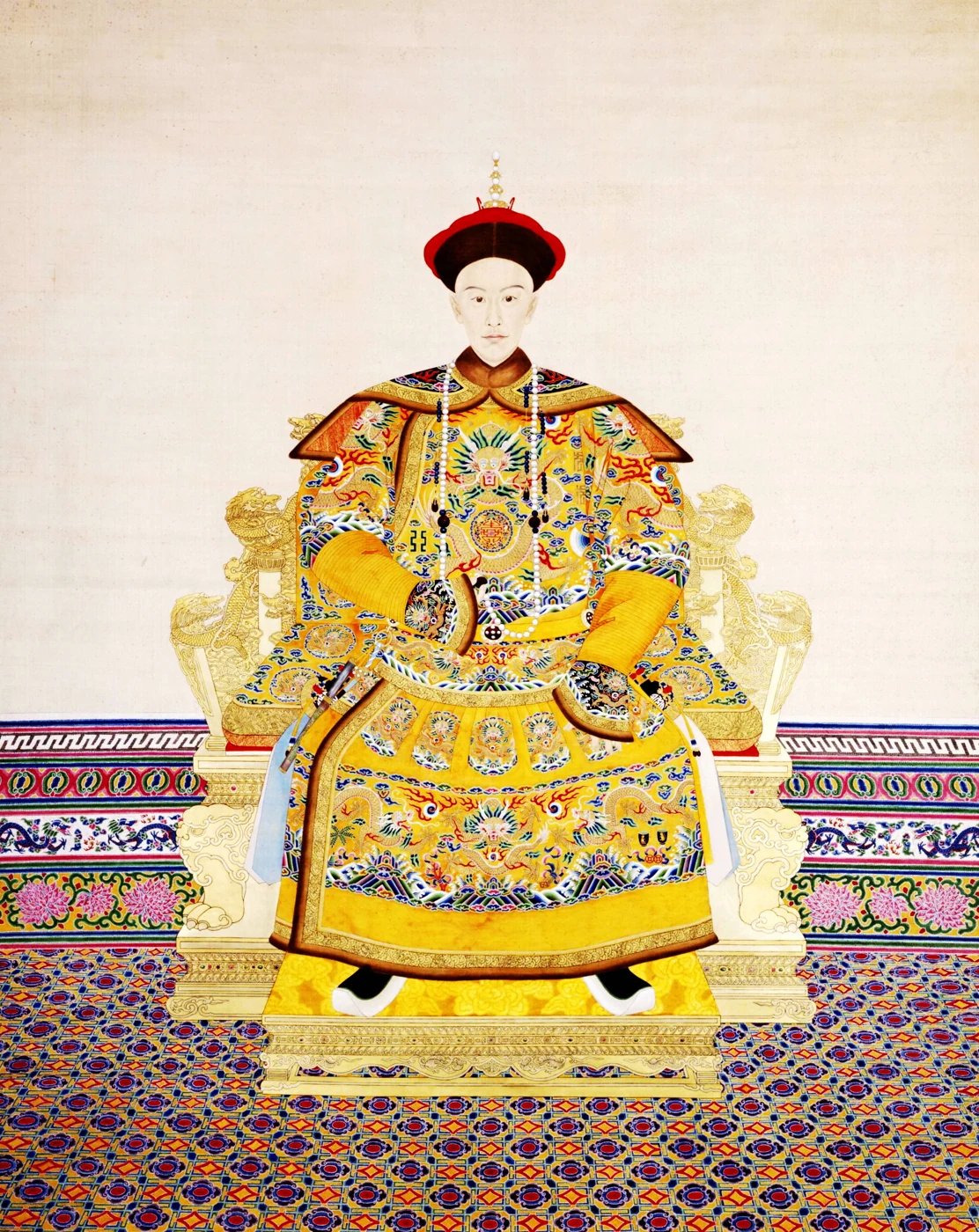
Biography
Family Background and Accession Aisin Gioro Zaitian was born on August 14, 1871 (twenty-eighth day of the sixth month, tenth year of Tongzhi). He was the son of Yixuan, Prince Chun, and Lady Yehenara Wanzhen, a younger sister of Empress Dowager Cixi. The *Draft History of Qing*, “Annals of Dezong I,” records that he was born at the Prince Chun residence by Taiping Lake in Beijing. On January 12, 1875 (fifth day of the twelfth month, thirteenth year of Tongzhi), the Tongzhi Emperor Zaichun died without an heir. The two empress dowagers and the princes and senior officials decided that Zaitian would be adopted into the Xianfeng line and succeed to the throne. The *Draft History of Qing* records that he was brought from his residence into the palace on January 13, 1875 (sixth day of the twelfth month, thirteenth year of Tongzhi). On February 25, 1875 (twentieth day of the first month, first year of Guangxu), he held the enthronement ceremony in the Hall of Supreme Harmony. Because he was a child, Empress Dowagers Ci'an and Cixi governed from behind the curtain. The *Draft History of Qing* also records that Weng Tonghe and Xia Tongshan were appointed to teach him in Yuqing Palace, while imperial attendants taught Manchu and Mongolian writing, riding, and archery. ### Personal Rule and Cixi’s Instructional Government After Empress Dowager Ci'an died in 1881 (seventh year of Guangxu), Cixi governed alone. Zaitian began personal rule in 1887 (thirteenth year of Guangxu), but this did not give him full independence in government. The court arranged for Cixi to continue instructional government, and major appointments and decisions remained subject to her influence. On February 25, 1889 (twenty-sixth day of the first month, fifteenth year of Guangxu), Zaitian married Lady Yehenara. Cixi formally returned government on March 4, 1889 (third day of the second month, fifteenth year of Guangxu) but continued to take part in state affairs through instructional government. The beginning of personal rule, the formal return of government, and the actual distribution of authority should be distinguished. ### First Sino-Japanese War and Peace In 1894 (twentieth year of Guangxu), China and Japan went to war amid the crisis over Korea. In 1895 (twenty-first year of Guangxu), the Qing court sent Li Hongzhang to negotiate in Japan. Zaitian approved the settlement, and the Qing court signed the Treaty of Shimonoseki with Japan. The treaty included the cession of Taiwan and the Penghu Islands and an indemnity. Zaitian’s preference for resistance, the military command, and responsibility for the peace settlement are distinct matters and are described separately here. ### The Hundred Days' Reform and Confinement After the defeat, Kang Youwei and others advocated reform. On June 11, 1898 (twenty-third day of the fourth month, twenty-fourth year of Guangxu), Zaitian issued the Edict on the Determination of National Policy and supported the reform movement. Subsequent edicts addressed education, the civil-service examinations, government offices, and military affairs. Tan Sitong, Yang Rui, Lin Xu, and Liu Guangdi took part in the new policies. On September 21, 1898 (sixth day of the eighth month, twenty-fourth year of Guangxu), a coup ended the reform, and Zaitian was confined at Yingtai in Zhongnanhai. Later accounts differ over responsibility and motives; disputed inferences should not be presented as uncontested fact. ### The Gengzi Crisis and Later Years After Allied forces entered Beijing in 1900 (twenty-sixth year of Guangxu), Zaitian accompanied Cixi and the Qing court west to Xi’an. The court signed the Boxer Protocol on September 7, 1901 (twenty-fifth day of the seventh month, twenty-seventh year of Guangxu) and returned to Beijing the following year. Zaitian resumed some court functions but remained under Cixi’s control. He died at Hanyuan Hall on Yingtai on November 14, 1908 (twenty-first day of the tenth month, thirty-fourth year of Guangxu), and was buried at Chongling in the Western Qing Tombs. The report alone does not establish who administered it, and responsibility remains unresolved.
Zaitian was born on 28 June 1871 (the twenty-eighth day of the sixth month of the tenth year of Tongzhi) at the Chun Prince's mansion on the east bank of the Taiping lake in Beijing. His natural father was Yihuan, Prince Chunxian, seventh son of the Daoguang emperor, and his mother was Yehenara Wanzhen, younger sister of the Empress Dowager Cixi. A elder brother, Zaihan, had died at two. On the fifth day of the twelfth month of 1875 the Tongzhi emperor died childless, the Xianfeng line thus ending. Within two hours of his death an emergency council met in the western warm room of the Yangxin hall, attended by the prince Dun, Yicong, and the grand councillors. When it was proposed to adopt an heir for Tongzhi from the Pu generation, Yicong objected with the words "a distant kinsman will not do," and Cixi at once agreed that none of the Pu generation was fit to be set up. When the grand councillors raised the claims of Zaicheng, son of Prince Gong, and voices were heard urging that the state came first and a worthy should be chosen and the empress dowagers then begged to resume the curtain, Cixi, to hold power in a proper form, herself named Zaitian, second son of Prince Chun and her own sister's child, to be adopted into the Xianfeng line and take the throne. As she spoke, Prince Chun wailed and fell to the ground weeping, and though the princes and nobles reached out to raise him no one could move him; Weng Tonghe's diary records that he "could not be lifted up." Zaitian, four years old, was chosen to succeed, and the era name Guangxu was taken the following year. At midnight all the great gates of the Forbidden City were opened in turn and the Prince of Fu, Yihui, led the officials of the Imperial Household to the Chun mansion to fetch the new sovereign. On the sixth he was carried in a chair into the palace, through the Wu gate; after greeting the empresses dowager and making obeisance before the coffin of the late emperor he had his hair cut and assumed mourning and entered into the succession. On the seventh CiAn was installed in the Zhongcui palace, known as the eastern dowager, and Cixi in the Changchun palace, known as the western dowager; Zaitian himself lived in the Yangxin hall, the two dowagers governing behind the curtain, the emperor's instructions being styled edicts and the dowagers' instructions decrees. The Chun mansion became the emperor's former residence, the southern mansion, and a new mansion was granted to Prince Chun on the north bank of the Houhai. On the twentieth day of the first month of 1875 the dowagers had Zaitian go through the accession ceremony with sacrifices to Heaven, Earth, the ancestral temple and the altars of land and grain. He was then five by Chinese reckoning, barely three and a half years old; in the second month the Jiaoshun empress of Tongzhi died. As the son adopted into the succession he stood to Cixi in the relation of mother and son, being both nephew of the Xianfeng emperor and sister's son of Cixi, and Cixi said of him that he often slept on her own couch, that she added or removed his clothing as the weather changed, that she wrote characters on paper to teach him and recited the Four Books and the Book of Songs to him, and that her tenderness could not have been greater. In the twelfth month of that year Prince Chun was charged with the emperor's studies in the Yuqing palace; the grand secretary Weng Tonghe and the vice minister Xia Tongshan were appointed to teach him, and the imperial guard officers to instruct him in Manchu and Mongol and in archery. He began his studies there on the twenty-first day of the fourth month of 1876. Weng Tonghe, who taught him letters, and Xia Tongshan, who taught him to write, had passed the examination in the same year. Zaitian studied hard, and Cixi praised him for reading his books sitting, standing and lying down, linking study with the duties of a ruler. Though his own father attended to his studies in the Yuqing palace, the etiquette of ruler and subject replaced the affection of father and son, and his studies there lasted more than ten years, with new subjects added in 1882 at the age of eleven. Before he took the government in his own hands the great affairs of state were decided by the two dowagers, Zaitian only taking his place in the ceremonial order. In 1877 Jinglian was made a grand councillor, and the Jilong hutuktu of Tsang was given charge of the treasury affairs before the Dalai Lama's birth with the title Dashan. In the same years Liu Jintang recovered Turfan, Dabancheng, Toksun, Karashahr, Kucha, Aksu, Ush and the rest, the Andijani leader Yaqub Beg taking his own life; Xinjiang being pacified, Zuo Zongtang was advanced to be a marquis of the second rank and Liu Jintang a baron of the second rank. In 1879 Japan seized the Liuqiu islands. Chonghou, having concluded a treaty with Russia over Ili and returned to the capital without leave, was impeached, dismissed and imprisoned, and in 1880 Zeng Jize was sent to Russia to renegotiate, Zuo Zongtang moving to Hami and the armies advancing on Ili; in the seventh month Zuo Zongtang was recalled to the capital to direct affairs beyond the passes. In the third month of 1881 CiAn died in the Zhongcui palace. In 1883 the French attacked Vietnam and Zaitian ordered Li Hongzhang back to his post at Beiyang to prepare the coastal defences, while the Vietnamese general Liu Yongfu beat the French at Hanoi. In the third month of 1884 Cixi dismissed Prince Gong from the grand council for negligence, the affair known as the change of the grand council in the jiashen year, and in the same year Xinjiang became a province with a governor and a treasurer. In 1885 Feng Zicai was sent to direct the defence beyond the Zhennan pass; the French took Langson and attacked the pass, where the general Yang Yuke was killed, but in the second month Feng Zicai and Wang Xiaoqi routed the French outside the pass and Langson was recovered, the French suing for peace; in the ninth month an admiralty was created under Prince Chun, who was given the coastal squadrons. In 1886 Zaitian was sixteen by Chinese reckoning and of age by Chinese custom, and was said to be able to read memorials, weigh the past and present and decide questions of right and wrong. When the dowagers had set him up and resumed the curtain they had called it a temporary expedient, promising to retire when the emperor's studies were complete; in the sixth month Cixi repeated this and announced that the ceremony of his taking the government in his own hands would be held the following year. In appearance she kept her word, but in fact she prepared the ground, and Prince Chun understood her: five days after the decree he memorialised with the other princes and grand ministers begging her to "instruct the government," proposing that all matters should continue to be reported first to her and then to the emperor. In the tenth month the Prince of Li reported the details, among them that at audiences and presentations the empress dowager should sit in state to instruct the government, which was in substance no different from the curtain. In the first month of 1887 Zaitian took the government in his own hands, with sacrifices and a general proclamation. To control him afterwards Cixi gave him as empress her own niece, the daughter of Guixiang, the Yehenara; she was enfeoffed in the tenth month of 1888, married him on the twenty-seventh day of the first month of 1889 and Cixi retired on the third day of the second month. Before and after her retirement she moved on many fronts: in appointments she relied on men loyal to herself, so that the emperor faced a court almost wholly of the ministers of the regency and the instruction period; and she had his study moved to the Western Garden near the Summer Palace, requiring him to come daily to pay his respects and to report all important matters to her before acting. Even so, the emperor, grown up and maturing, meant to put his own political ideas into practice. In 1890 the minister to the United States, returning home, was summoned at once and questioned about conditions abroad, and Zaitian sought out the writings of the councillor of the legation in Japan, which left a deep impression on him. When troubles arose in Korea the Japanese sent troops on the pretext of protecting their nationals, deliberately provoking a conflict. Zaitian and his party, seeing the seriousness of the provocation, felt that China would have no peace thereafter, and prepared for war, repeatedly ordering Li Hongzhang to prepare for defence and opposing his search for Russian mediation. On the thirteenth day of the sixth month he ordered a conference on the Korean question at which Weng Tonghe and Li Hongzhang put forward plans of preparation which were approved and reported in a joint memorial the next day, and on the sixteenth he again ordered Li Hongzhang to hasten his preparations. But Japan was ready: on the twenty-third, while the transport Kowshing was convoyed by the Jiyuan and Guangyi to the sea off Fengdao, the Japanese navy attacked and sank her. The truth being known, opinion at court and among the people turned strongly to war, and Zaitian resolved on it. On the first day of the seventh month of 1894 the court issued the edict of war against Japan. Zaitian held that Japan had provoked the quarrel and was coercing Korea, and that if matters could not be settled China should naturally send troops; on the twenty-fourth he warned Li Hongzhang not to lose the moment, and ordered the Korean forces to join the Chinese army in the north in attacking the Japanese. He ordered troops and funds repeatedly and stopped Cixi's diversion of naval funds to the Summer Palace, but Li Hongzhang did not obey. In the fighting the Chinese were beaten first at Asan, the Japanese took Jiulian, Fenghuang and then Dalian and Lushun, and the Northern Seas fleet was destroyed at Weihaiwei; in the same year the new army was raised at Xiaozhan in Tianjin. On the twenty-third day of the third month of 1895 Li Hongzhang, holding that the dynasty and its altars of state came first and the outlying marches last, initialled the Treaty of Shimonoseki in Japan. Finding its terms harsh, Zaitian refused to sign and seal it; he went to the Summer Palace to urge Cixi to accept the only course he saw, that of moving the capital and outmanoeuvring Japan, and was refused. On the eighth day of the fourth month the grand councillors brought the text from Tianjin and with Prince Gong pressed him to sign, and Cixi ordered approval; he paced the hall for about an hour and then, stamping his foot and weeping, signed, and the next day the seal was applied. That year Kang Youwei, with thirteen hundred candidates assembled in Beijing for the examination, petitioned the censorate against the peace, for the removal of the capital and for reform, and then composed the third memorial to the emperor, which reached Zaitian on the eleventh day of the fifth month. Uneasy at the loss of the army and ashamed of having sealed the treaty, he wanted means of wiping out the shame and strengthening the state, and the concrete measures of reform in Kang's memorial, and his insistence that reform be timely, that men of talent be sought and the ruler's attendants chosen with care, and that the feelings of those below be understood, struck a chord; he read it with pleasure and had four copies made, one for Cixi, one for the Grand Council to circulate later to the provinces. In the tenth month Russia, Germany and France intervened and forced Japan to abandon the Liaodong peninsula. He visited his mother's illness at the Chun mansion with Cixi several times, and after her death did not hold court for eleven days, Cixi decreeing that she should be styled the emperor's own mother. Weng Tonghe's role as intermediary helped him to know Kang Youwei and the reformers better and to confirm his faith in reform. On the third day of the first month of 1898 Kang Youwei was questioned in the western flower hall of the Zongli yamen, and after the report the emperor ordered that all his memorials be submitted at once, without obstruction or delay. Five days later Kang submitted his sixth memorial, asking for an edict fixing the direction of the state and arguing that China should learn from the Meiji reform of Japan, with three essentials: an oath to the officials, a bureau of institutions in the palace, and an office for waiting memorials. Reading it, the emperor agreed and resolved on reform. On the twentieth day of the second month Kang memorialised a seventh time, urging that the emperor follow Peter the Great of Russia and use the imperial power to force reform. On the twenty-seventh day of the third month Kang and his fellows founded the Society for the Protection of the State; the conservatives attacked it as certain to bring disorder, but the emperor said that to protect the state could hardly be other than good, striking a blow at the reactionaries. In the fourth month he sent princes and nobles abroad to travel; summoned Kang Youwei and made him a secretary of the Zongli yamen; ordered the army to drill in Western fashion; had the examinations at all levels from the next session tested in policy essays, and half of the Manchu bannermen armed with Western rifles. In the sixth month he issued the new examination regulations. In the seventh month he abolished the Zhanqiu, Tongzheng and other courts and merged their business with the appropriate ministries; gave the readers of the Grand Secretariat the fourth rank and a share in the new government; and ordered the Imperial University founded with Sun Jianai as its director and Liang Qichao as chief editor, with a translation bureau. These measures, limited as they were, embodied his resolve, partly realised the reformers' hopes, struck at the old learning, advanced modernisation and gave the people some rights of speech, publication and association. The edicts met with obstruction: many ministers leaned on Cixi and respected only her decrees, so that most of the reform edicts remained on paper. From the first the conservative party under Cixi plotted to control the situation: on the day Weng Tonghe was sent home Cixi compelled the emperor to decree that all officials of the second rank and above should thank her in person on appointment, and appointed her own favourites to command the troops of the capital region. He was not wholly weak: on the nineteenth day of the seventh month he dismissed six officials who had obstructed the secretary Wang Zhao's memorial and rewarded Wang Zhao, the next day appointing Tan Sitong, Liu Guangdi, Yang Rui and Lin Xu to the fourth rank and a share in the new government, and on the twenty-second driving Li Hongzhang from the Zongli yamen. He also sought to engage the retired Japanese premier Ito Hirobumi as adviser, which Cixi prevented. Cixi sent men repeatedly to Tianjin to plot with Ronglu, and it was widely said that at the autumn review at Tianjin she would depose him. As the review approached, the emperor, alarmed, gave Yang Rui a secret edict on the twenty-eighth day of the seventh month, saying that the times were hard, that nothing but reform could save China, that no reform was possible without removing the obscurantist ministers and employing men of understanding and courage, that the empress dowager disapproved and grew angry at his repeated remonstrances, that his position was scarcely secure, and that Kang Youwei, Yang Rui, Lin Xu, Tan Sitong and Liu Guangdi must secretly and quickly devise a way to save him. The reformers wept over it but had no plan, and fixed their hopes on Yuan Shikai. They arranged for the emperor to summon Yuan on the first day of the eighth month and give him the rank of vice minister, sought the Hunan secret-society leader Bi Yongnian to kill Cixi, and sent Tan Sitong by night on the third to Yuan's quarters, urging him to kill Ronglu and then surround the Summer Palace. Bi Yongnian, judging Yuan unreliable, left for Japan. Cixi learned of the plan and returned from the Summer Palace at night. On the morning of the sixth day of the eighth month she announced the resumption of the instruction of government, ordered the arrest of Kang Youwei and the rest, and the coup of 1898 took place. Kang fled Beijing the day before; Tan Sitong and the six gentlemen of the reform were executed in Beijing on the thirteenth. After the ceremony of resuming the government on the eighth Cixi imprisoned the emperor on Yingtai in the central lakes. The Hundred Days' Reform was strangled. She then set up Pujun, son of the Prince of Duan, as "great elder brother" in place of Zaitian, a move that failed for want of foreign support. In 1900 the court had to choose between peace and war. Between the twentieth and twenty-third day of the fifth month Cixi called four councils in four days, which Zaitian attended; he opposed declaring war, holding that the claim of the Boxers to be invulnerable was not to be relied on, that the powers were ten times stronger than Japan and would combine against China, and demanding whether the people's lives were to be made a game. She and the conservative ministers declared war on the twenty-fifth, but within four days she told the powers that the court was careful of foreign relations and would never lightly provoke them, and four days later that such disorderly people would be dealt with. When the emperor asked Xu Jingcheng whether China could fight the foreigners, Xu answered honestly that the empire could not resist even one power, let alone a coalition, and advised peace and the protection of the legations; Cixi, enraged, ordered the execution of the peace party. The allied armies broke into Beijing on the fourteenth day of the eighth month and Zaitian fled to Xi'an with Cixi on the fifteenth. On the twentieth day of the tenth month of 1901 Pujun's title was taken away. The emperor kept his throne but was a puppet, silent at audiences. In his last ten years, from 1898 to 1908, he studied law without ceasing, reading the legal codes of the world. After the return to Beijing he was no longer confined to Yingtai and often held court, but Cixi kept strict control, and when he issued the edicts of the post-1901 reform he had to begin by condemning Kang Youwei's reform as a confusion of the law. He told a princess that he wished to revive China but that, as she knew, he could not decide and could not have his way. In the tenth month of 1908 he took to his bed, Cixi also being gravely ill; she ordered Puyi, grandson of Prince Chun and son of the regent Zaifeng, to be brought up in the palace. At the hour of the cock on the twenty-first day of the tenth month, in the evening of 14 November 1908, the Guangxu emperor died on Yingtai at thirty-eight. Cixi had Puyi succeed, adopted into the Tongzhi line and also heir to the Guangxu emperor. He was given the posthumous title Jing and buried in 1913 in the Chongling at the western Qing tombs in Yi county, Hebei.