Biography
Family Background and Early Years
On November 29, 1835, the tenth day of the tenth lunar month of the 15th year of the Daoguang era, a daughter of the Yehe Nara clan was born in the capital, present-day Beijing. She came from a branch of a Manchu military family in the Bordered Blue Banner. Her great-grandfather Jilang'a served as a department director in the Ministry of Revenue, her grandfather Jingrui had served as a secretary in the Ministry of Justice, and her father Huizheng later served as circuit intendant of Ningchi-Taiguang in Anhui. One tradition identifies Cixi as a descendant of Gintaisi, beile of the Yehe, but a genealogy in the First Historical Archives of China, the *Genealogy of Succession to the Hereditary Company of Dehene*, states that her ancestor was Kashan of the Suwan Nara, whose family had long lived at Suwan in the Yehe region. Although both were associated with Yehe, the family was not of the same line as the Yehe beile and had submitted to Nurhaci before the destruction of the Yehe polity in 1619, the fourth year of Tianming. Her mother was a Fuca woman of the Manchu Bordered Yellow Banner, daughter of Huixian, deputy military governor of Guihuacheng. A ritual text cited in *Miscellaneous Records of Palace Duties and Archives*, in which Empress Xiaoqinxian referred to herself as a “filial second daughter” when making offerings to her natal ancestors, suggests that she was Huizheng's second daughter.
In 1851, the first year of the Xianfeng era, the Qing court issued an edict for the selection of banner women. In the second lunar month of the following year, the 18-year-old future Cixi was presented for the Eight Banners selection by Enxiang, a company commander of the Bordered Blue Banner. The Xianfeng Emperor gave her the title Noble Lady Lan, with “Lan” said to echo the sound of “la” in Nara. She entered the palace on the ninth day of the fifth lunar month and lived at the Hall of Beautiful Scenery in the Palace of Accumulated Elegance. On July 8, 1853, the third day of the sixth lunar month of the third year of Xianfeng, her father Huizheng died in Zhenjiang Prefecture.
The Xianfeng Reign: From Noble Lady to Imperial Noble Consort
On the 26th day of the second lunar month of 1854, when she was 19, Noble Lady Lan was promoted by decree to Imperial Concubine Yi. The Manchu word corresponding to “Yi” is recorded as *nesuken*, meaning mild or serene. On the 25th day of the 11th lunar month, Associate Grand Secretary Jia Zhen served as chief envoy and Left Vice Minister of Rites Sushun as deputy envoy for the investiture ceremony. At two o'clock in the afternoon of April 27, 1856, the 23rd day of the third lunar month of the sixth year of Xianfeng, she gave birth in the Palace of Accumulated Elegance to the emperor's first son, Zaichun. The next day she was promoted to Consort Yi. On the first day of the 12th lunar month, Grand Secretary Peng Yunzhang and Minister of Rites Ruilin served as chief and deputy envoys at the investiture. On the second day of the first lunar month of 1857 she was promoted again to Noble Consort Yi. Her palace rank was then second only to the Xianfeng Emperor's empress, Lady Niohuru, later Empress Dowager Ci'an.
The Xianfeng Emperor was physically weak, and the Qing simultaneously faced the Anglo-French invasion and the Taiping Rebellion. Noble Consort Yi was skilled in calligraphy, so the emperor sometimes dictated while having her write and review memorials on his behalf and allowed her to offer opinions. From this period she began to intervene in political affairs.
In 1860, the tenth year of Xianfeng, Anglo-French forces pressed north during the Second Opium War, captured the Dagu Forts, occupied Tianjin, and seriously threatened the capital. Noble Consort Yi argued that the emperor's presence in Beijing could steady the realm and that if he departed the ancestral temples would be left without their sovereign and might be trampled and destroyed by foreigners. Her view was forceful but was not accepted. After news arrived of defeat at the Battle of Baliqiao near Tongzhou and the allied forces approached Beijing, she fled north with the Xianfeng Emperor to the Mountain Resort at Rehe. There she “read memorials from the provinces” and discussed successes and failures of government. These actions gradually displeased the emperor and courtiers close to him, including Sushun. Sushun is said even to have urged the emperor to follow the example of Emperor Wu of Han and order her death as he had done with Lady Gouyi, but the Xianfeng Emperor could not bring himself to do so. Her influence was then said to have declined sharply, and she no longer dared lightly promise favors to petitioners.
The Xinyou Coup and Rule from Behind the Curtain
On August 22, 1861, the 17th day of the seventh lunar month of the 11th year of Xianfeng, the Xianfeng Emperor died at Rehe. Zaichun succeeded as emperor, initially with the era name Qixiang. He honored Empress Niohuru as Mother Empress Dowager and Noble Consort Yi as Holy Mother Empress Dowager. On the 25th day of the fourth lunar month of 1862, the first year of Tongzhi, the two received the honorifics Ci'an and Cixi respectively. Cixi was subsequently also known as the “Western Empress Dowager” and “Western Buddha.”
Before his death, the Xianfeng Emperor appointed eight men—Prince Yi Zaiyuan, Prince Zheng Duanhua, Jingshou, Associate Grand Secretary and minister Sushun, Muyin, Kuangyuan, Du Han, and Jiao Youying—as regent ministers assisting the Tongzhi Emperor, later known as the “Eight Regents.” He also gave the empress and the crown prince, the latter seal being held by Zaichun's birth mother, two seals representing imperial authority. After the Tongzhi Emperor's accession, edicts were drafted and submitted by the regent ministers and then issued only after the empress dowager and emperor affixed the seals. The upper seal read “Imperial Appreciation” and the lower “Tongdaotang,” functioning as paired tokens of authority. As the emperor's birth mother, Cixi exercised his powers on his behalf.
Cixi remained dissatisfied with this arrangement and sought rule from behind the curtain and control of supreme power. The regents led by Zaiyuan and Sushun strongly opposed her intervention in government. Cixi first won over Ci'an and then sent representatives to contact Prince Gong Yixin in Beijing. On the first day of the eighth lunar month Yixin reached Rehe. After mourning at the imperial bier, he was summoned by Cixi. Zaiyuan and others tried to prevent the meeting on the grounds that a brother-in-law and widow should avoid suspicion, but Cixi insisted. Yixin met Cixi and Ci'an privately, and the three secretly planned to take power from the regents. Yixin argued that Rehe was their sphere of influence and that they could only be removed after a return to Beijing. He also stated that he had consulted foreign envoys in Beijing and that they had no objection.
On the 23rd day of the ninth lunar month the Xianfeng Emperor's coffin left the Mountain Resort for Beijing. Cixi, Ci'an, and the Tongzhi Emperor went ahead by a shorter route, accompanied by Zaiyuan, Duanhua, Jingshou, and Muyin, while Sushun and Yixin followed with the coffin. In this way the three central figures among the regents were split apart. On the 30th day of the ninth lunar month, Cixi issued in the emperor's name an edict drafted earlier at Rehe. It removed Zaiyuan, Duanhua, and Sushun on charges including failure to conduct peace negotiations wholeheartedly, obstructing the late emperor's return, and opposing rule by the empress dowagers, and ordered Jingshou, Muyin, Kuangyuan, Du Han, and Jiao Youying out of the Grand Council. Sushun was soon beheaded, Zaiyuan and Duanhua were ordered to commit suicide, and the rest were dismissed. The era name was then changed to Tongzhi, with the following year designated Tongzhi 1.
On December 2, 1861, the first day of the 11th lunar month, the Tongzhi Emperor accompanied the two empress dowagers to the Hall of Mental Cultivation for the ceremony initiating rule from behind the curtain. Prince Gong Yixin became Deliberative Prince and Grand Councillor and also supervised the Office for the General Management of Affairs Concerning the Various Countries, concentrating domestic and foreign affairs in his hands and becoming a central figure in the ruling group. This inaugurated the roughly twenty-year pattern of “two empress dowagers ruling behind the curtain, with a prince deliberating government.”
The Tongzhi Restoration and the Struggle with Prince Gong
After Cixi and Ci'an obtained supreme power, they purged Sushun's faction and consolidated their rule. In addition to making Yixin Deliberative Prince, they placed Yixuan in command of the Peking Field Force and trained elite troops. The Qing court relied on regional armies organized by Zeng Guofan, Li Hongzhang, Zuo Zongtang, and others—the Xiang Army, Huai Army, and Chu forces—and cooperated with foreign powers to suppress the Taiping Heavenly Kingdom, the Nian forces, and Miao and Muslim uprisings in Yunnan, Guizhou, Shaanxi, Gansu, and other regions. Qing rule was thereby temporarily stabilized. Cixi adopted the Self-Strengthening movement's programs of “self-strengthening” and “pursuit of wealth,” purchasing foreign firearms and artillery, training naval and land forces, and establishing modern military and civilian industries, while at the same time supporting conservative officials as a counterweight to the Self-Strengtheners in order to secure her own rule. Contemporary observers called the resulting period the “Tongzhi Restoration.”
As Cixi's position strengthened, conflict with Yixin became sharper. The Cai Shouqi affair of 1865, the fourth year of Tongzhi, effectively opened the struggle for power between them. On the fourth day of the third lunar month, Hanlin compiler Cai Shouqi impeached Yixin for corruption, arrogance, monopolizing power, and favoritism and demanded that he “return government to the court and retire to his princely residence.” Cixi handed Grand Secretary Zhou Zupei and others a vermilion rescript filled with writing errors, accusing Yixin of presumptuous self-importance, arrogant behavior, and disregard for sovereign authority, and ordered all his offices stripped away. After Zhou and others corrected the wording, the Grand Secretariat promulgated the order, but many princes and ministers opposed it. Prince Dun Yicong memorialized requesting a collective deliberation by princes and ministers. Under broad pressure Cixi withdrew the order. Yixin was restored to office, but the title Deliberative Prince was removed and his power was greatly reduced.
By 1872, the 11th year of Tongzhi, the emperor was 18 and Cixi reluctantly arranged his marriage. The following year the two empress dowagers withdrew the curtain and returned government to him. After assuming personal rule, the Tongzhi Emperor sought to demonstrate filial devotion by ordering the reconstruction of the Old Summer Palace for the two empress dowagers. Severe fiscal constraints and the scale of the project drew opposition from Yixin and many princes and ministers. The emperor responded by attempting to dismiss them all, but Cixi intervened and stopped the order. In January 1875, the 12th lunar month of the 13th year of Tongzhi, the Tongzhi Emperor died at age 19 without an heir. Cixi selected Zaitian, son of the Xianfeng Emperor's younger brother Yixuan, to enter the senior line and inherit the Qing throne as the Guangxu Emperor. The two empress dowagers again assumed regency.
The Guangxu Reign: Sole Control of Power
Cixi became seriously ill in 1880, the sixth year of Guangxu, but recovered the following year. In that same year the eastern empress dowager, Ci'an, died, leaving Cixi to preside over court alone. The Sino-French War broke out in 1883. Although results in the field were mixed, the court favored ending the conflict after limited successes. In 1884, after poor Qing performance in northern Vietnam, Cixi dismissed the entire Grand Council headed by Prince Gong Yixin. Prince Li Shiduo became the leading Grand Councillor, while Prince Qing Yikuang headed the foreign affairs office, leaving Cixi to decide major policy herself. This political change is known as the Cabinet Change of Jiashen. In 1885 the Sino-French agreement was signed, and China tacitly recognized French protection over Vietnam.
In 1888 the Guangxu Emperor married. Cixi favored appointing her niece as empress, the future Empress Dowager Longyu. After the wedding, the emperor began personal rule, but appointments and administration continued to follow Cixi's wishes; the source states that “the emperor served the empress dowager carefully, and major affairs of court had to be submitted for her approval before action.” In 1894 the emperor planned celebrations at the Summer Palace for Cixi's sixtieth birthday, but she announced their suspension as the Sino-Japanese War grew critical. After naval hostilities began, the Guangxu Emperor directed the war effort, while Cixi also insisted that communications should contain “no words showing weakness.” Qing forces soon collapsed in Korea, the Beiyang Fleet was ultimately destroyed, and the Qing government was compelled to sign the Treaty of Shimonoseki.
In 1898 the Guangxu Emperor launched the Hundred Days' Reform. On September 21, Cixi carried out the 1898 coup, confined the emperor on Yingtai, resumed tutelage, annulled the new policies, and ordered the execution of the “Six Gentlemen of 1898.” In 1900, as the Boxer movement expanded, Cixi used it in a declaration of war against the foreign powers, precipitating the invasion by the Eight-Nation Alliance. After Beijing fell, she fled west to Xi'an with the Guangxu Emperor. In 1901 the Qing signed the Boxer Protocol with the powers and later returned to Beijing. Cixi thereafter promoted the Late Qing New Policies in an attempt to preserve the dynasty. On November 15, 1908, the 22nd day of the tenth lunar month of the 34th year of Guangxu, she died at the Hall of Ceremonial Phoenix in Zhongnanhai at age 73. The source text states that the Guangxu Emperor died the next day. Three years later Cixi's niece, the last empress dowager Longyu, promulgated the Imperial Edict of the Abdication of the Qing Emperor, ending Qing rule.
The Xinyou Coup: Prince Gong's Secret Audience and Dong Yuanychun's Memorial
The coup began with Prince Gong Yixin's journey to Rehe. "On the first day of the eighth month Yixin reached Rehe, and after the mourning sacrifice the empress dowager Ci Xi sent word that she would receive him, but Zaiyuan and the others obstructed it with all their might, declaring that 'between brother-in-law and sister-in-law there should be avoidance of suspicion, and moreover the late emperor is but newly dead and the empress dowager is in mourning, so that it is especially unfitting to receive a prince'. But Ci Xi was determined to see him and sent eunuchs with her orders again and again. Yixin, to show his innocence, asked Duanhua to attend him, and Duanhua looked at Sushun, who said with a laugh that 'number six, you are but brother-in-law and sister-in-law to the two palaces — why should we attend?', and so Yixin went in alone and secretly planned with Ci Xi and Ci'an to seize power from Zaiyuan and the rest. Yixin held that Rehe was Zaiyuan's ground and that to destroy them he must return to Beijing; and when Ci Xi feared that the foreigners would interfere, Yixin said with confidence that 'the foreigners make no objection, and if there be difficulty, let it be visited on your servant'. So Yixin had already consulted the foreign envoys in Beijing before going to Rehe, and all was prepared. The secret talk lasted more than two hours, and when all was arranged Yixin left Rehe and rode back to Beijing by night."
Before this, Dong Yuanychun's memorial had opened the dispute: he "memorialised for the empress dowager to hold the government, and for one or two princes to be appointed to assist in all affairs. Ci Xi, seeing it, was much pleased and summoned Zaiyuan and the others to be told to issue the decree as asked. But Zaiyuan and the rest, on the ground that the old rules of the ancestors had never provided for an empress dowager's regency, insisted on issuing an open decree sharply refuting it, and Jiao Youying drafted a decree in severe terms which was sent to Ci Xi. Ci Xi kept it and Dong Yuanychun's original memorial and would not put them out for copying. She summoned Zaiyuan and the others, who showed anger and said that they were 'assisting the emperor and could not obey the empress dowager's orders', and pointed out that 'for the empress dowager to see the memorials is a superfluous business'. Ci Xi was so enraged that her face went blue and her hands trembled, and the young Tongzhi emperor was frightened into crying and wet her clothes. Ci'an mediated, advising both sides to 'leave it until tomorrow'." The next morning "Ci Xi did not summon them. Zaiyuan and the others threatened to 'stop the carriage', refusing even to open the memorials sent down, saying that 'it is not settled who is to look at them'. Only at noon did Ci Xi send down Dong Yuanychun's memorial and Jiao Youying's draft decree for copying. Zaiyuan and the rest demanded that the seals be applied, and Ci Xi complied. And Zaiyuan and the others then 'went on with business as usual, laughing and talking as before'. They thought Ci Xi had yielded to them and no longer took her seriously; but Ci Xi, using their complacency, actively prepared the coup. On the eighteenth day of the ninth month she had her brother-in-law, the prince of Chun, Yihuan, the emperor Xianfeng's half-brother, make preparations."
On the day the coffin was sent off the division was complete: "the coffin was sent back to Beijing from the mountain resort, and Ci Xi, Ci'an and the Tongzhi emperor, having escorted the coffin to the carriage outside the Lizheng gate of the resort, went ahead by a side road, with Zaiyuan, Duanhua, Jingshou and Muyin in company, while Sushun with Yixin and the others followed with the coffin. The three chief figures of the assisting ministers — Zaiyuan, Duanhua and Sushun — had been skilfully separated." On reaching the capital the decree came down, and "Ci Xi, on the charge that Zaiyuan and Duanhua had 'spoken recklessly against receiving outer ministers and wilfully obstructed them', had Zaiyuan, Duanhua and Sushun stripped of rank and arrested. Before long Sushun was beheaded, Zaiyuan and Duanhua were ordered to take their own lives, and Jingshou, Muyin, Kuang Yuan, Du Han and Jiao Youying were all dismissed. It is said that Sushun, before his execution, cried out that 'I never thought I should be taken in by a little woman'."
Of the regency itself, the ministers invoked antiquity. The Draft History of the Qing records that "when the Tongzhi emperor returned to court, Jia Zhen with the grand secretaries Zhou Zupei and the ministers Shen Zhaolin and Zhao Guang memorialised that 'our dynasty has never had the rule of an empress dowager's regency… for the present the right course is that the empress dowager should herself wield the authority of government, so that the ministers may have one to look to and the orders one to consult, not sitting in the empty name of a regency but gathering the substance of administering the government. Following the law of former dynasties and the precedents of recent ages, the mean is not hard to find. Of old the empress dowager Deng of Han, the empress Liang, the empress Chu of Jin and the empress Xiao of Liao all held court as empresses dowager, and the histories praise them. Let the court ministers be ordered to deliberate on the ceremonies of the empress dowager's reception of officials and on all the rules of business, whether to follow the old practice of the grand councillors receiving the decrees, or to adapt them in due degree and set them out for approval, that they may be observed'", and the memorial being received, the court deliberated and approved it.
The Case of Cai Shouqi and the Check to Prince Gong
The case of Cai Shouqi in the fourth year of Tongzhi was in truth the prelude to the struggle for power between sister-in-law and brother-in-law. By the Draft History, "when Yixin came to audience, Ci Xi said to him that 'someone has impeached you', and showed him the memorial. Yixin did not thank her but only asked who it was, and Ci Xi said 'Cai Shouqi', at which Yixin cried out that 'Cai Shouqi is no good man' and wished to have him arrested and tried. Ci Xi and Ci'an were much angered and summoned the grand secretary Zhou Zupei and others that same day, wishing to deal with Yixin heavily, but the ministers asked that it be investigated first and the guilt fixed afterwards. Then the grand secretaries Woren and Zhou Zupei and the rest deliberated in the grand secretariat and summoned Cai Shouqi to examine his testimony, and on the seventh day memorialised that Cai's memorial had no evidence, and also that if the prince of Gong had been strict with himself how should he have repeatedly drawn criticism, so that the charges in Cai's memorial were not necessarily without foundation. And Woren and the others' equivocal reply being presented, Ci Xi at once summoned them." Their memorial said that "his words and manner were in many places open to criticism, yet in the end they were not made known to the subjects and the people; and the charges against him being investigated without evidence, if he were at once dismissed I should fear that rumour within and without would talk, which would not be a small matter for the court's employment of men and conduct of government", and so they asked that "the princes and great ministers be ordered to assemble and deliberate and to memorialise for the decree". That day Ci Xi summoned the prince of Fu and others; "the next day at the council in the grand secretariat she sent down the memorials of the prince of Dun and of Cai Shouqi and told Wenxiang and the others that she had 'no preconception in the matter and regarded only the state's business', and that if 'you insist that the state cannot be governed without the prince, then let it be deliberated with the outer court and a joint memorial presented for his reappointment, and I will grant it'. And so it was spread abroad in Beijing that Ci Xi's anger had cooled and that she still trusted Yixin, and it was even said in the palace that the prince of Gong would again take up the government. But before the council Ci Xi, in summoning Woren, Zhou Zupei and the others, turned to rebuke Yixin severely as 'madly insolent to the highest degree and by no means to be employed again', and required Woren and the rest 'to settle him for me'. And when the summons was over, Woren and the others went to the grand secretariat and the council of princes and ministers and reported Ci Xi's opinion, while Wenxiang reported what she had said at the audience the day before. These two wholly contrary opinions left the ministers staring at one another, not knowing which way to turn, and no resolution could be made." Afterwards "Yihuan, hurrying back to Beijing, at once memorialised in Yixin's favour, asking Ci Xi to pardon what was past, let him mend his ways and observe what he should do thereafter. Ci Xi sent this memorial too to the council of princes and ministers. On the fourteenth the princes and ministers met again in the grand secretariat and still talked at large, and Woren, following Ci Xi's spoken order of the day before, drafted a memorial holding that the memorials of the prince of Chun and the rest might be laid aside." And while the ministers spoke for Yixin, "some of the foreign envoys in Beijing 'also inquired how the grand council's business stood', showing their concern at the affair of Yixin. Ci Xi felt that if the matter were not settled well it would not only meet opposition within the ruling group but would bring foreign interference; and since the purpose of the warning had been achieved, she let it go with the current and on the sixteenth issued a decree that 'the prince of Gong, Yixin, is graciously permitted to walk in his former place and still to manage the affairs of the Zongli Yamen'. Though this decree in part restored the prince of Gong, it did not let Yixin into the grand council, and so the ministers were still much dissatisfied and memorials came from time to time; and Ci Xi on the fourteenth of the fourth month, on the ground that Yixin at his audience of thanks had fallen on the ground weeping, deeply blaming himself and showing much remorse, had him walk again in the grand council, the title of prince of deliberation not being restored. And so Yixin's power was greatly weakened."
The Killing of An Dehai, the Rift in the Palace and the Quarrel over the Garden
Within the palace in the Tongzhi years there was also the affair of An Dehai: "men were sent to detain An Dehai and his party and to send at once to the capital for orders. Ci Xi, hearing of it, was in terror and knew not what to do, but Ci'an summoned Yixin and the others to deliberate and it was decided to put him to death on the spot. The execution of An Dehai was then much to men's liking, and Ding Baozhen, for his vigour in the case, became a man of the hour. And within the court the two palaces grew daily more estranged, Ci Xi, pressed by public opinion, not daring openly to shield An Dehai but deeply resenting the treatment of Ci'an and Yixin." Of the Tongzhi emperor's marriage, "her own son did not obey her but obeyed Ci'an, which angered Ci Xi greatly, and so after the marriage she warned the Tongzhi emperor that 'the daughter of Fengxiu has been humbled to be consort Hui and should be favoured; the empress is young and unskilled in the courtesies of the palace, and you should not often go to her palace to the hindrance of business', and she had eunuchs watch the emperor's movements. This rough interference troubled the Tongzhi emperor exceedingly and made him the more distant from Ci Xi." Of the Yuanming garden: "she let it be known that the work might be stopped only with Ci Xi's consent; and from the middle of the seventh month the great ministers within and without, headed by Yixin, quarrelled with the emperor again and again over the garden, which provoked the Tongzhi emperor's resentment; and between the seventh and eighth months he not only rebuked Yixin several times but would have dismissed Yixin and nine other Manchu and Chinese grand councillors and chief officials and prepared to summon the six boards to proclaim the decree. The two empress dowagers, hearing of it, were greatly alarmed and hurried" to stop it.
The Choice of Guangxu, the Death of Ci'an and the Politics of the Early Guangxu Years
The Tongzhi emperor dying without an heir, Ci Xi's choice shows her skill: "more than twenty princes and great ministers being present, Ci Xi asked first how the regency should be thereafter, and one grand councillor answered that 'the altars of state are weighty; let a worthy be chosen and set up, and then let the regency be begged', but Ci Xi said that 'Wenzong had no second son, and this change having come, if I take an elder as heir I am indeed unwilling; only a young one can be taught. Now one word settles it for ever, without change; we two are of one mind, do you listen.' The one she chose was the son of Yihuan, and the nephew of herself and the emperor Xianfeng, four years old" — Zaijuan. Afterwards "when the Guangxu emperor came to the throne Ci Xi much wished to achieve something: on the one hand she strove by every means to draw the great ministers within and without, giving them gracious looks and rare gifts, to make them serve her; on the other she issued decrees requiring the governors to be diligent and frugal, faithful to their duties, attentive to the government of officials and to binding the people's hearts. Yet the ever graver frontier crisis and the struggles for power within the palace wore Ci Xi with overwork and strain, so that in the sixth and early seventh years of Guangxu she fell" gravely ill. "Her illness was heavy, so that she could not deal with government at all, and Ci'an alone managed all business great and small; and Ci'an, unskilled in the weight of state affairs, bore a great pressure and at last died suddenly in the Zhongcui palace on the tenth day of the third month at only forty-five. After Ci'an's death Ci Xi, barely recovered, at once called the ministers into the palace to arrange the aftermath. Some hold that Ci'an was poisoned by Ci Xi." Ci'an being dead, "Yixin became the only 'nail in the eye' obstructing Ci Xi's autocracy. From the middle Tongzhi years the censure of Ci Xi and the attacks of the conservatives had seen Yixin sometimes dismissed and sometimes admonished, so that he took offence at every turn, knew not which way to turn and dared not act freely; and in the early Guangxu years Ci Xi, the further to check him, deliberately fostered and indulged the" pure-stream party against him.
Of the surrender and resumption of the government and the tutelage there is the same reluctance to let go: the emperor "all went in person to perform the rites, and she bade him 'hold the ceremony of assuming the government in the coming year'. The Guangxu emperor at once knelt long and begged to decline, and Yihuan and Shiduo and the others also begged for delay, all of which Ci Xi refused. Before long Ci Xi issued the order that 'the ceremony of the emperor's assumption of government shall be held on the fifteenth day of the first month of the coming year'. The princes and great ministers memorialised again and again asking for her tutelage, and only after repeated requests did Ci Xi agree that after the emperor assumed the government she would continue to tutor him for several years." In the first month of the next year "the marriage was accomplished; and to show his resistance to Ci Xi's arranging of the marriage the Guangxi emperor, on the plea of illness, cancelled the great feast for the Nara clan and the next day sent the tables of food to the princes and ministers in the capital; but his decree made no mention of the empress's father or clan, and so Weng Tonghe noted in his diary that 'because the feast was cancelled there was unavoidable rumour without'. The discord between mother and son led to the estrangement of husband and wife, and the party strife of empress and emperor which troubled the late Qing court was already seeded then." There was also the case of Tu Renshou: he "asked that an order be plainly issued that 'secret memorials from the provinces and sealed memorials from the court ministers should still bear the words for the holy regard of the empress dowager, praying her gracious perusal, and then be carried out'. Ci Xi rebuked Tu Renshou as 'perverse', removed him from the censorate and sent him to the board for punishment. But Ci Xi's haste to surrender the government was not a voluntary abandonment of power; her repeated refusals and even her punishment of Tu Renshou were but an attempt to make men believe that 'the regency was never what I wished to do'. Her regency and her tutelage were both 'expedients of the moment', out of 'utter necessity'." Of the prince of Chun's end: "in the sixteenth year of Guangxu Yihuan was gravely ill, and Ci Xi, then already suspicious of the prince of Chun's house, seldom went to see him; only when Yihuan was at the point of death did Ci Xi 'take the emperor to visit him, father and son facing each other without words, and when the empress dowager asked what his last wishes were, the prince with an effort told the emperor to be filial, scarce able to speak; and afterwards, when the emperor wished to go again, he was never permitted'. From these records it is not hard to see that the contradiction between Ci Xi and Guangxu was already sharp."
The Boxers and the Declaration of War in 1900
Towards the Boxers the court was at first divided between suppression and conciliation. "Yuan Shikai being put in his place, within ten days she issued decrees three times ordering Yuan Shikai strictly to instruct his subordinates that 'in cases between the people and the Christians they should act with equity and not rely on force alone', making dispersal by pressure the first consideration and securing the peace of the capital region. At this time the government under Ci Xi dared neither offend the imperialist powers nor, by over-harshness, provoke a great calamity; it wished the governors to choose good officials and set the localities in order and give the people rest, and in suits between the people and the Christians to act with equity without leaning either way, making the great small and the existing nothing, so as to 'strengthen the root' and 'join the friendship of states'." The prefect of Shuntian, He Naiying, "memorialised that the Boxers were so strong that 'they cannot all be killed; better to conciliate and use them', appointing generals to lead them and enrol them in the ranks, so that 'their hatred of the Christians might be turned to daring', and so 'private wrath be transformed into public righteousness' and they might be 'relied on in emergency'. Ci Xi much approved of this. But before conciliating them she sent Zhao Shuqiao and the co-grand secretary" and others "to Zhuozhou on the ninth and tenth of the fifth month to examine the Boxers. On the night of the tenth Ci Xi summoned the princes and great ministers to a secret council on how to deal with them, and after sharp dispute it was decided to conciliate them. On the night of the twelfth the foreign consuls in Beijing received urgent telegrams from their ministers to send troops to the capital at once, and met and decided to form a force of some two thousand" men. "The foreign ministers jointly addressed the Zongli Yamen, declaring that 'the troops of the various states have now decided to enter the capital; we are powerless to stop them and deeply regret it for your country'. The invading troops, entering Beijing under the pretext of protecting the legations and commanded by the legation officials, seized, drove out, shot and even shelled Boxers and Chinese residents at will in the streets of Beijing." "Ci Xi, though inclined to the former view, found a declaration of war on the powers too grave a matter, and so for a time wavered between suppression and conciliation, war and peace. To gather more support she held four successive" council meetings "from the twentieth to the twenty-third of the fifth month". Yun Yuding's record gives the scene: "the chief of the court of sacrifices, Yuan Chang, shouted from beyond the railing that 'your servant Yuan Chang has something to memorialise', and being permitted to enter he said at length that the Boxers were in truth disorderly folk on whom nothing could be relied; even if they had arts, from antiquity to the present nothing was ever accomplished by such means. The empress dowager answered him that 'if their arts are not to be relied on, is men's hearts also not to be relied on? Today China is weak to the extreme, and what we rely on is men's hearts; if we lose men's hearts too, how shall the state stand?'" On the day of the declaration Ci Xi "said in a loud voice that 'what is done today you ministers have all heard. For the sake of the altars of state and the grain, I declare war because I cannot do otherwise; but the event is uncertain, and if after war the altars of state still be not preserved, you are all here today and should know my bitter heart and not lay the blame on me alone, saying that the empress dowager gave away the three-hundred-year realm of the ancestors'. And the ministers knocked their heads again and said that 'we will with one heart requite the state'." On the twenty-second she held the third council to consider war and peace; on the twenty-third she learned that the information sent in by Luo Jiajie was wholly forged; but the note of the French consul-general at Tianjin, Dusoulange, that the admirals and commanders of the various powers required the Qing troops to hand over the Dagu forts by two o'clock in the morning of the twenty-first or have them taken by force, had already been reported to the court by the governor-general of Zhili. "Dusoulange's note showed that war was about to begin; and when Ci Xi read it the Dagu forts had long since fallen. At the hour of Wei that day Ci Xi held a fourth council in the Yiluan hall and decided on war, ordering Xu Jingcheng and others to inform the foreign ministers that they must leave Beijing within twenty-four hours. The Guangxu emperor, unwilling to fight, took Xu Jingcheng's hand and said that 'we should consider further', and Ci Xi rebuked him, saying that 'the emperor should let go and not spoil the business'; and so the Zongli Yamen sent notes to the foreign ministers, requiring them with their households and legation guards to leave for Tianjin within twenty-four hours. In the afternoon of the twenty-fourth" she informed "Liu Kunyi, Zhang Zhidong and the other governors of the coast and the river that the declaration was not 'a quarrel begun by us'. That afternoon Ci Xi ordered Ronglu to go to the legations to comfort the foreign ministers and had a wooden tablet set up at the North Imperial Canal bridge inscribed 'in obedience to the gracious order, the legations are to be protected with all strength'. On the third day of the sixth month Ci Xi, in her decree to the ministers abroad, though still insisting that the quarrel was not 'begun by us', changed the Boxers from 'righteous people' to 'disorderly people', saying that 'China, even if she did not know her own measure, how should she open a quarrel with all the powers at once? And how should she rely on disorderly people to quarrel with the powers?', requiring them to declare plainly to the foreign offices and make China's true intent known, and promising that the legations would still be protected by the officers in charge and that the 'disorderly people' would be dealt with 'by whatever means opportunity offers'."
While the war was on, peace missions went out at the same time: "in the face of the imperialist attack Ci Xi on the one hand went on declaring that 'now that China and the powers are at war there can be no question of immediate peace', requiring the governors 'to sweep the word peace from their breasts' and to prepare their defences in earnest, while on the other she sent letters to the sovereigns of Russia, England and Japan asking them to 'settle the difficulty'. Then she transferred Li Hongzhang to be governor-general of Zhili and commissioner of the northern ports, to negotiate with the powers. Though she still used the Boxers, she had already before this ordered Zai Xun that 'if they still gather in bands and kill at will out of hatred, they shall be seized and punished by the rules for bandits, to quiet the locality'. On the eighteenth of the sixth month Tianjin fell; on the twenty-first Ci Xi sent letters to the German emperor and to the presidents of America and France asking them to 'find means to preserve'" the peace. Afterwards, as she went west, "Zaiyi, Zailan, Yingnian, Gangyi and Zhao Shuqiao" were condemned, and "as to returning to the capital, Ci Xi was most unwilling: for Beijing being under the control of the eight-power army, once she returned the Guangxu emperor would recover his freedom and exercise the imperial power, while she could no longer 'take part in government' but only 'retire into the depths of the palace to enjoy her remaining years'. Such terms she could by no means accept; and she not only would not return but went further afield, leaving" Taiyuan on the eighth of the intercalary eighth month. When peace was near, "the twelve-point draft; on the first day of the eleventh month Yikuang and Li Hongzhang copied this 'peace outline' from the American legation and at once telegraphed it to the grand council to be sent on to Ci Xi. Ci Xi, learning that she was not named as a chief criminal and that the Guangxi emperor was not to be restored to power, was as one pardoned, and that day telegraphed Yikuang and Li Hongzhang that she agreed in principle to the twelve articles. On the twenty-sixth day of the twelfth month of the twenty-sixth year of Guangxu she issued a decree declaring that she would 'measure the strength of China's resources to win the favour of the friendly powers'. To bring the peace about as quickly as possible she accepted all the conditions the imperialists proposed; and on the twenty-fifth day of the seventh month of the twenty-seventh year of Guangxu Yikuang and Li Hongzhang on behalf of the Qing court signed with eleven imperialist states the treaty that ceded sovereign rights."
The New Policy, the Constitution and His Last Years
After 1900, "these new measures did not go beyond the scope of the reform of 1898; and with the revolution led by the bourgeoisie advancing swiftly, piecemeal and slow improvement was of no avail, so that Ci Xi herself had to admit that though 'the court has repeatedly issued clear decrees striving for reform and revival', yet 'for several years, though the forms are there, the effect is not seen'." Then came the mission to study constitutional government: "in the fifth month of the next year Zaize and the others returned one after another, memorialising for the proclamation of constitutional government; and Zaize in his secret memorial said that constitutional government had three great advantages, that the imperial throne would be for ever secure, that foreign troubles would lessen, and that internal disorder could be checked. After sharp dispute Ci Xi on the thirteenth of the seventh month issued the decree of 'imitating constitutional government'; but its principle was that 'the great power is gathered in the court and the common government given to public opinion', so that it was autocracy in the name of constitutionalism, and on the pretext that 'the regulations are not yet complete and the people's understanding not yet opened' no date was fixed for it." Earlier "in the thirty-first year of Guangxu Ci Xi stated that if constitutional government could make 'the foundations of the Qing for ever firm' and cause 'the talk of revolution among the people to die of itself', and if on examination it were found 'indeed to have no defects', she would resolve to imitate it; and in the same year she sent Zaize, Duanfang and others" abroad. "At the end of the year Ci Xi published the central official system, the grand council remaining as before in the centre of administration and the boards increased to eleven; and in the thirty-third year of Guangxu the government published the local official system, transferring the military and financial powers of the governors to the boards of war and of revenue respectively, and at the same time using the device of promotion in name and demotion in fact to move the most powerful of the governors" away. In the Outline of the Constitution "twenty-three articles, modelled on those of Germany and Japan, protected 'the great authority of the sovereign' at its core, retaining the privileges of autocracy, the imperial succession for ever hereditary, the imperial power inviolable, laws to take effect only with the emperor's approval, the people's liberties to be limited by decree, war and peace to be decided by the emperor, and appointment and justice to be grasped by him, the people having no true rights; and there were also proclaimed the Essentials of the Law of Election to the Assembly and the List of Constitutional Measures to be Prepared Year by Year, fixing nine years from that year as the period of preparation." Of her last illness: "in the summer of the thirty-fourth year of Guangxu she, who had always been in good health, 'had frequent discomfort', and in the ninth month came diarrhoea; on the tenth of the tenth month she passed her seventy-fourth birthday at the western park, and the celebration and the excessive activity made her illness worse; on the fourteenth she showed 'headache and weariness of the eyes,… restlessness, thirst and dryness of the tongue, cough, and alternate chills and fever', and the next day 'pain all over the body and puffiness of the face'."
The Ding East Mausoleum, the Cost of the Summer Palace and the Things After Her
Of her tomb: "the Ding East mausoleum is that of the Empress Xiaozhen Xian (Ci'an) and the Empress Xiaoqin Xian (Ci Xi); because it lies east of the Ding mausoleum of Xianfeng it is called the Ding East mausoleum, Ci'an's being at Puxiang valley and Ci Xi's at Putuo valley, and to distinguish them Ci'an's is called the Puxiang valley Ding East mausoleum and Ci Xi's the Putuo valley Ding East mausoleum", and "on the old plan were added the pavilion of the spirit-road stele and the dismounting stone, of good quality and among the finest of imperial tombs; Ci'an dying in the third month of the seventh year of Guangxu was buried in the ninth; and in the twenty-first year Ci Xi, on the ground that they had long been out of repair, had the Putuo valley tomb rebuilt, the Longen hall, the eastern and western side halls, the square city and the bright tower all being demolished and rebuilt and the other buildings retiled and repaired, the work lasting thirteen years and being finished only a few days before her death, so that the rebuilt tomb was the more splendid." Of the cost of the Summer Palace modern scholars have established "that the outlay on the works of the Summer Palace was about 8,145,148 taels, taken from 7,375,148 taels of the funds of the naval office and 770,000 of the Zongli Yamen; and apart from the 321,183 taels of interest on the 'great naval fund' raised for the Summer Palace itself, the sum of naval office funds of a 'diverted' character was about 7,053,965 taels, while the diverted coastal defence funds would not exceed 668,265 taels; the works of the Summer Palace had no direct connection with the timely development of the northern fleet, 'but when the Qing government preferred to spend huge sums on the Summer Palace and the pursuit of ease, it is not surprising that the northern fleet could not be developed in time'." The so-called "great naval fund" "was raised at the instance of Yihuan and some governors of the coastal provinces, who were to contribute to the Summer Palace works; but since raising money for the Summer Palace could not be put on the table, the name of the navy was devised, and in the end two million six hundred thousand taels were collected", "yet when the money was subscribed it was not paid into the Summer Palace works but all deposited in foreign banks and modern enterprises at Tianjin, the interest being used to subsidise the Summer Palace and the principal being said to be for future naval construction; and after the war of 1894 broke out Ci Xi decreed that the whole principal of the 'great naval fund' be drawn for the purchase of munitions, though because the deposits were not yet mature only one million five hundred and eighty thousand taels could be drawn early."
Western Descriptions of Her Appearance and Temper
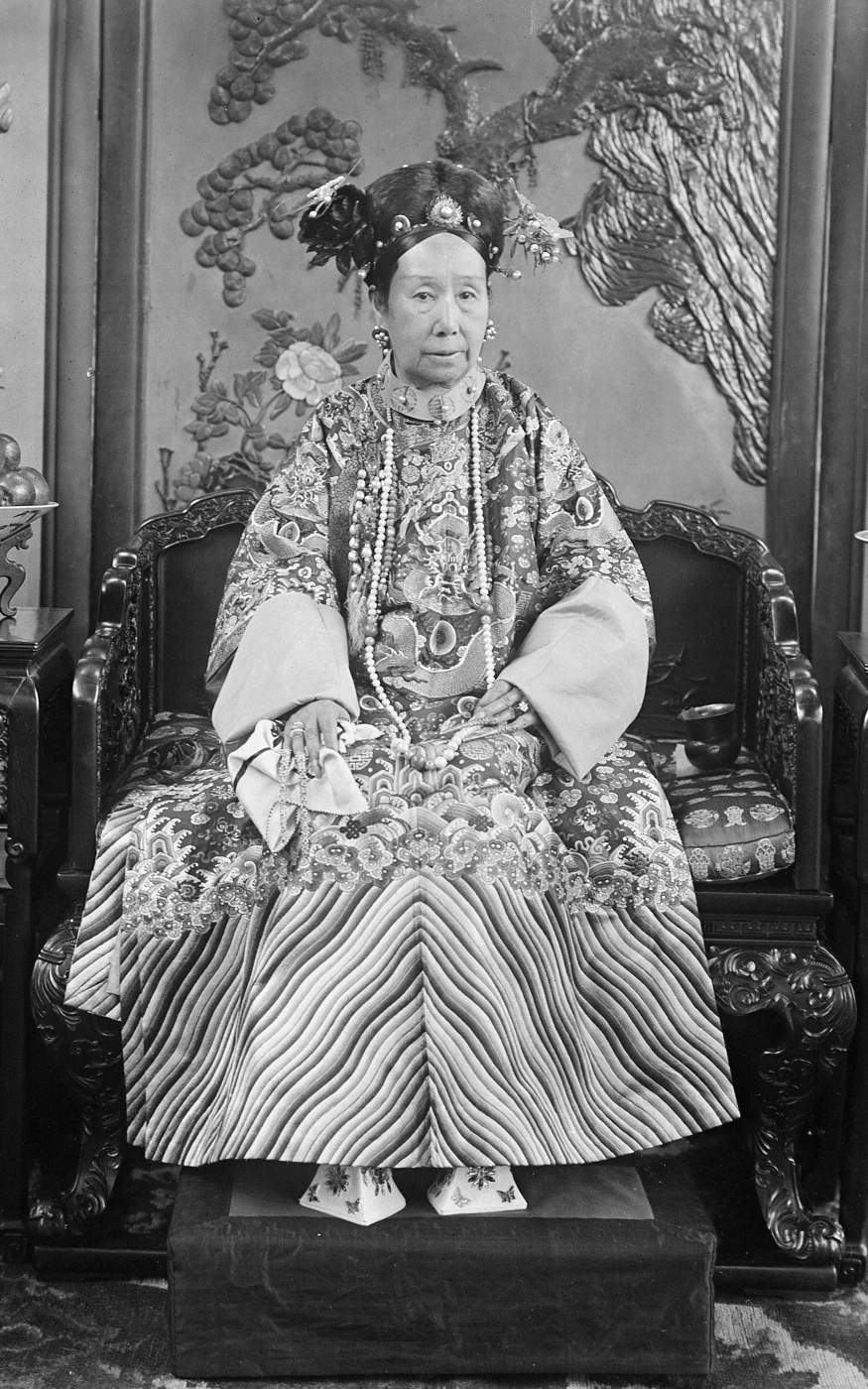
Western accounts of Ci Xi's appearance are many and may be noted. The wife of the American minister Conger wrote in her Letters from China that "the empress dowager's first reception of seven ladies of the diplomatic corps was brought about only by the efforts and urging of the foreign minister. After the troubles of 1900 were over and the court returned to Beijing, the empress dowager's attitude changed greatly: she herself initiated many invitations to meetings, and all naturally accepted and lunched with her. In private audience this great woman would show her wit and feminine charm, with the brilliance and attraction of a hostess. She would take the guest's hand and ask in the most concerned tone whether our journey to the palace had been tiring; she would complain of the cold in summer; if the food did not suit our taste she would be anxious; and she would tell us in the kindest words that it was her good fortune to see us. She could charm every guest, even those who had come with prejudice, and she could attend to each one, which showed her practised skill as a hostess." The American writer Eliza Ruhamah Scidmore, in China, the Long-Lived Empire, says that "the few who have seen this Ci Xi describe her as a tall and striking woman; her eyes seem to transmit a spirit and she has marked Tatar features. In all her movements there is an inward nobility and pride, and in her talk there is an immovable authority and absolute majesty". Another, describing her dress, says that "Ci Xi was of middling height, a little short, but her shoes had a square heel six inches high in the middle of the sole... she wore a splendid Manchu robe, not only beautiful but making her seem unusually tall and solemn, as if a born empress dowager; her figure was well proportioned and beyond reproach, and her every movement showed the bearing of an outstanding woman and ruler. Her face was less beautiful than lively and moving; her complexion was somewhat olive, and thick lashes set off the more her jet-black eyes." The portrait painter Katharine Carl, painting her in the palace, recorded that "the empress dowager's figure is well proportioned, her hands slender and beautiful and very well cared for; her features are regular and the outline of her ear excellent. Her black hair, like lacquer, is combed smooth into a most ingenious style; her forehead is broad and her eyebrows curved; her eyes are bright and spirited with a most penetrating look; her nose is high and straight, the 'noble' nose of the Chinese; the line of her upper lip is firm and decided, her mouth large and beautiful and full of movement, showing white teeth when she smiles, and her jaw rather broad without exaggeration. All this makes her most attractive. Had I not known beforehand that she was nearly sixty-nine, I should have taken her for a woman of forty who keeps herself well... And the empress dowager is a person of keen observation and insight, and so of uncommon presence and strong personal charm." Arthur H. Smith in China in Convulsion says that "for a Manchu woman to master the knowledge of military and state affairs would in itself be a rare chance, yet she, wholly unlike the eastern empress dowager who knew only needlework, is always calm in handling great matters, and the gates of China have never been opened to hostile powers, which in the history of Chinese semi-autocracy is all but unique; and the only reason I can find is that this ruler herself possessed a distinctive quality and ability". The Blackwood's Magazine remarked that "in the past thirty years the most interesting figure in China has been beyond doubt the lady we call the empress dowager. During her regency she stood at the head of every movement of a reforming character, and the nature of her rule can only be judged from the nature of the period." Lady Susan Townley, wife of the British minister Walter Townley, in My Chinese Notebook says that "who knows whether Ci Xi will sleep in the luxurious tomb she has taken such pains to build? And who knows whether some new dynasty will not plunder its treasures to adorn its own? Ci Xi grows old! By the unchanging law of nature her body will fail, her iron will grow brittle, her far-seeing gaze grow dim; and after her, who will be able to resist the tide of foreign invasion or calm the flood of internal disorder?"