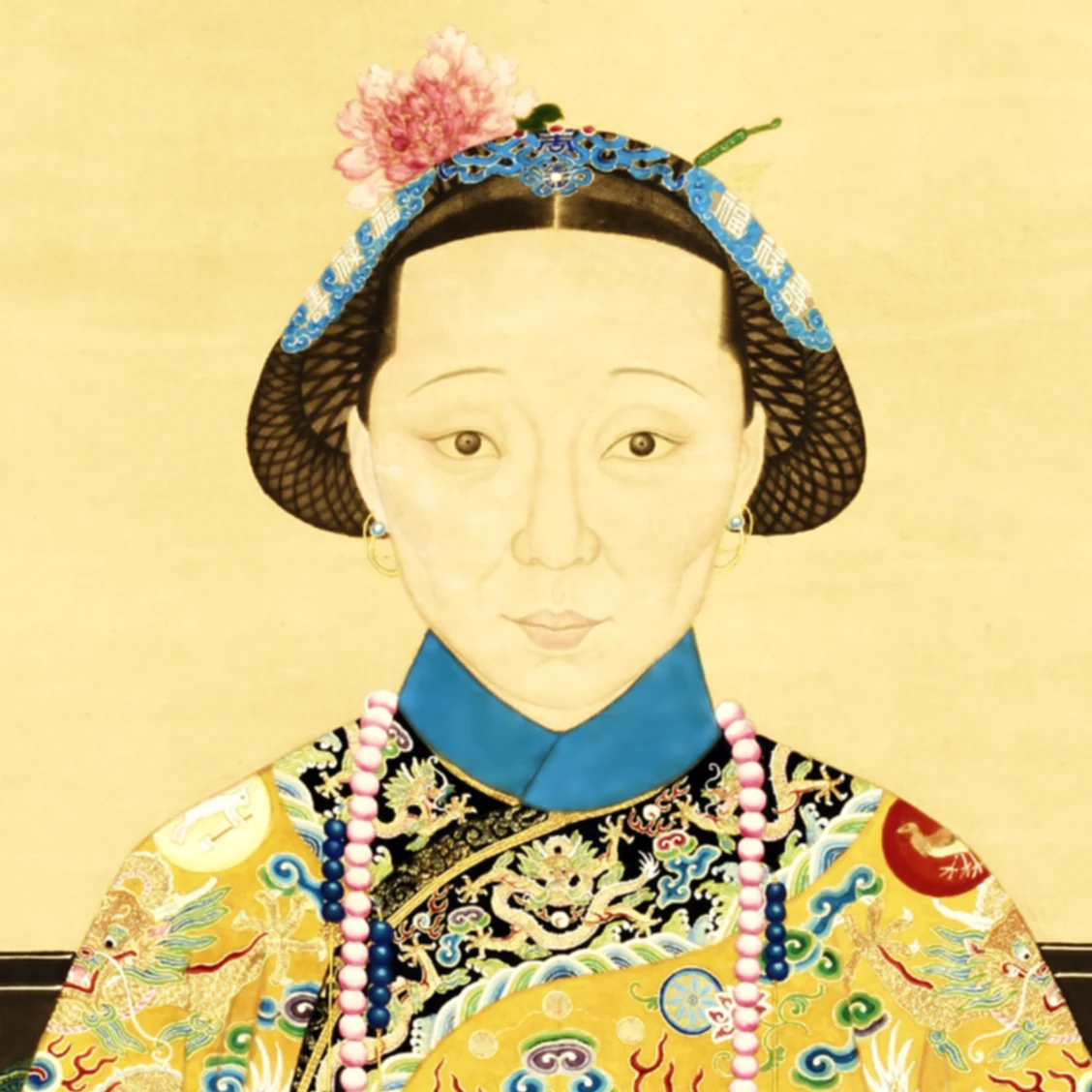
Biography
Family Background and Early Years
Empress Dowager Ci'an was born at the mao hour on the twelfth day of the seventh month of the seventeenth year of the Daoguang era (12 August 1837). She belonged to the Niohuru clan of the Manchu Bordered Yellow Banner and came from a distinguished Manchu military-aristocratic family. Her eighth-generation ancestor was Niohuru Eidu, a founding Qing meritorious official and first-rank duke. Her line belonged to the third branch of Duke Hongyi's family. Its founder was Eidu's third son Cerge, and Cerge's sixth son Baka became the ancestor of this branch. Her father, Niohuru Muyang'a, served as circuit intendant of Youjiang in Guangxi. Her birth mother was the concubine Lady Gingiya; her father's principal wife was an Aisin-Gioro woman, daughter of Gioro Hafeng'a; and her stepmother was a granddaughter of Qingheng, Prince Keqin of the Second Rank.
The Niohuru clan maintained close marriage ties with the Qing imperial house and prominent members of the imperial lineage. Empress Dowager Ci'an belonged to the same broad Duke Hongyi lineage as the primary consort of the Qing Taizong Emperor, Empress Xiaozhaoren of the Kangxi Emperor, Empress Xiaohherui of the Jiaqing Emperor, and Empress Xiaomucheng of the Daoguang Emperor. Among the family's marriage connections, one of the most important was with Duanhua, Prince Zheng of the First Rank: Duanhua's principal consort was Ci'an's paternal aunt, making Duanhua her uncle by marriage. Her descent from a distinguished family and these kinship ties with imperial princes and nobles were important reasons she was considered a suitable candidate for empress.
Entry into the Palace and Installation as Empress
In the second month of 1852, the second year of the Xianfeng era, the Niohuru woman was selected as an imperial consort candidate. She entered the palace on the twenty-seventh day of the fourth month (14 June), when the Xianfeng Emperor proclaimed her Consort Zhen. On the twenty-fifth day of the fifth month (12 July), she was promoted to Noble Consort Zhen. On the eighth day of the sixth month (24 July), she was designated empress, and on the seventeenth day of the tenth month (28 November) the formal installation ceremony was held. Because the promotions came in such rapid succession, the ceremonies for her appointment as consort and then noble consort were not held; she proceeded directly to the empress's installation ceremony. She was the fastest-promoted second empress in Qing history, rising from consort to empress in only forty days, or six months if calculated to the formal installation.
After entering the palace, she lived in Zhongcui Palace. When appointing her empress, the Xianfeng Emperor described her as possessing “a gentle and fine disposition, with conduct in accord with rules and standards.” Qing palace eunuchs later recalled that she was “mild in temperament, yielding, and disinclined to compete.” She was gentle and kind but consistently frail in health. Soon after entering the palace she suffered from a condition described as heat in the liver and stomach caused by retained fluids, as well as amenorrhea. Although she was respected by the Xianfeng Emperor, she never bore children.
Support to the Xianfeng Emperor
In the eighth month of 1860, the tenth year of the Xianfeng era, Anglo-French forces approached the capital and the Niohuru empress fled with the Xianfeng Emperor to Rehe. At the time, the Taiping Rebellion, the Nian Army, and other uprisings were spreading across China, while Anglo-French forces occupied the capital, leaving Qing rule in a precarious condition. Exhausted, the Xianfeng Emperor sought distraction in pleasure and wrote the four characters “Qiele Daoren” on a placard that he hung in the temporary palace. When the empress saw it, she immediately remonstrated: “The Son of Heaven has myriad affairs each day; how can he seek ease for himself? Even though we are now in exile, this is all the more inappropriate.” She personally ordered attendants to remove the placard. Whenever the Xianfeng Emperor neglected state business or failed to review military affairs, she reminded him and caused him to “examine them at once.” She also mediated when palace consorts were reprimanded. For these reasons, she was already praised during the Xianfeng reign for wisdom and virtue.
The Xinyou Coup and Rule from Behind the Curtain
On the sixteenth day of the seventh month of 1861, the eleventh year of the Xianfeng era, the Xianfeng Emperor at the Rehe palace proclaimed his eldest son Zaichun crown prince and ordered Zaiyuan and the other “Eight Regents” to assist in all affairs of government. He also gave the Niohuru empress the “Yushang” seal and Zaichun the “Tongdaotang” seal, directing that they be used in place of the vermilion brush where required, thereby creating mutual restraint between palace and court. On the seventeenth day (22 August), the Xianfeng Emperor died and Zaichun succeeded to the throne. That day the Niohuru empress led Noble Dowager Consort Lin and others in making offerings before the late emperor's spirit. The next day, the Yehe Nara consort was honored as empress dowager. The Niohuru empress became “Empress Dowager Mother,” while the Yehe Nara consort became “Empress Dowager Holy Mother.” On the first day of the ninth month, the honorific “Ci'an” was bestowed on her.
The authoritarian conduct of the Eight Regents angered Ci'an, while common interests drew her closer to Empress Dowager Cixi. The two were said to have “bent over a large vat to speak, making their plans in great secrecy,” and sent confidants to urgently summon Prince Gong Yixin to Rehe to plot the seizure of power from the regents. On the eighteenth day of the ninth month, Ci'an and Cixi ordered Prince Chun Yixuan to draft an edict. Ci'an concealed the prepared edict inside her clothing in readiness for publication after their return to Beijing. On the twenty-ninth day of the ninth month, Ci'an entered the Desheng Gate in the same carriage as the Tongzhi Emperor and returned to the palace. On the thirtieth day, the two empress dowagers issued an edict in the Tongzhi Emperor's name stripping Zaiyuan, Duanhua, and Sushun of their ranks and offices and ordering their arrest. Soon afterward Sushun was executed, Zaiyuan and Duanhua were ordered to commit suicide, and the remaining five were removed from office. The Xinyou Coup had succeeded.
On the first day of the eleventh month of the eleventh year of Xianfeng (2 December 1861), Zaichun formally requested the two empress dowagers to rule from behind the curtain at the Hall of Mental Cultivation, while Yixin became Prince Deliberating on Government and a Grand Councilor. The arrangement later summarized as “the two empress dowagers ruling from behind the curtain, with a prince deliberating on government” was thereby established and continued for roughly twenty years.
Joint Regency of the Two Empress Dowagers
During the joint regency, Ci'an was described as “honest and substantial” and, when meeting officials, as “hesitant, as though she had nothing to say.” When memorials were presented, Cixi often read and explained them beside her, so Ci'an frequently yielded practical authority to Cixi, who was “quick-witted and keen to manage affairs.” Cixi, mindful of Ci'an's trust and of the distinction between principal and secondary consort, continued to consult Ci'an on important state measures even when she knew Ci'an had no objection; it was said that “Cixi was restrained by the distinction between principal and secondary rank and respectfully did not dare neglect propriety.”
On several major decisions, however, Ci'an played the decisive role. These included the execution of He Guiqing, governor-general of Liangjiang, for losing territory; the imprisonment and ordered suicide of the arrogant and corrupt Shengbao; the granting of noble ranks to Zeng Guofan, Zuo Zongtang, and Li Hongzhang; and, in 1869, the eighth year of Tongzhi, authorization for Shandong Governor Ding Baozhen to execute eunuch An Dehai for leaving the capital in violation of regulations. A contemporary saying held that “the Eastern Palace excelled in virtue and actually decided the great punishments, rewards, and major measures; the Western Palace excelled in talent and reviewed memorials, decided routine affairs, and questioned officials on advantages and disadvantages.”
Later Years and Death
In 1873, the twelfth year of the Tongzhi era, the two empress dowagers withdrew the curtain and returned government to the Tongzhi Emperor. The following year the Tongzhi Emperor died. Ci'an and Cixi supported the accession of the Guangxu Emperor and resumed rule from behind the curtain. In 1876, the first year of Guangxu, the two empress dowagers supported Zuo Zongtang's reconquest of Xinjiang. On the tenth day of the third month of the seventh year of Guangxu (8 April 1881), Ci'an died at Zhongcui Palace, aged forty-five. She was buried in the Ding Mausoleum at Puxiangyu and ultimately received the full posthumous title Empress Xiaozhen Ci'an Yuqing Hejing Chengjing Yitian Zuosheng Xian.
Her Family and Her Entry into the Palace
The empress dowager Ci'an, the filial and chaste empress Xian, was of the Niohuru clan and a Manchu of the Bordered Yellow Banner, daughter of Niohuru Muyang'a, circuit intendant of the right river in Guangxi: by the biographies of empresses in the Draft History of the Qing, "the filial and chaste empress Xian was of the Niohuru clan, daughter of Muyang'a, intendant of the right river of Guangxi." She came of a great Manchu house and of a family allied to the imperial clan, her eighth-generation ancestor being Eidu, a meritorious minister of the early Qing and duke of the first rank; the Hongyi duke's house was divided into sixteen branches, the Niohuru belonging to the third, whose founder was Eidu's third son Che'er'ge, and Che'er'ge's sixth son Baka was the ancestor of her own line. Her branch stood as a collateral of the Hongyi duke's house, tending to decline under Kangxi and Yongzheng but returning to the ranks of high officials under Qianlong and Jiaqing, and continuing to marry into the great houses. The most important of its marriage connexions was with the prince Zheng of the first rank: the prince Zheng's household was much in the ascendant under Daoguang and Xianfeng, the mother of the filial and virtuous empress Xian being the sister of the prince Zheng Shen of the first rank, and the principal consort of Duanhua, prince Zheng, being Ci'an's own paternal aunt. Such descent from a great house and such kinship with the imperial clan were probably among the chief reasons for her selection as a candidate for empress. By the Draft History she "served Emperor Wenzong in his princely residence," and in the second year of Xianfeng, 1852, was made consort Zhen, raised to consort of the noble rank Zhen, and then made empress; but because the promotions came so close together, neither the ceremony of her elevation as consort nor that as noble consort was held, and on the seventeenth day of the tenth month, 28 November 1852, the rites of investiture as empress were performed directly, so that from consort to empress took only forty days, the fastest rise of any empress by succession in the Qing. The character zhen as a title and as a posthumous name, though the same, was not the same in meaning: as a title its Manchu form was gingguji, meaning reverent, showing how Emperor Xianfeng regarded her, whereas as a posthumous name its Manchu form was jekdun, a word used specifically of chastity, while the Chinese zhen extended to mean upright, which was how the ministers judged her. The patent of investiture said that the noble consort Niohuru, taught in a famous house and blessed with the merit of a noble one, was to be set in the place of the empress with the golden tablet and seal. The palace eunuchs remembered her as gentle in temper and given to yielding rather than contending, so that she seems to have been a mild and kindly woman; but her health was always weak, poor even when she first entered the palace, suffering from heat in the liver and stomach and from amenorrhoea, and the common talk of the time had it that the lame phoenix sat in the hall of state, mocking the lameness of Emperor Wenzong and the sickliness of the empress. Though respected by Emperor Xianfeng, she bore no children.
Her Remonstrances under Xianfeng and Her Reputation for Wisdom
In the tenth year of Xianfeng, 1860, the English and French occupying the capital and the peasant risings sweeping the land, the Qing stood tottering; and Emperor Xianfeng, worn out in mind and body, gave himself up to music and women and wrote with his own hand the four characters "the Taoist who takes his pleasure" and hung them in the audience hall of his travelling palace. Ci'an, finding them, at once remonstrated, saying that with the sovereign's daily multitude of affairs such a thing was especially unfitting, and with her own hands urged the attendants to take the scroll down. Whenever Emperor Xianfeng grew slack in government and neglected military business she would remind him, so that he "at once reviewed it," and when other consorts and concubines were reproved she mediated for them so that they regained his favour. Thus in Xianfeng's reign she already had a reputation for sagacity. By the second volume of the Yong'an Notes, on the holy virtue of the empress dowager Ci'an: "in the leisure of his myriad affairs the late emperor would sometimes take his pleasure in excursions and feasts, but hearing the gentle remonstrance of the empress he never failed to follow it; memorials of the provinces and of the ministers lying unopened, at a word from the empress he never failed to review them at once; and consorts and concubines reproved were mediated for by the empress and presently regained favour."
The Coup of Xinyou
On the sixteenth day of the seventh month of the eleventh year of Xianfeng, 1861, Emperor Xianfeng at the Rehe travelling palace decreed the setting up of his eldest son Zaichun to "assist in all the affairs of government," and gave to Niohuru and to Zaichun each a seal, hers named the Imperial Appreciation and his named the Hall of the Same Way, ordaining that whatever required the seals should have both, so that the inner palace and the outer court should check one another. On the seventeenth the emperor died and Zaichun took the throne as Emperor Tongzhi. That day Niohuru led the noble lady Lin and others in the rites, but the Yehe Nara lady being unwilling to attend in the capacity of noble consort dowager, on the following day she too was honoured as empress dowager: Niohuru as the empress dowager mother, the Yehe Nara as the empress dowager mother of the emperor, distinguished as such in the decrees. On the first day of the ninth month Emperor Tongzhi conferred on his principal mother Niohuru the honorific Ci'an and on the other the honorific Cixi. At that time the eight ministers assisted in the government, and Ci'an and Cixi, as the emperor's principal and natural mothers, in fact exercised his authority. When Xianfeng had just died the two empresses dowager were "not well pleased" with one another over a question of ceremony, and Sushun, to widen the breach between them, "begged leave to see each empress dowager separately," with differing words to each. Yet the arrogance of Sushun and the rest roused Ci'an's displeasure, and a common interest improved her relations with Cixi; and it was said that the two, to prevent their plans being overheard, "spoke leaning over a great jar, in closest counsel," sending trusted men to summon Prince Gong, Yixin, to Rehe to plot the seizure of power from the eight ministers. On the tenth day of the eighth month Dong Yuanshun memorialised asking that the empresses dowager take charge of government for a time and that one or two princes be appointed to assist in all business together, which Cixi much approved; and on the eleventh Ci'an and Cixi summoned Zaiyuan and the rest, intending to issue the decree they had asked for, but Zaiyuan and the others, holding that "our dynasty has never had the rite of empresses dowager behind the curtain," insisted on an open edict and attacked Dong Yuanshun's memorial sharply. When the fair copy of the decree was handed in, Cixi withheld it and the original memorial as well, and at the next audience there was a violent quarrel with Zaiyuan and the others, who declared that if the words of others were trusted, they could not obey the order; and Cixi was in such a rage that her hands trembled, while Emperor Tongzhi wept in terror and wet her clothes. Then Ci'an mediated, saying that they would speak of it again tomorrow. On the twelfth the two empresses dowager did not summon Zaiyuan and the rest, and they, threatening to "halt the carriage," refused to open and look at the documents sent down; and Cixi would not give way, insisting on holding court, until Ci'an came forward and persuaded her to be accommodating for the present, and towards noon Cixi had Dong Yuanshun's memorial and the decree drafted by Zaiyuan and the rest sent down for copying; and they asked for the seals, which Cixi and Ci'an granted. This affair strengthened the two empresses dowager's resolve to destroy the eight ministers, while Zaiyuan and the rest, taking it that Ci'an and Cixi had yielded, the more despised them. On the eighteenth day of the ninth month Ci'an and Cixi at the Rehe travelling palace sent the prince of Chun, Yixuan, and others ahead, while Sushun went behind with the coffin, so that the three principals of the regency, Zaiyuan, Duanhua and Sushun, were cleverly separated. On the twenty-third Ci'an, Cixi and Emperor Tongzhi, having escorted the coffin beyond the Lizheng gate of the mountain resort, went ahead by a side road; on the twenty-eighth Cixi reached Shicao, and Shengbao, imperial commissioner for the military affairs of Zhili and Shandong and vice-minister of war, memorialised asking the empresses dowager to take charge of government personally and to appoint a prince of the near branch to assist; and on the twenty-ninth, at the hour of the sheep, Ci'an and Emperor Tongzhi entered the capital in one carriage with Cixi behind, and the hour of the coup had come. The same day the two empresses dowager in the emperor's name issued the edict drafted long before at Rehe, stripping Zaiyuan, Duanhua and Sushun of rank and office and arresting them; and presently Sushun was beheaded, Zaiyuan and Duanhua were ordered to take their own lives, and Jingshou, Muyin and others were punished in turn. On the first day of the eleventh month of the eleventh year of Xianfeng, 2 December 1861, Zaichun with the two empresses dowager held court behind the curtain in the Hall of Mental Cultivation, the reign name Qixiang was changed to Tongzhi, and the arrangement of two empresses behind the curtain and a prince discussing government, which was to last twenty years, was formally established. In the first month of the first year of Tongzhi the two empresses dowager received congratulations in the Palace of Compassion and Tranquillity, as they did every year thereafter; and on the twenty-fifth day of the fourth month Emperor Tongzhi presented the honorific tablets and formally styled her the empress dowager Ci'an.
The Two Empresses behind the Curtain and the Great Affairs of State
By the Yong'an Notes, the age said that the eastern palace, Ci'an, excelled in virtue and that the great rewards, punishments and measures were truly hers to decide, while the western palace, Cixi, excelled in ability and in reading the memorials, deciding ordinary business, and in audiences questioning the good and ill of things with an exact insight. Ci'an before ministers was "as one without words," and every memorial had to be read and expounded to her by Cixi, so that "a whole month might pass without a single matter decided"; yet where the great plans of the state and the weightiest appointments were concerned, "whenever the eastern palace did a thing the realm all clapped their hands and praised her." In the first years of Tongzhi, esteeming the worth of Zeng Guofan she promoted him from governor-general of the two Jiangs to associate grand secretary and issued the decree on the first day of the first month, so that all military plans and the administration of officials and the promotions and dismissals of governors-general and governors were consulted on and their words used, "and the work of restoration began from this." He Guiqing, having lost his province, was gravely guilty and the ministry of justice had sentenced him to death, when seventeen of his fellow provincials, fellow graduates and fellow officials at court memorialised to save him and the court was almost swayed; but the eastern empress dowager alone accepted the memorial of Li Tangjie, the chief minister of the court of imperial sacrifices, and ordered He Guiqing beheaded to warn those who fled from battle, at which the realm was awed. Presently, esteeming Li Tangjie as a scholar of great repute, she made him a grand councillor, and within a year he rose to be a minister, afterwards offering much good counsel; and Shengbao, for arrogance, greed and lewdness, was thrown into the prison of the ministry of justice and, again on Li Tangjie's word, ordered to die, which the realm thought fitting. When Nanjing and the provinces of Jiangsu and Zhejiang were recovered, the enfeoffment of Zeng Guofan, Li Hongzhang and Zuo Zongtang as marquises and earls came truly from the eastern palace's intention, and the western palace agreed to it. In the eighth year of Tongzhi, 1869, the eunuch An Dehai, being somewhat employed, slipped out of the capital and passed through Shandong, and the governor Ding Baozhen impeached him; and the eastern palace, asking the grand councillors what the ancestral rule was and being told that he should be beheaded, ordered him executed on the spot, so that the realm admired Ding's courage and praised the empress dowager's discernment. The western empress dowager being alert and keen in business, Ci'an "yielded all power to her, listless as one who had no part in it," and afterwards the western palace, moved by this, would consult her before acting even on matters she knew Ci'an would not oppose. Emperor Tongzhi served Ci'an with a filial piety that anticipated her wishes, and Ci'an cherished him with the utmost kindness, so that the emperor's devotion never flagged to the end, and though the western palace was his own mother she could not surpass it. In the eleventh year of Tongzhi, when the seventeen-year-old emperor was to marry, Ci'an favoured the daughter of Chongqi, gentle, quiet and complete in beauty and virtue, while Cixi favoured the daughter of Fengxiu, young, pretty and quick; and the choice being left to the emperor, he followed Ci'an and made the Aruite lady empress and the Fuca lady a consort, which showed Ci'an's standing in the palace and in the emperor's heart. In the tenth month of that year, on the emperor's marriage, two more characters were added to Ci'an's honorific, and two more in the second month of the following year. On the tenth day of the eleventh month of the thirteenth year of Tongzhi the emperor fell ill and the two empresses dowager again took charge; and on the fifth day of the twelfth month, the emperor dying, they summoned the princes and ministers in the western warm chamber of the Hall of Mental Cultivation and, on Cixi's proposal, set up Yixuan's son Zaitian as Emperor Guangxu, and the two empresses dowager once more held court behind the curtain. On the twelfth day of the seventh month of the second year of Guangxu, on Ci'an's fortieth birthday, four more characters were added to her honorific, so that it ran as the empress dowager Ci'an, Duan Yu Kang Qing Zhao He Zhuang Jing. Thereafter she "yielded ever more and had no leisure, and every matter great or small had to await the western palace's decision or was left to the grand council."
Her Death and the Dingdong Tomb
On the day renshen of the third month of the seventh year of Guangxu, 8 April 1881, Ci'an died at forty-five and was buried east of the Dingling at Puxiang valley, the tomb being called the Dingdongling; and in the fourth month of the first year of Xuantong, 1909, two more characters were added to her posthumous name, which in full was the filial, chaste, kind and tranquil empress Xian of abundant celebration and harmonious reverence, sincere and quiet, revering heaven and blessing the sage. Her sudden death gave rise to many tales, and the cause of it became one of the great mysteries of Qing palace history: the Veritable Records of Emperor Dezong say that on the ninth day she caught a slight chill and on the tenth her illness grew suddenly grave, but this record comes from her testamentary proclamation, which was made after her death at Cixi's direction, so that there is reason to doubt it. By Weng Tonghe's diary Ci'an fell ill on the tenth day of the third month of the seventh year of Guangxu, when "the eastern empress dowager, catching cold, had drunk and was slightly unwell," and Weng set down her pulses, prescriptions and the course of the illness: in the morning prescription with gastrodia, very grave; at noon a pulse but no medicine, with clouded consciousness and clenched teeth; in the afternoon two prescriptions that could still be poured in but were thought unsafe, with incontinence and the same phlegm blocking and breath shut; in the evening a prescription saying the six pulses were about to fail and medicine could not be given; and at the hour of the dog, about eight in the evening, she passed away. From these symptoms, classed in Chinese medicine as a severe epilepsy-like seizure, it may be judged that her illness was a stroke. Her cerebral disease was in fact chronic rather than sudden, and Weng's diary records two earlier attacks: one on the ninth day of the second month of the second year of Tongzhi, when she was twenty-six, her illness from the fifteenth of the first month being like a liver seizure with loss of speech, from which she recovered after twenty-four days; and another on the fourth day of the twelfth month of the eighth year of Tongzhi, when she was thirty-three, "the old illness returning yesterday, with a fainting fit for about half an hour, the physicians giving bitter orange and radish seed," both being further attacks of insufficient blood to the brain, which left no after-effects because they were treated in time. On the day before the fatal attack she was seen to have "both cheeks slightly red," and though she felt nothing much amiss the colour was ominous; and on this occasion, Cixi being ill and Ci'an governing alone, unskilled as she was in the conduct of great affairs, she bore a heavy strain and could not but be worn out. There were also popular tales that Emperor Xianfeng on his deathbed had secretly left Ci'an an edict to watch over Cixi, to be produced only if Cixi did not keep her place, and that the honest Ci'an told Cixi of it and burned it before her eyes, whereupon Cixi, feigning tears of gratitude, conceived the thought of killing her and used the offering of a Manchu cake to poison her. After her death Ci'an was buried in the ninth month of the seventh year of Guangxu at the Dingdongling at Puxiang valley, west of the southern slope of Changrui mountain; the tomb was later repaired and its underground palace restored and opened.