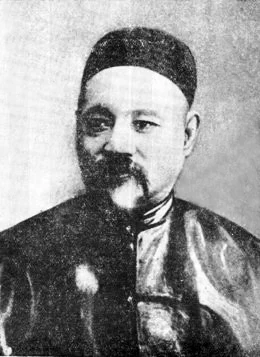
Biography
Family Background and Early Life
Xue Fucheng was born into a scholarly and official family in Binyanli, Wuxi. His father Xue Xiang served for twelve years as an instructor in government schools after obtaining the provincial degree and in 1847, the twenty-seventh year of Daoguang, earned the jinshi degree and became professor of the Zhenjiang prefectural school. Xue Xiang was skilled in eight-legged essays and had a distinctive prose style known contemporaneously as the “Xue manner,” highly regarded among examination candidates. Zeng Guofan and Li Hongzhang both said that Xue Xiang’s writings had helped them succeed in the examinations. Xue Fucheng’s mother, Lady Gu, came from a prominent Wuxi family, managed the household, and was known as a dutiful daughter-in-law and capable wife.
Xue Fucheng entered a private school at age six. His first teacher was Gu Hongsheng, already in his eighties. On returning home from class, his mother always supervised his studies; regardless of weather or season, he studied until midnight. In 1850, at age twelve, Xue moved with his family to Zhenjiang to join his father and studied eight-legged prose intensively in the prefectural-school compound. At this time he understood little of the changes China had undergone after the First Opium War. His ambitions remained to pass from shengyuan to juren to jinshi and ultimately enter the Hanlin Academy through the imperial examination system.
In 1853, the Taiping Heavenly Kingdom extended into the Yangtze region and occupied Nanjing. The event shocked the Qing court and also Xue, then immersed in examination prose. He realized that he had not been born into an age of peace and prosperity but into a period of great upheaval. In 1856 the Second Opium War began, with British and French forces attacking along the coast while Qing forces proved unable to respond effectively. The combination of internal disorder and external danger deeply disturbed Xue. He resolved not to concern himself solely with success or failure in the examinations but to devote himself to practical statecraft so that he might be useful should the state one day need men of ability. While still preparing for examinations, he studied the causes of two millennia of political rise and decline, military strategy and formations, astronomy and cosmology, and geographical conditions.
Experience amid Disorder
In the spring of 1858, Xue and his younger brother Xue Fubao both passed the shengyuan examination. Soon afterward their eldest brother Xue Fuchen, then serving as a secretary in the Ministry of Works in Beijing, returned to Wuxi. Xue Fucheng went with him to Hunan to visit their father, who died of illness not long after their arrival. Because the accounts handled during their father’s tenure as a county magistrate were unclear, the brothers spent a long period in Hunan settling public funds owed by their father.
In the spring of 1860, before the brothers had finished, they learned that the Jiangnan Camp had collapsed and the Taiping army was advancing directly into the Suzhou-Changzhou region. Fearing for their family in Wuxi, they hurried home through widespread fighting and danger. Wuxi had already been occupied by the Taiping army. Their mother had fled with the family, while an aunt’s household had been killed in the disorder. Their eldest brother Xue Fuchen was captured by Taiping troops and released only because his identity was not recognized. The brothers eventually crossed the Yangtze and found their dispersed family in the eastern countryside of Baoying in northern Jiangsu.
That same year British and French troops burned the Old Summer Palace and entered Beijing, and the Xianfeng Emperor fled to Rehe. These severe crises made Xue even more convinced that he had to study and discipline himself to acquire real ability capable of responding to the shocking changes of the age. He increasingly studied the causes of good and bad government in history and used journeys to Beijing for the examinations and travel to Kaifeng and elsewhere to observe popular suffering and social abuses. Because he devoted so much energy to practical statecraft, however, he repeatedly failed in the examinations.
Joining Zeng Guofan’s Staff
An opportunity arose in 1865. After repeated Qing failures against the Nian Army and the death in battle of Sengge Rinchen, who had led operations against the Nian, the court ordered Governor-General of Liangjiang Zeng Guofan to take the Hunan Army north. Zeng posted notices along the route recruiting talented men. Xue greatly admired him and regarded this as an ideal opportunity. He condensed years of thought about social problems into the more-than-ten-thousand-character “Letter to Marquis Zeng,” proposing eight measures: cultivate talent, expand reclamation, promote military farming, control the Nian rebels, purify administration, improve the people’s livelihood, plan coastal defense, and respond to changing times.
On June 28, as Zeng’s boat passed Baoying along the canal, Xue, accompanied by his eldest brother Xue Fuchen, went through wind and rain to seek an audience and presented the long letter. Zeng praised it highly, believing Xue’s writing especially strong in political argument and predicting that he might one day develop an independent body of ideas. He immediately recruited Xue to his staff. Xue then traveled widely with Zeng and conversed daily with a group of talented staff members. Zeng loved go and every morning invited Xue, who shared the interest, to play. Their games also became occasions to exchange ideas on “military affairs, finance, administration, literary affairs,” and other major matters of state.
Over seven years Xue was recommended by Zeng for “meritorious service” and “military merit” and became a fifth-rank expectant assistant prefect. On March 12, 1872, Zeng died in Nanjing. His staff dispersed, and because Xue’s formal seniority remained limited he did not receive a court appointment. After helping Zeng’s eldest son arrange the funeral, Xue hired two carriages, loaded them with his cherished books and manuscripts, and went directly to Suzhou. Passing Wuxi, he did not enter his home but continued to the Suzhou publishing bureau, where he began a period devoted to writing and editorial work.
Responding to the Imperial Call and Joining Li Hongzhang’s Staff
While in Suzhou, Xue continued to follow social conditions. He found that areas around Suzhou, once called an earthly paradise, had been devastated, with many households empty, prices high, and livelihoods difficult. Alarmed that powerful enemies were pressing China’s land and sea frontiers, he exclaimed: “Alas! If China does not seek self-strengthening, how can things end well?” He believed reform was essential, that Self-Strengthening enterprises should be developed, and that China should learn methods of strengthening from the West. Yet as a fifth-rank minor official without an active post, he had no right to submit memorials directly to the court.
At the end of 1874 the Tongzhi Emperor died and the four-year-old Guangxu Emperor, Zaitian, succeeded. The following spring Xue traveled from Suzhou to Beijing to pay court. Passing Jinan in Shandong, he visited his younger brother Xue Fubao, then serving on the staff of Shandong governor Ding Baozhen. From the court gazette he learned that the two empress dowagers had issued an edict opening channels for remonstrance and ordering officials inside and outside the capital to submit proposals.
Encouraged, Xue responded immediately. He summarized his proposals for correcting abuses and changing old methods in the “Six Policies for Order and Peace” and “Ten Confidential Proposals on Coastal Defense,” asking Ding Baozhen to forward them. The Six Policies dealt with cultivating talent, purifying administration, relieving popular hardship, planning maritime transport, strengthening military preparedness, and increasing fiscal resources. The Ten Confidential Proposals advocated careful choice of diplomatic partners, advance cultivation of talent, precision in weapons manufacture, development of shipbuilding, attention to commercial conditions, reform of tea administration, planning for mining, naval training, purchase of armored ships, and distribution of treaty texts to prefectures and counties. They set out a Western-inspired “way of self-strengthening.”
The memorials created a major response at court. The two empress dowagers personally instructed the grand councillors to circulate them among the government offices for discussion. Reform-minded people throughout the country copied and discussed the texts, and Xue became famous almost overnight. Li Hongzhang, governor-general of Zhili, immediately invited him to join his staff. Xue then served as one of Li’s important advisers for ten years.
Circuit Intendant of Ningbo, Shaoxing, and Taizhou and the Defense of Zhenhai
In 1879 the British official Robert Hart repeatedly submitted proposals for organizing a Chinese navy, presenting himself as eager to help while, according to the source, seeking to control the navy. The Qing government decided to let Hart concurrently serve as Director-General of Coastal Defense. Xue believed Hart to be calculating and domineering and warned that if military and financial power were concentrated in his hands the consequences would be severe. He proposed to Li Hongzhang that the Zongli Yamen formally notify Hart that the Director-General of Coastal Defense would have to reside personally on the coast and devote himself to military training. Hart would then have to surrender the lucrative post of Inspector-General of the Imperial Maritime Customs. Xue predicted that Hart would refuse to give up the latter office for the more difficult coastal post. The court adopted the plan, and Hart indeed abandoned the coastal-defense appointment. Chinese naval authority therefore did not pass into foreign hands.
In early summer 1884 Xue received a substantive fourth-rank appointment as circuit intendant of Ningbo, Shaoxing, and Taizhou, ending nearly twenty years of staff service. The circuit supervised officials in the three prefectures, was responsible for coastal military preparedness, and oversaw the lucrative Zhejiang maritime and Ningbo customs houses.
As Xue took office, Chinese and French troops clashed at Lang Son in Vietnam. The French government used the incident to exert pressure and sent Vice Admiral Amédée Courbet’s Far East fleet to the Chinese coast. The entrance to Zhenhai, about fifty li east of Ningbo, guarded Zhejiang. Governor of Zhejiang Liu Bingzhang established a coastal-defense headquarters at Ningbo under Xue’s direction. Orders, strategy, and operational matters at the front were transmitted or handled through this office. Xue immediately traveled to Zhenhai, inspected defenses, and discussed defensive plans. During the Battle of Zhenhai he helped coordinate the defense, and the French were unable to force their way into the harbor.
Mission to Four Countries and Yunnan-Burma Boundary Negotiations
In May 1889 the Qing court granted Xue the insignia of second rank and appointed him, as an expectant metropolitan official of the third rank, minister to Britain, France, Italy, and Belgium. On January 31, 1890, the steamship *Irrawaddy* departed with the mission headed by Xue. After more than a month at sea, it reached Marseille on March 6. Xue disembarked and set foot on the European continent for the first time, fulfilling his long-held desire to see the wider world directly.
Xue traveled among France, Britain, Belgium, and Italy, presented credentials, and visited foreign ministries. He also visited Germany, Switzerland, and other countries, attended banquets, teas, musical and dance performances, toured institutions, and interacted closely with prominent Western figures. He concentrated on examining the strengths and weaknesses of European society. From visits to parliaments and factories, he concluded that a fundamental reason European and American states were advanced while China lagged behind was the difference in institutions. This represented a significant development beyond the views he had expressed in *Proposals for Managing Foreign Affairs*.
During his mission Xue paid close attention to protecting overseas Chinese and sought consulates in regions with large Chinese communities. He drafted a note to the British Foreign Office citing international law and international practice and declaring China’s right to station consuls in British territories. Britain ultimately agreed in principle. Xue then submitted the “Memorial on a General Plan to Establish Consulates on the Islands of the Southern Seas to Protect Overseas Chinese.” In the autumn of 1891 Huang Zunxian became Qing consul-general in Singapore, and the Qing government issued several regulations protecting returning overseas Chinese. Xue later obtained the right to establish a vice-consulate at Penang and a consulate at Rangoon in Burma.
Another major matter was negotiation of the Yunnan-Burma boundary and commercial relations. After Britain occupied all of Burma in 1885, it had reportedly given minister Zeng Jize three assurances: it would not occupy Burmese territories close to the Chinese border, the Irrawaddy would be a river of common use for both countries, and China could establish a treaty port and customs station near Bhamo west of the river. The 1886 Sino-British Burma convention did not include these three points. Xue concluded that Britain intended to deny the earlier understandings and thereby penetrate farther into Chinese territory. He sent a diplomatic note to the British Foreign Office restating the three points and asking Britain to fulfill provisions regarding tribute.
In February 1892 Britain delivered a boundary memorandum to the Chinese legation that completely rejected the three understandings. In negotiations Xue invoked international law and argued that the Wild Man Mountains extending for thousands of li on both banks of the Irrawaddy formed an intermediate zone that was “neither Burmese nor Chinese” and should be divided equally between the two states. After two years of repeated negotiations, on March 1, 1894, Xue signed the *Additional Articles on the Yunnan-Burma Boundary and Commerce* with Britain on China’s behalf. The source notes that for half a century Sino-British negotiations had usually ended in unequal treaties, whereas in this case Xue relied on international law and combined persistence with flexibility, compelling the strongest Western power to recognize legitimate Chinese claims. The Guangxu Emperor praised him: “Xue has handled affairs very well.”
Death
Not long after the boundary and commercial articles were signed, Xue completed his term. On the night of May 25, 1894, he left Paris for Marseille and boarded the ship home. He arrived in Shanghai on the evening of July 1. Already suffering from chronic illness, he had endured intense heat in the Red Sea and a typhoon in the seas off Fujian and was exhausted by the time he reached Shanghai. He immediately took to bed. On July 20, according to the biographical narrative, he suddenly contracted an epidemic disease and died late that night, aged fifty-seven.
More than twenty days later, Shanghai residents held a large funeral procession for Xue. His family accompanied the coffin back to Wuxi, and in the eleventh lunar month of that year he was buried at the foot of Junzhang Mountain by Lake Tai.