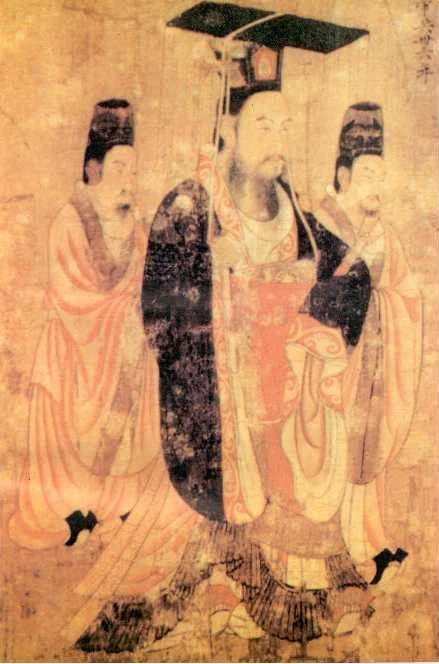
Biography
Family Background and Early Life
Yang Jian was born on July 21, 541, the thirteenth day of the sixth month in the seventh year of Western Wei’s Datong era, at Bore Nunnery in Fengyi. His father Yang Zhong was an important general under Western Wei and Northern Zhou who rose to Pillar of State and Duke of Sui and made major military contributions to the establishment of Northern Zhou. His mother, Lady Lü, came from a less prominent background, but Yang Zhong’s military achievements placed the family among the core of the Guanzhong aristocratic group. At Yang Jian’s birth, the nun Zhixian of the nunnery gave him the childhood name “Narayana,” a Sanskrit term glossed in the source as “indestructible like a vajra,” reflecting the family’s connections with Buddhism.
As a youth Yang studied at the Imperial Academy. He was not described as exceptionally brilliant but was deep, steady, serious, and reserved. In 560 he married Dugu Jialuo, daughter of Dugu Xin, one of the eight great Pillars of State of Northern Zhou. This marriage strengthened Yang’s position within the Guanzhong elite. Dugu Jialuo came from a military family and had a forceful, decisive temperament. She later played an important part in Yang’s political career. All five of Yang Jian’s sons were born to Empress Dugu and none to other consorts, which the source notes as unusual among imperial households.
In 568 Yang Zhong died and Yang Jian inherited the title Duke of Sui. He thereafter advanced gradually in Northern Zhou politics, serving in posts including General of Agile Cavalry and Duke of Daxing Commandery. In 576 he accompanied Emperor Wu of Northern Zhou, Yuwen Yong, on the eastern campaign that destroyed Northern Qi and helped unify northern China. After the conquest Yang was appointed inspector of Suizhou, gaining further administrative experience.
Seizure of Power
In 578 Emperor Wu of Northern Zhou died and Emperor Xuan, Yuwen Yun, succeeded him. Yuwen Yun was described as violent and extravagant, killing senior ministers and favoring former East Palace associates such as Zheng Yi, while government became disorderly. In 579 he abdicated in favor of his seven-year-old son Yuwen Chan, Emperor Jing, and styled himself Tianyuan Emperor while retaining actual authority.
In the fifth month of 580 Emperor Xuan died suddenly. Close attendants Liu Fang and Zheng Yi had earlier ties with Yang Jian and regarded him as the most prominent available figure. They forged an edict summoning him into the palace to serve as regent. Historical accounts say Yang initially “firmly declined and dared not accept,” until Liu Fang warned, “If you do not do it, I will.” Yang then accepted. Zheng Yi and others concealed the emperor’s death temporarily and, in the name of the Tianyuan Emperor, appointed Yang to overall command of internal and external military affairs, concentrating civil and military authority in his hands.
After taking power Yang first summoned princes of the Northern Zhou imperial family—including Yuwen Zhao, Prince of Zhao; Yuwen Chun, Prince of Chen; Yuwen Sheng, Prince of Yue; Yuwen Da, Prince of Dai; and Yuwen You, Prince of Teng—to the capital under the pretext of escorting Princess Qianjin for marriage to the Turks, thereby removing their regional military authority. He also executed Yuwen Xian, Prince of Bi and governor of Yongzhou, together with his three sons, on charges of treason. In the seventh month Yuwen Zhao arranged what the source calls a “Hongmen banquet” in an attempt to assassinate Yang, but Yang’s close retainer Tuoba Zhou protected him and the attempt failed. In the twelfth month Yang executed Yuwen Zhao and Yuwen Sheng and their sons on treason charges and subsequently killed Yuwen Da and Yuwen You, largely eliminating the adult princes of Northern Zhou.
In the sixth month of 580 Yuchi Jiong, commander of Xiangzhou, rose against Yang and many eastern prefectures joined him; Wang Qian, commander of Yizhou, also rebelled. Yang sent generals Wei Xiaokuan, Wang Yi, and others, who quickly suppressed the revolts. Yuchi Jiong killed himself after defeat, while Wang Qian was captured and executed. Yang’s position was thereafter unchallengeable.
On March 4, 581, the fourteenth day of the second month in the first year of Dading, Emperor Jing issued an abdication edict. Yang took the throne in the name of accepting abdication, changed the state name to Sui, inaugurated the Kaihuang era, and made Daxing City, present-day Xi'an, the capital. From regency to imperial accession took only about ten months, prompting the later remark that “none obtained a state more easily than Yang Jian.” Soon after becoming emperor, Yang secretly had the nine-year-old former Emperor Jing killed and killed thirteen sons of the Yuwen imperial house and their descendants according to the account in the source.
Reunification of the Realm
After the establishment of Sui, the southern regimes of Chen and Western Liang remained. Western Liang occupied only the Jiangling region, had long depended on northern dynasties, and was militarily weak. In 587 Yang deposed Xiao Cong, last ruler of Western Liang, ending the regime.
Chen still controlled Jiangnan but had only a relatively small military force, estimated by the source at about one hundred thousand. After becoming emperor, Yang stationed Heruo Bi at Guangling, present-day Yangzhou, and Han Qinhu at Lujiang, present-day Hefei, while secretly planning the conquest. To weaken Chen, Sui troops repeatedly harassed its frontier during agricultural seasons and burned stored grain and supplies, exhausting Chen’s resources.
In 588 Yang launched a three-pronged invasion with 518,000 troops: Prince of Jin Yang Guang advanced from Liuhe, Prince of Qin Yang Jun from Xiangyang, and Xinzhou commander Yang Su led naval forces from Yong'an, present-day Fengjie in Chongqing. Yang Su’s navy moved down the Yangtze and defeated Chen defenses along the river. The source states that Chen officials Shi Wenqing and Shen Keqing withheld emergency reports, preventing the main Chen forces from leaving Jiankang in time.
On February 10, 589, the twentieth day of the first month of the ninth Kaihuang year, Chen general Ren Zhong surrendered and guided Han Qinhu into Jiankang, where the last Chen ruler Chen Shubao was captured. Chen collapsed. Remaining Chen armies either surrendered under Chen Shubao’s orders or were defeated by Sui. In 590 Lady Xian of Lingnan led her followers in welcoming the Sui envoy Wei Guang, and the Lingnan prefectures came under Sui control. The source therefore describes China as reunified after 273 years of division dating from the Disaster of Yongjia in Western Jin.
Kaihuang-era Rule
After reunification, Yang pursued a series of political, economic, and military reforms aimed at enriching and strengthening the state.
Politically, he ordered Su Wei and others to compile the Kaihuang Code, revising criminal law and abolishing some severe punishments of earlier dynasties. Capital punishment was reduced to strangulation and decapitation. He also sought to improve official administration. Liu Yu was sent with an imperial tally to inspect fifty-two prefectures in Hebei and reported more than two hundred corrupt or incompetent officials for dismissal. In local administration, in 583 Yang abolished commanderies and adopted a two-tier prefecture-county system, simplifying bureaucracy. The source cites Qian Mu’s calculation that central government expenditure fell by two-thirds and local administrative expenditure by three-quarters, making total administrative costs roughly one-third those of the Northern and Southern Dynasties period.
Economically, Yang accepted Su Wei’s proposal to abolish state monopolies on salt and alcohol and market-entry taxes and repeatedly reduced taxes. The equal-field system of land distribution and taxation was implemented across the empire, allocating land to peasant households and stabilizing agricultural production. In 585 the Shujidingyang system was introduced to reorganize household registration and increase reliable tax assessment. As registers and revenue collection became more regular, the Sui treasury became increasingly full.
Militarily, Yang changed the early Fubing system, under which soldiers and agriculture had been separated, into a system in which militia households farmed in peacetime and assembled under commanders appointed by the court for wartime expeditions. This reduced the fiscal burden of maintaining standing soldiers while preserving manpower for campaigns.
In foreign relations Yang defended the north against the Turks and successfully resisted their incursions. In 603 the Sui defeated Tardu Qaghan, who dominated the northern steppe. The following year Qimin Qaghan referred to the Sui emperor as “Sage Qaghan.” Turkic groups that moved south became subordinate to the Sui. Yang built the cities of Jinhe and Dingxiang in the Ordos region for the Turks led by Qimin Qaghan, helping stabilize the northern frontier.
Yang Jian, a native of Huayin in Hongnong commandery and a fourteenth-generation descendant of the Han grand commandant Yang Zhen, was given the childhood name Naluoyan, Sanskrit for the indestructible diamond, and the surname Puliuru, which he restored to Yang when he came to power. His mother, Lady Lü, bore him at the Bore monastery in Fengyi on the night of the guichou day of the sixth month of 541, when purple vapour filled the courtyard. A nun from Hedong told her that the child was of no common origin and could not be raised among the vulgar, and took him to a separate house to bring up herself; he grew up in the monastery, eating vegetarian food and chanting with the nun Zhixian for thirteen years, a time that shaped his sober and steady character and his habit of thinking for himself. The Sui history records that he had a dragon's jaw, five ridges rising to the crown of his head, eyes that shot light, and a mark like the character for king on his hand; tall above and short below, grave and severe, so that even his closest intimates at the academy dared not trifle with him. At fourteen he was called by the governor of the capital region as an officer; at fifteen he was made cavalier attendant, general of chariots and cavalry and equal of the three ministers, enfeoffed Duke of Chengji; at sixteen he was general of the swift cavalry and permitted to open a office. The Zhou TaiZu marvelled at his bearing, and Emperor Ming made him a palace officer and Duke of Daxing. Under Emperor Wu he became prefect of Suizhou and a great general; recalled to the capital, he nursed his mother for three years through her illness without leaving her side, and was praised as truly filial. Yuwen Hu, in power, feared him and often sought to harm him, and only the protection of the generals Hou Fu and Hou Shou saved him. When his father died, Yuwen Hu wished to take him as a confidant, and Yang Jian asked his father's advice; his father said that between two mothers-in-law a wife fares ill, and that he should not go, and Yang Jian declined. He inherited the dukedom of Sui. When Emperor Wu took his daughter as wife of the heir apparent he was treated with greater honour, but Yuwen Xian told the emperor that Puliuru Jian's countenance was extraordinary and that he feared he would not stay below other men and should be removed early; the emperor answered that he was fit only to be a general. The secretary Wang Gui said again that the heir apparent was no master of the altars of state and that Puliuru Jian had the look of a rebel, at which the emperor was displeased and said that if Heaven had a decree, what could be done. Yang Jian, greatly afraid, hid himself the more. In the Jiande years he broke the Qi fleet at the He bridge with thirty thousand sailors, followed the emperor in the conquest of Qi, was made a pillar of state, broke the Qi prince at Jizhou with Yuwen Xian and was made governor of Dingzhou, where the west gate, long shut since the Qi emperor had said that a sage would open it, opened at his coming to general astonishment. Under Emperor Xuan he was made a pillar of state and grand marshal as the father of the empress, and in the first year of Daxiang became grand rear assistant and then grand counsellor, being left in charge whenever the emperor travelled. The emperor's penal code was savage and Yang Jian remonstrated against it in vain. As his position rose the emperor grew suspicious: with four favourite concubines all made empresses, the families quarrelled and slandered one another, and the emperor in anger told the empress he would destroy her family, then summoned Yang Jian and told his guards to kill him if he changed colour; Yang Jian came with a serene face and was spared. He let it be known that he wished to be posted to the provinces, which suited the emperor, and was made commissioner of Bozhou. In the fifth month of 580 he was to be made commissioner of Yangzhou, but a sudden illness of the foot prevented him from setting out; the emperor died, and as the young Jing emperor could not govern, Zheng Yi and Liu Fang, holding that Yang Jian as the empress's father was the man in whom all rested their hopes, forged an edict bringing him into the government as commander of all military affairs. Liu Fang told him that if he would do it he must do it quickly, and that otherwise Liu Fang would do it himself; and Yang Jian consented. Zheng Yi, his old fellow student, had long thought his physiognomy extraordinary and attached himself to him; when a southern campaign was planned Zheng Yi asked for the command and proposed that the Duke of Sui march as commissioner of Shouyang, and the emperor agreed. When the emperor lay dying, others plotted to bring in Yuwen Zhong as regent, but Zheng Yi entered with Yang Hui, Liu Fang and others and Yang Jian had him seized; and the next day Yang Jian was chancellor. Fearing that the princes in the provinces would rise, he summoned the five princes of Zhao, Chen, Yue, Dai and Teng to the capital on the pretext of the marriage of one of their daughters to a Turkic khan; mourning was declared, and the emperor made him left grand chancellor with the yellow axe, all officials to take their orders from him and the Zhengyang palace to be his secretariat. Where the late emperor's government had been harsh and men's minds had broken, Yang Jian now promoted generous government, simple laws and frugality, and the realm was pleased. In the sixth month the five princes reached Changan. Yuchi Jiong, commissioner of Xiangzhou and an old general of weight, raised troops in the east, and the men of Zhao and Wei followed him like a stream until he had more than a hundred thousand within ten days, with Yuwen Zhou, Shi Xun and Xi Pi responding from three other prefectures and Yuchi Jiong sending his son as a hostage to Chen for aid; Yang Jian sent Wei Xiaokuan against him. The Prince of Bi and the five princes plotted, and Yang Jian had the prince executed while pardoning the five, granting them the privilege of entering court with swords and shoes and without hurrying, to reassure them. Sima Xiaonan rose in response and fled to Chen; the Man of Jing and Ying rebelled and were put down by He Ruoyi; and Wang Qian in Yi province raised the strength of Ba and Shu in the name of restoring the Zhou, advancing to Jiange and taking Shizhou, until Liang Rui was sent against him and sent his head to the capital, and the road through Jiange was destroyed and a warning inscription set up. The five princes plotted the more, and Yang Jian, going in person with wine to the Prince of Zhao's house to see what he would do, was ambushed and nearly killed, and only Yuan Zhou saved him; then he executed the princes of Zhao and Yue. The era was changed to Dading. In the second month Yang Jian received the titles of chancellor, chief of the hundred offices and the nine gifts, and his wife Dugu was made princess and his heir Yong the heir apparent. On the jiazi day of the second month of 581 he entered the palace in ordinary dress from his chancellery and took the throne in the Linguang hall, sacrificing to Heaven in the southern suburb; he made his wife empress, his heir apparent, and degraded the Zhou sovereign to Duke of Jie, having Yuwen Chan killed in the fifth month with the posthumous name Jing.