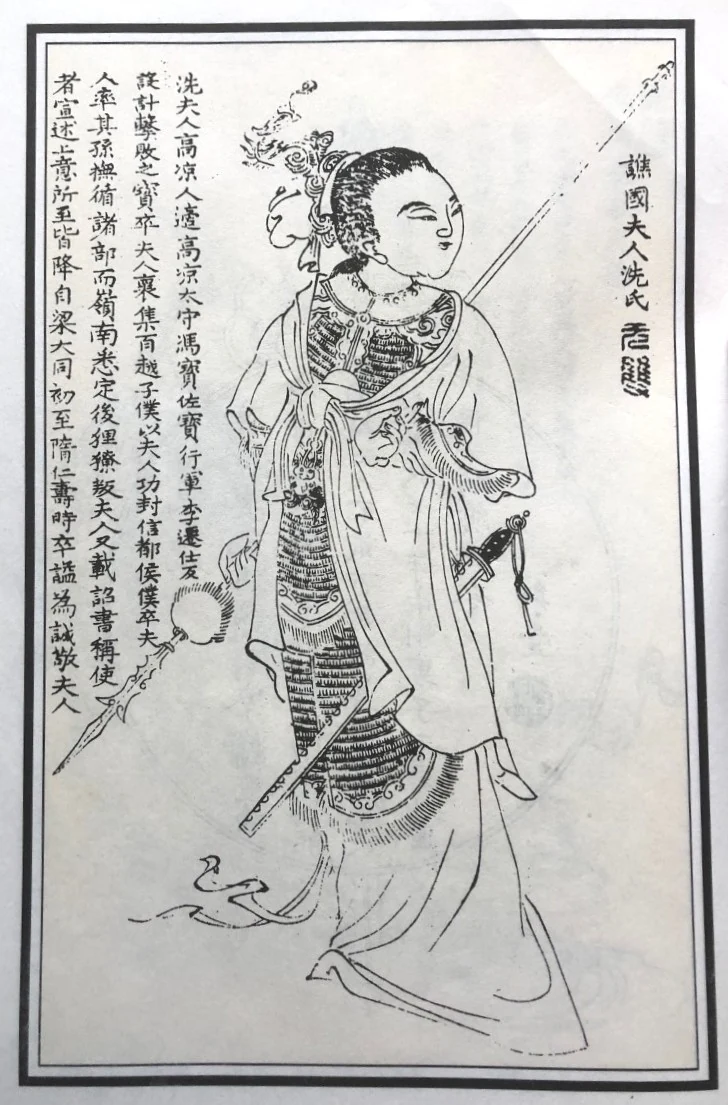
Biography
Family Background and Early Years
Lady Xian was born around 513, the twelfth year of the Tianjian era under Liang, though the source also records alternatives including 512 and 522. She was born at Shandouding Village in Gaoliang Commandery, in present-day Maoming. Her family had long served as leaders of Li communities and reportedly controlled mountain settlements totaling more than one hundred thousand households. From an early age she was regarded as intelligent, capable of planning, and able to command troops. While still young she succeeded as a senior leader within her community, in a family said to have permitted female succession to leadership.
Her elder brother Xian Ting served as Regional Inspector of Nanliangzhou and used his strength to attack and plunder neighboring prefectures. Lady Xian repeatedly remonstrated with him, reducing conflict with surrounding communities. Her growing prestige led more than a thousand communities along the southern coast and on Hainan to accept her leadership.
In 528, the second year of the Datong era, the Liang court created Gaozhou and Luozhou to strengthen administration in Lingnan. The source states that Lady Xian then memorialized the court asking that Yazhou be established on Hainan, a request that was approved. It credits this with restoring commandery-and-county government to Hainan after centuries of weak central administration and with encouraging education and production. This episode, however, is not recorded in the “Biography of the Lady of Qiao” in the *Book of Sui*. It appears in later local gazetteers and regional writings, and its exact date is disputed.
Marriage Alliance with Feng Bao
In 535, the first year of the Datong era, Feng Rong, Regional Inspector of Luozhou, learned of Lady Xian's reputation and arranged a marriage between her and his son Feng Bao, Administrator of Gaoliang. Feng Rong was descended from the former Northern Yan ruling house. When Feng Hong, the last ruler of Northern Yan, fled to Goguryeo, Feng Rong's grandfather Feng Ye was sent with three hundred followers by sea to Liu Song and thereafter remained in Xinhui. Three generations of the Feng family served as administrators of Gaoliang, but because they were outsiders their orders initially carried limited authority.
After the marriage, Lady Xian required her own kin to observe the legal and ritual practices of the Han-administered districts. When she and Feng Bao handled lawsuits, chiefs who broke the law received no special treatment even if they were her relatives. The source presents this marriage and joint administration as a major factor in improving relations between Li and Han communities and in increasing cultural exchange.
Choice during the Hou Jing Rebellion
In 548, the second year of the Taiqing era, the Hou Jing Rebellion broke out. Xiao Bo, Military Governor of Guangzhou, called up troops to aid the capital. Li Qianshi, Regional Inspector of Gaozhou, occupied Dagaokou and summoned Feng Bao. Feng Bao intended to go, but Lady Xian warned him that a regional inspector had no reason to summon a commandery administrator in this way and was probably trying to draw him into rebellion.
She reasoned that Li Qianshi had claimed illness when ordered to aid Taicheng, yet was forging weapons and gathering followers; if Feng Bao entered his camp, he would likely be held hostage to force his people to join the revolt. A few days later Li Qianshi openly rebelled and sent his commander Du Pinglu into Ganshi.
Lady Xian proposed a stratagem. Because Du Pinglu was away fighting the government forces, Li Qianshi's position in the prefectural seat was weak. Rather than send Feng Bao into a direct confrontation, she suggested sending a deferential message and gifts while claiming that Feng Bao was too afraid to appear personally and that she would come in his place. Believing her harmless, Li Qianshi relaxed his guard. Lady Xian then led more than a thousand people carrying assorted goods as if delivering gifts, approached the stockade amid loud conversation and laughter, and launched a surprise attack. Li Qianshi was defeated and fled to Ningdu.
Lady Xian then led troops to meet Chen Baxian at Ganshi. On returning, she told Feng Bao that Chen was formidable and had won the people's support, and that Feng should give him substantial assistance. Feng Bao followed her advice and thereafter supported Chen Baxian.
Loyalty under the Chen Dynasty
Around 557, the first year of the Yongding era, Feng Bao died and disorder spread in Lingnan. Lady Xian pacified the Baiyue communities and stabilized several prefectures. In 558 she sent her nine-year-old son Feng Pu with local leaders to the capital to pay court to Chen Baxian, who had become emperor. Feng Pu was appointed Administrator of Yangchun Commandery.
In 570, Ouyang He, Regional Inspector of Guangzhou, rebelled and summoned Feng Pu to Gao'an, trying to persuade him to join the revolt. Feng Pu sent a messenger to inform Lady Xian. She replied that her family had served loyally for two generations and could not betray the state out of concern for a son. She mobilized forces to block the rebels and coordinated with General of Chariots and Cavalry Zhang Zhaoda. Their forces defeated Ouyang He's fleet at Kuangkou and captured him. Because of Lady Xian's contribution, Feng Pu was enfeoffed as Marquis of Xindu, given the additional title General of the Household for Pacifying the Yue, and transferred to serve as Administrator of Shilong. Emperor Xuan of Chen sent an envoy with credentials to invest Lady Xian with military and honorary titles and granted her vehicles, music, banners, tallies, and ceremonial equipment comparable to those of a regional inspector.
Feng Pu died during the Zhida era. After the Chen dynasty fell, Lingnan had no clear political authority. Several commanderies jointly honored Lady Xian as the “Holy Mother,” and she maintained local security.
Submission to Sui and Later Years
In 590, the tenth year of the Kaihuang era, Emperor Wen of Sui sent the administrator-general Wei Guang to pacify Lingnan. A former Chen commander, Xu Deng, held Nankang Commandery and resisted. Wei Guang reached the passes but hesitated to advance. Lady Xian had previously presented a rhinoceros staff from Funan to the last Chen ruler. Prince of Jin Yang Guang now produced a letter left for her by the former Chen emperor, informed her that Chen had fallen, and sent the rhinoceros staff and a military tally as proof while urging her to submit.
When Lady Xian saw the staff and understood that Chen had indeed fallen, she gathered several thousand leaders and wept throughout the day. She ultimately accepted the new political situation and sent her grandson Feng Hun with followers to welcome Wei Guang into Guangzhou, after which Lingnan was pacified. Emperor Wen granted Feng Hun a court rank and enfeoffed Lady Xian as Lady of Songkang Commandery.
That same year Wang Zhongxuan of Panyu rebelled, besieging Wei Guang in the provincial city and drawing support from many Lingnan leaders. Lady Xian first sent her grandson Feng Xuan to rescue Wei Guang, but Feng Xuan had long been friendly with the rebel commander Chen Fozhi and delayed his advance. Enraged, Lady Xian had Feng Xuan arrested and imprisoned and instead sent another grandson, Feng Ang. Feng Ang killed Chen Fozhi and joined forces with Lu Yuan and Murong Sanzang to defeat Wang Zhongxuan.
Lady Xian personally donned armor, mounted a horse beneath a brocade parasol, led mounted archers, and escorted the imperial envoy Pei Ju as he toured the prefectures. Leaders from Cangwu, Gangzhou, Lianghua, Tengzhou, Luozhou, and other regions came to pay respects. Lady Xian ordered them to govern their communities under Sui authority, and Lingnan was thereby stabilized.
Emperor Wen was greatly impressed by her loyalty and courage. Feng Ang was appointed Regional Inspector of Gaozhou; Feng Xuan was released and appointed Regional Inspector of Luozhou; Feng Bao was posthumously granted high titles including Duke of Qiao; and Lady Xian was enfeoffed as Lady of Qiao. An administrative office was established under her title with officials headed by a chief secretary, she received a seal, and she was authorized to mobilize troops from six prefectures. Emperor Wen granted her five thousand bolts of silk, while Empress Dugu gave her jewelry and a formal robe. Lady Xian stored these gifts in a gold chest, keeping the grants from Liang, Chen, and Sui in separate repositories. At annual family gatherings she displayed them to her descendants and said that she had served three dynasties “with only one good heart” and that the preserved gifts were the reward of loyalty and filial conduct.
In 601, the first year of the Renshou era, Zhao Ne, Administrator-General of Panzhou, governed greedily and harshly, causing many Li and Lao communities to flee or rebel. Lady Xian ordered her chief secretary Zhang Rong to memorialize the court with proposals for pacification and accusations against Zhao Ne. Emperor Wen investigated, confiscated Zhao's illicit gains, punished him, and entrusted Lady Xian with bringing the rebels back into submission. Carrying the imperial edict and acting as the emperor's representative, she traveled through more than ten prefectures, proclaimed the emperor's intentions, and persuaded local communities to submit wherever she went.
The source further states that Emperor Wen granted her 1,500 households in Linzhen County as a personal estate and posthumously honored Feng Pu with additional titles, while noting that this particular detail is absent from the standard histories and derives from later genealogical traditions.
Lady Xian died in 602, the second year of the Renshou era, and received the posthumous title Lady Chengjing. The standard histories state only that she died “at the beginning of the Renshou era” and do not give a precise year or place of death. The date 602 and the claim that she died while traveling in Hainan are later deductions.