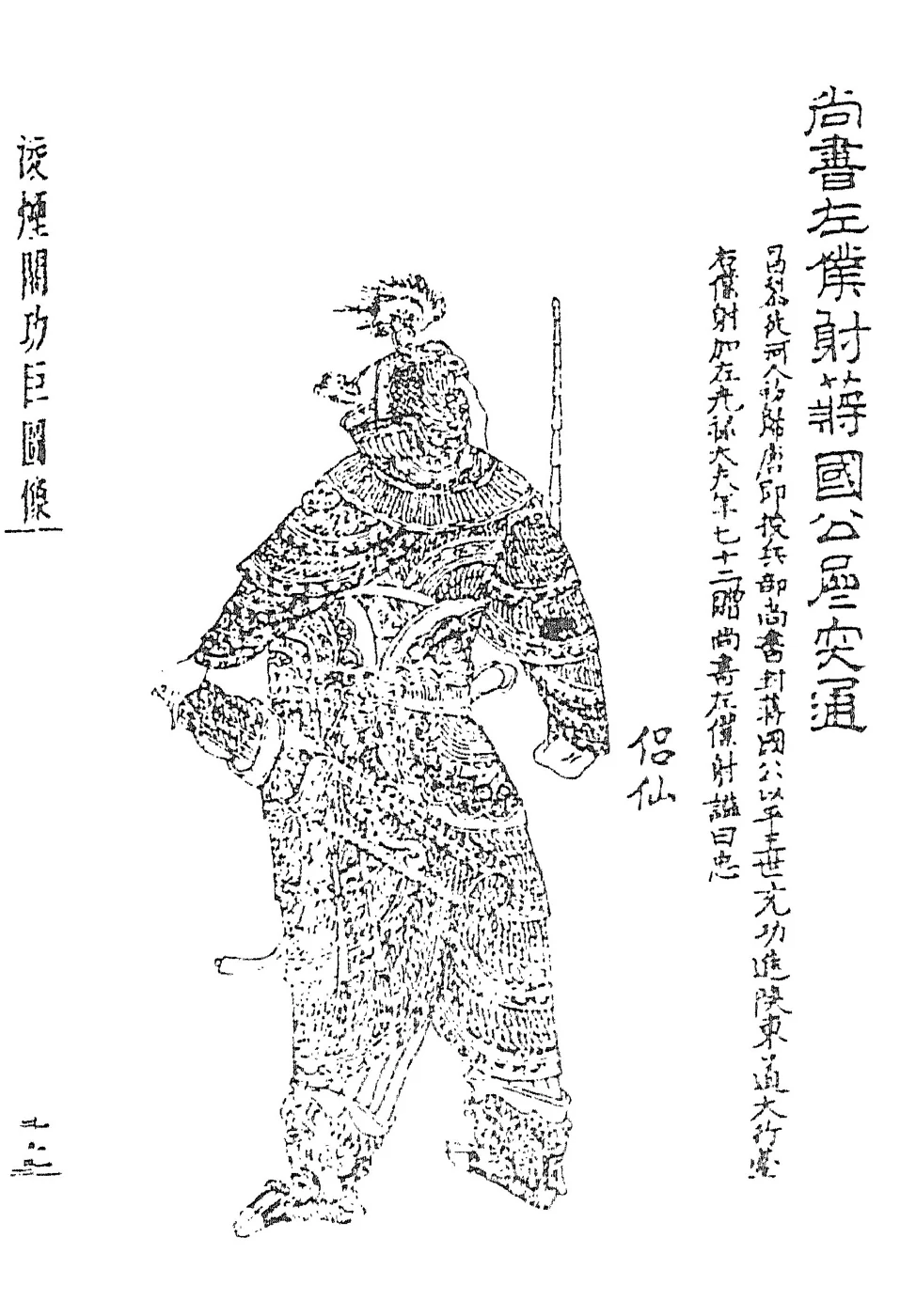
Biography
Family Background and Early Life
Qutu Tong's ancestors were from the Kumo Xi people and had attached themselves to the Xianbei Murong clan. His great-great-grandfather Qutu Yuan served as Central Commander. During the Yongxi era, Qutu's great-grandfather moved to Chang'an in Guanzhong, and the family became residents of Chang'an in Yongzhou. His grandfather Qutu Qingshang served as a palace attendant under Northern Wei and held the title Duke of Yichuan under Northern Zhou. His father Qutu Changqing served as Kaifu Yitong Sansi and governor of Qiongzhou under Northern Zhou. In youth Qutu Tong was upright, resolute, loyal, and plain in conduct, fond of military strategy, and skilled in riding and archery. Around age twenty he entered Northern Zhou service as a middle-ranking Siwei officer. After Sui was founded he became a military secretary in the Left Guard, inherited his father's title Duke of Yichuan, and transferred to Cavalry General of the Left Xunwei Guard.
In the third month of 597, the seventeenth year of Kaihuang, Qutu, then Grand Commander of the Imperial Guard, was ordered by Emperor Wen of Sui, Yang Jian, to inspect imperial horse herds in Longxi, in modern Gansu. Enforcing the law impartially, he discovered more than 20,000 horses that had been concealed from the authorities. Emperor Wen was enraged and intended to execute Taipu minister Murong Xida and more than 1,500 officials responsible for the herds. Qutu pleaded for them, arguing that human life was of the utmost importance and could not be restored once lost; a ruler who governed the realm with benevolence should not kill more than a thousand people in a single day over livestock. He offered his own life in exchange for theirs. Emperor Wen came to understand the point and spared the officials. Qutu's remonstrance impressed the emperor, who increasingly trusted him and promoted him to Cavalry General of the Right Wuhou Guard. A popular saying of the time remarked that one would rather eat mugwort or scallions for three years than encounter Qutu Gai or Qutu Tong, referring to the severe law enforcement of Qutu and his younger brother Qutu Gai.
A Prominent Sui General
In 604, the fourth year of Renshou, Emperor Wen died and Crown Prince Yang Guang became Emperor Yang. Qutu was appointed Beishen Langjiang and Zhengyi Dafu. Aware that his accession had involved political maneuvering and that his brothers were dissatisfied, Emperor Yang sought to summon them to the capital. He sent Qutu to Jinyang, southwest of modern Taiyuan, bearing what purported to be Emperor Wen's sealed order summoning Prince of Han Yang Liang. Emperor Wen had secretly arranged with Yang Liang that any valid summons would contain a particular mark and match a jade tally. The document did not satisfy those tests. Yang Liang realized something was wrong and questioned Qutu, who responded evasively. Yang Liang released him back to Chang'an and soon rebelled. Qutu helped suppress the revolt and was promoted to General of the Left Wuwei Guard. In 611, the seventh year of Daye, he accompanied Emperor Yang on campaign against Goguryeo and was promoted to Right Guanglu Grandee and General of the Left Wuhou Guard.
In the sixth month of 613, the ninth year of Daye, Yang Xuangan, son of the former minister Yang Su, rebelled while Emperor Yang was conducting his second campaign in Korea. Yang Xuangan attacked the Eastern Capital Luoyang but met strong resistance. Emperor Yang returned from Liaodong with the main Sui army, ordered Chen Leng to attack Yuan Wuben at Liyang, and sent Qutu and Yuwen Shu to reinforce Luoyang. Lai Hu'er also abandoned operations in Korea and moved west, creating a counter-encirclement around Yang Xuangan. In the seventh month Yang Xuangan accepted the advice of Li Zixiong and Li Mi and moved west toward Guanzhong. His army lost three crucial days at Wenxiang, near modern Lingbao, allowing Qutu, Yuwen Shu, Wei Wensheng, Lai Hu'er, and other Sui forces to catch up. The Sui army won three engagements in one day. In the eighth month they decisively defeated Yang Xuangan at Huangtianyuan, northwest of Lingbao. Yang fled toward Shangluo with only a few riders and, recognizing defeat, ordered Yang Jishan to kill him. Qutu was promoted for merit to General-in-Chief of the Left Xiaoqi Guard.
As Sui rule became increasingly harsh, rebellions spread, especially in the Qin and Long regions. In 614, the tenth year of Daye, Liu Jialun of Yan'an rebelled at Diaoyin, proclaimed himself emperor, adopted the era name Dashijie, and reportedly gathered 100,000 followers in coordination with the Jihu rebel Liu Yaozi. Emperor Yang appointed Qutu Commissioner for Suppression in Guanzhong and mobilized troops against him. Qutu advanced to Yan'an and initially refrained from battle, leading the rebels to think him timid. He publicly announced a withdrawal to lower their guard while secretly moving to Shang Commandery. Liu Jialun, unaware of the maneuver, moved south and camped seventy li away, dispersing troops to seize the countryside. Qutu selected elite armored soldiers and launched a night attack, killing Liu Jialun and more than 10,000 rebels, capturing tens of thousands of elderly people and children, and building a victory mound in the southern mountains of Shang Commandery. As Sui political decay deepened, many commanders were defeated or killed fighting uprisings; the source emphasizes that Qutu was unusually cautious and, while not always winning spectacular victories, was never defeated.
In 616, the twelfth year of Daye, Emperor Yang went south to the Jiangdu palace and ordered Qutu to remain in Chang'an with Prince Dai Yang You. Under the pressure of nationwide revolt, Sui power was already collapsing, while aristocrats, powerful local families, and provincial officials raised their own forces and seized territory.
Loyalty to Sui and Submission to Tang
In the fifth month of 617, the thirteenth year of Daye, Li Yuan, then governor at Taiyuan, and his son Li Shimin rose in rebellion. In the seventh month Li Yuan led 30,000 armored troops south along the Fen River. Prince Dai Yang You sent Song Laosheng with 20,000 elite troops to defend Huoyi and Qutu with tens of thousands of Xiaoguo troops to defend Hedong, the two forces supporting one another against Li Yuan. In the eighth month Li Yuan lured Song out of Huoyi, defeated his army, and opened the route toward Guanzhong.
After taking Huoyi, Li Yuan's army moved south and reached Longmen on the fifteenth day. Qutu held Hedong with tens of thousands of troops. Li Yuan judged that although Qutu had substantial forces only some fifty li away, his reluctance to fight showed weakening loyalty among his troops. If Qutu crossed the river to attack, Li Yuan intended to strike Hedong; if Qutu held the city, Li Yuan would destroy the bridges. In the ninth month Qutu sent Sang Xianhe with several thousand troops to launch a night attack on Wang Changxie's forces. The attack initially succeeded, but cavalry under Sun Hua and Shi Danai struck the Sui force from the rear and side, driving it back to Hedong. On the tenth day Li Yuan surrounded Hedong, but the city's strong defenses and Qutu's skill made a quick capture impossible. Li Yuan left part of his army to continue the siege and led the main force across the river on the twelfth day toward Guanzhong.
When Qutu learned that Li Yuan intended to attack Chang'an, he left Yao Junsu to defend Hedong and led his main force through Wuguan and Lantian toward the capital. Near Tong Pass, however, Liu Wenjing blocked his advance. The Sui officer Liu Gang held Tong Pass at the southern fort. Qutu sought to unite with him, but Wang Changxie seized the southern fort first and killed Liu Gang, forcing Qutu to withdraw to the northern fort. Qutu and Liu Wenjing remained in confrontation for over a month. Seeking to break through, Qutu again sent Sang Xianhe to attack Liu Wenjing's camp at night. Sang broke two stockades and fought repeatedly at the third; Tang forces lost several thousand men and Liu Wenjing was wounded by an arrow. Yet when Sang paused to feed his exhausted soldiers, Liu rebuilt his defenses. Several hundred mobile cavalry then struck the Sui rear from the Southern Mountains while troops from the stockades attacked from the front, annihilating Sang's force; Sang himself narrowly escaped.
Qutu's situation became increasingly desperate. When urged to surrender, he wept and said that he had received great favor from the state and served two rulers, and that one who received another's salary could not betray him in difficulty; he could only repay the state with death. Touching his neck, he declared that it should receive a blade for the country. His encouragement moved the soldiers to tears. By then Li Yuan had captured Chang'an and sent one of Qutu's household servants to persuade him to surrender; Qutu immediately killed the servant. Learning that Chang'an had fallen and his family had been captured, Qutu ordered Sang Xianhe to hold Tong Pass while he led the main force east toward Luoyang to join Prince of Yue Yang Tong. After Qutu departed, Sang surrendered Tong Pass to Tang. Liu Wenjing sent Dou Cong, Duan Zhixuan, and other elite cavalry with Sang in pursuit. At Chousang, on the southern bank of the Yellow River near modern Lingbao, Qutu was caught and formed a defensive array. Li Yuan sent Qutu's son Qutu Shou to persuade him. Qutu cursed him, saying that whereas they had once been father and son, they were now enemies, and ordered archers to shoot him. Sang then called to Qutu's troops that the capital had fallen and their families lived west of the passes, asking why they should continue east. The soldiers threw down their weapons and surrendered. Seeing the situation hopeless, Qutu dismounted, repeatedly bowed toward the southeast in the direction of Yangzhou, and cried that his strength was exhausted and his army defeated but that he had not betrayed the emperor, calling Heaven and the spirits to witness. He was forced to surrender and sent to Chang'an.
When Li Yuan asked why they had met so late, Qutu wept and replied that he had failed to fulfill a minister's loyalty and had brought shame upon his former dynasty, especially Prince Dai. Li Yuan praised him as “a loyal minister of Sui,” released him, appointed him Minister of War, enfeoffed him as Duke of Jiang, and made him chief secretary to the field headquarters of Li Shimin, Prince of Qin. Qutu was then sent to Hedong to persuade his former subordinate Yao Junsu to surrender. Both men wept on seeing one another. Qutu said that his army had failed, the Tang king's banner was receiving universal response, and Yao should surrender early. Yao instead rebuked him for abandoning the state and even riding a horse that Prince Dai had given him. Qutu sighed that he had come only after exhausting every possibility, but Yao replied that his own strength was not yet exhausted. Qutu withdrew unable to persuade him.
Founding Contributor of the Tang
On the twentieth day of the fifth month of 618, Li Yuan proclaimed the Tang dynasty at Chang'an as Emperor Gaozu. Although Tang was already stronger than any rival regime, many regional powers still resisted. Xue Ju of Western Qin attacked Jingzhou in the sixth month, threatening Guanzhong, and died suddenly in the seventh month; his son Xue Rengao succeeded him. In the eighth month Gaozu ordered Li Shimin to attack Xue Rengao, and Qutu accompanied him as chief secretary of the field headquarters. In the eleventh month Li Shimin won a major victory at Qianshuiyuan, killed several thousand, pursued the defeated army, surrounded Zhezhi City, and forced Xue Rengao to surrender. Treasure piled up after the victory and other commanders competed to seize it, but Qutu took nothing. Gaozu praised him for serving the state with integrity and granted him six hundred liang of gold and silver and a thousand bolts of colored silk.
While Tang prepared to move into the Central Plains, Liu Wuzhou, backed by the Turks, attacked Hedong. From the fourth through ninth months of 619 he seized territory and repeatedly defeated Tang relief forces. In the eleventh month Li Shimin led an army against him, with Qutu accompanying him. In the fourth month of 620, after Liu Wuzhou's forces were defeated, Li Shimin pursued and destroyed the regime. Liu's fierce general Yuchi Jingde then surrendered. Li Shimin welcomed him, but Qutu feared he might defect again and repeatedly raised the matter for Li Shimin's safety. When many former Liu Wuzhou officers later abandoned Tang, some Tang commanders imprisoned Yuchi. Qutu and Yin Kaishan urged Li Shimin to execute him immediately, arguing that the newly surrendered general was fierce and likely to resent suspicion. Li Shimin did not follow the advice, although the source states that he was moved by Qutu's loyalty.
Meanwhile, Wang Shichong proclaimed himself emperor at Luoyang in 619, naming his state Zheng, and Dou Jiande's power in Hebei grew. Gaozu therefore adopted a strategy of defeating Zheng first and Xia afterward. In the seventh month he ordered Li Shimin to lead more than 80,000 troops east against Wang Shichong. Qutu, while retaining his office, concurrently served as vice director of the Shaandong branch administration and joined the campaign. Two of Qutu's sons were in Luoyang. Gaozu tested him by asking whether his sons would affect his willingness to lead the eastern campaign. Qutu replied that although old, he was a general of the emperor and would repay the state with death; he would not alter his principles because of two sons. Qutu followed Li Shimin in defeating Wang Shichong, ranked first in merit, was appointed Right Vice Director of the Shaandong Branch Department of State Affairs, and remained at Luoyang.
Xuanwu Gate Incident and Later Years
In 626, the ninth year of Wude, Li Shimin contested the succession and, with trusted members of the Prince of Qin's establishment including Yuchi Jingde and Qutu Tong, launched the Xuanwu Gate Incident and killed Crown Prince Li Jiancheng. After Li Shimin became Emperor Taizong, he sent Qutu to guard Luoyang as acting vice director of the branch administration. The following year Qutu became governor of Luozhou and received the rank Left Guanglu Grandee. When the Shaandong branch administration was abolished in 627, he was appointed commander over the military affairs of eleven prefectures, governor of Luozhou, granted a real fief of six hundred households, and again promoted to Left Guanglu Grandee. On the nineteenth day of the tenth lunar month of the second year of Zhenguan, November 20, 628, Qutu died of illness in the official residence at Luozhou at age seventy-two. On the twenty-eighth day of the following month he was buried at Beimang Mountain north of Xuanming Ward, Qianjin Township, Henan County, Luozhou. Emperor Taizong deeply mourned him, posthumously granted him the office of Right Vice Director of the Department of State Affairs, and gave him the posthumous name Zhong. In 643 his portrait was displayed in Lingyan Pavilion, ranked twelfth. In 649 he was associated with Fang Xuanling in Emperor Taizong's ancestral temple, and in 654 he was posthumously granted the office of Sikong.