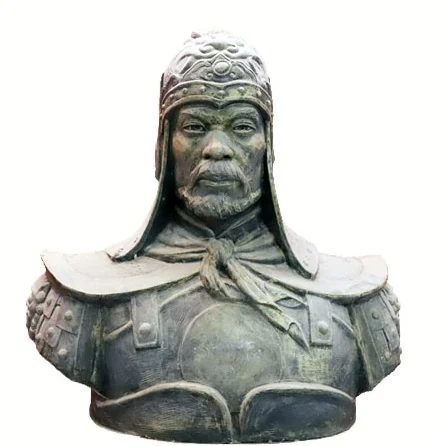
Biography
Family Background and Early Years Yu Dayou was born in 1503, the 16th year of the Hongzhi era, in Haoshi Hegetou Village, Jinjiang County, Quanzhou Prefecture, Fujian, now Heshicun in Luojiang District, Quanzhou. The Yu family traced its ancestral home to Huoqiu County in Fengyang Prefecture, Southern Zhili, now part of Anhui, before moving to Fujian. The family had practiced martial arts for generations, and Yu grew up immersed in military methods and martial training. As a youth he studied under his fellow townsman Zhao Benxue, learning to apply the *Book of Changes* to military thought and studying martial arts. Zhao was a noted martial artist and military thinker of the period, especially skilled in staff techniques, and Yu acquired from him a solid grounding in martial practice and military strategy. Yu also read widely in ancient military texts and studied classics such as *The Art of War* and the *Wuzi*. In addition to his martial ability, he was accomplished in literary composition and poetry, an uncommon combination among military officers of his day. ### Military Examination and Early Career In 1535, the 14th year of the Jiajing era, Yu Dayou sat the metropolitan military examination and ranked fifth among the successful military jinshi. He was appointed Commander of a Thousand and placed in charge of defending Kinmen, a key coastal-defense position near Quanzhou in Fujian that was frequently harassed by Wokou. After taking office, Yu strengthened the defenses, trained the troops, and repeatedly repelled small raiding groups. His abilities, however, did not immediately receive full recognition from his superiors. In 1542, the 21st year of the Jiajing era, he submitted a memorial outlining strategies for defense against the Wokou, but his superior rebuked him for speaking beyond the bounds of his office. The setback did not end his ambitions for public service. He continued in local military appointments and accumulated practical experience. ### Achievements against the Wokou and Promotion to Regional Command Around 1552, the 31st year of the Jiajing era, Wokou attacks along the southeastern coast grew increasingly severe. Raiders joined with coastal pirates, pillaging and killing and causing great suffering among local communities. Yu Dayou was ordered to lead troops against them. Drawing on his study of military strategy, he used flexible tactics and repeatedly won successes. In 1555, the 34th year of the Jiajing era, he fought a major engagement against the Wokou near Jiaxing in Zhejiang and killed about 2,000 of them. The victory brought him wide fame and established him as one of the leading commanders in the anti-Wokou campaigns. In 1556 he took over the chief military command in Zhejiang and assumed overall responsibility for operations there. He first suppressed raiding in western Zhejiang and then led an assault on Wokou strongholds on Zhoushan, largely eliminating their organized presence within Zhejiang. ### Campaigning in Fujian and Suppression of the Wokou In 1562, the 41st year of the Jiajing era, Yu Dayou was transferred from the post of deputy regional commander of the Shenwei Camp in Jiangxi to the chief military command in Fujian. Wokou activity in Fujian was then at its height, and raiders had captured the prefectural seat of Xinghua, present-day Putian, alarming the entire province. In 1563 Yu joined Qi Jiguang, Liu Xian, and other commanders in an attack on Pinghai Guard southeast of Putian and then recovered Xinghua city. The battle was a key engagement in the Campaigns against the Wokou. Yu and Qi coordinated closely, inflicted heavy losses on the raiders, and reversed the situation in Fujian. They then continued pursuing remaining Wokou groups along the coasts of Fujian and Guangdong. By 1566, the 45th year of the Jiajing era, the Wokou crisis along the southeastern coast had largely subsided. ### Later Campaigns and Political Setbacks In 1566 Yu Dayou was ordered to lead troops against bandits in the Huizhou and Chaozhou region. The campaign did not go well, and his inability to suppress the banditry quickly drew criticism from Guangdong literati. Yu was known as an upright and incorruptible official who refused to curry favor with powerful figures or to bribe agencies such as the Eastern Depot. As a result, he offended influential people and was at one point falsely accused and imprisoned for several months in the jail of the Embroidered Uniform Guard. He was eventually released with assistance from Lu Bing and others. During the Longqing era (1567–1572), Yu continued serving in Guangdong, Guangxi, and other regions, suppressing several rebellions and guarding the frontier. He died in 1579, the 7th year of the Wanli era, aged 77 . He was posthumously granted the office of Left Chief Military Commissioner and the posthumous title Wuxiang.
Family, Teachers and the Military Examination
Yu Dayou was born on the fourteenth day of the sixth month of 1503 at Heshi in Jinjiang county, Quanzhou prefecture, Fujian, his ancestral home being Huoqiu in Fengyang prefecture of the southern metropolitan region. Naturally quick and, as he grew, generous and self-styled a hero, he was poor yet easy of mind. He studied first under Wang Xuan and Lin Fu, receiving the tradition of Cai Qing, and then, hearing that Zhao Benxue deduced the military arts of the orthodox and the extraordinary, the substantial and the void from the Book of Changes, he studied under him too, so that his mastery of the Changes was deep and his knowledge of military method thorough. He used to say that the principle of military method begins from five, as the body has five members, so that a million men could be made to act as one. On the death of his father Yu Yuanzan he inherited his post, learned archery so that he never missed, and studied the long sword of Jing and Chu under Li Liangqin, who, after they had fenced, said that "your swordsmanship will be unmatched in the world". He then grasped the essence of the Changshan snake formation. In 1535 he passed the military examination fifth and was made a chiliarches in charge of Quemoy.
Quemoy and the Relief of the Starving
Quemoy's people were fierce and litigious, and Yu Dayou, on taking up his post, taught them filial duty and the Odes and Documents, heard suits himself without taking bribes, giving each side a fair hearing, and gathered the people in the covenant hall on the first and fifteenth of each month to make right and wrong clear. In five years no suit from Quemoy reached the higher offices, nor did those offices ever send to arrest a man there. In 1536 famine struck; the magistrate proposed to examine the registers, and the village clerks cheated so that most received nothing. Yu Dayou, in charge of relief, posted notices for the people to return to their villages, had them sit down by village, marked the starving on the forehead with powder and gave them tickets for grain at the office, saving perhaps ten thousand lives. That autumn pirates raided Quemoy and he beat them off and punished their leaders. When the Fujian and Guangdong pirates plundered at will he memorialised the assistant censor Chen Wushan on the matter, and Chen rebuked him for writing as a mere soldier, had him beaten and stripped of his post. His students wept and built him a living shrine; the scholars who had studied the Changes with him followed him to the prefecture, and the young men who had learned swordplay served in his house and would not leave. The people of Quemoy, remembering his virtue, called him "Buddha Yu", and after his departure built a commemorative pavilion.
Self-Recommendation and the Tingzhang Command
When Mao Bowen campaigned in Annam, Yu Dayou again memorialised with a plan of campaign and asked to serve, and Mao, struck by his grasp, was forestalled by the withdrawal of the army. In 1542, when Altan Khan invaded Shanxi, an edict called for military talent; no officer dared answer, and Yu Dayou, recommended by Qiu Yanghao, wrote to Mao Bowen asking to try himself on the frontier, arguing for a restrained army in a great formation, well-trained horse and foot, instruction in skills and attention to the regulars against cavalry. Summoned, he pointed out the weak points of troops reputed strong and the hollowness of camps reputed firm, without disparaging others to seek place. Zhai Peng marvelled that a southerner should understand battle formations and a warrior letters, saying that he should not have treated him as a mere soldier, but did not employ him. Yu Dayou then wrote to the libationer that men of the day sought only present ease and gave no thought to the state's long term. Mao Bowen made him commandant of Tingzhang; at Wuping he built the "Hall for Reading the Changes", held literary gatherings with the local scholars, taught swordsmanship to soldiers daily, and cleared the mountain bandits, defeating the pirate Kang Lao and taking over three hundred prisoners, after which he was promoted.
The Mountain Bandits and the Annam Campaign
After 1546 the bandit Tan Yuanqing of Xinxing and Enping rebelled repeatedly and the authorities could not subdue him, so the governor Ouyang Bijin gave the matter to Yu Dayou, who instituted the mutual-responsibility system, added camps and forts and had the people defend their own homes, then went through the bandit valleys himself explaining fortune and ruin and teaching them swordplay, so that they marvelled and submitted. Su Qingshe, who could wrestle tigers, was lured to the market and beheaded, and at He Laomao's valley the seized fields were restored to the people; the two counties were pacified. In 1549, when Annam was torn by succession disputes and Fan Ziyi raided Qin and Lian, Ouyang Bijin ordered Yu Dayou against him. Reaching Lianzhou while the city was hard pressed, he sent a few riders with a proclamation into the enemy camp announcing the approach of a great army, and the enemy withdrew; in the fifth month the fleet arrived and lay in ambush at Guantou ridge, and when the enemy returned they cut off their retreat and took their ships; in the seventh month he pursued and routed them, capturing Fan Ziliu and killing or taking twelve hundred, Fan Ziyi alone escaping to Annam. He pursued to Yuntun and summoned Mo Hongyi to send the rebel's head, whereupon Mo came to the Zhennan pass and submitted, and Jiaozhou was settled. Before setting out the prefect of Lianzhou had asked when the business would end, and he said with a smile that he would see him there again in forty days, which proved true. The emperor, displeased, issued a rebuke to the ministers, saying Yu Dayou was blameless and had merit, yet granting only fifty ounces of silver — Yan Song having wished his grandson to share in the reward. That year the Li of Wuzhi Mountain rose with the Li of Gan'en and Changhua, and Yu Dayou, with the Guangxi deputy general Shen Xiyi, killed over five thousand three hundred and received three thousand seven hundred surrenders; he then advised that "the Li are men too", and that cities and markets should be built and Han law applied, riding alone into the valleys to make terms, so that Hainan was pacified.
The War against the Japanese Pirates
In 1552, when the pirates ravaged eastern Zhejiang, the court made Wang Shu governor and Yu Dayou a Zhejiang assistant commander. He advised using the Fujian fleet to patrol the islands and bays, dealing with small bands separately and large ones jointly; he beat off the pirates at Changguo, and when they took Linshan and raided Songyang he intercepted them at sea with much slaughter, though he was suspended for a failure; soon after he burned more than fifty of their ships and was restored. When Wang Zhi, a Huizhou man turned sea-rover, held Liegang and traded with the pirates, Yu Dayou held that without his death there would be lasting trouble, and attacked him; with the pirates' arrows spent a sudden gale nearly capsized the government ships and they escaped to Japan. Dinghai, the port of Japanese tribute, was the pirates' chief target, and after his coming they dared not approach it, his troops doing no harm to the people, so that eastern and western Zhejiang were settled. In 1554 the pirates held Putuo, and when his men were halfway up the hill the pirates sallied out and killed three hundred, including the military graduate Huo Bin; he was blamed but kept in command, and soon after, having beaten them, was pardoned, and being sent against the pirates at Jiantiao he replaced Tang Kekuan as deputy general of Susong. Arriving with fewer than three hundred men while the pirates numbered tens of thousands, he refused when Governor Zhang Jing pressed him to fight, saying that "I can be killed, but why should you send me to fight a battle I cannot win", and instead fitted boats with screens and patrolled the rivers and lakes, meeting those who came and following those who left. In 1555 he fought the pirates at Pingwang bridge and Wangjiangjing with the Yongshun and Baojing troops, and at Liujin dam, Qiumu pavilion and Yingde lake with the Fujian troops, killing nine hundred and sixty. Zhao Wenhua, Yan Song's godson, having asked Zhang Jing for twenty thousand ounces of silver and been refused, maligned him as in league with the pirates; nevertheless Zhang Jing and Yu Dayou routed the pirates at Pingwang with three thousand killed, though Zhao reported that they had died of poison. In the fifth month the pirates entered Gusu, and Yu Dayou, ambushing them in the sandy river, cut down more than a thousand as they ferried their boats over the dam, clearing the Zhelin pirates. Because a memorandum of his on the ten difficulties of attacking Zhelin was shown to Yan Song without his knowledge, Yan had him demoted; still he fought on at Wusong river, Yingqiansha and Chashan ocean, killing or taking over five hundred.
Susong Again and Imprisonment
After the Zhelin defeat, thirty-odd new pirate ships raided Qingcun and joined the bands at Nansha, Xiaowukou and Langgang, raiding Suzhou and reaching the Lou gate, defeating the Nanjing commander Zhou Yude, then dividing to plunder Hushu and Hengtang and spreading to Changshu, Jiangyin and Wuxi, moving through Lake Tai. Yu Dayou, with the vice-commissioner Ren Huan, routed them at Lujing dam, burning thirty-odd ships, blocked those putting to sea at Sanzhangpu and sank seven, and beat them again at Yingdou lake. When the Sanbansha pirates seized fishing boats to flee he pursued them at Maji Mountain and took their chief; the pirates of Jinjing, Xupu and Baimaogang put to sea and he burned five ships at Chashan, and the troops broke three more at Maji Mountain and Sanbansha. The Zhelin pirates, having lost twenty-odd ships, landed and later put to sea again, and Yu Dayou and the assistant commissioner Dong Bangzheng took nine ships; three hundred more landed and held Taozhai at Huating, repeatedly beating Zhao Wenhua's great army, and camping by night at Yongding temple at Zhoupu were surrounded on all sides, while the storm-wrecked pirates at Chuanshawa gathered more than forty ships. The grand coordinator Cao Bangfu impeached Yu Dayou for letting the enemy go, and the emperor, enraged, took away his hereditary privilege, told him he deserved death, and ordered him to redeem himself by service. The Zhoupu pirates broke out by night to the northeast and were cut off by the colonel Cao Kexin, who killed a hundred and thirty, and joined those at Chuanshawa; the government forces attacked day and night, and Yu Dayou, with the vice-commissioner Wang Chonggu, put to sea and caught them at Laoguanzui, burning eight great ships with countless killed or taken. In 1556, the court having made the commissioner Liu Yuan general of Zhejiang and found him useless, Yu Dayou replaced him at the urging of the ministers, beat the pirates at Xi'an, Shenzhuang and Qingshuiwa, and had his family's hereditary privilege restored; that year he destroyed Xu Hai's pirates and cleared western Zhejiang. The pirates of Zhoushan, holding difficult ground, defied the government, and Yu Dayou, attacking on a day of heavy snow from all sides, saw the troops burn their palisades, so that the Zhoushan pirates were annihilated. In the fifth month of 1557 he was made a vice commissioner of the privy council; new pirates entering Shenjiamen met his fleet and lost fifty-two taken, and two hundred and forty were killed at Xiaogudu. When Wang Zhi guided the pirates the court insisted on his capture, and Yu Dayou alone opposed the plan of offering him terms, holding that it would bring future trouble; after Wang Zhi was lured ashore and imprisoned, his follower Mao Haifeng held Zhoushan and Cengang, and Yu Dayou and Qi Jiguang, attacking together from below the heights, could not take it though they suffered heavily, while pirate reinforcements kept coming; the court pressed Hu Zongxian, who blustered, and the ministers turned on Hu and impeached Yu Dayou, who with Qi Jiguang was dismissed with a month to finish the pirates. On the day the order came his bundle held less than a hundred ounces of silver and his family were lodging at Mingzhou, where Tan Lun relieved them.
The Cart Camps at Datong and the Later Campaigns
In 1559, Lu Bing, commander of the Embroidered Uniform Guard, bribed Yan Shifan with his own money and Hu Zongxian pleaded with Yan Song, so that Yu Dayou was released from prison and posted to the staff of Li Wenjin, who on hearing of his coming laid down his military books and went out to meet him; Yu Dayou clapped his hands and said that but for Hu Zongxian's impeachment he could not have met him here. He proposed and built a cart camp, with single-log wheels pushed by men, able to cross hills and gullies at will, with strong bows and divine guns to reach distant targets and shields to stop enemy arrows. In 1560, meeting the Mongols at Anyin fort, he charged ten thousand with a hundred carts and three thousand horse and foot, and the court, on his report, established cart camps, while an attack on Bansheng with Li Wenjin restored his hereditary privilege. In 1561, when the Guangdong bandit Zhang Lian, styling himself emperor of the Flying Dragon state, took cities in Jiangxi and Fujian, Yu Dayou was made assistant commander of Nangan and campaigned with three provinces. Holding that "the art of war bids you attack where the enemy must come to the rescue", he led fifteen thousand men up Baisong ridge overlooking the bandit lair, took it when they returned to defend it, killing over a thousand, and sent Chen Qike to offer the bandits terms, so that they wept, came out to surrender and persuaded Zhang Lian to submit, and he was taken with Xiao Xuefeng and the rest. When Guangdong and Fujian officers claimed his merit he said that he hated only that the rebels were not destroyed and would not contend for credit. The emperor, pleased, granted silver, a sealed decree, credentials and axes, made him deputy general with command over the four circuits of Jiangxi, Huguang, Fujian and Guangdong, and he advised establishing more counties among the five ridges to deny shelter to the wicked, though only Pingyuan was set up. In 1562 the pirates took Xinghua by a ruse, and Yu Dayou, made acting vice commissioner and general, refused to fight in the open with too few men, entrenched, dug ditches, and sealed the sea with his fleet, so that the pirates were penned in. In the first month of 1563 the court made Tan Lun grand coordinator, and Yu Dayou hurried into Fujian; when Tan arrived and the forces had gathered, they joined with Qi Jiguang and Liu Xian and advanced in separate columns, and the pirates, in panic, fell into the ditches and were destroyed. In the fourth month Qi Jiguang came with Zhejiang troops, and Tan Lun, making Liu Xian the left, Yu Dayou the right, himself the centre and Qi Jiguang the vanguard, stormed Pinghai garrison, beheaded more than two thousand, and pursuing, killed three thousand more; Xinghua was recovered, and because Qi Jiguang's merit was greatest he replaced Yu Dayou as general of Fujian. In 1564 Yu Dayou became general of Guangdong, where twenty thousand pirates under Wu Ping and the tribal chiefs Wu Duan, Wen Qi and Ye Danlou were in arms; he rode alone to win over Cheng Shaolu and through him Liang Daohui, took Wen Qi at Huizhou, and with Wu Duan as his vanguard burned four hundred pirates at Zoutang, the rest fleeing by sea, many drowning, and the two thousand survivors besieged at Jintidu for two months and destroyed when their food failed; he then won over Lan Songsan, Ye Danlou and Wu Ping. Wu Ping, with hundreds of ships and ten thousand men, rebelled, and Qi Jiguang drove him to Nan'ao, where Yu Dayou with the fleet and Qi Jiguang with the army crushed him; but when his officers Tang Kekuan and Li Chao failed and Wu Ping escaped by seizing a boat, Yu Dayou was impeached by the inspecting censor and dismissed. In 1566 Li Yayuan rose at Heyuan and Wengyuan; the governor raised a hundred thousand men and sent Yu Dayou, who in five columns struck the lair, killing or taking ten thousand four hundred and recovering eighty thousand people, and was made general of Guangxi and general of the subduing of the barbarians; he then killed Li Yuanli and Lai Shiqing, took Wang Xiqiao alive, and destroyed Zeng Yiben. In 1571, when Huang Chaomeng and Wei Yinbao rose in Guangxi, the grand coordinator Yin Zhengmao raised a hundred and forty thousand and sent Yu Dayou, who in four columns broke dozens of lairs, and failing to take Chaoshui for ten days feigned an attack on Malang and sent the assistant commander Wang Shike by night in rain to ambush on the hill, storming it at dawn and destroying the enemy, killing eight thousand four hundred and taking Huang and Wei alive. In 1572 he was transferred to command Fujian, but being dismissed for leaving before his successor arrived, he was, though past seventy, recalled as an assistant commissioner of the rear army command and adjusted the capital's military arrangements, forming ten camps in odd and even halves with set methods of attack and defence, his method being extended to the war-carts of Xuanfu, Datong, Shanxi and Shaanxi. In 1573, after a failure against pirates at Lüxia'ao he was dismissed and then restored, in 1576 made vice commissioner of the privy council, and in 1578 three times asked leave to retire. He died on the twenty-sixth day of the eighth month of 1579 at seventy-seven, was granted posthumously the rank of left commander, and in the seventh month of the following year was given sacrifice and burial with the posthumous name Wuxiang.