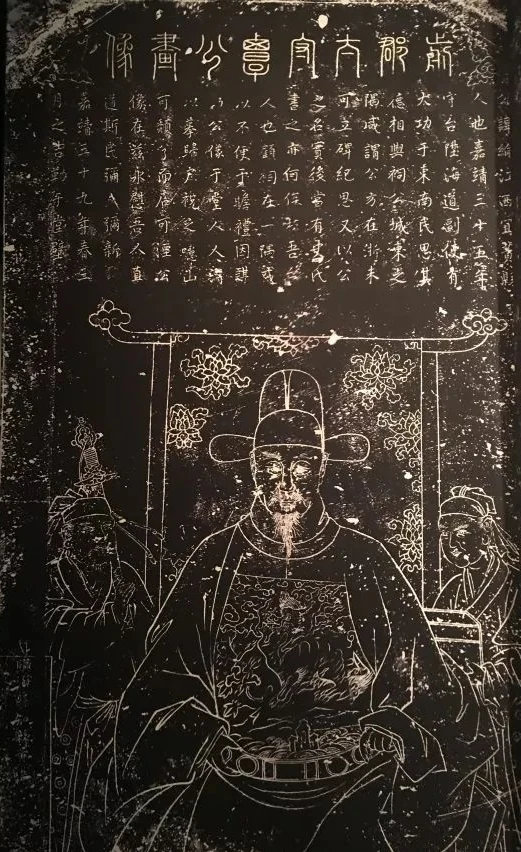
Biography
Family Background and Early Life Tan Lun was born into an official family in Yihuang, Jiangxi. His great-great-grandfather was Tan Shilong, his great-grandfather Tan Ji, his grandfather Tan Tingyong, and his father Tan Hao. From childhood he was steady, resolute, and strong, with broad strategic ambitions. His reading ranged widely, but he was especially fond of military texts and developed a strong interest in warfare. Jiangxi had a flourishing literary culture and examination tradition during the Ming, and Tan Lun followed the standard path into official life through the civil service examinations. In 1543, the twenty-second year of the Jiajing era, at the age of twenty-four he placed eightieth in the Jiangxi provincial examination. In 1544, the following year, he passed the metropolitan examination in the Jiachen degree class at the age of twenty-five. That cohort produced many later prominent officials, and Tan Lun became one of its most accomplished figures in military affairs. After earning the jinshi degree, Tan Lun first served as a secretary in the Nanjing Ministry of Rites and later became a director in the Bureau of Operations of the Ministry of War. Although Nanjing, the Ming secondary capital, contained many offices with limited actual authority, the Bureau of Operations handled maps, military organization, fortifications, garrisons, training, and campaigns. It thus provided Tan Lun with his first sustained exposure to practical military administration. He carefully studied frontier conditions and the development of military institutions, laying the foundation for his later command of regional defense. ### Defense of Taizhou and Achievements in Eastern Zhejiang In 1550, the twenty-ninth year of the Jiajing era, wokou repeatedly raided the Zhejiang coast, with Taizhou on the front line. Tan Lun was appointed prefect of Taizhou. Rather than confining himself to the ordinary civil duties of a prefect, he immediately began reorganizing and training military forces. Knowing that the hereditary garrison troops were no longer effective, he recruited one thousand local volunteers, personally supervised their training, enforced strict discipline, and devised methods for grouping troops into units. The resulting local force later became known as the “Tan Family Army” and represented an early experiment in the late-Ming shift toward recruited forces. In 1557, the thirty-sixth year of the Jiajing era, Tan Lun led troops to deal a severe defeat to the wokou at Taizhou. In 1558, the thirty-seventh year, tens of thousands of raiders again threatened Taizhou. Tan Lun personally led selected fighters into battle and won three successive engagements, greatly raising the army's prestige. After these victories he was promoted to maritime-defense vice commissioner of the Zhejiang Provincial Surveillance Commission and additionally appointed right administration commissioner. While serving in Zhejiang, Tan Lun met Qi Jiguang, then a regional commander fighting the wokou. The two immediately found common ground in their ideas about troop training. Tan Lun highly valued Qi Jiguang's abilities and repeatedly recommended him thereafter. Their cooperation lasted more than twenty years and became one of the most famous commander partnerships of the middle and late Ming. ### Campaigns in Fujian and Governorship of Fujian In 1562, the forty-first year of the Jiajing era, Tan Lun returned home to observe mourning for his father. At the time wokou activity in Fujian was severe. Raiders plundered the Shaowu and Xinghua regions, and the prefectural city of Xinghua was briefly captured—the only Ming prefectural seat to fall during the wokou crisis. In the first month of spring 1563, the forty-second year of Jiajing, the court recalled Tan Lun from mourning. He was restored to his former rank while concurrently serving as assistant surveillance commissioner and led 1,200 Zhejiang troops into Fujian, joining Governor-General Liu Xian and Regional Commander Yu Dayou in operations against the raiders. In the third month, Tan Lun was promoted to right vice censor-in-chief and governor of Fujian. While in Fujian, Tan Lun recommended renowned commanders including Qi Jiguang and Yu Dayou for operations. In the fourth month of the same year he served as overall commander and ordered Qi Jiguang, Yu Dayou, and others to advance on separate axes. Their forces killed more than two thousand enemies and recovered Xinghua. The following year the wokou attacked Xianyou. Tan Lun personally led Qi Jiguang's troops to reinforce the area, captured Xianyou, killed more than a thousand enemy troops, and forced the survivors to flee to sea. By the fourth month of 1564, the forty-third year of Jiajing, the wokou threat in Fujian had largely been suppressed. Tan Lun then requested leave to observe mourning for his mother, which the court granted. During his service in Fujian, Tan Lun also directed coastal-defense construction. He reorganized coastal naval strongpoints and restored and reinforced naval forces, helping rebuild and strengthen Fujian's maritime-defense system. These measures had a lasting effect on the security of the southeast coast. ### Command of Guangdong and Guangxi and Defense of Jizhou–Liaodong In the tenth month of 1565, the forty-fourth year of the Jiajing era, Tan Lun was recalled as governor of Shaanxi, and in the twelfth month transferred to Sichuan. In the tenth month of 1566, the forty-fifth year, he was promoted to right vice minister of the Ministry of War and concurrently right vice censor-in-chief, with overall command of military affairs in Guangdong and Guangxi and responsibility for military provisions. The region was then troubled by both wokou activity and Yao unrest. Tan Lun reorganized military affairs after taking office and stabilized the situation in the south. In the eleventh month of 1568, the first year of the Longqing era, Tan Lun returned to the Ministry of War. In the third month of 1568, the second year of Longqing, he was appointed left vice minister of the Ministry of War and supreme commander for Jizhou, Liaodong, and Baoding, responsible for the defense of the capital region. This was one of the most strategically important sectors of the Ming Nine Borders and directly protected the capital. After arriving, Tan Lun again recommended Qi Jiguang for frontier defense. Accepting Qi's proposal, he planned the construction of 3,000 defensive towers from Juyong Pass to Shanhai Pass. About 1,200 were ultimately completed, but even this greatly strengthened the defenses of the Jizhou sector. As supreme commander, Tan Lun reorganized frontier defenses and trained the border forces, significantly strengthening security in the northeast. In 1570, the fourth year of the Longqing era, Tan Lun was promoted to Minister of War. In the tenth month he requested leave because of illness and returned home. In 1572, the sixth year of Longqing, the Shenzong Emperor ascended the throne and recalled Tan Lun as Minister of War. Supervising Secretary Luo Zun impeached him for incompetence. Tan Lun submitted three memorials asking to resign, but each time the court issued an order retaining him in office. ### Final Years and Death In 1577, the fifth year of the Wanli era, Tan Lun died while serving as Minister of War, at the age of fifty-eight. The court posthumously granted him the title Grand Guardian of the Heir Apparent and the posthumous name Xiangmin. Having served three reigns and worked from the anti-wokou campaigns of the southeast to northern frontier defense, Tan Lun was one of the relatively few middle- and late-Ming military leaders to combine extensive combat experience with broad strategic judgment.
Tan Lun read widely from childhood, was quick in thought and of uncommon intelligence, and calm by nature. Passing the examination in 1544, he was made a secretary in the Nanjing board of rites and soon left office to mourn his mother. About 1550 he became prefect of Taizhou. The southeast coast had then suffered four years of Japanese piracy, and the court took counsel on training local militia against them: a brigade general asked for three years to train militia and send them to the front, and Tan Lun trained a thousand men of his own. He laid down rules binding the force, each rank from the deputy generals down checked by the next, with duties clearly divided and movement in perfect order, so that before long they were picked troops. When the pirates attacked Zupu, Tan Lun led them out in person and won three actions out of three; the pirates then plundered six counties from Songmen and Chanhu and laid siege to Taizhou, which they could not take and left, turning elsewhere, where Tan Lun took and killed them all.
In the intercalary seventh month of 1558 Tan Lun was promoted to be an assistant in the Zhejiang judicial commission and recruited more sons of good families from eastern Zhejiang for training; the troops Qi Jiguang had been training had then completed their term, and Tan Lun took them into his force, dismissing the outside troops and calling for no more. In the third month of the next year the pirates landed and struck at Taizhou, and Tan Lun broke them at Magang and Hejiazhuo with seventy-seven heads taken, and beat them again with Qi Jiguang at Gebu and Nanwan. In the ninth month of 1560, on the recommendation of the governor-general of Zhili and Zhejiang, he was made a right counsellor of the Zhejiang provincial administration, and afterward left office on the deaths of his parents; restored again, he served as right counsellor and concurrently deputy in the judicial commission and took part in putting down Lin Chaoxi, a remnant of the great bandit Zhang Lian. Lin held out in his lair and attacked Chengxiang; the county stood on guard and sent a secretary into the rebel camp to call on them to disperse, whereupon Lin's followers left him, he abandoned the lair and fled, and Tan Lun with the Guangdong troops pursued and took him.
In the sixth month of 1562 Tan Lun was transferred to the commissariat in Fujian and asked leave to go home on the ground that the country was somewhat quieter; in the tenth month he was rewarded for the suppression of Zhang Lian and the bandits of Jiangxi. While he was at home Qi Jiguang beat the pirates again and again and eastern Zhejiang became fairly quiet; the piracy of Zhejiang was at last ended, but in Fujian it grew worse than ever. In the same year the pirates raided Fujian in concert with those of Funing and Lianjiang and took Shouning, Zhenghe and Ningde, while others from Nan'ao in Guangdong joined those of Fuqing and Changle to take the Xuanzhong post and raid Longyan, Songxi, Datian, Gutian and Putian. In 1563 Tan Lun was made governor of Fujian and, working with Qi Jiguang, won the great victory at Pinghaiwei and soon after broke the pirates under the walls of Xianyou, so that the piracy of Fujian was wholly put down. He had taken part in the fighting on the southeast coast for nearly ten years and was one of the chief commanders who ended the piracy of the middle Ming.
He was afterward made governor-general of Ji and Liao in charge of the northern frontier, where he built three thousand defence posts, directed the rebuilding of more than two thousand li of the Great Wall along the Jizhou line, strengthened the defence of the northeast against the Tatars and did much for the peace of the northern border. He died in 1577 at fifty-eight, and the court gave him posthumously the title of grand guardian of the heir apparent and the name Xiangmin.
Tan Lun and Qi Jiguang were the two great commanders against the pirates of the middle Ming, known together as Tan and Qi; the history says that he spent thirty years among the armies and counted more than twenty-one thousand five hundred heads taken, a shield of his time. In his long military career he formed a distinctive thought of war, holding that troops should be trained to excellence, defences made solid and rewards and punishments kept faithful, valuing firearms and new tactics and carrying the experience of the southeast to the northern frontier. He was also fond of music and devoted to the drama, and amid his campaigns did much for its spread: it is said that when in office he brought a troupe of the Haiyan style back to his native Yihuang, where a notable Yihuang style took shape afterward.
The battle of Pinghaiwei in Fujian is a classic instance of Tan Lun's joint operations with Qi Jiguang and Yu Dayou: in 1562 the pirates took the city of Xinghua and Fujian was shaken, and the next year the court sent Qi Jiguang and Yu Dayou into the province, Tan Lun as governor directing all the forces, so that the pirates were heavily defeated about Pinghaiwei with great slaughter and several thousand captured people recovered; he then broke the pirate camps with Qi Jiguang under the walls of Xianyou, and the piracy of Fujian was all but ended. These campaigns show his capacity for coordinating several armies and their commanders, and gave him a high place among the soldiers of the middle Ming.
In Ji and Liao he worked with Qi Jiguang again. Qi Jiguang, as commander of Jizhou, trained the troops and held the frontier, while Tan Lun as governor-general took part in planning its defence, and together they reordered the Jizhou line. The watch-stations and beacon towers they built along the Great Wall, serving for look-out and signals as well as for storing arms and quartering men, were an important part of the Ming defences, and Tan Lun urged the greater use of firearms on the frontier and paid attention to the training and discipline of troops.
His contribution to the drama belongs to his years at Yihuang. It is said that while at home in mourning for his father he brought back from Zhejiang a troupe of the Haiyan style, which then combined with the speech and music of the place to form the Yihuang style; the performers of Yihuang honoured him as their founder, and the theatrical tradition of his home district has been the stronger for it. The taste sits oddly beside his military reputation, and later accounts of him commonly mention both.
Tan Lun's military career falls roughly into three stages: ten years against the pirates on the southeast coast, six years of frontier reorganisation in Ji and Liao, and his last years at court concerned with the capital garrison. When the war against the pirates ended, the court moved commanders of real experience to the north, and it was then that Tan Lun and Qi Jiguang went up, their experience shaping the training of frontier troops in the later Ming; the militia he had trained in the southeast and the Zhejiang troops he had taken over became the base of the Jizhou training. The histories dwell on his being both a leader in person and a good director of other commanders: at Taizhou he trained troops with a brigade general, in Fujian he directed several armies, at Jizhou he worked in concert with the commander, and he seems to have suited each level of command. Officials who were versed in both war and letters were not rare in the middle and late Ming, and Tan Lun, famous in arms and a lover of the drama besides, is one of the more striking of them; the court's provision for his family after his death was generous, and his career is recorded both in the Ming History and in the local gazetteers of Fujian and Zhejiang.
The court dealt generously with his family after his death.