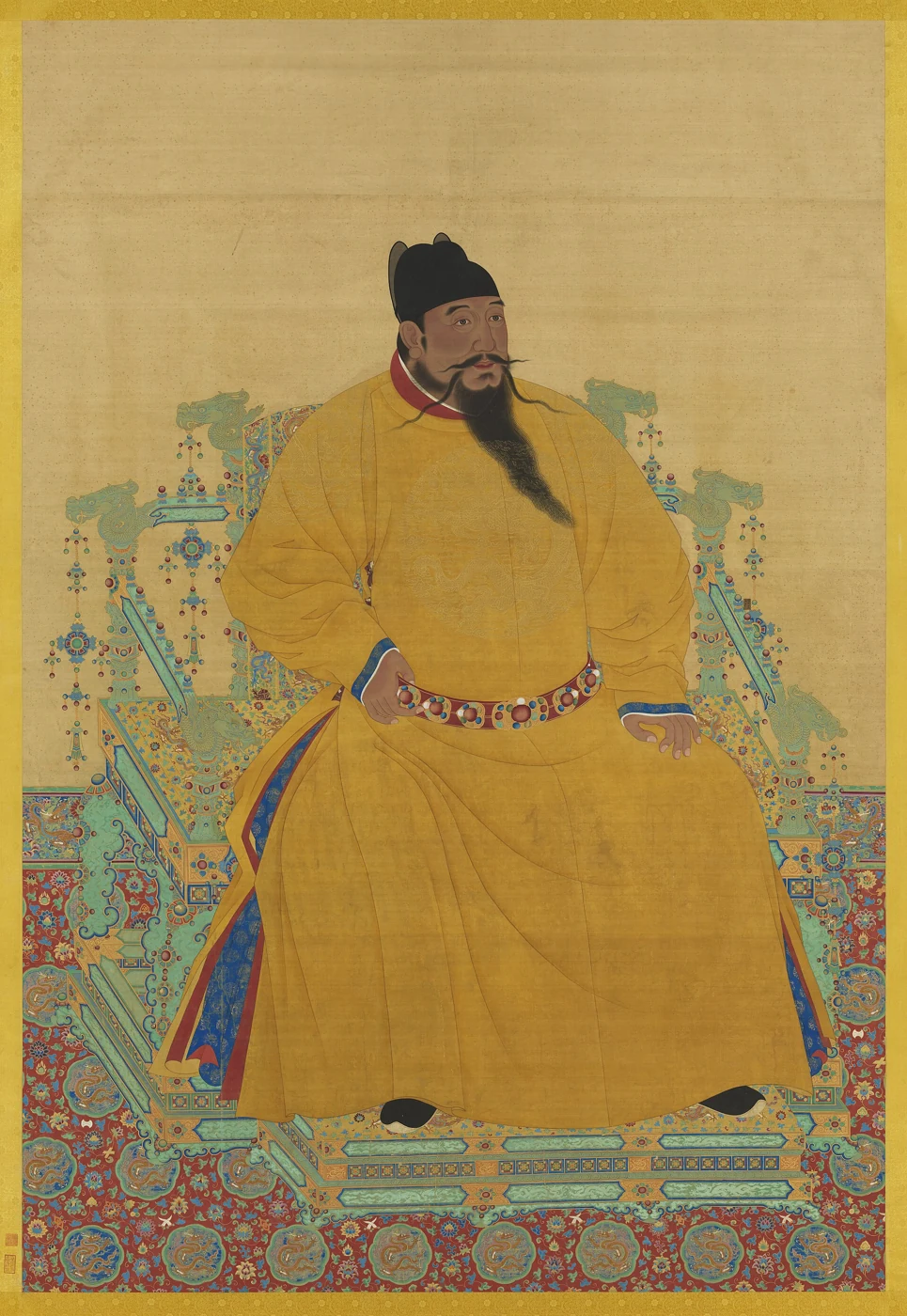
Biography
Family Background and Early Life
Zhu Di was born on the 17th day of the fourth lunar month in 1360, the 20th year of the Zhizheng era, during the wars at the end of the Yuan dynasty. His father Zhu Yuanzhang was then fighting Chen Youliang in the Jiangnan region and, according to the source, left to direct military operations without even seeing the newborn child. Zhu Di did not initially receive a formal personal name. At the end of 1367, when Zhu Yuanzhang was preparing to proclaim himself emperor, he reported to the imperial ancestral temple and named the seven sons born after his crossing of the Yangzi; the fourth son received the name Di. Zhu Yuanzhang also established twenty-character generational sequences for each branch of his descendants. The sequence for Zhu Di's line was: Gao, Zhan, Qi, Jian, You; Hou, Zai, Yi, Chang, You; Ci, He, Yi, Bo, Zhong; Jian, Jing, Di, Xian, You.
Zhu Di received a strict upbringing together with his brothers. Zhu Yuanzhang believed that his sons should become accustomed to hardship, requiring them to wear hemp shoes and leggings and make excursions outside the city like soldiers, partly on horseback and partly on foot. As they grew older, they also practiced military skills. Zhu Yuanzhang likewise emphasized literary education. In 1364 he arranged a place in the palace where his sons could study, and in 1368 the Great Foundation Hall was completed with a large collection of books and learned teachers. Zhu Di, the other princes, and the sons of meritorious officials there received an orthodox Confucian education.
Enfeoffment and Establishment at Beiping
In 1370 Zhu Yuanzhang enfeoffed his sons as princes, and Zhu Di became Prince of Yan. The source explains that Zhu Yuanzhang saw the fall of the Yuan partly in terms of a weak ruler and powerful ministers without sufficient support from imperial princes, and therefore used princely enfeoffment to strengthen the ruling house. In 1373 he issued the *Zhaojian Lu* and *Zuxun Lu*, collections of examples and instructions intended to educate the princes in dynastic and lineage norms.
In 1376 Zhu Di married Lady Xu, eldest daughter of Xu Da, Duke of Wei. Zhu Yuanzhang later ordered Zhu Di, Zhu Shuang, Prince of Qin, and Zhu Gang, Prince of Jin, to travel to the Central Capital at Fengyang to observe the place where their ancestors had begun their rise and to understand the foundations of the dynasty. Zhu Di was subsequently sent to reside in Fengyang on three occasions, where he trained troops while also learning about local livelihoods. The source describes this as a practical extension of his palace education.
In 1380 Zhu Di took up his fief at Beiping. Ming princes possessed guard units ranging from several thousand to as many as fifteen thousand men; in emergencies they could also draw on local garrison forces, and commanders might be placed under princely direction. After arriving in Beiping, Zhu Di cultivated relations with local civil and military officials. In 1382 the monk Yao Guangxiao, also known as Daoyan, accompanied him north and became an important adviser. Yao later introduced the physiognomist Yuan Gong, and the two became central members of Zhu Di's advisory circle.
Northern Campaigns and the Succession Question
In the first lunar month of 1390, the 23rd year of the Hongwu era, Zhu Yuanzhang ordered Zhu Di to lead Fu Youde and other commanders into the northern steppe. The army left through Gubeikou and learned that the Northern Yuan commander Nair-Buqa was encamped at Yidu. Heavy snow fell, and several commanders wished to wait until it stopped, but Zhu Di argued that the enemy would not expect an attack in such conditions and urged a rapid advance. The Ming army approached to within one stretch of sandy ground without being detected. Zhu Di sent Guantong, who knew Nair-Buqa, to persuade him to surrender. Nair-Buqa and his followers submitted. When the report reached the capital, Zhu Yuanzhang was said to have praised the Prince of Yan for clearing the desert frontier. Zhu Di's reputation increased, and he was repeatedly entrusted with northern military duties and authority over frontier forces.
Among the princes, Zhu Gang, Prince of Jin, and Zhu Di were particularly favored, but tensions arose between them. The Prince of Jin was wary of Zhu Di's growing military reputation and complained to Crown Prince Zhu Biao that Zhu Di exposed the army to unnecessary danger. In 1392 Crown Prince Zhu Biao died and Zhu Yuanzhang named his grandson Zhu Yunwen as imperial heir-apparent grandson. Zhu Shuang, Prince of Qin, died in 1395, and Zhu Gang died in 1398, leaving Zhu Di the eldest of the surviving senior princes and already possessed of substantial influence. According to the source, Zhu Yuanzhang's final instructions emphasized Zhu Di's ability and his responsibility to defend the frontier and maintain order, but the emperor also feared the prince's power and ordered the princes not to travel to the capital for his funeral.
The Jingnan Campaign
In the intercalary fifth lunar month of 1398, Zhu Yuanzhang died and Zhu Yunwen ascended the throne. Guided by Qi Tai and Huang Zicheng, the Jianwen Emperor began reducing princely power; within less than a year the princes of Zhou, Min, Xiang, Qi, and Dai were removed or punished. Zhu Di outwardly feigned illness and madness while secretly training troops, manufacturing weapons, and strengthening his guards. In the sixth lunar month of 1399 the court interrogated a Yan princely envoy and learned of plans for rebellion. Troops were sent to arrest members of Zhu Di's household, and Zhang Xin and others were secretly ordered to seize Zhu Di. Zhang Xin, however, had previously served Zhu Di and defected to him. In the seventh lunar month Zhu Di used a ruse to seize and kill Beiping provincial administrator Zhang Bing and military commander Xie Gui, then ordered Zhang Yu and Zhu Neng to take the nine gates of Beiping. He launched his campaign under the slogans of “upholding Heaven and pacifying disorder” and “clearing evil ministers from the sovereign's side.”
The Jingnan Campaign lasted three years. At first Zhu Di's forces were much smaller than the court armies, but he relied on maneuver and surprise. He defeated Geng Bingwen at Zhengding and then defeated Li Jinglong at Zhengcunba and Baigou River. In 1400 the Yan army failed to take Jinan and suffered defeats at the hands of Sheng Yong and Tie Xuan; Zhang Yu was killed at Dongchang. After consulting Yao Guangxiao, Zhu Di resumed the offensive, defeating Sheng Yong at Jiahe in 1401 and regaining the strategic initiative. The Yan army then campaigned through Shandong and Hebei, avoiding strongpoints and striking weaknesses. In 1402 it crossed the Yangzi and advanced directly on Nanjing. Zhu Hui, Prince of Gu, and Li Jinglong opened the Jinchuan Gate to surrender. Zhu Di entered Nanjing, while the Jianwen Emperor's fate became unknown. Zhu Di ascended the throne and adopted the Yongle era name.
The Yongle Reign
After taking the throne, Zhu Di continued policies limiting the power of the princes, relocating some and stripping others of military guards in order to strengthen central authority. He developed the Grand Secretariat, appointing Xie Jin, Yang Rong, Yang Shiqi, and others to participate in state affairs. He also established the Eastern Depot under eunuch control, expanding surveillance over officials. To strengthen control of the north, he repaired and dredged the Grand Canal, constructed the imperial palace at Beijing, and formally moved the capital there in 1421.
Militarily, Zhu Di personally led five campaigns into the northern steppe against Mongol Tatar and Oirat forces. In 1410 he defeated Bunyashiri and Arughtai during his first expedition; in 1414 he defeated the Oirat leader Mahmud at the Battle of Qulan Hūshūn. In 1407 Ming forces entered Annam and established the Jiaozhi Provincial Administration Commission. In the northeast the Nurgan Regional Military Commission was established to administer the Heilongjiang, Ussuri, and Sakhalin regions; the Hami Guard was created in the northwest; and the Guizhou Provincial Administration Commission was established in the southwest.
In foreign relations, beginning in 1405 Zhu Di sent Zheng He on seven large maritime expeditions, which reached as far as East Africa and promoted diplomatic prestige and overseas trade. In cultural affairs, he ordered Xie Jin, Yao Guangxiao, and others to direct the compilation of the *Yongle Encyclopedia*, a work of more than twenty-two thousand juan described by the source as the largest encyclopedia of premodern China.
In 1424 Zhu Di died at Yumuchuan while returning from his fifth northern campaign, at the age of sixty-four. He was succeeded by Crown Prince Zhu Gaochi, Emperor Renzong of Ming, and was buried at Changling on Tianshou Mountain near Beijing.
The Order of Names in the Ancestral Instructions and the Education of the Princes
The Huang Ming zuxun, in the Collected Statutes of the Ming, records the rule for naming the imperial clan: for the household of the heir apparent and of each prince twenty characters were drawn up, and thereafter when sons and grandsons were born the fact was reported to the Court of the Imperial Clan; the two characters of each name were formed by taking one character from the series as the first and choosing the second freely, the name being entered in the jade register, and after twenty generations the series was to be extended by the same rule, this being the permanent pattern. The twenty characters for the household of the Prince of Yan were: Gao, Zhan, Qi, Jian, You, Hou, Zai, Yi, Chang, You, Ci, He, Yi, Bo, Zhong, Jian, Jing, Di, Xian, You; and when the Prince of Yan came to the throne this series became the order of the imperial line, so that the names of the emperors of the Ming all come from it. In the education of his sons Zhu Yuanzhang did not let wealth and rank put an end to toil: holding that his seven sons should learn hardship, he ordered Zhu Di and his brothers to wear hempen sandals and leg wrappings and to march out of the city like soldiers, riding for seven parts of the road and walking for three, and as they grew older they practised at arms in the drill ground from time to time. Such discipline made Zhu Di familiar with saddle and camp from boyhood and was the basis of his later residence at Beiping and his repeated campaigns in the north.
The Enfeoffment of the Third Year of Hongwu and the Court of the Imperial Clan
Chapter 51 of the Veritable Records of Taizu records that on the yichou day of the fourth month of the summer of the third year of Hongwu, when the imperial princes were enfeoffed as kings, an edict to the empire declared that on the seventh day of that month the second son Shu was made King of Qin, the third Gang King of Jin, the fourth Di King of Yan, the fifth Su King of Wu, the sixth Zhen King of Chu, the seventh Bo King of Qi, the eighth Zi King of Tan, the ninth Qi King of Zhao, the tenth Tan King of Lu, and the grandson of a collateral line Shouqian King of Jingjiang. On the following day the Court of the Imperial Clan was established with the first grade of rank. Zhu Di was then eleven years old and was enfeoffed as Prince of Yan, and the title of the Yan fief dates from this. On the gengzi day of the second month of the ninth year of Hongwu, since the King of Qin, the King of Jin and Zhu Di were about to go to their fiefs, Zhu Yuanzhang ordered them first to go to Fengyang to see the ground from which their ancestors had risen, so that they might know how the royal enterprise had begun, and ordered the crown prince to lead them, and to sacrifice to the founding ministers before they set out. Fengyang was the place of Zhu Yuanzhang's own beginning, and to send his sons there first was meant to make them understand the difficulty of founding a state; what Zhu Di saw at Fengyang was in fact the first foundation of his later management of the north.
The Princely Guards and the Residence at Beiping
Under the Ming system of principalities each prince had a small force called his guard, of three thousand men at the least and fifteen thousand at the most. Nominal as it was, a prince might not meddle in local affairs, yet in an emergency he might call out the garrison troops of the region where his principality lay; and in every military operation the princes were to lead their guards with the army, so that the generals famous on the field of battle, though they held the rank of general-in-chief, sometimes had to accept the command of a prince. In the thirteenth year of Hongwu Zhu Di went to his fief at Beiping. Beiping was the old capital of the Yuan, lying where the northern farming region met the pasture land, convenient in communications and strong in position, at once the centre of trade between Chinese and Mongols and a political and military key point of the north; Zhu Di held it for many years with a comparatively stable rule, and from its position adjoining the northern frontier was repeatedly charged with leading armies beyond the passes. The strength of the Yan fief rested indeed on this ground and on the numbers of its guard.
The Northern Campaign of the Twenty-Third Year Against Nair Buhua
In the twenty-third year of Hongwu Zhu Di was ordered to lead an army north against the Yuan grand commandant Nair Buhua. Nair Buhua and his people were pasturing at Yidu, and Zhu Di marched on them; it happened that there was heavy snow, and the generals wished to wait until it stopped before advancing, but Zhu Di held that with such snow the enemy would certainly not expect the Ming army to come and that they should press on at speed through it. The army reached Yidu with only a stretch of sand between them and the Yuan force and was never discovered. Though he had overwhelming strength, Zhu Di still wished to take them by wit, and sent his officer Guan Tong to the enemy camp to persuade them to submit. By then the Ming army had already heavily defeated the Yuan force and Nair Buhua wished to escape on horseback, but Guan Tong told him that this was the army of the Prince of Yan and he need not fear, and invited him to come into the Ming camp to submit; he was duly received with wine, was deeply moved, and brought his tribe with their horses, camels, cattle and sheep to surrender to the Ming. This raised Zhu Di's reputation greatly and remains one of the most famous of his frontier achievements. There is, however, a divergent account: chapter 4 of Zhu Chun's Xianyuan ruizhi ji preserves a letter to the household of Jin, in which, under the intercalary fourth month of the twenty-third year of Hongwu, he wrote that he had received word that the great army had arrived at Niuwenhaizi on the tenth day of the fourth month and that the false official grand commandant Nair Buhua and the chancellor and the privy officials had come over one after another, praising Zhu Gang for his skill in comforting them; on this some scholars hold that the merit of this campaign belonged to Zhu Gang, King of Jin, and that the story of the Prince of Yan's clearing of the desert was an embellishment by the historians of Zhu Di's court. The two accounts stand side by side, but later ages in speaking of the frontier achievements of the Yongle reign have mostly followed the former.
Command over the Beiping Officers and the Yan Fief at the End of Hongwu
Chapter 226 of the Veritable Records of Taizu records that on the bingchen day of the third month of the twenty-sixth year of Hongwu it was ordered that Feng Sheng, Duke of Song, Fu Youde, Duke of Ying, and others should go to Beiping and elsewhere to guard the frontier, that the officers and troops of the guards of Shanxi should all obey the King of Jin, and the officers and troops of the guards of Beiping all obey the present emperor, and that any matter of military moment should be reported once to the court and once to the prince, this to be made a standing ordinance. By this edict Zhu Di obtained legitimate command over the troops of the Beiping guards. On the jiazi day of the third month of the twenty-ninth year of Hongwu Zhu Di led his armies north to Cheche'er Mountain, met the Hu troops in battle, took their chief commander Bolin Temur and several dozen others, pursued them to the city of Wulianghatu, met Halawu and fought again and defeated him, and so returned. On the yihai day of the fifth month of the thirty-first year of Hongwu Zhu Yuanzhang issued an edict to Zhu Di saying that he had ordered Yang Wen to command the armies of the Beiping military commission and its branch commission, and Guo Ying to command the Liaodong commission together with the guard of the household of Liao, all to be under his command; and that he should command the princes in general, weigh the circumstances and guard against trouble on the frontier and bring peace to the people, in answer to the mind of Heaven and to fulfil the trust placed in him, being reverent and careful and not slack. By this time the authority of the Prince of Yan already extended over the armies of Beiping and Liaodong, and the fullness of his power may be seen in this.
The Rift Among the Princes and the Founder's Testament
Among the princes, the King of Jin and the Prince of Yan were both powerful fiefs, and there was no lack of friction between them. Chapter 1 of the Veritable Records of Emperor Wen of Taizong records that when the King of Jin also heard that Taizu had his mind on the present emperor, reflecting that he was the elder brother and the emperor the younger, he conceived a grudge; afterwards, when the King of Jin and the emperor both came to court while the emperor was ill, the King of Jin repeatedly insulted him in words, so that the emperor, anxious and afraid within, grew worse in his illness and earnestly begged leave to return to his fief, while the King of Jin secretly sent men to spy out small matters in his fief to report to the court, and found nothing. In the twenty-eighth year of Hongwu the King of Qin died, and in the thirty-first year, on the eve of Zhu Yuanzhang's death, the King of Jin died, so that Zhu Di became the eldest of the princes; by this time his wings were full grown, with a guard long used to war and a measure of authority already beyond the rule that a prince should not govern the people. Zhu Yuanzhang, being shrewd beyond other men, also considered that the Prince of Yan and the other princes were too powerful and a threat to his successor, and therefore on his deathbed left a testament: that the princes should remain in their principalities and not come to the capital, and that the civil and military officials and soldiers within a principality should obey the court. This edict shows his anxiety. Once it was issued the power of the Yan fief was already formed, and the change of Jingnan was not far off.
The Rising in the First Year of Jianwen
The Ming shi, in the annals of Chengzu, records that in the sixth month of the summer of the first year of Jianwen the hundred-man commander of Yanshan, Ni Liang, denounced a plot, and the officers Yu Liang, Zhou Duo and others were seized and executed; an edict was issued reproving the prince, and eunuchs were sent to arrest the household of the princely establishment, whereupon the prince pleaded grave illness. The regional commander Xie Gui and the provincial administration commissioner Zhang Bing guarded the princely palace with troops. Zhu Di secretly took counsel with the monk Daoyan and ordered the commanders Zhang Yu and Zhu Neng to bring eight hundred braves secretly into the palace as guards. On the guiyou day of the seventh month he hid his braves at the Duanli Gate, decoyed Xie Gui and Zhang Bing in and killed them, seized the nine gates, and rose at Beiping. He at once sent up a memorial to the Son of Heaven accusing Qi Tai and Huang Zicheng of being treacherous ministers, and cited the Ancestral Instructions, which said that where the court had no upright minister and there was wickedness within, a prince might train troops and await orders, the Son of Heaven secretly commanding the princes to lead the garrison troops and put it down, and under the name of "clearing the difficulties" he took up arms. This was the beginning of the Jingnan war. At its outset the Yan army held only one corner of the land with no more than tens of thousands of men, while the court brought the strength of the whole empire against it, so that in the early years it was mostly on the defensive, striking out and falling back.
The Battles of Zhengcunba and Baigouhe
Several of the great battles of the Jingnan war were fought by Zhu Di in person at the front. The Ming shi, in the annals of Chengzu, records that Li Jinglong, hearing that the prince had gone to Da'ning, duly led his army to besiege Beiping and built ramparts at the nine gates, while the heir held the city and would not fight. On the gengwu day of the eleventh month the prince halted at Gushan, and his scouts reported that the water of the Bai River was running in broken ice and could not be crossed; the prince prayed to the spirit, and on reaching it the ice had closed and the army crossed. Li Jinglong sent the associate commander Chen Hui to scout, who went by a side road and came out behind the prince's army; the prince divided his troops and turned back on him, and as Chen Hui's men struggled to cross the river the ice suddenly broke and countless numbers were drowned. On the following day he fought Li Jinglong at Zhengcunba; the prince with his picked cavalry broke seven of his camps first, the other generals came up, and Li Jinglong was utterly defeated and fled back. There was afterwards the battle of Baigouhe: the prince, with a dozen or so horsemen, pressed on Sheng Yong's camp and bivouacked in the open, and when day came and he looked about he was already surrounded; he calmly led his horse out and rode through the camp to the sound of the horn, and the generals, because the Son of Heaven had decreed that no one should bear the name of having killed his uncle, stared at one another in confusion and dared not loose a single arrow. That day they fought again from the hour of the dragon to the hour of the goat with fortunes even on both sides, when a northeast wind suddenly rose and dust darkened the sky; the Yan soldiers shouted and charged with the wind, and Sheng Yong was utterly defeated and fled to Dezhou. Wu Jie and Ping An brought their armies from Zhendingzhen to join Sheng Yong, but hearing of the defeat eighty li short they turned back; the prince decoyed them by a stratagem, and when Wu Jie and Ping An marched out to attack him they met on the wuxu day of the intercalary month at Gaocheng, and on the following day fought, when a great wind tore up the trees, Wu Jie and Ping An were defeated and fled, and were pursued to beneath the walls of Zhendingzhen.
The Xiao River, the Northern Bank and the Victory at Lingbi
As the war dragged on the two sides contended between Hejian and Lingbi. The Ming shi, in the annals of Chengzu, records that on the bingyin day of the fourth month of summer the prince camped at the Xiao River and made a bridge to cross, and Ping An hurried to seize the bridge and Chen Wen was killed in the fighting; Ping An's army was south of the bridge and the prince's north of it, and they held each other for several days. As Ping An moved about he met the prince at the northern bank and the prince was almost reached by his spear, when the Tibetan cavalryman Wang Qi leapt into the press and carried the prince away. In another action, on the dingchou day, He Fu and the others camped at Lingbi and the Yan cut their supply road, so that Ping An divided off sixty thousand men to guard it; on the jimao day the prince led his picked troops across and cut the army in two, and He Fu came out of his ramparts to relieve it, so that the prince's army gave a little, when the hidden troops of Gaoxu rose and He Fu was defeated and fled; and on the xinsi day they closed on his ramparts and broke them, taking Ping An, Chen Hui and thirty-seven others alive, while He Fu escaped. With Lingbi broken the southern army had lost all its picked troops, and the southward advance of the Yan army could no longer be checked.
The Crossing of the River, the Entry into the Capital and the Change of the Era Name
In the sixth month of the fourth year of Jianwen the river defences wavered. The Ming shi, in the annals of Chengzu, records that on the guichou day of the sixth month Chen Xuan, associate commissioner of the river defence, turned with his fleet and joined the prince; on the jiayin day he sacrificed to the great river; on the yimao day he crossed at Guazhou, and Sheng Yong met him in battle with his sea-going ships and was defeated; on the wuwu day Zhenjiang was taken; on the gengshen day he halted at Longtan; and on the xinyou day the Son of Heaven again sent great ministers to negotiate a partition of territory, and the princes came one after another, but none were heard. After this the Yan army entered the capital. On the first day of the seventh month, at daybreak, Zhu Di sacrificed to Heaven and Earth in the southern suburb with Taizu associated, and issued an edict: that the present year should be reckoned as the thirty-fifth year of Hongwu and the next as the first year of Yongle; that the changes made in the statutes during the Jianwen period should all be restored to the old system; that the prefectures and counties of Shandong, Beiping and Henan that had suffered from the war should be exempted from labour service for three years, and those that had not, together with Fengyang, Huai'an and the three prefectures of Xu, Chu and Yang, be remitted one year's rent; and that the remaining prefectures and counties of the empire should all be remitted half of that year's land tax. On the same day a general amnesty was proclaimed: that from the first day of the seventh month of the thirty-fifth year of Hongwu, within the civil and military officers, soldiers and people, all offences except treason, great sedition, the murder of grandparents or parents, a wife or concubine killing her husband, a slave killing his master, premeditated murder, sorcery and poisoning, and the wicked who had been brought forward, should be pardoned whether discovered or not, whether judged or not, however great or small; and that anyone who brought suit on matters before the amnesty should be punished with the crime he alleged. On the jiashen day of the ninth month of that year the merits of the Jingnan war were reckoned, and Qiu Fu was made Duke of Qi and Zhu Neng Duke of Cheng, with Zhang Wu and others thirteen marquises and Xu Xiang and others eleven counts; and the merit of those who came over was also reckoned, the imperial son-in-law Wang Ning being made a marquis and Ru Shang, Chen Xuan and the associate commissioner Wang Zuo all counts.
The Reduction of the Princes in the Yongle Reign
Having come to the throne as a prince, Zhu Di well knew the threat that the princely group posed to the imperial authority; accordingly, while rewarding the princes, he kept a close watch on their movements and proceeded to reduce them, with methods more swift and decisive than those of Emperor Jianwen. Three measures were particularly forceful: moving princes of important frontier regions into the interior, stripping them of their guards, and reducing them to commoners. The princes came to the capital in crowds to see the new Son of Heaven, and Zhu Di gave them lavish rewards, ostensibly in accordance with the ancestral system to make much of kinship but in fact with a design of control. When the Prince of Qi, Zhu Bo, who had also been reduced to a commoner under Jianwen, had his old fief restored by Zhu Di, he would not mend his ways, but secretly kept assassins, called in strange men and magicians to work curses, and used his guard troops to hold the city of Qingzhou, walling off the city and building a park wall to cut off comings and goings, so that the watchmen did not even go up on the walls by night. When he was denounced, Zhu Di recalled him to the capital, and when some of the ministers impeached his crimes the Prince of Qi behaved insolently at court, saying that the treacherous ministers chattered and would play at being Jianwen again, and that they should all be beheaded. Zhu Di resolutely had him confined at Nanjing, abolished his three guards, and reduced him and his sons to commoners.
The Change of Fief of the Prince of Ning and the Moving of the Other Princes
Among the princes the change of fief of Zhu Quan, Prince of Ning, was the most striking. When Zhu Di rose he had coerced the Prince of Ning into alliance and promised that when the enterprise succeeded they should divide the empire between them; but when he came to the throne he did not honour the old account, and the Prince of Ning could not obtain even Suzhou or Qiantang. The Ming shi, in the lives of the princes, records that on his accession the prince asked for a change to the south: he asked for Suzhou, and was told it was within the metropolitan region; he asked for Qiantang, and was told that his imperial father had meant it for a younger brother but it had not come about, and that Jianwen in his wickedness had given it to his own brother who could not enjoy it, and that Jianning, Chongqing, Jingzhou and Dongchang were all good places and he might choose among them; and in the second month of the first year of Yongle he was moved to Nanchang, the emperor composing a poem himself to see him off, with an edict that the provincial administration office should serve as his residence without any change of its bricks and tiles. To move a prince's principality into the interior and to lodge him in an old provincial office without alteration was the practical method of the reduction: it did not fail in the courtesy of kinship while removing the advantage of frontier ground and military power. Afterwards princes were stripped of their guards and their principalities abolished or themselves ruined one after another, so that the princely troubles of the Yongle reign came to an end and the concentration of imperial authority was complete.
The Defeat of Qiu Fu in the Seventh Year
The first great northern campaign of the Yongle reign met with a reverse. The Ming shi, in the life of Qiu Fu, records that Qiu Fu, Duke of Qi, was made general-in-chief for the suppression of the enemy with Wang Cong, Marquis of Wucheng, and Huo Zhen, Marquis of Tong'an, as his deputies and Wang Zhong, Marquis of Jing'an, and Li Yuan, Marquis of Anping, as left and right aides, against Benyashili. Qiu Fu went out beyond the passes and with more than a thousand men reached the south bank of the Luzhu River ahead of the rest, met and defeated a scouting party, crossed the river, and took one of their ministers, whom he plied with wine and asked where Benyashili was. The minister said that hearing of the great army he had fled north in terror and was perhaps thirty li away. Qiu Fu was delighted and said they should gallop and take him. The generals asked that they wait until the armies were gathered and send scouts to learn the truth before advancing, but Qiu Fu would not; taking the minister as guide he pressed straight to the enemy camp and fought for two days, the enemy each time feigning defeat and drawing off, and Qiu Fu eagerly followed. Li Yuan remonstrated that the general had lightly trusted an enemy agent and led a detached force into battle after battle; that the enemy were showing weakness to lure them in and that to advance would be unfortunate while to retreat would invite pursuit, so that the only course was to fortify the camp, display banners and beat drums by day and send out surprise parties to challenge, and by night light many torches and fire guns to make a show of strength and leave the enemy uncertain, waiting until their own armies had all arrived to attack with united strength, which must bring victory, or failing that to bring the whole army home; and he asked whether the general had forgotten what the emperor had said to him. Wang Cong also argued strongly against it, and Qiu Fu would hear neither, crying out in a loud voice that whoever disobeyed would be beheaded, and galloped ahead himself, waving his soldiers to follow while those who held the horses wept. The generals had no choice but to go with him. On the jiayin day of the eighth month Qiu Fu was defeated at the Luzhu River and he, Wang Cong, Huo Zhen, Wang Zhong and Li Yuan all died in battle. After this defeat Zhu Di resolved to campaign in person.
The Building of Beijing and the Removal of the Capital There
Beiping was the ground on which Zhu Di had risen, held by him for many years with a comparatively stable rule; and being where the northern farming region met the pasture land, convenient in communications, strong in position, the centre of trade between Chinese and Mongols and the political and military key of the north, it was a place whose choice as capital would not only resist the Mongols raiding from the north but also control the northeast, and from the south command the central plain, all of which favoured the unity of the empire. Hence in the Yongle years Beijing was built and the capital moved there. The new capital's buildings followed Nanjing in their regulations, a cultural continuation of the Chinese polity; yet besides this, from the Great Wall on the frontier guarding the capital to the splendid Forbidden City and the north-south axis with its symmetry, Beijing differed greatly in its whole aspect from Nanjing, which followed the lie of the land and the natural arrangement. At the same time the Grand Canal was dredged to join north and south by water, so that the revenue of the southeast could reach the northern capital; the two were two sides of one matter.
The Capital Army and the Reorganisation of the Northern Frontier
Having won the imperial power by holding military command, Zhu Di knew well the importance of the army, and of the capital army above all, which was the great pillar of imperial authority. Under Taizu the capital had a capital army, the most picked force, numbering two hundred and seven thousand eight hundred and more by the count of the fourth year of Hongwu, though its picked men were said to be only seventy or eighty thousand. Zhu Di gave particular attention to the capital army as the mainstay linking inner and outer. He also greatly adjusted and remodelled the northern frontier defence, not only changing the command system and the disposition of troops along the frontier but improving the combination of attack and defence there; on this basis the pattern of defence in separate sectors with the capital army in support took shape. From this came the later arrangement by which the Son of Heaven guarded the frontier.
The Naming of Tianjin and the Defence of the Sea River
When Zhu Di came south in the Jingnan war he passed through the coastal region of the north, and from this came the name of Tianjin. The stele of the Three Officials Temple erected there records that Tianjin, at the little Zhi Gul, was in ancient times a district of salt marsh; that the present dynasty's Emperor Wen, coming in to quell internal troubles, had passed by here on his way to Cangzhou, and therefore gave it the name Tianjin, building a walled town and digging out the moat, whereupon the three guards were established. The stele sets out in detail the naming of Tianjin, the building of the town and the founding of the guards, and confirms the account of the histories. With three guards and a walled town, Tianjin became the southeastern gate of the capital, on which both the grain transport and the coastal defence depended. To the north were the imperial horse pastures, where a horse station was built every three or four li, more than twenty great and small in all, each with its wall, stables within the wall and open grassland without where the herds grazed at ease; and when a mare conceived and foaled a shed was built for the delivery. The place names relating to horses and to the imperial progress, such as horse station, horse shed, foal shed and travelling palace, survive to this day.
Music and Letters at the Yongle Court
Zhu Di also had a taste for letters, and among the men of his princely establishment were writers of songs and drama. The Xulu guibu xubian records that Jia Zhongming was skilled in chanting and especially in veiled meaning in music, having attended Emperor Wen in the Yan residence, where he was much favoured; at every banquet his compositions were praised without exception, and he wrote a very great number of romances and songs, ornate and skilful beyond the reach of others, so that his contemporaries bowed and served him respectfully. Tang Shunmin was fond of jesting, was greatly favoured in the Yan residence, and received continual gifts in the Yongle years, writing a great many songs, suites and short lyrics. Yang Jingxian loved mockery and rose above others in his songs, was favoured like Tang Shunmin at the beginning of Yongle, and died at Jinling. It is also recorded that in the Yongle period there was a famous singing woman in the capital named Qi Yaxiu, who once attended Zhu Di's banquets at the palace and sang beside him while he ate; after leaving the palace she told people that this was a sovereign who understood music, for whenever she reached a crucial passage he would raise his cup to her. In the first month of the spring of the fourth year of Yongle Zhu Di told his attendants that the day before, at leisure, he had taken up his brush and written freely, and was pleased with the excellence of the craftsmanship, finding it greatly to his taste; and he sighed that such craft could not be born in a man but must come of accumulated study, and that the scholars of today did not equal the ancients, which was due to their own sloth, for the great scholars and gentlemen of former ages all reached the utmost by accumulated diligence, while men today are rough and impatient of trouble, and before they have exerted themselves claim that the Way is hard to seek, as if one should plough without diligence and hope for a harvest. So much did he attend to the accumulation of skill.
The Ennoblement of the Seventh Year and the Inner Palace
Chapter 88 of the Veritable Records of Emperor Wen of Taizong records that on the jimao day of the second month of the seventh year of Yongle, Zhang was ennobled as Imperial Consort, Quan as Worthy Consort, Ren as Complaisant Consort, Wang was made Brilliant Countenance, Li Bright Ceremony, Lü Fair Lady and Cui Beauty. Zhang was the daughter of the late Zhang Yu, posthumously created Prince Zhongwu of Hejian; Wang was of Suzhou, and the rest were all Koreans. To make the daughter of a meritorious minister the Imperial Consort and to fill the ranks of the inner palace with Korean women was the actual condition of the Yongle court: the ceremony of ennoblement and the titles of rank followed the institutions of earlier dynasties, while the women came both from within and from the offering of vassal states. Zhu Di's empress, née Xu, bore the posthumous name Renxiao Ciyi Chengming Zhuangxian Peitian Qisheng Wen, and was buried with him at Changling; and more than twenty consorts, from the Dowager Consort Wu and the Dowager Imperial Consort Zhang of Zhao, the Dowager Consort Yang of Duanjing Gonghui, the Dowager Consort Qian of Huimu Zhaojing, Cui of Kangjing Zhuanghe, Li of Kangyi, Lu the beauty of Gonghui, Han of Kanghui Zhuangsu, Wang of Gonghe Rongshun, Wang of Zhaoxian, Wang of Zhaosu Jinghui, the Worthy Consort Quan of Gongxian, Wang of Zhaohui Gongyi, Zhang of Zhenjing, Guo of Huimu, Liu of Zhaoshun and Ren, were also buried each according to her rank beside Changling. The inner palace of this reign was the most numerous of the early Ming emperors.
The Enfeoffment of the Princesses and the System of the Imperial Clan
Zhu Di's daughters were enfeoffed according to rule. The Veritable Records of Emperor Yingzong records that on the jihai day of the sixth month of the fifth year of Zhengtong the Grand Princess of Xianning died: she was the fourth daughter of Emperor Wen of Taizong, her mother being the Empress Renxiao Wen, born in the eighteenth year of Hongwu, enfeoffed as Princess of Xianning in the first year of Yongle and married to the imperial son-in-law Song Ying, Marquis of Xining, advanced to Grand Princess in the twenty-second year and further honoured in the second year of Zhengtong, dying at the age of fifty-six. The stages of a princess's enfeoffment, advancement and further honour show the order of titles for princesses in the early Ming; and the marriage of imperial sons-in-law to the sons of meritorious ministers was the usual way in which the imperial house and the founding families were joined. The system of the imperial clan is seen in the order of names fixed by the Ancestral Instructions: the twenty characters for the household of the Prince of Yan became the order of the imperial line, and each princely household had its own twenty to distinguish the generations and order the elder and younger, so that the great multiplication of the Ming imperial clan sprang from the system fixed in the Hongwu period, which the Yongle reign took over unchanged.
The Imperial Writings and His Attitude to Auspicious Signs
Zhu Di left a collection of imperial writings, of which the fourth chapter, containing twenty-three prefaces, includes prefaces to the recorded sayings of Puan, to the Veritable Record of Puan, to the collected commentary on the Diamond Sutra, to the Daoist canon, to the Wondrous Secret of the Transmitted Mind and its sequel, to the Auspicious Responses of the Great Qi, to the Auspicious Responses of the Sutra Offerings at Huai'an, at the Bao'en Temple and at Mount Wutai, to the Biographies of Immortals, to the Biographies of Marvellous Monks, to the Water Repentance, to the Treatise on Wisdom, to the Supreme Bliss Tantra, to the Orthodox Great Enlightenment Sutra, to the Four Sutras, to the Dharani of the Buddha's Crown, to the Dharani of Great Compassion, to the Avatamsaka Sutra, to the Sutra of True Names, to the Universal Gateway of Guanyin and to the Diamond Prajnaparamita Sutra. The books prefaced belong to both Buddhism and Daoism, showing the two sides of his religious attitude. As to auspicious signs he especially disliked empty display: chapter 162 of the Veritable Records records that Jiang Tingzan, the right administration commissioner of Guizhou, reported that when the edict reached Wuchuan county in Sinan prefecture after the northern campaign, a voice was heard from the great cliff calling "ten thousand years" three times in succession, and all took it as a sign that the emperor's grace had reached the mountains and rivers, whereupon the minister of rites, Lü Zhen, asked to lead the ministers in a memorial of congratulation, and the emperor said that a subject serving his lord should do so by the right way, and that winning favour by flattery was not the conduct of a worthy man or a gentleman; that a hollow sound answering between the hills was natural and nothing strange; that the provincial official had not understood and taken it for an omen, and that Lü Zhen, as a great minister of state, could not correct him and wished to present a memorial to flatter him, which was not the way for a gentleman to serve his lord; and the matter was dropped. On the jiawu day of the eighth month of the fifteenth year of Yongle the office of the transmitting board reported that a man of Ouning county had presented an elixir of gold and a book of prescriptions, and the emperor said that this was a sorcerer, that the First Emperor of Qin and Emperor Wu of Han had been deceived all their lives by physicians and sought the medicine of deathlessness, and that this man wished to deceive him too; that he had no use for it, and that the man should be made to eat the elixir himself and the book of prescriptions be destroyed so that he could deceive no one else. In matters of auspicious signs and of magic arts his mind was of this temper, so that although in the Yongle reign pictures of the unicorn were used to display the peace of the age, he himself never lightly accepted flattery.
The Couplet Before Taizu and the Temper of the Prince of Yan
It is said that Zhu Yuanzhang once set his sons and grandsons to match couplets so as to see their ambition. Zhu Di and Zhu Yunwen were in attendance together, and since Zhu Yunwen was by then intended as heir to the throne, Taizu improvised a line and had the two match it: "The wind blows the horse's tail into a thousand threads." Zhu Yunwen matched it with "The rain sprinkles the sheep's wool into a sheet of felt," which Taizu judged to be weak in spirit; Zhu Di matched it with "The sun shines on the dragon's scales in ten thousand points of gold," a line far more vigorous than the other. Afterwards Zhu Di took the throne from Zhu Yunwen and moved the capital from Nanjing to Beijing. This story comes from later notebooks and need not be wholly true, yet the scholars of the Ming liked to use it to discuss the difference between the two men's characters, and its wide currency may be seen in this.
Accounts of His Mother and Their Later Examination
Official Ming sources all record Zhu Di's mother as the empress, but later ages had other accounts. The Nanjing taichangsi zhi contains the statement that the consort of the right, née Gong, gave birth to Emperor Wen of Taizong; and a Mongol source says that in the year wushen a Chinese named Zhu Ge Nuoyan, then twenty-five, seized the great capital and took the throne, calling himself the Great Ming Zhu Hongwu Khan, and that the third consort of the Uqagatu Khan, a daughter of Tokto of the Khonggirad named Geqelekhatun, being seven months with child, was taken by the Hongwu Khan and three months later bore a son, whence came the story that Zhu Di was the son of the last Yuan emperor. Both accounts have been examined by scholars and found baseless. One proof comes from an inscription: the stele of Li Jie records that his name was Jie, his courtesy name Maoshi, his family long settled in Shou'an village in Huoqiu county of Shouzhou; that in the year bingshen he crossed the river and attached himself to the founder, who was pleased and had him serve under the general-in-chief Xu Da; that in the first year of Hongwu he died in battle at the age of thirty-eight; that in the eighth month of the second year of Hongwu he was buried south of Jubao Hill in the capital; and that he had two sons and one daughter, the daughter being the imperial consort Shu. The stele was set up on the twentieth day of the fifth month of the summer of the thirty-first year of Hongwu, before Zhu Di came to the throne, and is therefore most trustworthy. Reckoning from the inscription, when the crown prince Zhu Biao was born in the fifteenth year of Zhizheng, Li Jie was twenty-five, so that his daughter, the consort Shu, could have been at most ten and could not have borne Zhu Biao, which proves the statement of the Nanjing taichangsi zhi that the consort Shu gave birth to the heir apparent and the two kings of Qin and Jin to be baseless; and the same compilation's statement that the consort of the right, née Gong, gave birth to Emperor Wen of Chengzu must therefore also be doubted. As for the story that Zhu Di was the son of the last Yuan emperor, scholarship has settled the matter: Fu Sinian, Zhu Xizu and Wu Han all wrote on it and agreed that Zhu Di could not have been born of a Khonggirad woman; for by the accounts of the Veritable Records of Taizu, the Guoque and other works Zhu Di was born in the twentieth year of Zhizheng of the Yuan, and when Zhu Yuanzhang took the great capital in the early years of Hongwu, in 1368, Zhu Di was already nine years old, so that the falsity of the story is evident.
The Abandonment of Da'ning and the Northern Situation
In the Jingnan war Zhu Di seized the Prince of Ning and made use of the Wuliangha three guards belonging to Da'ning. The Prince of Ning, Zhu Quan, had been enfeoffed at Da'ning, ground of great strategic importance on the northern frontier, with a strong guard; and Zhu Di, having coerced him into alliance, also raised the Wuliangha three guards, tempting them with profit so that they would do their utmost for him, and so fought his way to the throne. On his accession the Prince of Ning was moved to Nanchang, and the land of Da'ning was given over to the three guards, so that Kaiping and Xinghe were left isolated and in time had likewise to be abandoned. Thereafter the line of Ming defence in the north drew inward, and beyond Xuanfu and Datong the screen was gradually lost; those who later discussed the frontier troubles of the Ming often said that the deep design of Taizu's frontier defence was altered in Chengzu's reign, the source being the borrowing of strength beyond the passes during the Jingnan war. The five campaigns beyond the desert in the Yongle years overawed the north for a time, yet his hold on the frontier lands could no longer be what it had been under Hongwu; and this was the two sides of the Yongle reign's military achievement and its frontier legacy.