Biography
Family Background and Early Life
Liang Hongyu’s grandfather and father were both military men, and she learned martial skills while accompanying the men of her family. In 1120, the second year of Xuanhe under Emperor Huizong of Song, Fang La of Muzhou rebelled and rapidly gathered hundreds of thousands of followers, taking multiple prefectures as government armies repeatedly failed. Liang Hongyu’s grandfather and father were both convicted and executed for delays and defeat during the suppression of the rebellion. The Liang family consequently fell into decline, and Liang Hongyu became a military courtesan at Jingkou, one of the government-regulated entertainers attached to local military establishments.
Liang Hongyu was said to be skilled in sword dancing and rope walking and accomplished in music, dance, calligraphy, and painting. The Ming play *Shuanglie Ji* by Zhang Siwei depicts her as beautiful and talented in music, dance, calligraphy, and painting. The source further describes her as exceptionally strong and able to draw a powerful bow accurately, while avoiding excessive association with wealthy young men.
Meeting Han Shizhong
Han Shizhong was from the Suide Military Prefecture of Yan'an, present-day Suide County in Yulin, Shaanxi. The source describes him as physically powerful, courageous, upright, and ready to help people in difficulty. After Tong Guan suppressed Fang La and returned through Jingkou, he summoned entertainers for a victory banquet. Liang Hongyu attended with other singers and there met Han Shizhong. Han’s subdued manner amid the boasting and celebration of other generals drew Liang’s attention, while her spirited bearing attracted Han. The two showed mutual interest and became husband and wife.
Luo Dajing’s Southern Song work *Helin Yulu* records another legend: Han Shizhong’s wife was said to have been a courtesan of Jingkou who, while waiting at a prefectural office before dawn, saw what appeared to be a tiger sleeping by a temple pillar. When others later arrived, she returned and discovered that it was a soldier, Han Shizhong. Believing he was no ordinary man, she told her mother, invited him to her home, entertained him, gave him money and goods, and agreed to marry him. The source treats this account as a legend but presents it as reflecting Liang Hongyu’s ability to recognize talent.
Carrying the Imperial Order to Suppress the Rebellion
After Northern Song fell and Jin armies plundered Bianjing and withdrew, Southern Song was established with its capital at Lin'an, present-day Hangzhou. In 1129, the third year of Jianyan, Jin armies led by Nianhan advanced from Pengcheng through Sizhou to Chuzhou. Emperor Gaozong of Song fled toward Zhejiang. External pressure contributed to internal unrest: imperial army commander Miao Fu and Inspector Liu Zhengyan of Weizhou led a rebellion, killed Wang Yuan, who controlled the Bureau of Military Affairs, hunted eunuchs, and forced Gaozong to abdicate in favor of the crown prince under the regency of Empress Dowager Longyou. During the uprising, Liang Hongyu and her son, while Han Shizhong held substantial forces at Xiuzhou, were detained as hostages.
With Gaozong effectively deprived of freedom, Chancellor Zhu Shengfei and Empress Dowager Longyou secretly agreed to send Liang Hongyu out of the city to Xiuzhou and urge Han Shizhong to march rapidly on Hangzhou to restore the emperor. The empress dowager enfeoffed Liang as Lady of Anguo and Han Shizhong as Left General for Pacifying Rebels of the Imperial Army. Zhu Shengfei deceived Miao Fu into believing that sending Han’s wife to him might persuade Han to join the rebels. Miao agreed. Liang returned home, took her son, mounted a horse, and rode to Xiuzhou within a day and a night. After learning the situation, Han Shizhong joined Zhang Jun and Zhang Jun and led forces to suppress Miao Fu and his allies. Emperor Gaozong personally welcomed the couple at the palace gate, appointed Han Shizhong Military Commissioner of Wusheng and later military administrator of Jiangsu-Zhejiang, and enfeoffed Liang Hongyu as Lady of Huguo. The court also granted her a stipend, which the source describes as establishing a precedent for paying the wives of meritorious officials.
Battle of Huangtiandang
Southern Song’s internal disorder provided an opportunity for Jin invasion. In the tenth lunar month of 1129, Jin armies under Wanyan Zongbi, commonly known as Jin Wuzhu, advanced into Jiangsu and Zhejiang. Emperor Gaozong fled from Hangzhou to Mingzhou, present-day Ningbo, and then out to sea. After operating deep in the south for more than five months and facing widespread local resistance, Zongbi began withdrawing north after extensive plundering.
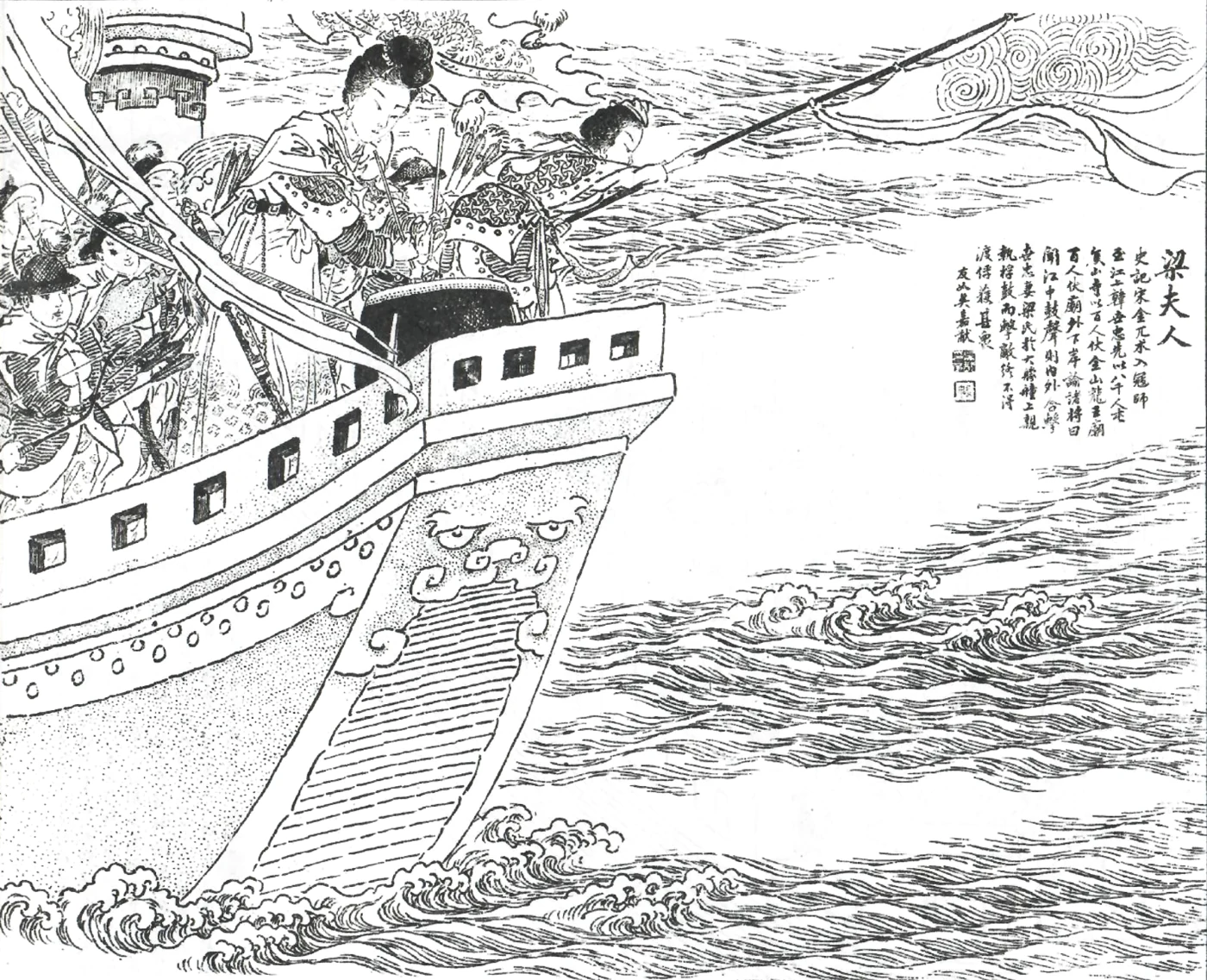
Han Shizhong, then military administrator of western Zhejiang, heard of the retreat and led eight thousand naval troops to Zhenjiang to intercept the Jin. The source says the Jin force claimed one hundred thousand troops and greatly outnumbered him. Zongbi challenged Han to battle on a fixed date and Han accepted. When the Jin began crossing the Yangtze, Han’s navy intercepted them. During repeated fighting on the river, Liang Hongyu personally beat the war drum under arrow fire. The Song force repulsed more than ten attacks and prevented the Jin from crossing.
The setback surprised Zongbi. He sent an envoy offering to return all goods taken south of the Yangtze and give Han famous horses if allowed to pass. Han refused. As the two sides fought while moving along the river, Jin troops unfamiliar with local geography were driven into the dead-end waterway of Huangtiandang. Zongbi had a thirty-*li* stretch of the long-silted Laoguan River channel cut open and escaped toward Jiankang, present-day Nanjing. On the way, he was checked again by Yue Fei and had to turn back toward the Yangtze. Han’s navy used large seaworthy vessels with strong stability and attacking power. He had craftsmen make large iron hooks linked by chains and trained strong sailors to use them against smaller Jin boats. At dawn on the twelfth day of the fourth lunar month, the Jin fleet attacked. Han divided his navy into two forces and counterattacked. With favorable wind, the larger Song ships moved rapidly and used hooks from above to seize one side of enemy vessels and overturn them. The Song force again won.
Repeated victories made Han Shizhong overconfident because he believed the Jin lacked naval skill. An adviser told Zongbi that Han’s large ships could not move without wind and recommended attacking on a calm day. Zongbi prayed for calm weather, and the following day there was no wind. Jin forces launched a full assault in small boats and used fire arrows against the sails of Song ships. Unable to maneuver, the Song vessels became targets and were burned. Song commanders Sun Shixun and Yan Yun were killed, Han Shizhong withdrew to Zhenjiang, and the Jin broke through.
The source characterizes the immediate tactical result as a serious defeat for Han, but argues that strategically the smaller Song force had blocked the Jin for forty-eight days and discouraged further southward operations. After the Jin escaped, Liang Hongyu did not seek reward. Instead, because they had broken through the river defenses, she submitted a memorial accusing Han Shizhong of “missing the opportunity and allowing the enemy to escape” and asked that he be punished. The episode became widely praised, and the court further enfeoffed her Lady of Yangguo.
Chuzhou and the Disputed Date of Death
In 1136, the sixth year of Shaoxing, Han Shizhong was appointed Military Commissioner of Wuning and Anhua and stationed at Chuzhou, present-day Huai'an District in Jiangsu. Liang accompanied him. Using the Huai River as the defensive boundary, they led soldiers in building a new city beyond the old walls to resist Jin troops. Chuzhou had been devastated by war, with insufficient food and housing. Liang personally wove reeds into shelters. Because Han and Liang labored with their soldiers and shared their hardships, the troops were willing to serve. Chuzhou gradually recovered and became an important stronghold. Han Shizhong remained there for more than ten years, and the source says that although his force numbered only thirty thousand, Jin troops did not attack.
The year of Liang Hongyu’s death is disputed. Li Xinchuan’s Southern Song *Chronological Record of Important Events since 1127*, volume 92, records under the dingmao day of the eighth lunar month in 1135 that “the wife of Han Shizhong, Pacification Commissioner of Huainan East, Lady Liang of Qinguo, died; an edict granted five hundred units of silver and silk,” corresponding to October 6, 1135. The source notes, however, that this conflicts with an earlier inscription composed by Minister of Rites Zhao Xiong on imperial order for Han Shizhong. That inscription identifies Lady Bai as Han’s principal wife with the title Lady of Qinguo and Liang Hongyu as Lady of Yangguo. The *History of Song* also records Liang as alive in 1136, when Han received the Wuning and Anhua military commissions and broader pacification authority and established offices at Chuzhou, with Liang accompanying him.
After Liang’s death, the court posthumously granted her the title Lady of Binguo. A posthumous investiture document preserved in Zhang Kuo’s *Dongchuang Ji* praises her gentleness, loyalty, and support of her husband and laments that their prosperity did not continue through old age together.
The *Huaiyin City Gazetteer* and other materials state that Liang Hongyu and Han Shizhong guarded Chuzhou for more than ten years, later resigned from military service after Yue Fei’s wrongful death, and retired to Suzhou. These sources claim that Liang died in 1153, two years after Han Shizhong, but the source explicitly notes that this view remains disputed.
Liang Hongyu's grandfather and father were both military men, and she trained in arms from childhood. In 1120 Fang La rose at Muzhou and quickly gathered several hundred thousand followers, taking prefectures and towns while the government troops failed again and again; her grandfather and father, having missed their opportunities in suppressing the rising, were defeated, condemned and killed, and the family declined, Liang Hongyu falling to the status of a registered courtesan at Jingkou, one of the singing women under official management. She could dance with swords and walk the rope, was skilled in music, song and painting, and being versed in letters and possessed of unusual strength, able to draw a strong bow and never miss, she kept her distance from wealthy young men and had nothing of the courtesan about her.
When Tong Guan returned in triumph from suppressing Fang La he halted at Jingkou and summoned singing women to the feast; Liang Hongyu came in with the others and there met Han Shizhong. While the other officers shouted and drank, Han Shizhong sat gloomily apart, which drew her notice, and her dashing air, free of vulgarity, drew his; each showed the other attention and they were drawn together, the hero and the beauty becoming man and wife. Another account in the *Helin Yulu* relates that Han Shizhong's wife had been a Jingkou courtesan who, going to the office before dawn to await the new-moon congratulations, saw a tiger lying beneath a temple pillar snoring; terrified she fled, and when more people had come and she looked again it was a soldier, whom she kicked awake and asked his name — Han Shizhong. Thinking him no common man she told her mother so, later invited him home, feasted him, pledged herself to him with gifts of gold and silk and became his wife; when he later won great merit as a general of the restoration she was enfeoffed as a lady of two states.
Her most famous deed is the battle of Huangtiandang in 1130. Han Shizhong's fleet blocked the Jin at Zhenjiang, and Liang Hongyu in person took the drum, mounting the tower to beat it and raise the troops' spirits; the Jin were held at Huangtiandang for more than forty days and Wuzhu barely escaped. She was rewarded for it, and her story was elaborated again and again in later drama and fiction, becoming a major figure in the tales of resistance to the Jin. She died in 1135.
The course of the battle of Huangtiandang is recorded in Han Shizhong's biography in the *History of Song* and elsewhere: in 1130 the Jin commander Wuzhu withdrew north from Jiangnan and Han Shizhong with eight thousand sailors held Jiaoshan at Zhenjiang, cutting his route, the two fleets fighting several times on the Yangtze and the Jin being penned in at Huangtiandang for more than forty days. Liang Hongyu in person beat the drum to raise the army's spirit, and her image was shaped again and again in later drama, fiction and painting, making her the most famous woman in the stories of the Song-Jin war. She afterward held Chuzhou with Han Shizhong and shared in military affairs, dying in 1135, and later ages generally take her as the type of the heroic woman.
Her status is variously given in the sources as singing woman, registered courtesan or Jingkou prostitute, and her early life is told in several ways, differences magnified in later drama and fiction. What can be confirmed are her marriage to Han Shizhong and her conduct at Huangtiandang, both recorded in his biography in the *History of Song* and in Song memoirs. Her titles differ among the sources — Lady of Anguo, Lady of Yangguo and others — and the name Liang Hongyu in common use comes from drama and popular usage, her original name and family being unclear in the official histories.
Records of women in Song sources are few, and Liang Hongyu is remembered both for her marriage to Han Shizhong and because the concrete scene of her drumming at Huangtiandang was written down. Later drama, such as the *Record of Two Martyrs*, elaborated her story until her image settled into that of a woman of both letters and arms with uncommon judgment; the distance between those works and the histories is what must be distinguished in using the figure.
Han Shizhong continued to command long after Huangtiandang, holding Zhenjiang and then Chuzhou, and is named with Yue Fei and Zhang Jun among the generals of the Southern Song restoration. While with him at Chuzhou, Liang Hongyu was recorded doing such household things as weaving screens for quarters and encouraging the troops, brief notices consistent with her overall image: a commander's wife who lived with the army and shared in its affairs.
After the Southern Song her image was recreated repeatedly in literature and pictures: her origins and misfortunes, the scene of her beating the drum, the story of how she met Han Shizhong. The relation of these recreations to the brief records in the histories is an interesting topic in the memory of the Song-Jin war.
Shrines to her were built in later ages about Huai'an and her story appears in local gazetteers; these local memories supplement the brief records of the official histories, forming another face of her image.
The battle of Huangtiandang has its limits in Southern Song military history: Han Shizhong, holding the river with his fleet, penned the Jin for a time but, lacking support on land or forces in reserve, could not prevent their withdrawal north through the dredged old channel of the Laoguan river. The engagement did not change the balance between Song and Jin, yet it became a symbol of the will to resist, and Liang Hongyu's image was remembered accordingly.
After the Song, records of her appear mostly in memoirs, gazetteers and drama, her image settling into that of the heroic woman beating the drum at Jinshan. Jinshan is the area of the Jinshan temple at Zhenjiang, where later tradition places the drumming at Huangtiandang, a detail not stated in the official histories but layered on by popular tradition.
Her titles vary among the sources, "Lady of Anguo" and "Lady of Yangguo" among them, the exact style and date of grant not fully consistent — again in keeping with the legendary tendency of her image.
The Southern Song had fixed rules for honors to the wives of generals: Han Shizhong rose to grand tutor and Prince of Xian'an, and his wife's title advanced with his rank. Such institutional matters interweave with the legends of her deeds, so that in discussing Liang Hongyu today one must sift the sources and also weigh the influence of the literary image.
After the Qing her story entered various novels and local opera, most of the episodes invented and far from the historical record; this must be distinguished in using them.
Her tomb is traditionally placed in the Suzhou area, with Huai'an and Zhenjiang also claimed, the dispute over the site itself part of her later commemoration.
She is one of the few women of the early Southern Song remembered for military activity.