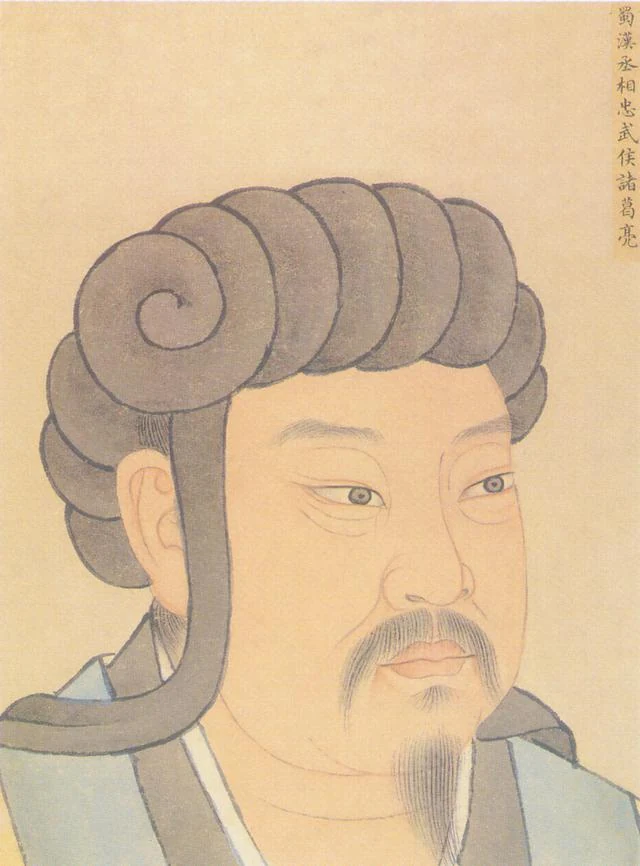
Biography
Family Background and Early Years
Zhuge Liang was born in 181, the fourth year of the Guanghe era under Emperor Ling of Han, into an official family in Yangdu County, Langya Commandery. The Zhuge clan was a prominent family of Langya. His ancestor Zhuge Feng served as Colonel Director of Retainers under Emperor Yuan of Western Han and was known for his uprightness. His father Zhuge Gui, courtesy name Jungong, served as Assistant Administrator of Taishan Commandery in the late Eastern Han. His mother, Lady Zhang, died when Zhuge Liang was three. His father remarried but also died when Zhuge Liang was eight, after which Zhuge Liang and his younger brother Zhuge Jun were raised by their uncle Zhuge Xuan.
In 194, the first year of the Xingping era, Yuan Shu, who had longstanding ties with Zhuge Xuan, appointed him Administrator of Yuzhang. Zhuge Xuan took Zhuge Liang, Zhuge Jun, and their two elder sisters with him. Their elder brother Zhuge Jin remained behind to care for their stepmother and later fled with her to Jiangdong, where he eventually entered the service of Sun Quan. The Eastern Han court later appointed Zhu Hao to replace Zhuge Xuan as Administrator of Yuzhang. Because Zhuge Xuan had old ties with Liu Biao, Governor of Jing Province, he went to Jing Province to seek refuge. Zhuge Xuan married Zhuge Liang's elder sister to Kuai Qi of Zhonglu and his second sister to Pang Shanmin, son of Pang Degong.
In 197, the second year of the Jian'an era, Zhuge Xuan died. At age seventeen, Zhuge Liang settled at Longzhong, twenty li west of present-day Xiangyang in Hubei, where he farmed and studied. According to *Chronicles of Han and Jin*, Longzhong lay in Deng County of Nanyang Commandery, west of Xiangyang. Zhuge Liang was said to be eight chi tall, approximately 185 centimeters in modern measurement. He enjoyed chanting the *Liangfu Yin* and often compared himself to Guan Zhong and Yue Yi. Most contemporaries did not take these comparisons seriously, but his friends Cui Zhouping and Xu Shu believed in his ability.
While in Jing Province, Zhuge Liang studied with Shi Tao, Xu Shu, and Meng Jian. The three sought detailed mastery of texts, whereas Zhuge Liang “grasped their general import.” Morning and evening he would sit calmly, clasp his knees, and let out a long whistle. He once told the others that they could attain office as provincial governors or commandery administrators. When they asked what office he himself might hold, Zhuge Liang merely smiled. Later, when Meng Jian wished to return north because he missed home, Zhuge Liang told him that there were many scholar-officials in the Central Plain and that he could travel widely rather than hurry back to his native place.
During his years at Longzhong, Zhuge Liang married the daughter of Huang Chengyan, a noted scholar from south of the Mian River. Huang told him that he had an unattractive daughter, yellow-haired and dark-complexioned, but well matched to him in talent. Zhuge Liang accepted and married her at once. The marriage became a local anecdote, and a saying warned others not to choose a wife as Kongming had and end up with “Old Huang's ugly daughter.”
Three Visits to the Thatched Cottage and Entry into Service
In 201, the sixth year of the Jian'an era, Liu Bei was defeated by Cao Cao and sought refuge with Liu Biao in Jing Province. Liu Biao received him as an honored guest, increased his troops, and stationed him at Xinye. Liu Bei asked Sima Hui about current affairs. Sima Hui replied that ordinary Confucian scholars could not understand the times and that only outstanding men could do so, adding that the region had its “Crouching Dragon” and “Young Phoenix.” Asked who these were, he named Zhuge Kongming and Pang Shiyuan.
In 207, the twelfth year of the Jian'an era, Xu Shu recommended Zhuge Liang to Liu Bei, saying that Zhuge Kongming was the Crouching Dragon and asking whether Liu wished to meet him. Liu Bei told Xu to bring Zhuge Liang along. Xu replied that Zhuge Liang could be visited but could not be summoned and that Liu himself should go to see him. Liu Bei therefore visited in person and met Zhuge Liang only on the third attempt.
Liu Bei dismissed the others and asked Zhuge Liang for a strategy, explaining that the Han house had declined, powerful ministers had seized authority, the sovereign was in distress, and although he wished to uphold righteousness under Heaven, his own abilities had proved insufficient. Zhuge Liang then set out a plan to divide the realm into three, later known as the *Longzhong Plan* and also called the *Caolu Plan*. He argued that Cao Cao commanded a vast army and controlled the emperor while issuing orders to the lords, so he could not be directly challenged; Sun Quan had held Jiangdong for three generations, with defensible terrain and popular support, and could be allied with but not conquered; Jing Province commanded access to the Han and Mian rivers, the south, the Wu-Hui region, and Ba-Shu, making it strategically valuable, though its ruler could not hold it; and Yi Province was naturally defensible and fertile, while Liu Zhang was weak and capable men there wanted an able ruler. Zhuge Liang advised Liu Bei to control Jing and Yi, secure their natural defenses, maintain good relations with peoples to the west and south, ally externally with Sun Quan, and strengthen government internally. If the realm later changed, a leading general could advance from Jing toward Wan and Luoyang while Liu Bei himself marched from Yi through Qin, making hegemony possible and allowing the Han to be restored.
Liu Bei greatly praised the plan and strongly urged Zhuge Liang to enter his service. Their relationship soon became extremely close, which displeased Guan Yu and Zhang Fei. Liu Bei explained that having Kongming was like a fish having water and asked them to say no more. They stopped objecting. Zhuge Liang was twenty-seven when he entered Liu Bei's service.
The *Weilüe* and *Jiuzhou Chunqiu*, however, record a different version in which Zhuge Liang sought out Liu Bei himself, differing from the account of the Three Visits to the Thatched Cottage found in the *Records of the Three Kingdoms* and the *Memorial on Dispatching the Troops*.
Battle of Red Cliffs and Alliance with Eastern Wu
In 208, the thirteenth year of the Jian'an era, Liu Biao died and was succeeded by his younger son Liu Cong. Cao Cao led a large army south, and Liu Cong sent envoys to surrender. Liu Bei, then at Fancheng, did not initially know Cao Cao had arrived so suddenly. He learned of it only upon reaching Wancheng and then led his followers south. Passing Xiangyang, Zhuge Liang urged him to attack Liu Cong and seize Jing Province, but Liu Bei replied that he could not bring himself to do so.
Earlier, Liu Biao's eldest son Liu Qi had been endangered by slander from his stepmother Lady Cai and repeatedly asked Zhuge Liang how to protect himself. Zhuge Liang initially refused to advise him. Liu Qi then arranged matters so that Zhuge Liang was left upstairs after a ladder had been removed, forcing him to answer. Zhuge Liang asked whether Liu Qi had not heard how Shensheng was endangered by remaining inside while Chong'er was safe outside. Liu Qi understood. When Huang Zu was killed, he took up the post of Administrator of Jiangxia and thereby removed himself from danger.
Cao Cao defeated Liu Bei's army at Changban near Dangyang, and Liu Bei fled to Xiakou. Zhuge Liang volunteered to go as envoy to Eastern Wu and traveled with Lu Su to Chaisang to meet Sun Quan. Zhuge Liang told Sun Quan that disorder had spread throughout the realm, that Sun had raised forces in Jiangdong while Liu Bei had gathered men south of the Han River to contend with Cao Cao, and that Cao's conquest of Jing Province had left heroes with little room to act. He urged Sun to judge his own strength: if Wu and Yue could resist Cao, it was better to break with him at once; if they could not, why not lay down arms and submit northward.
When Sun Quan asked why Liu Bei did not surrender, Zhuge Liang replied that even Tian Heng of Qi had kept faith and refused humiliation, and Liu Bei was a descendant of the imperial house, a man of outstanding talent whom men followed as streams run to the sea; if his cause failed, it would be Heaven's will, and he could not submit to another. Sun Quan answered angrily that he could not hand all of Wu and its hundred thousand troops over to another's control and declared his decision made.
Zhuge Liang then analyzed the military situation. Liu Bei's scattered troops were returning, Guan Yu had ten thousand picked naval troops, and Liu Qi's Jiangxia forces also numbered no fewer than ten thousand. Cao Cao's army had come from afar and was exhausted; his light cavalry had marched three hundred li in a day and a night while pursuing Liu Bei, like “the end of a powerful crossbow, unable to pierce even Lu silk.” Northerners were not accustomed to naval warfare, and the people of Jing had submitted to Cao only under military pressure rather than from genuine loyalty. Zhuge Liang concluded that if Sun sent a capable commander with several tens of thousands of troops to coordinate with Liu Bei, Cao's army could certainly be defeated. Sun Quan was delighted and sent Zhou Yu, Cheng Pu, Lu Su, and others with thirty thousand naval troops to join Liu Bei against Cao Cao.
That winter, the Battle of Red Cliffs ended in Cao Cao's defeat and retreat north. While traveling to Eastern Wu, Zhuge Liang passed Moling and reportedly remarked that Zhongshan coiled like a dragon and Shitou crouched like a tiger, making the place truly fit for an imperial residence. Sun Quan later moved his capital to Moling and renamed it Jianye.
Entry into Shu and the Founding of Shu Han
After the Battle of Red Cliffs, Liu Bei occupied the four commanderies south of the Yangzi in Jing Province. Liu Qi died in 209, the fourteenth year of the Jian'an era, and Liu Bei's followers acclaimed him Governor of Jing Province. Liu Bei appointed Zhuge Liang Military Adviser General of the Household and placed Lingling, Guiyang, and Changsha commanderies under his supervision, with responsibility for gathering tax revenues for military supplies. According to *Lingling Xianxian Zhuan*, Zhuge Liang was stationed at Linzheng because it lay between the three commanderies and was convenient for arranging their revenues.
In 211, the sixteenth year of the Jian'an era, Liu Zhang, Governor of Yi Province, sent Fa Zheng to invite Liu Bei into Shu to help attack Zhang Lu. Zhuge Liang remained in Jing Province with Guan Yu. In 212, Liu Bei broke with Liu Zhang and turned from Jiameng to attack him. Zhuge Liang left Guan Yu to guard Jing and led Zhang Fei, Zhao Yun, and others upriver into Shu. They divided their forces to pacify the commanderies and counties and joined Liu Bei in the siege of Chengdu. In 214, the nineteenth year of the Jian'an era, Chengdu fell. Liu Bei became Governor of Yi Province, appointed Zhuge Liang Military Adviser General, and placed him in charge of affairs of the Left General's headquarters.
When Guan Yu heard that Ma Chao had submitted, he wrote to Zhuge Liang asking whom Ma could be compared with. Knowing Guan Yu's pride, Zhuge Liang replied that Ma Chao was accomplished in both civil and military matters and possessed extraordinary courage, a hero of his age comparable to Qing Bu and Peng Yue and worthy of being ranked with Zhang Fei, but still not as outstanding and peerless as the “Bearded Lord.” Guan Yu was delighted by the letter.
In 221, the first year of the Zhangwu era, Liu Bei proclaimed himself emperor at Chengdu and founded Shu Han, appointing Zhuge Liang Grand Councilor. The same year Liu Bei attacked Wu to avenge Guan Yu. Zhuge Liang opposed the expedition and lamented that if Fa Zheng were still alive, he could have prevented the ruler from marching east. Liu Bei suffered a major defeat at the Battle of Yiling and withdrew to Yongan.
Entrustment at Yongan and Regency
In 223, the third year of the Zhangwu era, Liu Bei fell gravely ill and summoned Zhuge Liang to Yongan to entrust him with affairs after his death. Liu Bei told him that his talent was ten times that of Cao Pi, that he could surely secure the state and complete the great undertaking, and that if the heir could be assisted he should assist him, but if the heir proved unworthy, Zhuge Liang could act as he saw fit. Zhuge Liang wept and replied that he would exhaust the strength of his limbs, maintain loyal integrity, and continue until death. Liu Bei also instructed Liu Shan to serve Zhuge Liang as he would a father.
After Liu Shan succeeded, Zhuge Liang was enfeoffed as Marquis of Wuxiang, appointed Governor of Yi Province, and opened an administrative headquarters. As Grand Councilor he effectively directed the military and civil affairs of Shu Han. He reorganized offices, revised laws and regulations, restored the alliance with Eastern Wu, improved relations with southwestern peoples, and implemented Tuntian to strengthen military preparedness.
Southern Campaign and Northern Expeditions
In 225, the third year of the Jianxing era, rebellion broke out in Nanzhong. Zhuge Liang led a southern campaign and adopted Ma Su's advice that winning hearts was superior to attacking cities and psychological victory superior to battle. According to Pei Songzhi's annotations citing *Chronicles of Han and Jin*, Zhuge Liang captured and released Meng Huo seven times, finally convincing him to submit. Meng Huo is said to have declared that Zhuge Liang's authority was like that of Heaven and that the southern peoples would never rebel again. This story is legendary in character and does not appear in the main text of the *Records of the Three Kingdoms*. After Nanzhong was pacified, Zhuge Liang used local leaders to govern and neither stationed troops nor appointed outside officials there; the region thereafter remained stable.
In 227, the fifth year of the Jianxing era, Zhuge Liang submitted the *Memorial on Dispatching the Troops*, moved his army to Hanzhong, and began Zhuge Liang's Northern Expeditions against Cao Wei. Over the next seven years, he launched five expeditions.
First Northern Expedition (228, sixth year of the Jianxing era): Zhuge Liang used a diversion, sending Zhao Yun and Deng Zhi as a feint at Jigu while personally leading the main force toward Qishan. Nan'an, Tianshui, and Anding commanderies rebelled against Wei in response, shaking Guanzhong. Emperor Ming of Cao Wei, Cao Rui, went personally to Chang'an and sent Zhang He to resist. Zhuge Liang assigned Ma Su to defend Jieting, but Ma disobeyed orders and lost the position, placing the entire campaign at a disadvantage. After withdrawing, Zhuge Liang executed Ma Su and memorialized to demote himself by three grades.
Second Northern Expedition (winter 228, sixth year of the Jianxing era): Zhuge Liang besieged Chencang but withdrew after his supplies ran out. Wei general Wang Shuang pursued and was killed by Zhuge Liang's forces.
Third Northern Expedition (229, seventh year of the Jianxing era): Zhuge Liang sent Chen Shi to attack Wudu and Yinping commanderies. Wei general Guo Huai led troops to their relief, but Zhuge Liang advanced in person. Guo withdrew, and Shu Han obtained both commanderies.
Fourth Northern Expedition (231, ninth year of the Jianxing era): Zhuge Liang again advanced toward Qishan and used the wooden ox and flowing horse for transport. Sima Yi led the defending army. During Zhuge Liang's withdrawal, Wei general Zhang He was killed by missile fire in an ambush.
Fifth Northern Expedition (234, twelfth year of the Jianxing era): Zhuge Liang led the army out through Xie Valley and encamped at Wuzhang Plains, where he faced Sima Yi for more than one hundred days. Sima Yi remained behind his defenses. Zhuge Liang sent women's clothing to taunt him, but Sima still refused battle. He instead questioned a Shu envoy about Zhuge Liang's food and daily routine. On learning that Zhuge Liang ate little and was burdened by many affairs, Sima judged that he could not endure for long.
After the two armies had faced one another for more than one hundred days, Zhuge Liang died of illness in the army camp at Wuzhang Plains in the eighth lunar month of 234, aged fifty-four. Before his death he arranged the order of retreat, assigning Wei Yan to cover the rear and Jiang Wei behind him. After the Shu army withdrew, Sima Yi inspected its camp and exclaimed that Zhuge Liang was “an extraordinary talent under Heaven.”
After Zhuge Liang's death, Liu Shan granted him the posthumous title Marquis Zhongwu. Later generations commonly honored him as Marquis Wu or Zhuge Marquis Wu.
Zhuge Liang, whose courtesy name was Kongming, was a native of Yangdu in Langya and a descendant of Zhuge Feng, who had been a metropolitan commandant of the Western Han. His father Zhuge Gui, styled Jungong, was an assistant to the governor of Taishan at the end of the Eastern Han. Zhuge Liang lost his mother when he was three and his father at eight, and lived with his younger brother Zhuge Jun; his father's younger brother Zhuge Xuan, appointed by Yuan Shu as governor of Yuzhang, took the boys with him to his post, and when the court sent Zhu Hao to replace him Zhuge Xuan, an old friend of the governor of Jingzhou, Liu Biao, went to attach himself to him. After Zhuge Xuan's death Zhuge Liang ploughed the fields at Longzhong, twenty li west of Xiangyang in the Deng district of Nanyang, fond of singing the "Liangfu Song", a man of eight chi in height who often compared himself to Guan Zhong and Yue Yi; his contemporaries mostly did not believe it, and only Cui Zhouping of Boling and Xu Shu of Yingchuan, his friends, thought it true.
Studying in Jingzhou, he and Shi Guangyuan of Yingchuan, Xu Shu and Meng Gongwei of Runan read together; the other three sought mastery of detail, while Zhuge Liang "took only the broad outline". Morning and evening he would sit with his arms about his knees and whistle, and he once told the other three that their official careers would reach the governorship of a province or a commandery; asked what his own would be, he only smiled and said nothing. When Meng Gongwei later longed for home and wished to go north, Zhuge Liang told him that the Central Plains had scholars in plenty and that a man on the move had no need of his native place. That early circle both showed his confidence in the times and built his reputation among the gentry of Jingxiang. Liu Qi, the eldest son of the governor Liu Biao, also esteemed him greatly; when Liu Biao, heeding his second wife of the Cai family, favored his younger son Liu Cong and cooled toward Liu Qi, Liu Qi asked Zhuge Liang repeatedly for a way to secure himself and was put off, until he contrived to take him up a tower for wine and have the ladder removed, saying that between heaven and earth, with the words passing only from his own mouth to Liu Qi's ear, they could speak; Zhuge Liang answered with the lesson of Shensheng, who was endangered at home, and Chong'er, who was safe abroad, and Liu Qi, taking the point, sought a post away from the center and, on Huang Zu's death, became governor of Jiangxia.
Liu Bei, then dependent on Liu Biao, was told first by Sima Hui that pedants and ordinary scholars knew nothing of the times, and that men who knew the times were the outstanding — that here were a Crouching Dragon and a Fledgling Phoenix, namely Zhuge Kongming and Pang Shiyuan; and then, on Xu Shu's strong recommendation, that Zhuge Kongming was the Crouching Dragon, a man to be visited and not summoned, whom the general should wait upon in person. Liu Bei therefore went three times to Longzhong before he saw him, and dismissing his attendants told him that the Han house was falling, that wicked ministers had usurped its commands and the sovereign was in the dust; that he had not measured his own virtue and strength but wished to extend great righteousness through the empire, yet with shallow wisdom and short craft had met defeat after defeat; his purpose, however, was unspent, and he asked what plan there might be. Zhuge Liang then set out what later ages called the Longzhong plan: since Dong Zhuo, heroes had risen without number and held whole provinces and commanderies; Cao Cao, compared with Yuan Shao, was of small name and few followers, yet had beaten him, and not by heaven's timing alone but by men's planning; now Cao Cao had a million troops and, holding the emperor, commanded the lords — he was not to be contested in the field. Sun Quan held Jiangdong for three generations, with strong terrain, a people attached to him and able men in his service: he was to be an ally, not a target. Jingzhou, resting on the Han and Mian rivers, drawing the profits of the southern sea, joining Wu and Kuaiji in the east and Ba and Shu in the west, was a country for war whose master could not hold it — a gift of heaven to the general. Yizhou was a natural fortress of rich fields in which the founder of the Han had made his empire, but Liu Zhang was weak and Zhang Lu was to the north, and its people, wealthy and well supplied, were not cared for, so that able men looked for a wise lord. The general, a scion of the imperial house whose righteousness was known throughout the empire, who gathered heroes and sought talent as a thirsty man seeks water, should hold both Jing and Yi, guard their fastnesses, be at peace with the Rong in the west and gentle with the Yi and Yue in the south, make alliance with Sun Quan abroad and order his government within; then, when the empire changed, one general should lead the army of Jingzhou toward Wan and Luo while the general himself brought the host of Yizhou out through Qin, and who among the people would not welcome him with food and wine? So the hegemony might be achieved and the Han restored. Liu Bei said it was good, and from then on the two were ever closer, so that when Guan Yu and Zhang Fei were displeased Liu Bei explained that with Kongming he was as a fish with water.
In 208, Cao Cao, having unified the north, came south into Jing and Chu with a great army; Liu Biao had died, Liu Cong succeeded and sent envoys to surrender. Liu Bei was then at Fancheng and heard of Cao's approach only at Wan, and marched south with his people; crossing Xiangyang, Zhuge Liang urged him to attack Liu Cong and take Jingzhou, and Liu Bei refused, saying he could not bear it. Cao Cao's cavalry caught and broke him at Changban in Dangyang, and he fell back on Xiakou. Lu Su came to observe the situation and proposed that Liu Bei ask help of Sun Quan, and Zhuge Liang offered to go to the east himself. At Chaisang he met Sun Quan and set out the situation, urging him either to join Liu Bei against Cao or to submit at once rather than waver; within Jiangdong, Lu Su and Zhou Yu stood for war, and Sun Quan resolved on an alliance with Liu Bei against Cao Cao.
Zhuge Liang's argument at Chaisang was the decisive step in forming the alliance. He asked Sun Quan first to weigh his strength: if the host of Wu and Yue could stand against the Central Plains he should break with Cao Cao at once, and if he judged he could not, he should lay down his arms and serve Cao as a subject; to keep the outward name of submission while wavering within, and to hesitate when the crisis was upon him, would bring disaster at once. Sun Quan asked in return why Liu Bei did not himself submit. Zhuge Liang answered that Tian Heng was only a brave man of Qi and yet kept his honor unstained; how much less could Liu Bei, a scion of the royal house whose talents overshadowed his age and to whom the hosts of the realm looked as rivers to the sea, bow to another — and if his cause failed, that would be heaven's will. Sun Quan, roused, said he would not take all Wu and a hundred thousand men and submit to another's control; his mind was made up, and he asked only whether Liu Bei, so lately beaten, could withstand Cao. Zhuge Liang then took up the forces in detail: those of Liu Bei's troops who had rallied and Guan Yu's marines made ten thousand picked men, and Liu Qi's Jiangxia troops were no fewer; Cao's host was wearied from far off, having chased Liu Bei three hundred li in a day and a night with light cavalry — the arrow at the end of its flight that cannot pierce thin silk, which the art of war warns against; and the northerners were unused to fighting on water, while the people of Jingzhou followed Cao only by force, not in their hearts. He concluded that Cao would certainly be beaten and that the outcome would decide whether the three powers stood. Sun Quan, delighted, sent Zhou Yu, Cheng Pu and Lu Su with thirty thousand marines to join Liu Bei against Cao. In the winter of 208 the allied fleets broke Cao Cao heavily at Red Cliff; his losses were great, plague broke out in his army, and he withdrew north.
After Red Cliff, Liu Bei took the southern commanderies of Jingzhou and made Zhuge Liang general of the army of the center, charging him with the three commanderies of Lingling, Guiyang and Changsha and with their taxes for the army's needs. In 210 Pang Tong, then acting magistrate of Leiyang, was dismissed for neglecting his county; Lu Su wrote to Liu Bei that Pang Shiyuan was no talent for a hundred li, and that only as an assistant governor could he stretch his legs, and Zhuge Liang spoke for him too, so that Liu Bei summoned him, talked with him at length, valued him greatly and made him assistant governor, second only to Zhuge Liang in his favor, both being generals of the army of the center. In 211 the governor of Yizhou, Liu Zhang, alarmed by word that Cao Cao meant to send Zhong You against Zhang Lu in Hanzhong, was advised by Zhang Song to invite Liu Bei into Shu to attack Zhang Lu; Fa Zheng was sent with four thousand men to welcome him, and privately laid out how Yizhou might be taken. Zhuge Liang, judging the moment not to be lost, urged Liu Bei to accept; he himself stayed with Guan Yu, Zhang Fei and Zhao Yun to hold Jingzhou while Liu Bei entered Yizhou with several tens of thousands of foot. Hearing that Liu Bei had gone west, Sun Quan sent ships for his sister, and when she would have taken Liu Bei's son Liu Shan back to Wu, Zhang Fei and Zhao Yun barred the river with troops and kept the boy. The next year Liu Bei and Liu Zhang fell out, Zhang Song was executed, and Liu Bei turned to attack Chengdu, sending his generals to reduce the counties while Zhuge Liang with Zhang Fei and Zhao Yun went up the Yangtze, pacifying Baidi, Jiangzhou and Jiangyang, Guan Yu alone holding Jingzhou. In 214, after a long siege, Liu Zhang surrendered; Liu Bei took the governorship of Yizhou and made Zhuge Liang general of the army.
Governing Shu, Zhuge Liang was strict, and many complained. Fa Zheng, holding the capital region without and acting as chief counsellor within, repaid every meal's kindness and every glance of enmity and killed several who had spoken against him; when men urged Zhuge Liang to restrain him, he answered that Fa Zheng had given Liu Bei wings to soar and should not be forbidden to have his way a little, and let the matter drop. On the general policy of government, however, he held his own view: Fa Zheng, citing the founder of the Han who entered the passes with a law of three articles, urged him to relax punishments and lift prohibitions to win the people; Zhuge Liang answered that he knew one thing and not the other — the Qin had been harsh and the people resentful, so that a common man's shout brought the empire down and the founder could afford to be lenient; but Liu Zhang had been weak and benighted, and since Liu Yan's time the laws had been tangled and the government without virtue or authority, so that the great clans of Shu took their own way and the relation of ruler and minister decayed: favor shown through office ends when office is exhausted, and kindness answered by compliance ends when kindness is exhausted. His remedy was to awe them with law, so that when the law ran they would know favor, and to limit them by rank, so that when rank was given they would know honor — favor and honor together, with order above and below. This insistence on law as the maker of authority and rank as the measure of distinction set the tone of Shu-Han government thereafter.
In 219, when Liu Bei faced Cao Cao at Hanzhong and sent urgently for troops from Chengdu, Zhuge Liang asked the Shu commandery official Yang Hong, who answered that Hanzhong was the throat of Yizhou and that without it there would be no Shu, that this was a calamity at the family gate and a matter of survival, that men should fight and women carry, and that there could be no doubt about sending troops; Zhuge Liang sent them at once. Liu Bei held the defiles and would not give battle, and after months of failure Cao Cao withdrew, so that Liu Bei gained Hanzhong and in the autumn was made king of Hanzhong by his assembled subordinates — the Longzhong design of holding Jing and Yi together was now all but achieved. Yet the Eastern Wu had always meant to hold the whole Yangtze: in the winter of 219 Lü Meng crossed the river in white robes, took Jingzhou and killed Guan Yu, a heavy blow to that design. In 220 Cao Pi usurped the Han throne, and with word in Shu that the Han emperor had been murdered, Liu Bei went into mourning and gave him the posthumous title Xiaomin; the grand tutor Xu Jing, the general Mi Zhu, Zhuge Liang as general of the army and more than eight hundred others memorialized together, citing auspicious signs and prophecies, asking Liu Bei to take the throne. In the fourth month of 221 he took it south of Wudan in Chengdu, proclaimed a general amnesty and changed the era name to Zhangwu, making Zhuge Liang chancellor and director of the secretariat with the staff of authority.
After Liu Bei took the throne, Zhuge Liang was chancellor, director of the secretariat and holder of the staff of authority, and on Zhang Fei's death he also took the office of metropolitan commandant. In 222 Liu Bei, in the name of vengeance for Guan Yu, campaigned east against Wu and Zhuge Liang could not stop him; in the spring of the next year he came from Chengdu to Yong'an. In the third month Huang Yuan rose at Linqiong and Zhuge Liang sent the general Chen Hu against him; Huang Yuan was beaten, went downriver and was bound by his own guards and sent to Chengdu for execution. In the fourth month of 223, as Liu Bei lay dying, he entrusted the future to Zhuge Liang with Li Yan as his second, telling him that his ability was ten times Cao Pi's, that he would surely settle the state and complete the great work, and that if the heir could be helped he should help him, but if he were unfit he might take the place himself. Zhuge Liang, weeping, answered that he would exhaust the strength of his limbs and uphold his loyal duty to the death. Liu Bei also left a decree for his heir to serve the chancellor as a father. On Liu Bei's death Liu Shan succeeded, made Zhuge Liang marquis of Wuxiang with his own establishment and soon after governor of Yizhou, and all business great and small was decided by him.
In the first year of Jianxing (223) the commanderies of the south rebelled one after another on the news of Liu Bei's death. Judging the time unfit for war in a year of mourning, Zhuge Liang sent envoys to Wu to make peace and let the people rest, and only in the spring of 225 took the field against the four commanderies, completing the campaign by autumn and returning to Chengdu in the twelfth month. According to the Han-Jin Spring and Autumn Annals, he was victorious everywhere in the south, and hearing that Meng Huo was obeyed by both the Yi and the Chinese, contrived to take him alive and showed him his camps and ranks, asking what he thought of the army. Meng Huo answered that he had failed before through ignorance of the facts but now, seeing the formations, found them easy enough to beat; Zhuge Liang laughed and released him to fight again, capturing and freeing him seven times and again offering to send him home, until Meng Huo stayed of his own will and said that this was heavenly power and the southerners would not rebel again. Having pacified the south he went on employing the local chiefs in their own districts. Remonstrated with, he explained that to keep outsiders there would require troops, and troops would have nothing to eat — the first difficulty; that the Yi, newly broken and in mourning for their fathers and brothers, would certainly turn any outsider without troops into a disaster — the second; and that the Yi, having repeatedly been guilty of deposing and killing their own, would never trust an outsider — the third. He meant, he said, to leave no troops and carry no grain, and yet to give the region rough order and the Yi and Chinese rough peace. The commanderies were then reorganized and the revenues of the south fed the state, so that Shu, well supplied, could drill and arm for a great campaign.
In 227 Zhuge Liang moved to Hanzhong and camped at Yangping Shima north of the Mian, and presented the Memorial on the Expedition, setting out that the late emperor had died with his work half done, that the empire was divided in three and Yizhou worn out, urging his sovereign to draw near to worthy men and keep the petty at a distance, and declaring that he had taken up his charge in the hour of defeat and received his commission in the midst of peril. In the spring of the next year he made a show of marching through the Xie valley against Mei, sending Zhao Yun and Deng Zhi as a decoy to Jigu, which the Wei general Cao Zhen held with all his force; he himself led the armies against Qishan with his ranks in order and rewards and punishments clear, so that Nan'an, Tianshui and Anding went over to him and Guanzhong shook. The Wei emperor Ming went west to hold Chang'an and sent Zhang He against him, and Zhuge Liang put Ma Su in command of the forward troops; Ma Su disobeyed his orders and was heavily beaten at Jieting, so that Zhuge Liang took the thousand households of Xi county and fell back on Hanzhong, and had Ma Su executed before the army. He then memorialized that his own shallow talents and misplaced trust had brought about the failure at Jieting and the neglect at Jigu, and asked to be reduced three grades; he was made general of the right, acting as chancellor with the same powers.
In the winter of 228 he came out through Sanguan and besieged Chencang, held by Cao Zhen, and withdrew for want of grain, turning to cut down the Wei general Wang Shuang who pursued him. In 229 he sent Chen Shi against Wudu and Yinping; when the Wei governor Guo Huai moved to attack, Zhuge Liang came out to Jianwei in person, Guo Huai withdrew and the two commanderies were taken; the emperor restored him to the chancellorship, noting that the fault at Jieting had been Ma Su's while he had blamed himself, and that his recent services — Wang Shuang killed, Guo Huai driven off, the Di and Qiang brought in — were plain. In the autumn of 230 Wei sent Sima Yi by Xicheng, Zhang He by Ziwu and Cao Zhen by the Xie valley against Hanzhong; Zhuge Liang waited for them at Chenggu and Chiban, and thirty days of rain cut the roads, so that they all withdrew, while Wei Yan broke Guo Huai at Yangxi.
In 231 he came out through Qishan again, using the wooden ox for transport, and on withdrawing for want of grain fought and shot down Zhang He. In that campaign his troops broke Sima Yi's command badly near Lucheng, taking three thousand armored heads, five thousand suits of black armor and three thousand one hundred crossbows, and Sima Yi fell back behind his ramparts, earning the Wei soldiers' taunt that they feared Shu as they feared tigers. In 234 he led the army out through the Xie valley and camped on the Wuzhang plain, facing Sima Yi for more than a hundred days while part of his troops farmed the fields along the Wei, living among the people without alarming them. In the eighth month Zhuge Liang died in camp at fifty-four, having ordered his burial at Dingjun mountain in Hanzhong, on the hillside, in a grave just large enough for the coffin, dressed in ordinary clothes without grave goods. Shu gave him the posthumous name Zhongwu; among the people it was said that the dead Zhuge Liang put the living Sima Yi to flight, and that Sima Yi, seeing his camps after his death, called him a genius such as the world had seldom seen.
After the fourth campaign Zhuge Liang did not give up the plan of moving north. In 232 he rested his troops, encouraged farming and built the wooden ox and flowing horse at Huangsha while drilling and training the army for another expedition; in the winter of 233 he had the troops transport grain and concentrated the army at the mouth of the Xie valley, improving the depot there. In the second month of 234 he led the whole host out through the Xie valley and took up position at Wuzhang plain on the Wu river, facing Sima Yi south of the Wei. Because his earlier campaigns had time and again failed for want of transport, he divided his troops to farm as a base for a long stay, the ploughmen living among the people along the Wei, who were undisturbed and suffered nothing from the army. Sima Yi built his ramparts with his back to the river, intending to wear the Shu army out and make it withdraw for hunger, and though Zhuge Liang challenged him repeatedly he would not come out; Zhuge Liang even sent him a set of women's clothes and a kerchief to shame him into battle, at which the Wei generals were furious and demanded to fight, until Sima Yi pretended to memorialize for permission and the Wei emperor sent the commandant Xin Pi with the staff of authority to forbid it.
The two armies faced each other for more than a hundred days. Sima Yi asked the Shu envoy about Zhuge Liang's sleeping and eating and the weight of his business, saying nothing of military matters; the envoy answered that his master rose early and slept late, that he personally read every punishment above twenty strokes, and that he ate less than a few pints — whereupon Sima Yi told those about him that a man who ate so little and worked so much could not last long. Zhuge Liang indeed fell gravely ill from overwork. The president of the secretariat Li Fu came to inquire after him and to ask about the state's affairs, took his leave, and returned some days later; Zhuge Liang said he knew why he had come and named Jiang Wan as fit to take up his charge, and when Li Fu asked who after Jiang Wan, he named Fei Yi, and to a third question he gave no answer. In the eighth month Zhuge Liang died in camp at fifty-four. His last dispositions had Yang Yi and others keep the death secret, draw the army off in good order with Wei Yan and Jiang Wei covering the rear, and Jiang Wei had Yang Yi turn the banners and beat the drums as if to attack, so that Sima Yi drew back and did not press; only after the army was through the valley was the death announced. The people made a saying that the dead Zhuge Liang had put the living Sima Yi to flight, to which Sima Yi remarked that he could reckon with the living but not with the dead, and later, inspecting the abandoned camps, he called Zhuge Liang a genius such as the world had seldom seen.
Zhuge Liang ordered that he be buried at Dingjun mountain in Hanzhong, on the hillside, in a grave just large enough for the coffin, clad as he was, without grave goods. He had earlier memorialized that he owned eight hundred mulberry trees and fifteen qing of thin land in Chengdu, enough for his family's food and clothing, and that in service he depended on the state for all he wore and ate, held no other property and would leave behind neither surplus silk nor unearned wealth to disappoint his sovereign — and it was as he said. After his death the commanderies asked that temples be raised to him, and the court refused on grounds of ritual order, so that the people sacrificed privately by the roads at the four seasons; only in the spring of 263 did the emperor decree a temple at Mianyang — for, as the commandant Xi Long and the palace secretary Xiang Chong memorialized, the men of Zhou spared the pear tree for the sake of Shao's virtue and the king of Yue cast a likeness to remember Fan Li, whereas a man whose virtue reached far and near and on whom the survival of the royal house had in fact depended was being worshipped by the people in the lanes and by the Yi and the Rong in the open fields, which was no way to remember merit and virtue; better to raise a temple near his tomb so that his kin might sacrifice at the proper seasons and old servants come there to do him honor, and private worship be ended in favor of regular rite.
With Zhuge Liang's death the fortunes of Shu-Han ran out. In the winter of 263 the Wei general Deng Ai invaded Shu by the path beside the Jinggu road from Yinping; Zhuge Zhan led the armies to Fu and halted, and after his vanguard was broken withdrew to Mianzhu. Deng Ai sent a letter offering to have him made prince of Langya if he surrendered, and Zhuge Zhan in anger killed the messenger, went out to fight, was badly beaten and died in the field at thirty-seven, his eldest son Zhuge Shang dying with him. Deng Ai drove on to Chengdu and Shu-Han came to an end. A grandson, Zhuge Jing, was afterward given office under the Jin, and the line was not extinguished.