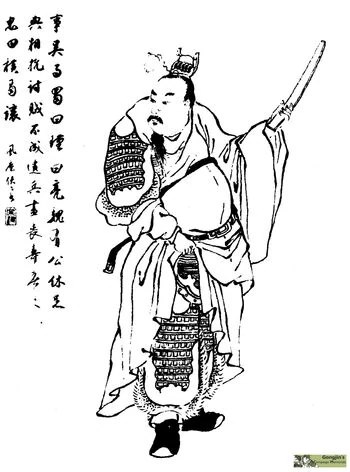
?–258 CE
Senior imperial generalstatesmanleader of the Third Shouchun RebellionMinister of Works (*Sikong*)
Zhuge Dan
诸葛诞
Zhuge Dan, courtesy name Gongxiu, a native of Yangdu in Langya Commandery (modern Yinan, Shandong Province), was an eminent military commander and senior statesman of Cao Wei during the Three Kingdoms period. Descended from the Western Han Director of Retainers Zhuge Feng, he was of the same illustrious lineage as Zhuge Liang of Shu Han and Zhuge Jin of Eastern Wu, celebrated in contemporary adage: "Shu gained the Dragon, Wu…
?–258 CEThree Kingdoms period
PROFILE
Zhuge Dan, courtesy name Gongxiu, a native of Yangdu in Langya Commandery (modern Yinan, Shandong Province), was an eminent military commander and senior statesman of Cao Wei during the Three Kingdoms period. Descended from the Western Han Director of Retainers Zhuge Feng, he was of the same illustrious lineage as Zhuge Liang of Shu Han and Zhuge Jin of Eastern Wu, celebrated in contemporary adage: "Shu gained the Dragon, Wu gained the Tiger, and Wei gained the Hound" (the term "hound" historically designating a fierce martial defender of the state). Zhuge Dan commenced his imperial career as Gentleman of the Masters of Writing and Magistrate of Xingyang before serving as Gentleman of Personnel, acclaimed for administrative transparency. His close intellectual fellowship with prominent figures such as Xiahou Xuan and Deng Yang earned widespread renown in Luoyang, but provoked the ire of Emperor Ming of Wei, who dismissed him in a campaign against "superficiality." Reinstated following the emperor's death, he successively governed Yangzhou, suppressed the conspiracy of Wang Ling, and weathered defeat at the Battle of Dongxing. In 255 CE, he executed envoys sent by rebels Guanqiu Jian and Wen Qin, leading forces to recapture Shouchun and winning promotion to Grand General Campaigning against the East and Marquis of Gaoping. Following the execution of Xiahou Xuan and the consolidation of autocratic power by Sima Zhao, Zhuge Dan grew terrified for his personal survival. He expended his wealth in Huainan, cultivating thousands of sworn retainers. In 257 CE, when Sima Zhao summoned him to Luoyang as Minister of Works, Zhuge Dan executed Yangzhou Inspector Yue Lin, dispatched his young son Zhuge Jing as a hostage to Eastern Wu for reinforcements, and launched a massive rebellion of over one hundred thousand troops at Shouchun. Sima Zhao personally surrounded Shouchun with 260,000 soldiers for ten agonizing months. As supplies vanished and civil starvation ensued, Zhuge Dan killed Wen Qin amidst internal discord. Sima Zhao breached the fortress, and Zhuge Dan was slain while attempting a mounted breakout, leading to the extermination of his lineage. Upon the fortress's fall, hundreds of his personal guards refused imperial pardons, declaring in unison: "To die for Lord Zhuge is without regret!" Their collective martyrdom was likened by contemporary historians to the ancient legend of Tian Heng.
- Era
- the Three Kingdoms period (Cao Wei,?—258 CE)
- Dynasty
- the Three Kingdoms period (Cao Wei,?—258 CE)
- Identity
- Senior imperial general, statesman, leader of the Third Shouchun Rebellion, Minister of Works (*Sikong*)
- Date of Birth
- Not recorded in historical sources
- Date of Death
- April 10 258
- Ethnicity
- Huaxia (Han Chinese)
- Ancestral Home
- Yangdu County, Langya Commandery (Modern Yinan County, Linyi, Shandong)
- Place of Birth
- Yangdu County, Langya Commandery, Xuzhou (present-day Yinan County, Shandong)
- Place of Death
- Unknown
- Lifespan
- Unknown
- Peerage
- Marquis of the Pavilion of Shanyang; Marquis of Gaoping
LIFE TIMELINE
Formative Years | Born into the prominent Zhuge lineage of Yangdu, LanOpen
Formative Years | Born into the prominent Zhuge lineage of Yangdu, Langya; studied classical canons and statutes, developing a commanding and severe demeanor.
County magistrate of Xingyang | He went out from the post of gentlemanOpen
County magistrate of Xingyang | He went out from the post of gentleman of the Secretariat to be magistrate of Xingyang County, and when he and the deputy director Du Ji were shipwrecked on a trial voyage on the Tao River he called to the rescuers to save Du Ji first.
Heroic Sacrifice | Served as Gentleman of the Masters of Writing; shipOpen
Heroic Sacrifice | Served as Gentleman of the Masters of Writing; shipwrecked during a naval trial on the Tao River with Du Ji, he refused rescue until Du Ji was saved, earning imperial admiration.
Entered the Ministry of Personnel | He entered the court as a gentlemaOpen
Entered the Ministry of Personnel | He entered the court as a gentleman of the Ministry of Personnel and was promoted to Censor-in-Chief and Director of the Secretariat, associating with Xiahou Xuan, Deng Yang and others.
Ministry of Personnel | Promoted to Gentleman of Personnel; mandated tOpen
Ministry of Personnel | Promoted to Gentleman of Personnel; mandated that all private solicitations be debated openly before appointments, purifying bureaucratic practices.
Dismissal for ostentation | Because Emperor Ming of Wei detested men oOpen
Dismissal for ostentation | Because Emperor Ming of Wei detested men of showy reputation, he was dismissed from office together with Deng Yang and others.
The Superficiality Purge | Censured by Emperor Ming for ideological clOpen
The Superficiality Purge | Censured by Emperor Ming for ideological cliques alongside Xiahou Xuan and Deng Yang; stripped of ministerial rank and returned to private life.
Imperial Reinstatement | Restored to office following Cao Shuang's regOpen
Imperial Reinstatement | Restored to office following Cao Shuang's regency; appointed Vice Censor-in-Chief, Master of Writing, and subsequently Inspector of Yangzhou.
Restoration under Cao Shuang | With Cao Shuang in charge of governmentOpen
Restoration under Cao Shuang | With Cao Shuang in charge of government he was restored to office as Censor-in-Chief and Director of the Secretariat, sent out as governor of Yangzhou and granted the title of General of Illustrious Martiality.
Defense of Huainan | Supported Sima Yi in suppressing Wang Ling's insuOpen
Defense of Huainan | Supported Sima Yi in suppressing Wang Ling's insurrection; promoted to General Pacifying the East and created Marquis of Shanyang Pavilion.
Defeat at Dongxing | Commanded seventy thousand soldiers attacking EasOpen
Defeat at Dongxing | Commanded seventy thousand soldiers attacking Eastern Wu's Dongxing Dam; ambushed in heavy snow by Wu general Ding Feng, resulting in administrative transfer to General Pacifying the South.
In 252 CE | In 252 CE, following the death of Sun Quan, Regent Zhuge KOpen
In 252 CE | In 252 CE, following the death of Sun Quan, Regent Zhuge Ke of Eastern Wu constructed the Dongxing Dam, erecting twin fortresses across the Yangtze to threaten Wei outposts.
Suppressing Huainan Insurgency | Executed emissaries sent by rebels GuOpen
Suppressing Huainan Insurgency | Executed emissaries sent by rebels Guanqiu Jian and Wen Qin; reclaimed Shouchun and was elevated to Marquis of Gaoping and Grand General Campaigning against the East.
### The Second Huainan Rebellion and the Defeat of Liu Zan In 255 CE |Open
### The Second Huainan Rebellion and the Defeat of Liu Zan In 255 CE | ### The Second Huainan Rebellion and the Defeat of Liu Zan In 255 CE, Guanqiu Jian and Yangzhou Inspector Wen Qin rose in rebellion at Shouchun, issuing a fiery manifesto denouncing Sima Shi for deposing Emperor Cao Fang.
Confrontation with Jia Chong | Severely rebuked Sima Zhao's confidant Open
Confrontation with Jia Chong | Severely rebuked Sima Zhao's confidant Jia Chong over dynastic usurpation, secretly raising thousands of sworn retainers in Huainan for personal survival.
In the winter of 256 CE | In the winter of 256 CE, Zhuge Dan petitioneOpen
In the winter of 256 CE | In the winter of 256 CE, Zhuge Dan petitioned the court for an additional hundred thousand troops and permission to build riverine fortresses along the Huai, citing threat of Eastern Wu invasions.
The Shouchun Insurrection | Defied imperial appointment as Minister ofOpen
The Shouchun Insurrection | Defied imperial appointment as Minister of Works, executed Inspector Yue Lin, sent his son Zhuge Jing to Wu as hostage, and revolted with over one hundred thousand troops.
In 257 CE | In 257 CE, when Sima Zhao summoned him to Luoyang as MinisOpen
In 257 CE | In 257 CE, when Sima Zhao summoned him to Luoyang as Minister of Works, Zhuge Dan executed Yangzhou Inspector Yue Lin, dispatched his young son Zhuge Jing as a hostage to Eastern Wu for reinforcements, and launched a massive rebellion of over one hundred thousand troops at Shouchun.
Siege, Defeat, and Martyrdom | Besieged in Shouchun for ten months untOpen
Siege, Defeat, and Martyrdom | Besieged in Shouchun for ten months until famine forced defeat; killed while breaking out; hundreds of captured retainers chose death over surrender, singing his praises.
In the first month of 258 CE | In the first month of 258 CE, as starvaOpen
In the first month of 258 CE | In the first month of 258 CE, as starvation forced survivors to resort to cannibalism, Zhuge Dan, Wen Qin, and Tang Zi manufactured siege ladders and assault towers, assaulting the southern circumvallation day and night for six desperate days.
### The Fall of Shouchun and the Unmatched Martyrdom of the Retainers Open
### The Fall of Shouchun and the Unmatched Martyrdom of the Retainers On April 10 | ### The Fall of Shouchun and the Unmatched Martyrdom of the Retainers On April 10, 258 CE (the 20th day of the second month), Sima Zhao ordered a simultaneous four-sided assault.
BIOGRAPHY
Major Activities
Selfless Rescue on the Tao River During a naval disaster on the Tao River, Zhuge Dan surrendered his personal chance of survival to prioritize the rescue of senior minister Du Ji, exemplifying aristocratic virtue and establishing his reputation for supreme rectitude. ### Reforming the Selection of Imperial Officials Serving as Gentleman of Personnel, he instituted the practice of publicly broadcasting private recommendations, ensuring that nominations were scrutinized by collective deliberation and eradicating corruption within the civil bureaucracy. ### Defense of Huainan and the Slaying of Liu Zan Long stationed on the southeastern front, he pacified refugees after Guanqiu Jian's rebellion, demonstrated acute operational timing, and pursued and executed Eastern Wu's decorated veteran Liu Zan. ### The Third Shouchun Insurrection against the Sima Hegemony Faced with the systematic eradication of Cao Wei royalists, Zhuge Dan mobilized over one hundred thousand troops in Shouchun, defying Sima Zhao's overwhelming forces in the largest military rebellion of the late Three Kingdoms period. ### Inspiring Unwavering Devotion to the Death Through deep personal magnetism and generosity, he inspired an unmatched bond of loyalty among his retainers. Following the citadel's fall, hundreds of captured warriors faced the block without flinching, choosing death over surrender in an echo of Tian Heng's ancient martyrs.
Personal Relations
- | Category | Name | Relationship Details |
- | :--- | :--- | :--- |
- | Paternal Cousin | Zhuge Jin | Eldest cousin; Grand General of Eastern Wu and Marquis of Wanling, revered for monumental magnanimity |
- | Paternal Cousin | Zhuge Liang | Celebrated cousin; Chancellor of Shu Han and Marquis of Wuxiang, revered across China as a strategic sage |
- | Surviving Heir | Zhuge Jing | Youngest son; sent to Wu as hostage, survived the clan purge, and refused ever to look eastward toward the Jin court out of filial piety |
- | Close Companion | Xiahou Xuan | Renowned Wei scholar and companion of the "Four Astute Ones"; his brutal execution inspired Zhuge Dan's rebellion |
- | Close Companion | Deng Yang | Intimate friend and Cao Shuang partisan; executed in the Gaoping Tomb Purge |
- | Imperial Nemesis | Sima Zhao | Autocratic regent of Wei (later Emperor Wen of Jin); personally commanded 260,000 troops to annihilate Zhuge Dan and his clan |
- | Imperial Provocateur | Jia Chong | Sima Zhao's chief strategist; provoked Zhuge Dan in Shouchun and counseled his preemptive imperial summons |
- | Slain Adversary | Yue Lin | Inspector of Yangzhou and son of veteran Yue Jin; executed by Zhuge Dan during the initial outbreak of the revolt |
- | Volatile Ally | Wen Qin | Wei general turned Wu commander; reinforced Shouchun but was slain by Zhuge Dan during terminal internal disputes |
- | Surviving Defector | Wen Yang | Legendary warrior son of Wen Qin; defected to Sima Zhao after his father's murder, collapsing Shouchun's defense |
- | Sworn Retainers | The Hundreds of Martyrs | Devoted retainers who refused pardons upon Shouchun's fall, unanimously crying "To die for Lord Zhuge is without regret!" |
Historical Assessment
- Chen Shou, *Records of the Three Kingdoms*: "Zhuge Dan was severe, resolute, and imposing; Zhong Hui was acute and master of statecraft. Both attained distinction and exalted office, yet their ambitions outstripped prudence, bringing destruction upon their clans. How lamentable was their delusion!"
- Gan Bao, *Annals of Jin*: "Hundreds stood hand-in-hand in ranks; with each man executed, the next was offered surrender, yet none wavered until all were slain. Contemporaries likened them to the men of Tian Heng."
- Sun Sheng, *Spring and Autumn Annals of Wei*: "Shu gained the Dragon, Wu gained the Tiger, and Wei gained the Hound. In Wei, Dan was equal in fame to Xiahou Xuan; in Wu, the court deferred to Jin's magnanimity. Here, 'hound' refers to a fierce warrior of state, honoring his unyielding valor."
- Wang Shen, *Book of Wei*: "Dan was lavish in gifts; even when men committed capital crimes, he mitigated the law to preserve them. Thus, he was able to extract men's devotion unto death."
- Jia Chong: "In Yangzhou, Zhuge Dan's military reputation is long established; he commands the absolute devotion of men unto death."
- Zheng Qiao, *Comprehensive Treatises*: "The Jin histories sided with Jin against Wei, styling all who remained loyal to Wei as rebels. Wang Ling, Zhuge Dan, and Guanqiu Jian have carried their wrongful dishonor into the yellow earth."
- Wang Fuzhi, *Readings in the Comprehensive Mirror*: "Zhuge Dan rebelled at Shouchun, borrowing foreign arms to attack usurpers. Yet that hundreds of his retainers chose the executioner's blade rather than surrender, proclaiming to the end that dying for Lord Zhuge held no regret, proves how profoundly he moved the hearts of men."
CONTEMPORARIES
Bibliography
- Chen Shou, *Records of the Three Kingdoms*, Volume 28, "Wei: Biographies of Wang, Guanqiu, Zhuge, Deng, and Zhong"
- Pei Songzhi, *Annotations to the Records of the Three Kingdoms*, Volume 28
- Fang Xuanling, *Book of Jin*, Volume 2, "Chronicles of Emperor Wen"
- Sima Guang, *Comprehensive Mirror in Aid of Governance*, Volume 77, "Wei Records IX"
- Gan Bao, *Annals of Jin*