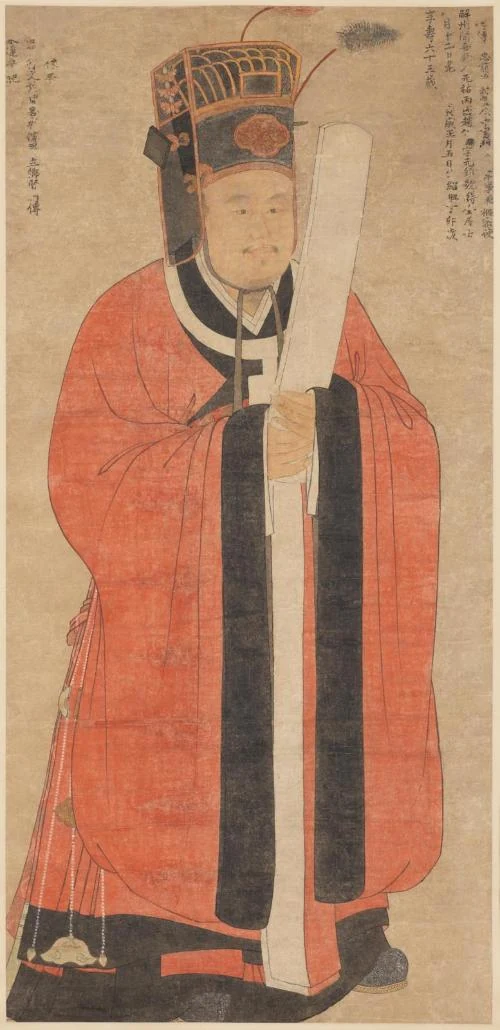
Biography
Family background and early years
Zhao Ding was born in 1085, the eighth year of Yuanfeng in the Northern Song, and was from Wenxi in Jie Prefecture. His father died when he was young, and he was raised and educated by his mother, Lady Fan. She disciplined him strictly and personally supervised his studies. Zhao Ding became familiar with the classics and histories while still young and developed a reputation for literary ability.
In 1106, the fifth year of Chongning, Zhao Ding passed the jinshi examination at the age of twenty-two. According to his biography in the *History of Song*, his policy response criticized current affairs and accused Zhang Dun of having harmed the state. Although this offended powerful figures, it won approval among scholars. After entering official service, Zhao Ding held a succession of local posts, including magistrate of Luoyang in Henan Prefecture and judicial staff officer in Kaifeng Prefecture. He became known for administrative competence and integrity and was attentive to hardships among the population.
Southward flight and rise to power
After the Jingkang Incident and the fall of the Northern Song, Zhao Ding followed Emperor Gaozong of Song south. During the Jianyan era he successively held censorial posts, including service in the Palace Censorate, and actively advised the throne. He once submitted a memorial setting out forty proposals concerning appointments, military administration, finance, and other matters, which drew Emperor Gaozong's attention.
In 1134, the fourth year of Shaoxing, Zhao Ding was appointed Right Vice Director of the Department of State Affairs and concurrently placed in charge of the Bureau of Military Affairs, bringing him into the center of government. In 1135, the fifth year of Shaoxing, he was promoted to Left Vice Director of the Department of State Affairs and formally became Grand Councilor. While in office, he sought recovery of the Central Plains, reorganized government, recommended capable officials, and cooperated with pro-war ministers such as Zhang Jun in planning military action to the north.
Grand councilorship and dismissal
Zhao Ding's most prominent achievement as Grand Councilor lay in personnel appointments. He recommended generals such as Yue Fei and Han Shizhong and entrusted them with regional commands, strengthening Southern Song military capacity. Yue Fei's recovery of the six prefectures of Xiangyang in 1134 took place with Zhao Ding's support.
As the military situation between Song and Jin changed, however, Emperor Gaozong and Qin Gui increasingly favored peace. In 1138, the eighth year of Shaoxing, Zhao Ding firmly opposed negotiations that would require Song to acknowledge subordination to Jin and send tribute. He entered into direct conflict with Qin Gui and was eventually removed from office and sent to govern Shaoxing Prefecture. Qin Gui continued to suppress him. In 1139, the ninth year of Shaoxing, Zhao Ding was impeached by Xiao Zhen, demoted to Vice Director of the Palace Library, assigned nominal service at the Western Capital, and made to live in Quzhou and other places. In 1140, the tenth year of Shaoxing, he was further demoted to deputy military commissioner of Qingyuan Command and assigned to residence in Chaozhou.
Exile and death by refusing food
In 1144, the fourteenth year of Shaoxing, Zhao Ding was transferred to Jiyang Command, in the area of present-day Sanya, Hainan. In exile he lived in seclusion and refused visitors as a form of protest against Qin Gui's persecution. Qin Gui nevertheless remained suspicious and reportedly remarked that "this old man is still stubborn," continuing to have him watched.
The local prefect Wang Ti once lent Zhao Ding a sedan chair to assist his travel. When Qin Gui learned of this, Wang Ti was demoted to Jinzhou. Later Zhang Zongyuan sent a messenger with poems, books, medicine, and other supplies to comfort Zhao Ding, and soon afterward Zhang was also transferred away from Guangnan West Circuit.
In the eighth month of 1147, the seventeenth year of Shaoxing, Zhao Ding died in Jiyang Command after refusing food. Before his death he wrote on a grave stone: "Riding the Winnowing Basket and Tail constellations, I return to heaven; my spirit becomes the mountains and rivers and strengthens this dynasty," expressing his refusal to yield. After his death he was buried at Jiuxian Village in Changhua County.
Posthumous honors
In 1156, the twenty-sixth year of Shaoxing, after Qin Gui's death, the court posthumously restored Zhao Ding to the rank of Tejin and Grand Academician of the Guanwen Hall. After Emperor Xiaozong came to the throne, Zhao Ding received the posthumous name Zhongjian. His writings were later collected as the *Dequan Ji*, and a number of his memorials, poems, and prose works survived.
Counsel and Chancellorship in the Jianyan and Shaoxing Years
Zhao Ding, whose courtesy name was Yuanzhen and whose sobriquet was the Recluse of Dequan, was a native of Wenxi county in Xiezhou, born in 1085. After the disaster of Jingkang, when the northern army reached the river and Gaozong took refuge at Kuaiji, he summoned the censors to deliberate whether to stay or go, and Zhao Ding set out the three courses of fighting, holding and avoiding, and was made assistant censor-in-chief. He asked to have Wang Xie advance to Xuanzhou, Zhou Wang divide his troops to Guangde and Liu Guangshi cross the river to station at Qi and Huang, as a plan of intercepting attack; and he said further that the management of the central plain must begin with the passes, the management of the passes must begin with Shu, and if the emperor would go to Shu he must begin with Jing and Xiang; that Wu and Yue, being confined to a corner, were no ground from which to advance into the central plain, while Jing and Xiang looked left to Sichuan and the passes, held the lakes and Xiang on the right, and overlooked the capital and the Luo, being the ground that the Three Kingdoms must fight for, so that Gong'an should be made the travelling court and heavy troops stationed at Xiangyang, with the grain of Jiang and Zhe sent to support the armies of Sichuan and the passes, there being no better plan for the great enterprise. This argument laid down the strategic pattern by which the Southern Song held the upper waters through Jing and Xiang.
Literary Office and Two Chancellorships
In the fifth month Zhao Ding reached Jiankang, where Gaozong had arrived two days before and had ordered a report on the autumn defence; on the twenty-fifth he sent up his memorial on the advantages and disadvantages of the autumn defence, holding that the place where the six palaces halted should be called the court. In office he repeatedly memorialised, as in his argument on the imperial progress and military dress, that the emperor's escort and dress should not be too plain but should uphold the majesty of the sovereign and the ceremonies of the court; and in his argument that shrinking and drifting must give way to each taking his own responsibility, he held that the evil of the government then lay in the censors not speaking fully and the court not taking responsibility, and that those who governed should not shrink and drift, but should hold their purpose firmer and meet the moment with more vigour, so that ministers should bear the duty of ministers and officers the duty of officers, and so the realm could be ordered within and repelled without.
Afterwards he was sent out to a provincial post, and the scholars all regretted his going, some of the censors seeking to keep him. Just then frontier reports came thick, and as Zhao Ding constantly set out the great plans of war and came into the palace to take leave, Gaozong said that he could not go far, and that he would surely make him chancellor. When Zhu Shenfei left the chancellorship, Zhao Ding indeed became right vice director of the department of state affairs and joint manager of government affairs. When Jin and the puppet Qi joined forces in a great attack and the whole court was shaken, on the first day of the tenth month Zhao Ding asked Gaozong to take the field in person and set out the plan of fighting and defending; the generals each held their own view, and only Zhang Jun thought an advance should be made, with whom Zhao Ding agreed, and so Zhang Jun was ordered to lead his troops to aid Han Shizhong and Liu Guangshi to move his army to Jiankang, and Han Shizhong was pressed to advance. When some advised Gaozong to move his court elsewhere, Zhao Ding said that if the fight were lost it would not be too late to go; and Gaozong said that he would lead the six armies in person and fight a decisive battle at the river.
Dealings with Zhang Jun and Qin Hui
Zhao Ding and Zhang Jun had once contended over the command of the upper waters, and when Zhang Jun was displeased at Zhao Ding's opposition to his plan, Zhao Ding used the way of removing petty men as a figure: that from of old, if one was too hasty in removing petty men they would close ranks and do greater harm, whereas if one went slowly they could be made to push one another out. Taking the guilt of the eunuch Feng Yi as his example, he said that to put him to death would not be enough to satisfy the hearts of the realm, and that it were better to banish him far off, since this would neither go against the imperial will nor move the eunuchs to plead hard for him, so that his party might gradually come apart. Zhang Jun, hearing it, was convinced. Zhao Ding also memorialised that the matter of Feng Yi was obscure and hung between being and not being, yet touched the dignity of the state; and that if the court took no punishment at all, outsiders would certainly think that the emperor had indeed sent Feng Yi to do this, which would injure the imperial virtue, so that it were better to relieve him of office for a time and send him elsewhere to dispel the doubts of the many; and Gaozong, pleased, sent Feng Yi to eastern Zhe.
In the eighth year of Shaoxing, when Jin sent envoys to discuss peace and the opinion of the court held it untrustworthy, Gaozong was enraged. Zhao Ding said that the emperor had with the men of Jin a hatred that could not be worn in the same sky, and that in stooping to seek peace he did so because of the coffins of the two former emperors and the empress dowager; that the indignant words of the ministers sprang from love of their sovereign and could not be made a crime; and that the emperor should tell them that peace was not his own wish but was done for the sake of his kin and because he could not do otherwise. Afterwards, over the matter of Xiang Ziyin and the objection of Zhang Zhiyuan, Gaozong, having prior words in his ear, was from that time displeased with Zhao Ding; and when Qin Hui stayed behind to report and Zhao Ding asked on his way out what the emperor had said, Qin Hui answered that the emperor had said nothing, only that he feared the chancellor was displeased. After Zhao Ding became chancellor a second time, some accused him of doing nothing, and he answered that the situation was like a man gravely ill, who should be quiet and nursed, and that if he were further cut and probed his vitality would surely be injured. Through his insistence Gaozong went south from Jiankang to Lin'an, and from that time Lin'an became formally the travelling seat of the Southern Song.
Afterwards Zhao Ding was hated by Qin Hui and repeatedly banished, at last to the army of Jiyang for the south of the sea. He wrote on his funeral banner that his body would ride the Winnowing Basket and Tail to heaven and his spirit become rivers and mountains to strengthen the dynasty, and died in the place of banishment in the seventeenth year of Shaoxing, 1147.
Early Years and the Jingkang Crisis
Zhao Ding lost his father at four and was raised and taught by his mother, of the Fan family, who was posthumously given the title of Lady of Qin. He mastered the classics, histories and the hundred schools, passed the examination as a presented scholar in the fifth year of Chongning, and in his policy answer directly denounced Zhang Dun for ruining the state. He rose to be magistrate of Luoyang in Henan, and the chancellor Wu Min, knowing his ability, promoted him to be an officer of Kaifeng; in the fifth year of Zhenghe, 1115, he was transferred to be assistant magistrate of Hedong, and later passed to the regular capital ranking and was made a revenue officer of Tongzhou. In the Jingkang years, when the men of Jin took Taiyuan and the court deliberated ceding the three garrisons to buy peace, Zhao Ding said that the land of the ancestors could not be given to others and that there was nothing to deliberate; and soon after the capital fell and Huizong and Qinzong were carried north. In the second month, when the men of Jin proposed to set up Zhang Bangchang, Zhao Ding fled with Hu Yin and Zhang Jun into the imperial academy and would not sign the memorial of assent. When Shao Zemin told him that Zhang Bangchang meant to have the Empress Dowager Meng hold the curtain and had already sent the imperial seal to her, Zhao Ding consented to be made vice director of the imperial library, judicial commissioner of the capital region and acting deputy commissioner of transport; afterwards, unwilling to hold office under the puppet Chu regime, he refused it in every way he could.
The Centre and the Reform of Military Administration in Jianyan
On the eleventh day of the second month of the third year of Jianyan, 1129, Gaozong ordered the secretaries of the several boards to recommend men of talent. On the eighteenth day of the eleventh month of that year the men of Jin came south in force, and Zhao Ding at once sent up his memorial asking the Hubei military commission to guard Wuchang and other places, saying that one should not hope the enemy will not come but should rely on having made one's own preparations. At that time the military administration of the court was divided, the office of the imperial camp and the bureau of military affairs standing side by side so that orders issued from two sources; and Zhao Ding first reformed the imperial camp, having its office merged into the bureau of military affairs as the bureau of swift measures, with the chancellor still cognisant of the bureau, and settling the system of the five imperial armies with their officers under the bureau, so that the imperial camp, which had existed four years, was abolished. He also regularised the working procedure of the great provincial officials, holding that officials had lost their functions and were legislating by precedent to great harm, and had the capital office collect the precedents of earlier and later practice, reduce them to a middle standard and fix them as standing law for the offices to keep. He further memorialised against the power of the palace attendants, reproving those who moved bamboos into the inner palace, and calling a revenue official who sent money into the palace to the chancellery for severe reproof and having him transferred to a provincial post.
Rifts with Lü Yihao and Joint Chancellorship with Zhang Jun
In the seventh month Gaozong, because Zhao Ding and Zhu Shenfei differed, sent him out to a provincial post; and Zhao Ding had once told Gaozong that the emperor had the sincerity to receive counsel while the chancellor set out the doctrine of rejecting remonstrance, and that the emperor had the will to favour the censors while the chancellor used his power to break the majesty of the remonstrating officials. He then stayed at home and did not go out, and sent up a memorial listing more than a thousand words of Lü Yihao's faults. Gaozong dismissed Lü Yihao and by edict again made Zhao Ding assistant censor-in-chief, telling him that he had always regretted not knowing the loyal remonstrating ministers of earlier reigns and now saw one in him. Gaozong said of him that as a remonstrating official he had been most fit for the office and that of the forty matters he had spoken of, thirty-six had been carried out. After Lü Yihao became chancellor a second time he disliked Zhao Ding's disagreement with him and transferred him again; yet Zhao Ding still employed the fiscal officials whom Lü Yihao had used, so that under his government the economic measures suffered no great disturbance.
The period when Zhang Jun and Zhao Ding were chancellors together is held to have been the cleanest government of the early Southern Song: Zhang Jun was right vice director of the department of state affairs, cognisant of the bureau of military affairs and superintendent of the armies of the several circuits, standing outside as a chancellor who was also a general, while the government of the court was entrusted to Zhao Ding. When Wang De put his subordinate Chen Yanzhang to death without authority, Zhao Ding judged Wang De guilty of death, and although Gaozong spared him for his military merit, Zhao Ding said that Wang De, commanding troops abroad, killed without fear and that if this were not punished none would fail to do the same; Gaozong had Wang De arrested, and Zhao Ding further asked that Han Shizhong be sharply reproved by edict and his officers and clerks handed to the offices for judgement, so that the generals were awed. Zhang Jun was able in strategy and Zhao Ding held the balance, the one within and the one without supporting each other. Later, because of Lü Zhi's mediation and the proposal to dismiss Liu Guangshi, the two grew estranged, and Zhao Ding asked to resign the chancellorship.
Banishment and After Death
After Zhao Ding left the chancellorship to govern Shaoxing prefecture, Qin Hui led the ministers of government to see him off, and Zhao Ding, treating him without courtesy, bowed once and went away, so that Qin Hui hated him the more. When Zhao Ding returned from Quanzhou and again memorialised on the government, Qin Hui, fearing he would be used again, had Wang Ciweng impeach him for having accepted the puppet mandate and embezzled a hundred and fifty thousand strings of cash from the supervisory office, and he was banished to Chaozhou. In Chaozhou for five years he shut his door and received no guests, spoke not of the times, and when asked only took the blame on himself. Afterwards, accused again of taking bribes, he was moved to the army of Jiyang, and there for three years lived deep in retreat, while the officials of his former staff dared not write to greet him and only the commander of Guangxi from time to time sent him some rice wine; and Qin Hui, learning of it, had the local army report each month whether he lived or died. Zhao Ding wrote on his funeral banner that his body would ride the Winnowing Basket and Tail to heaven and his spirit become rivers and mountains to strengthen the dynasty, and charged his son to ask that his body be brought home for burial, and so starved himself to death at the age of sixty-three. After Emperor Xiaozong came to the throne he was posthumously made grand mentor, given the posthumous name Zhongjian, the Loyal and Simple, and enfeoffed as Duke of Feng; and in the fifteenth year of Chunxi, 1188, he was granted sacrifices in the temple of Gaozong together with Lü Yihao, Han Shizhong and Zhang Jun.
Military Measures and the Front
In the ninth month of the fourth year of Shaoxing the son of Liu Yu, the puppet emperor of Qi, joined the men of Jin in a great invasion. Zhao Ding asked Gaozong to take the field in person and to issue an edict pacifying the Huai west; and on Li Gang's earlier plan he had the generals hold the enemy by separate roads. Han Shizhong defeated the men of Jin heavily at Dayi, and for a time good news came often, though through poor communication alarms still passed back and forth between front and rear. Liu Guangshi, learning of it, sent to advise Zhao Ding that he should go into Shu himself and not take another's danger on himself; and Han Shizhong too said of him that Chancellor Zhao truly dared to act. On the twenty-first day of the twelfth month, when the men of Jin had long lain in Huainan and, knowing the Song army was prepared, were slowly minded to go north, Zhao Ding said that the men of Jin could do nothing more. Gaozong had the generals intercept them among the Huai and they were defeated again and again and fled, and Gaozong told Zhao Ding that the officers now strove to be first and the defending ministers everywhere answered to the call, which was the effect of his employment.
In the sixth year of Shaoxing, Liu Lin and Liu Ni invaded again. Zhao Ding ordered Yang Yizhong to hasten to Hefei to aid Liu Guangshi, but Liu Guangshi had already abandoned Luzhou and gone back north of the river; and Zhang Jun wrote to Zhao Ding, who had Gaozong send an edict to Zhang Jun that those who disobeyed were to be dealt with by military law. Liu Guangshi, greatly alarmed, advanced again to the Fei river and fought Liu Lin and defeated him, so that Liu Lin and Liu Ni broke camp and fled. Earlier Zhang Jun had held his troops and brought about the fall of Chuzhou, and the men of Jin remained by the Huai, whereupon Zhao Ding asked by memorial to resign. He told Gaozong that to seize Liu Yu was easy, but that if Henan were taken could it be guaranteed that the men of Jin would not invade again, and that Liu Guangshi had been a general for generations and to dismiss him without cause would, he feared, unsettle men's minds. He differed with Zhang Jun on dismissing Liu Guangshi and therefore in the twelfth month asked to resign the chancellorship. Liu Guangshi's officer Li Qiong, having an old grudge against Wang De and getting no redress from Lü Zhi, seized Lü Zhi and led his whole army over to the puppet Qi.
The Recommending of Men and the Question of the Succession
Throughout his chancellorship Zhao Ding drew in men of worth with all his strength. He praised to Gaozong the left guard commander who had done good service in intelligence, and recommended Yue Fei for the command of the upper waters; and as the three prefectures of Shu, Qi and Huang were administratively divided among several circuits and militarily bound by several authorities, he advised that they be subject to one office, and Gaozong ordered Shu and Qi subject to Yue Fei and Huang to Lü Zhi. He asked that the court give Yue Fei strong support and had Gaozong write in his own hand to the supervisory and military offices to supply Yue Fei's army, so that its reputation rose greatly and it took Xiangyang at one blow. Zhang Jun had long been out of office, and Zhao Ding said he could bear great charge, whereupon Gaozong recalled him as cognisant of the bureau of military affairs and sent him to inspect the troops on the Yangtze. The man he recommended, Xiao Zhen, once in the censorate impeached the assistant administrator Liu Dazhong and had him dismissed; and Zhao Ding said that Xiao Zhen's true aim was not Liu Dazhong, while Xiao Zhen said of him that Chancellor Zhao would leave office of himself before he was blamed.
On the succession, when Gaozong enfeoffed Zhao Yuan as Duke of Jianguo and Zhao Qu as Duke of Wu, Zhao Ding objected, saying that the state of Jianguo given to Zhao Yuan was small while the state given to Zhao Qu was great, and urging that Zhao Yuan be given a first-class small state to settle men's minds. Gaozong said they were but children and let it pass, but in the end, through the insistence of Zhao Ding and others, Gaozong had to withdraw the order giving Zhao Qu the dukedom of Wu. Qin Hui seized the chance to slander him, saying that Zhao Ding wished to set up an imperial son, which was as much as to say the emperor would never have a son of his own, and that the heir should be set up only after the emperor had a son; and so their hatred deepened.
The Question of the Capital and the Terms of Peace
Zhao Ding, twice chancellor, had strong views on where the capital should be: he held Jing and Xiang to be the root of the upper waters and would have Gong'an made the travelling court and heavy troops stationed at Xiangyang; and afterwards he strongly urged the return from Jiankang to Lin'an, saying that the situation was like a man gravely ill who should be quiet and nursed and that further cutting would injure his vitality, and Gaozong followed him, so that Lin'an became formally the seat of the Southern Song. In the negotiations with Jin he gave more than twenty instructions in person, insisting that the annual tribute of silver and silk should not exceed two hundred and fifty thousand taels and bolts, demanding all the land ruled by Liu Yu and refusing to accept enfeoffment from Jin, so that though he presided over the peace he yet upheld the interest and dignity of Song. He afterwards contended hard over the terms with Jin and differed from Qin Hui; and when Gaozong was minded to banish Zhang Jun to Lingnan, Zhao Ding held back the palace order and did not send it down, and pleaded hard for Zhang Jun's error, saying that his fault was but a mistaken plan, that no man's calculations sought anything but safety, and that if one mistake were to bring death no man with a secret stratagem would dare speak again, and that this concerned the court and not his private affection for Zhang Jun; and Gaozong's anger was appeased.
Measures in a Provincial Post and the Welcoming of the Imperial Tombs
In the Jianyan years Zhao Ding went from the centre to be pacification commissioner of Jiangxi and prefect of Hongzhou. In the fourth month of the fourth year of Shaoxing, having just reached Hongzhou, he sent up a memorial asking for the grant of money and grain, and another saying that Hongzhou had suffered war and fire, that the people were deeply afflicted and that no paper households remained, and praying that their purchases be remitted. At that time Han Shizhong, pacification commissioner of the Jiangnan east and west circuits, was stationed with his army in the prefectural city and treated Zhao Ding with great courtesy; and as many of the troops in both armies were bandits taken into service, seeing Zhao Ding so upright they kept their discipline. He also sent up his memorials asking that the emperor write to Yue Fei in his own hand, seeking real support for Yue Fei's army and having the transport officials gather money and grain for five months of its expenses, which made Yue Fei very willing to follow him.
In the fourth month of the third year of Shaoxing, Zhao Ding again memorialised on the return of the imperial carriage, urging that the emperor should not go at once back to Jiankang; and afterwards, when the court welcomed the tablets of the imperial tombs and empresses to the court at Lin'an, Zhao Ding led the hundred officials and the imperial clan to receive the tablets of the ancestral temple outside the Houzhao gate. He attended also to small matters of the river defence: in the tenth month, because Yue Fei, as commissioner of the riverside command, kept a great army and had posts along the river while warships were short, Zhao Ding memorialised asking that ready money be granted to build boats; and because Tang Dongye, prefect of Jiankang, was remiss, he impeached his failure of control along with Lian Nanfu's neglect.
Recall in Later Years and Posthumous Honours
In his later years Zhao Ding was once recalled and again held the chancellorship. In court he recommended several tens of men of good repute to be distributed through the government, such as Liu Dazhong, Hu Yin, Lü Benzhong and Chang Tong; and he once sent up a memorial of thanks saying that with white hair he had nowhere to return and grieved that little life was left, but that his loyal heart was not yet dimmed and he vowed that through nine deaths he would not change. When Qin Hui saw it he said that the old man was as stubborn as ever. Thereafter Qin Hui pressed him out step by step, until he was banished far off to Chaozhou and Jiyang. After his death twelve of his sons and grandsons were given office; after Emperor Xiaozong came to the throne he was posthumously made grand mentor, given the name Zhongjian and enfeoffed as Duke of Feng; and in the fifteenth year of Chunxi, 1188, he received sacrifices in the temple of Gaozong with Lü Yihao, Han Shizhong and Zhang Jun. The shrine of the Five Lords at Haikou in Hainan was built to offer sacrifice to five famous ministers of history including Zhao Ding, and is so named because men looked up to those five lords.