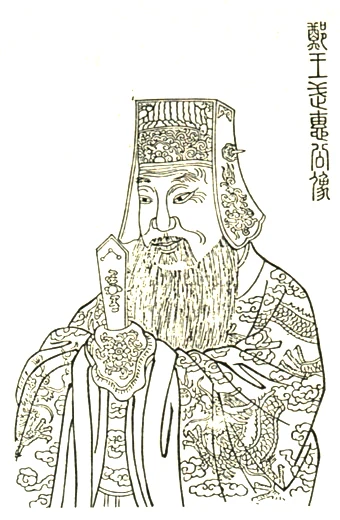
Biography
Family Background and Early Years
Pan Mei came from a military family. His father, Pan Lin, served as a military officer stationed at Changshan, present-day Zhengding in Hebei. As a young man Pan Mei was known for his spirited bearing and served in his local administration as an usher. He once told his fellow townsman Wang Mi: "The Han regime is nearing its end. Treacherous officials act violently and without restraint, and there are signs that the realm is about to change dynasties. If a true man does not establish merit and seek rank and fortune at such a time, but instead lives obscurely and perishes together with the ordinary world, that would truly be shameful." The remark reflected his early ambition to win distinction through public service.
In the winter of 950, the third year of the Qianyou era, Guo Wei, Military Affairs Commissioner of Later Han, launched a mutiny and in the first month of the following year proclaimed himself emperor, establishing Later Zhou. Pan Mei joined Guo Wei and became an attendant to Chai Rong, then prefect of Kaifeng. In the first month of 954, the first year of the Xiande era, Chai Rong became Emperor Shizong of Later Zhou and Pan Mei was appointed a Palace Attendant. In the third month, Northern Han and Liao jointly attacked Later Zhou. Shizong met them in Zezhou and defeated the Northern Han army at Gaoping. Pan Mei participated in the campaign and was ordered to hold Jiangzhuling with several thousand picked troops. Enemy reinforcements indeed approached by that route, but Pan Mei held his position rather than giving battle, and the enemy withdrew. For this service he was promoted to Deputy Commissioner of the Western Upper Gate. He soon became army supervisor in Shanzhou and later an usher commissioner. When Chai Rong planned military operations toward Long and Shu, Pan Mei was ordered to command troops stationed at Yongxing and manage western military affairs.
Achievements in the Early Song
Zhao Kuangyin treated Pan Mei generously. After the Chenqiao Mutiny, Zhao ordered him to go first to the chief ministers and proclaim the new imperial instructions to officials and the wider realm. At the time, Yuan Yan, the commanding officer at Shanzhou, was fierce, trusted unworthy men, was fond of killing and accumulating wealth, and had been repairing weapons. Zhao Kuangyin feared that he might rebel and sent Pan Mei to observe and deal with his troops. Pan Mei rode alone to deliver the imperial message, arguing that the Mandate had already been settled and that Yuan Yan should fulfill the duties of a subject. Yuan Yan consequently came to court. Zhao Kuangyin was pleased and said, "Pan Mei did not kill Yuan Yan, yet he made him come before me. This fulfilled exactly what I wished."
In 960, the first year of Jianlong, Li Chongjin rebelled. Zhao Kuangyin personally led the campaign, appointed Shi Shouxin as campaign commander, and assigned Pan Mei as army inspector to assist him. After Yangzhou was pacified, Pan Mei remained as circuit inspector to carry out measures of pacification and was appointed Training Commissioner of Taizhou for his service. In 963, the first year of Qiande, after the Song suppressed the Hunan rebel Wang Duan, local society remained unsettled, so Pan Mei was appointed Defense Commissioner of Tanzhou, present-day Changsha in Hunan. Liu Chang, ruler of Southern Han, repeatedly sent forces against Guiyang, Jianghua, and other places; Pan Mei defeated them each time. Xidong Man-Liao communities had frequently raided settled districts since the Tang, causing serious hardship. Pan Mei pursued them into their strongholds, killed or captured many, and reassured the survivors, bringing the minority regions under control. In 964, the second year of Qiande, he also joined Army Inspector Ding Deyu and others in capturing Chenzhou.
Conquest of Southern Han and Southern Tang
In 970, the third year of Kaibao, the Song court ordered a campaign against Southern Han. Pan Mei was appointed commander-in-chief of all expeditionary forces and concurrently Training Commissioner of Langzhou, present-day Changde in Hunan, with Yin Chongke as his deputy. The army advanced and captured Fuzhou, in present-day Zhaoping County, Guangxi. Liu Chang sent more than ten thousand troops to reinforce it, but Pan Mei defeated them and captured Hezhou. In the tenth month, he captured Zhaozhou, Guizhou, and Lianzhou, after which the prefectures along the Xi River surrendered in succession. For these victories Pan Mei was transferred to command the southern expeditionary forces and advanced to Shaozhou, present-day Shaoguan in Guangdong. Shaozhou guarded the northern approach to Guangzhou, and more than one hundred thousand enemy troops assembled there. Pan Mei seized an opportunity to attack, captured the city, and killed or captured tens of thousands of Southern Han soldiers.
Under extreme pressure, Liu Chang sent the official Wang Gui to the Song camp to ask for peace and then sent Left Vice Director Xiao Cui and Secretariat Drafter Zhuo Weixiu with a formal submission offering surrender. Pan Mei conveyed Zhao Kuangyin's position: those able to fight should fight, those unable to fight should defend, those unable to defend should surrender, those unable to surrender should die, and those unable to die should flee; no outcome beyond those five would be accepted. Liu Chang then sent his younger brother Liu Baoxing to resist. Pan Mei marched rapidly to Zhatou, only 120 *li* from Guangzhou. A Southern Han force of 150,000 held strong positions in the valleys. Pan Mei told his generals: "The enemy has woven bamboo and timber into palisades. If we use fire, their ranks are certain to collapse; if we then strike them from both sides with elite troops, victory will be secure." Several thousand laborers were each issued two torches and secretly led to the palisades. At night more than ten thousand torches were set to the defenses at once. A strong wind rose and the fire spread fiercely. The Southern Han army surged out in alarm, and Pan Mei immediately led a counterattack. The enemy was routed and tens of thousands were beheaded. The Song army drove straight to Guangzhou. Liu Chang burned the government storehouses, but the Song troops captured the city, took Liu Chang prisoner, and sent him to the capital. On that day, the court appointed Pan Mei and Yin Chongke as joint administrators of Guangzhou and Maritime Trade Commissioners. In the fifth month, Pan Mei was appointed Military Governor of Shannan East Circuit. In 972, the fifth year of Kaibao, he concurrently became Fiscal Commissioner for Lingnan Circuit and suppressed the local magnate Zhou Siqiong's rebellion, bringing Lingnan under control.
In 974, the seventh year of Kaibao, the Song planned a campaign against Southern Tang. In the ninth month, Pan Mei, Liu Yu, and other generals were sent in advance to Jiangling. In the tenth month, Pan Mei was appointed army inspector for the Shengzhou-route expedition and set out with Cao Bin, establishing positions near the Qinhuai River. Boats were not yet ready, but Pan Mei ordered: "I have received the imperial command and lead tens of thousands of brave and battle-hardened troops in the expectation of certain victory. How can we allow a stretch of shallow water to stop us from crossing directly?" He then ordered the army across the river, defeating the Southern Tang forces. When the floating bridge at Caishiji was completed, Southern Tang attacked upstream with more than twenty warships, beating drums as they advanced. Pan Mei led a fierce counterattack, captured enemy vessels, took seven Southern Tang officers including Zheng Bin prisoner, broke through the enemy's southern waterside stockade, and assigned naval forces to guard it. He reported to the court. Zhao Kuangyin sent an envoy ordering the warships to be moved immediately in case of a surprise attack, and Pan Mei complied at once. That night Southern Tang did indeed attack the naval camp but failed. Pan Mei advanced on Jinling. A Southern Tang army of one hundred thousand deployed outside the city by land and water; Pan Mei attacked and routed it. Li Yu, ruler of Southern Tang, sent Xu Xuan to seek peace, but Zhao Kuangyin refused. Li Yu then sent several thousand men at night with torches and drums to attack. Pan Mei led picked troops into close combat and, taking advantage of the situation, joined Cao Bin at dawn in a multi-pronged assault on the city. After Southern Tang was pacified, Pan Mei was appointed Northern Court Commissioner of Palace Communications for his service.
Northern Campaign against Taiyuan and Defense of the Frontier
In the eighth month of 976, the ninth year of Kaibao, the court appointed Pan Mei army inspector to assist Dang Jin in attacking Taiyuan, capital of Northern Han. The two armies fought on the Fen River and the Song forces inflicted a major defeat on Northern Han. Early in the Taiping Xingguo era under Emperor Taizong, Pan Mei was transferred to the southern court commission. In 978, the third year of Taiping Xingguo, Zhao Guangyi granted him the additional rank of Kaifu Yitong Sansi.
In 979, the fourth year of Taiping Xingguo, Emperor Taizong ordered the conquest of Taiyuan. Pan Mei became commander for the northern route and head of the Taiyuan field administration, coordinating the various generals in the destruction of Northern Han. The army then campaigned against Fanyang, and Pan Mei was appointed head of the Youzhou field administration. When the main force withdrew, Zhao Guangyi appointed him concurrently commander at Sanjiao and left him to defend the northern frontier. Three hundred *li* northwest of Sanjiao lay a place called Gujun, whose rugged terrain made it a strategic throat of the northern defenses. Pan Mei secretly attacked and occupied it, accumulated grain, stationed troops there, and held the position, after which the northern frontier became more secure.
In the third month of 980, the fifth year of Taiping Xingguo, Pan Mei traveled from Sanjiaokou toward Daizhou to inspect the frontier and encountered an enemy force of one hundred thousand invading Yanmen. He ordered Yang Ye to lead several hundred cavalry from Xijing, move by a small pass to the northern entrance of Yanmen, and strike southward while Pan Mei attacked from the other direction. The enemy army was decisively defeated. Their military governor, imperial son-in-law, and palace attendant Xiao Duoli was killed; Li Chonghui, commander-in-chief of cavalry and infantry, was captured alive; and large quantities of armor and horses were seized. The court enfeoffed Pan Mei as Duke of Dai. In 983, the eighth year of Taiping Xingguo, Pan Mei was transferred as Military Governor of Zhongwu Circuit and promoted to Duke of Han.
The Yongxi Northern Expedition and the Death of Yang Ye
In 986, the third year of Yongxi, Zhao Guangyi ordered Pan Mei, Cui Yanjin, and others to launch a northern expedition. Pan Mei's force independently captured Huanzhou, Yunzhou, and Yingzhou among the Sixteen Prefectures of Yan and Yun. Cao Bin's army, however, suffered reverses, and the court ordered all routes to withdraw. Pan Mei and the others were instructed to escort the populations of Huan, Shuo, Yun, and Ying prefectures south into Song territory during the retreat.
When Pan Mei and Yang Ye reached Langya Village in Shuozhou while escorting the people south, the Liao empress dowager, together with officials Yelü Hanning, the northern and southern Pishi units, and five officers bearing the title Yinti, led more than one hundred thousand troops and recaptured Huanzhou. Yang Ye told Pan Mei and the others: "The Liao army is now strong in numbers and morale, and we cannot fight it. The court has only ordered us to escort the people of these prefectures. We should take the troops along the Dashi route, first secretly inform the commanders at Yunzhou and Shuozhou, and on the day the main army leaves Daizhou order Yunzhou's troops to move first. My force will be stationed at Yingzhou. The Khitans will certainly come against us; then order the people of Shuozhou to leave the city and go straight into Shijie Valley. Place one thousand archers in ambush at the valley mouth and cavalry in support along the central route. In that way the people of all three prefectures can be brought to safety without fail."
Wang Shen objected: "We command tens of thousands of elite troops, yet you are so fearful and timid. We need only march directly through the northern valley of Yanmen with banners fully displayed." Liu Wenyu agreed with Wang Shen. Yang Ye replied, "No. If we do that, we will certainly be defeated." Wang Shen said, "General, you have always been known as 'Invincible.' Now you see the enemy and hesitate to advance. Can it be that you harbor some other intention?" Yang Ye answered: "I am not afraid of death. The circumstances are simply against us; to throw away the lives of our soldiers without accomplishing anything would be pointless. Since you now reproach me for not dying, I shall go ahead of everyone." Before departing, Yang Ye wept and told Pan Mei: "This operation is certain to go badly for us. I was a surrendered general from Taiyuan and by rights should have been put to death. His Majesty did not kill me; instead he favored me, made me a commander, and entrusted me with troops. It is not that I spare the enemy and refuse to attack. I only wish to wait for the right moment and win some military merit to repay the state. Now everyone accuses me of avoiding the enemy, so I shall be the first to fight to the death." Pointing to Chenjiagu Pass, he added: "Deploy infantry and archers here, with forces supporting both wings. When I fight my way back to this place, use the infantry to strike the enemy from both sides and rescue us. Otherwise, we will all be killed by the enemy."
Pan Mei and Wang Shen accordingly deployed their troops at the pass. From the hour of the tiger until the hour of the snake, Wang Shen sent men up Tuoluotai to observe the battlefield. Believing that the Liao had been defeated and were withdrawing, he and the others wanted to compete for credit and immediately led troops away from the pass. Pan Mei was unable to restrain them and therefore marched twenty *li* southwest along the Jiao River. Soon afterward Yang Ye was killed in battle, and Pan Mei immediately withdrew his troops. Emperor Taizong was deeply grieved by Yang Ye's death. Pan Mei was reduced by three ranks and reassigned with the acting rank of Grand Protector.
Later Years and Posthumous Honors
In 987, the fourth year of Yongxi, Pan Mei held the acting rank of Grand Preceptor and served as prefect of Zhending. He was soon reassigned as military commander and assistant administrator of Bingzhou. In 991, the second year of Chunhua, he received the additional title Participant in Determining Government Matters and died several months later at the age of sixty-seven. He was posthumously appointed Secretariat Director and given the posthumous name Wuhui. After Emperor Zhenzong of Song came to the throne, Pan Mei was posthumously created Prince of Zheng because of Empress Zhanghuai, née Pan. In 999, the second year of Xianping, he was included among those receiving associated sacrifices in Emperor Taizong's temple. Beginning in the Yuanyou era of the Song (1086–1094), Pan Mei, remembered as a Guangzhou official of outstanding merit and integrity, was enshrined among the "Eight Worthies of the Song" in the Yanggao Shrine of the Guangzhou Prefectural School. In 1102, the first year of Chongning, he was placed among meritorious officials receiving sacrificial honors, in the second rank beside the court hall. In 1138, the eighth year of Shaoxing, portraits of ministers and generals of outstanding service were painted on the walls of Jingling Palace, and Pan Mei, Prince of Zheng, was among them. In 1388, the twenty-first year of Hongwu under the Ming, he was accorded sacrifice in the Temple of Emperors and Kings.