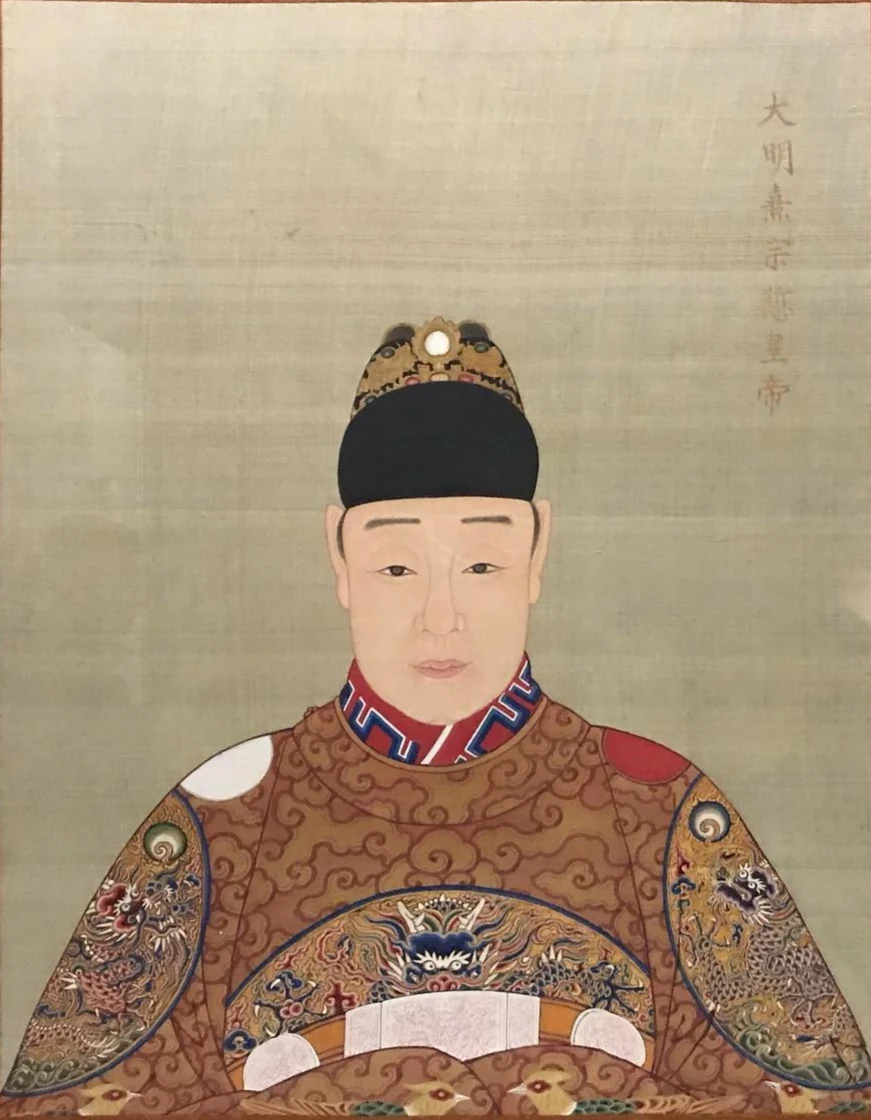
Biography
Family Background and Early Life Zhu Youxiao was born on the fourteenth day of the eleventh lunar month in the thirty-third year of Wanli, December 23, 1605, the eldest son of Zhu Changluo, later Emperor Guangzong of Ming. His biological mother was Lady Wang, originally a selected consort in Zhu Changluo's household when he was crown prince and later promoted to the rank of *cairen*. In the second lunar month of 1606, Grand Secretaries Shen Yiguan, Shen Li, and Zhu Geng were ordered by Emperor Shenzong to propose names for the imperial grandson. They submitted Youben, Youxiao, Youguo, and Youge, and Shenzong selected “Youxiao.” Zhu Youxiao's early years were unsettled. His grandfather Emperor Shenzong long disliked his father Zhu Changluo and wanted to replace him with Zhu Changxun, Prince of Fu, but court officials defended the crown prince during the prolonged succession controversy. Although Zhu Changluo retained the title of crown prince, he lived for years in insecurity and showed limited affection toward his children. In 1619, the forty-seventh year of Wanli, Zhu Youxiao's mother died. Because the imperial grandson was still young, Emperor Shenzong ordered Western Consort Li, one of Zhu Changluo's consorts, to raise him. There were two consorts surnamed Li in the crown prince's household, conventionally distinguished as Eastern Li and Western Li; Western Li was the woman who cared for Zhu Youxiao. In the seventh lunar month of 1620, the forty-eighth year of Wanli, Emperor Shenzong died. Zhu Changluo ascended the throne in the eighth lunar month as Emperor Guangzong. Guangzong favored Western Li and wanted to elevate her to imperial noble consort. Dissatisfied, she urged him to make her empress, but Vice Minister of Rites Sun Ruyou opposed the proposal. Guangzong became gravely ill after only a month on the throne. Noble Consort Zheng had the eunuch Cui Wensheng, who managed the imperial pharmacy, administer a purgative containing rhubarb, after which the emperor reportedly suffered dozens of bouts of diarrhea in a single day and became extremely weak. On the twenty-ninth day of the eighth lunar month, Honglu Court official Li Kezhuo offered the “red pill.” Guangzong took it and died at the fifth watch on the first day of the ninth lunar month, aged thirty-nine. The episode became known as the Red Pill Case. ### Accession and the Palace Removal Case After Guangzong's death, Consort Li remained with Zhu Youxiao in Qianqing Palace and intended to use control of the young heir to influence government. Liu Yijing and palace eunuch Wang An devised a plan to deceive her and escort Zhu Youxiao out of Qianqing Palace to Wenhua Hall, where the Duke of Ying Zhang Weixian and other officials bowed and acclaimed him. Zhu Youxiao was then placed in Ciqing Palace. Minister Zhou Jiamo and other officials memorialized that Consort Li should leave Qianqing Palace and move to Huanluan Palace. Senior Grand Secretary Fang Congzhe hesitated. Censor Zuo Guangdou strongly denounced Consort Li and warned that another disaster like that of Empress Wu might arise. Supervising Secretary Yang Lian pressed for her removal, arguing that she outwardly claimed to protect the young ruler while secretly seeking personal control and therefore had to leave the palace. Consort Li was forced to move, an episode known as the Palace Removal Case. On the sixth day of the ninth lunar month in 1620, the first year of Taichang, Zhu Youxiao ascended the throne. He designated the period after the eighth lunar month as Taichang and the following year as Tianqi 1. After accession he granted his wet nurse Madame Ke the title Lady Fengsheng and promoted the eunuch Wei Jinzhong, who had served him since childhood and later took the name Wei Zhongxian, to writing eunuch in the Directorate of Ceremonial. Madame Ke and Wei Zhongxian formed an alliance and gradually gained control of the inner court. ### Early Tianqi Government and the Liaodong Crisis At the beginning of Zhu Youxiao's reign he employed many Donglin officials. Yang Lian, Zuo Guangdou, Zhao Nanxing, Gao Panlong, Sun Chengzong, Yuan Keli, and others held important posts while figures such as Fang Congzhe were increasingly pushed aside, and official administration briefly appeared more orderly. The dynasty, however, faced a major external crisis. In the third lunar month of 1621, the first year of Tianqi, Nurhaci led Later Jin armies in capturing Shenyang. Ming commanders You Shigong and He Shixian were killed. Reinforcement forces under Chen Ce, Tong Zhongkui, Qi Jin, and Zhang Mingshi fought Later Jin at the Hun River and were annihilated. Later Jin then captured Liaoyang, and military commissioner Yuan Yingtai killed himself. Xizong had dismissed the capable Liaodong military commissioner Xiong Tingbi, worsening the frontier situation. In the third lunar month of Tianqi 1 he recalled Xiong in an attempt to stabilize Liaodong. Xiong advocated a “three-front deployment,” while Liaodong governor Wang Huazhen favored divided garrisons and offensive action. The emperor failed to resolve the conflict between the military commissioner and governor. In the first lunar month of 1622, Later Jin captured Xiping Fort and Guangning fell. Xiong Tingbi and Wang Huazhen both retreated inside the Great Wall. Xiong was imprisoned and finally executed in 1625, with his severed head sent to the nine frontier commands. ### Eunuch-Faction Rule and the Donglin Conflict In 1623, the third year of Tianqi, Wei Zhongxian took control of the Eastern Depot and used the eunuch faction to counter the Donglin group. Zhu Youxiao was deeply absorbed in carpentry. According to the source, whenever the emperor was working on woodcraft, Wei Zhongxian would bring state business before him. The emperor, annoyed by the interruption, said that he already understood and told Wei and the others to handle the matters themselves. Wei exploited such opportunities to issue false edicts, exercise unauthorized power, drive Donglin officials from office, and allow Eastern Depot agents to act lawlessly. In the sixth lunar month of 1624, Left Vice Censor-in-Chief Yang Lian impeached Wei Zhongxian on twenty-four major charges. Officials in both northern and southern administrations followed with accusations, but Xizong rejected them all. In the tenth lunar month Yang Lian, Zuo Guangdou, and others were removed from office. Wei Zhongxian became increasingly dominant and was popularly called the “Nine-Thousand-Year Lord,” while shrines in his honor were built in many places. Madame Ke caused turmoil within the harem, reportedly sending women to the emperor and arranging harm to pregnant consorts; the source even states that she caused the empress to miscarry. In the third lunar month of 1625, Wang Wenyan was tried and imprisoned. Yang Lian, Zuo Guangdou, Yuan Huazhong, Wei Dazhong, Zhou Chaorui, Gu Dazhang, and others were arrested, while Minister Zhao Nanxing and additional Donglin figures were removed from office. Yang and others soon died in prison in what became known as the “Disaster of the Six Gentlemen.” In the eighth lunar month the court ordered local academies associated with Donglin teaching destroyed. The eunuch faction also reopened judgments connected to three personnel evaluations from the Wanli period, leading to the removal of Li Sancai, Gu Xiancheng, and others. ### Final Years and Death On the eighteenth day of the fifth lunar month in 1625, after performing sacrifices at the Altar of Earth, Zhu Youxiao went boating in the Xiyuan with Madame Ke, Wei Zhongxian, and others. After drinking aboard a large boat in shallow water north of a bridge, he entered a small craft in deeper water with Wang Tiqian, Wei Zhongxian, and two favored young eunuchs. A sudden strong wind overturned the boat and he nearly drowned. Although rescued, the incident left lasting health problems and his condition gradually worsened despite treatment. In the fifth lunar month of 1626, a massive explosion occurred around the Wang Gongchang arsenal in Beijing. More than twenty thousand people were reportedly killed or injured, and three thousand workers repairing walls fell from their scaffolding. Zhu Youxiao, then eating breakfast, survived only by taking shelter beneath the imperial writing desk. Explanations of the explosion varied widely. Amid claims of heavenly anger and popular resentment, the emperor issued an edict of self-reproach and proclaimed a general amnesty. In 1627 Minister Huo Weihua offered the emperor a sweet-tasting preparation called “Linglu Drink.” Zhu Youxiao drank it daily and developed severe swelling, eventually becoming bedridden. On the *yisi* day, the twelfth day of the eighth lunar month, he summoned the grand secretaries and supervisory officials to Qianqing Palace and issued an edict declaring Wei Zhongxian and Wang Tiqian loyal men capable of handling major affairs. He also made Wei Zhongxian's nephew Wei Liangdong Marquis of Dong'an. Realizing that he had little time left, he summoned his fifth younger brother Zhu Youjian, Prince of Xin, to the bedchamber and reportedly said, “Come. My younger brother should become a Yao or Shun.” He instructed him to succeed to the throne and entrusted Empress Zhang to his care. On the *yimao* day, the twenty-second day of the eighth lunar month, Zhu Youxiao died in Qianqing Palace at the age of twenty-three. Prince Xin Zhu Youjian ascended the throne two days later and adopted the Chongzhen era name.
His Birth and His Naming
Zhu Youjiao's mother, the lady Wang, was a chosen attendant of the heir apparent in the Wanli period and was advanced to be a lady of talent. On the fourteenth day of the eleventh month of the thirty-third year of Wanli Zhu Youjiao was born. On the twenty-first day of the second month of the thirty-fourth year the grand secretaries Shen Yiguan, Shen Li and Zhu Geng memorialised that the emperor had commanded them to propose names for the heir apparent's first son, and that having proposed them that day they had received no imperial mark, while the days for announcing at the Fengxian hall, for the naming and for issuing the decree were pressing and could not be delayed, and they begged that the mark be given at once; and that day they proposed for the generation of You the names Ben, meaning root and also order and beginning; Jiao, as in the summer school, the name of a school, for the school teaches and its meaning is to teach the people; Guo, fruit and also daring and good faith; and Ge, pattern and measure; asking the emperor to mark one. On the twenty-fifth a decree to the ministry of rites said that the emperor's eldest grandson had been named by prayer to the imperial ancestors and the imperial father and was to be called Youjiao, and that it should be entered with the office concerned. In the forty-seventh year of Wanli his mother died, and the Wanli emperor, considering the imperial grandson young, had him brought up by a chosen attendant of the heir apparent Zhu Changluo. There were then two chosen attendants surnamed Li, distinguished as the eastern and western Li, and it was the western Li who cared for Zhu Youjiao.
Taichang, the Removal of the Palace, and His Accession
After Zhu Changluo came to the throne the western Li was favoured, and he wished to make her an honoured consort; but she was not satisfied and urged him to make her empress. When Zhu Changluo fell ill Cui Wensheng, as eunuch in charge of the imperial pharmacy, gave him a purgative of rhubarb, so that in a day and a night he had thirty or forty evacuations and was left utterly weak and failing. On the twenty-eighth day of the eighth month he summoned thirteen men into the palace and had the eldest son Zhu Youjiao come out to see them, as if charging them with his orphan, and ordered Cui Wensheng driven from the palace. On the twenty-ninth the assistant of the court of state ceremonial Li Kezhuo said he had an elixir to present, and at the fifth watch of the first day of the ninth month Emperor Guangzong died at thirty-nine, having reigned a month. After his death the chosen attendant Li and Zhu Youjiao dwelt in the Qianqing palace; and Liu Yizhu with the eunuch Wang An tricked the chosen attendant Li and brought Zhu Youjiao out to the Wenhua hall, where with Zhang Weixian and others they knocked their heads and shouted the ten thousand years and set him in the Cixiao palace. The minister Zhou Jiamo and others memorialised asking that the chosen attendant Li be moved out of the Qianqing palace to the Yueluan palace to prevent her meddling in the government; and the chief grand secretary Fang Congzhe hesitated, while the censor Zuo Guangdou memorialised directly denouncing the chosen attendant Li and saying that the calamity of the Empress Wu would be seen in their time, at which she was enraged and summoned Zuo Guangdou, who refused to go; and the supervising secretary Yang Lian pressed Fang Congzhe to decide the removal and memorialised sternly that she sheltered herself under the name of protection while plotting in truth to monopolize, and that the palace must be removed from. Liu Yizhu and Zhou Jiamo and the rest joining in the matter, the chosen attendant Li was forced to move. On the sixth day of the ninth month the prince Zhu Youjiao returned to the Qianqing palace and took the throne, changing the era for the months after the eighth month of that year to the first year of Taichang, and making the next year the first of Tianqi. After his accession Zhu Youjiao arrested the commander of Liaodong and buried the Xian emperor and the empress Xiaoduanxian at the Ding tomb; and in the tenth month he made the grand coordinator of Liaodong and censor-in-chief Yuan Yingtai vice-minister of war and charged him with the affairs of Liaodong in place of Xiong Tingbi.
The Donglin and the Faction of Madam Ke and Wei Zhongxian
After the chosen attendant Li moved out the young Xizong had no reliance in the inner court, and he enfeoffed his nurse Madam Ke as the lady of Fengsheng, and the eunuch Wei Jinzhong, who had served him in childhood, was advanced to be eunuch of the vermilion brush in the directorate of ceremonial; and Madam Ke and Wei joined together, and the struggle of the inner court with the outer officials continued. Some, fearing that Madam Ke would meddle in the government, proposed that she be sent out of the palace by rule; and Madam Ke and Wei Zhongxian worked together against the Donglin party, and for a time monopolized the government. At the same time, after Zhu Youjiao's accession, he had the Donglin men hold the censorate and the six ministries, so that the Donglin were strong and good men filled the court, and Zou Yuanbiao, Zhao Nanxing, Gao Panlong and Yuan Keli and others held important posts while Fang Congzhe and the rest were gradually pushed out, and the administration was somewhat clearer. In the first month of the first year of Tianqi the emperor decreed praise of Wei Zhongxian for his service as a guard, and gave Madam Ke twenty qing of land; and the censor Wang Xinyi memorialised in opposition, saying that before the coffin was buried they thought first of the nurse's incense and before the tomb works were done they forced in the eunuchs' labours, which was unreasonable in principle and unfit in feeling, and the emperor would not hear. In the fourth month the emperor made the lady Zhang empress, and when the ceremony was done he gave Wei Jinzhong the name Zhongxian and hereditary office to two of his nephews; and the supervising secretary Cheng Yuan memorialised that by the ancestral rule no hereditary rank was given without military merit and that the state's statutes should not be lavished, and the emperor would not hear again. The grand secretary Liu Yizhu asked that Madam Ke be sent out of the palace, and the emperor, on the pretext of protecting the empress, said it should be discussed after the burial of the imperial father. In the fifth month Madam Ke and Wei Zhongxian had the supervising secretary Huo Weihua impeach the eunuch Wang An and have him leave the palace, and had the eunuch Liu Chao, who had been pardoned after being implicated in stealing treasure, kill Wang An and report it as suicide; and with Wang An dead the link between the Donglin officials and the inner court was cut, and Madam Ke and Wei became the more powerful. In the ninth month, when the funeral of Guangzong was over, Liu Yizhu asked again that Madam Ke be sent out by the former decree, and the emperor was forced to send her out, but soon recalled her; and the supervising secretary of the personnel section, Hou Zhenyang, memorialised again in remonstrance, pointing directly at the forbidden places of the palace where wicked eunuchs and petty men looked askance from the side, at which the emperor was angry and degraded him, and the ministers who one after another asked the expulsion of Madam Ke were all degraded. In the tenth month the Donglin leader Ye Xianggao became chief grand secretary and asked that the "inner decrees" cease and that all matters be proposed by the grand secretaries, and the emperor would not adopt it. Madam Ke and Wei, supported by the emperor, grew daily stronger.
The War in Liaodong
In the Tianqi years the Xizong emperor faced troubles within and without. On the thirteenth day of the third month of the first year of Tianqi Shenyang fell and the news reached the capital on the nineteenth, and Zhu Youjiao, three months on the throne, in the midst of panic gathered the civil and military officers in council, and in the discussion the ministers thought of the former commissioner of Liaodong, Xiong Tingbi, then at home awaiting examination: the grand secretary Liu Yizhu said that Xiong Tingbi had held Liaodong a year and the slave chief had gained nothing, and that he did not know why he had first been driven out, and that when it went to the nine ministers and the censors in council they all feared to differ and Xiong Tingbi was lost, so that now there was the affair of Shenyang; and the censor Jiang Bingqian said too that Xiong Tingbi's talent, judgement and daring were greatly beyond other men, and that had he been left in his post to display them the affair would not have gone so ill. The emperor had therefore to employ Xiong Tingbi again, and on the twenty-ninth day of the third month sent a special envoy with a decree to Jiangxia to summon him to the capital, fully acknowledging in the decree his merit in preserving Liaodong in its peril, reproving his colleagues for driving him out, and blaming himself for listening to idle talk and begging him to come out and share his burdens. On the second day of the fourth month a further decree said that Xiong Tingbi had held Liaodong a year without great fault, but that with Yuan Yingtai in his place all was lost, and asked who had first proposed it and what officers had concurred, to hand over the ancestors' battlefield won in a hundred battles to the rebels with folded arms; and that unless this were strictly examined the past could not be a warning. So the court punished the censors Feng Sanyuan and Zhang Xiude and the supervising secretary Wei Yingjia, who had impeached Xiong Tingbi, each by three grades, and struck Yao Zongwen from the rolls. Xiong Tingbi came to audience in the capital on the eighteenth day of the fifth month; and on the first day of the sixth month, having the matter well in mind, he presented the plan of three dispositions against the Jin and for the defence of Liaodong, and the emperor made him minister of war and concurrent right censor-in-chief, to hold Shanhaiguan and direct the affairs of Liaodong. On the third day of the seventh month he left the capital for his post, and the emperor, on the grand secretaries' request, gave him besides the special commission a further decree and a sword of authority, so that officers below the rank of deputy commander who disobeyed might be beheaded first and reported after; and he gave him a great red qilin robe and four bolts of figured silk, feasted him outside the city, had the civil and military ministers escort the feast, and gave five thousand men of the capital camps to attend him, such ceremony being rare before. But before Xiong Tingbi came to the capital, on the sixth day of the fourth month the court had already made the right consultant Wang Huazhen grand coordinator of Guangning; and Wang Huazhen, disregarding the enemy's strength and the danger of being beaten in detail, insisted on dividing the troops to hold everywhere and attack on every side; and Zhu Youjiao, irresolute and without a mind of his own, made no proper decision between the commissioner and the grand coordinator, so that the Later Jin beat them in detail and took Guangning with more than forty cities about it; and under the eunuch faction's management the court killed Xiong Tingbi, who had held to the right plan, and the grand coordinator Wang Huazhen too was arrested and condemned. In the eighth month of the second year of Tianqi the court sent Sun Chengzong as a grand secretary to direct the military affairs of Shanhaiguan, Ji, Liao, Tianjin and Deng-Lai, and to supervise Liaodong. In the ninth month of the third year the defences of Ningyuan were finished and the frontier defence system complete, and Sun Chengzong, planning to order Liaodong, asked for two hundred and forty thousand taels of silver, which the emperor granted; but the ministers of war and of works, who were not on good terms with him, obstructed and delayed. Wei Zhongxian tried hard to draw Sun Chengzong to him, but Sun Chengzong, because he was a powerful villain, would not exchange a word with him, at which Wei hated him greatly and wished him dead. In the latter half of the fifth year Sun Chengzong asked to make a western tour of Ji and Liao and passing the capital to congratulate the emperor on his birthday, to see him and set out the frontier situation; and Wei Zhongxian falsely accused him of leaning to the Donglin and of having several tens of thousands of troops to clear the ruler's side, and ran to the emperor and wept about his bed; and the emperor, unable to tell true from false, believed the slander and decreed that to leave one's station without a decree was against the ancestors' law and would not be pardoned, and had the ministry of war send flying couriers three times to stop him from entering the capital; and Sun Chengzong, having by then reached Tongzhou, had to turn his horse back to Shanhaiguan. Afterwards Gao Di, fearing battle, ordered the garrisons outside the passes to dismantle the defences and withdraw within, so that Jinzhou, Youtun and the Greater and Lesser Ling rivers and other forts were abandoned; and Nurhaci led the Later Jin against Ningyuan, and the commander Man Gui and the Ningqian circuit's assistant councillor Yuan Chonghuan held Ningyuan firmly; and Yuan Chonghuan, undaunted in the danger, gathered the generals to discuss attack and defence, decided on a policy of fortified positions and cleared country, and organized the whole city's soldiers and people to hold it together, and presently with the red barbarian cannon beat Nurhaci, which is called the great victory of Ningyuan; and in the second month of the sixth year Yuan Chonghuan was made assistant censor-in-chief with sole charge of the military affairs of Liaodong, still stationed at Ningyuan. Besides this Zhu Youjiao sent men to Macao to engage Portuguese gunners; and the court being loud against bringing in foreigners, Zhu Youjiao set the objections aside and went on to bring in twenty-six red barbarian cannon, of which twelve were taken beyond the passes to Ningyuan, and the great victory of Ningyuan in the sixth year of Tianqi relied on their power; so that in the third month of the sixth year of Tianqi, when the news came, Zhu Youjiao conferred on the red barbarian cannon the title of the great general who pacifies the state, completes the army, pacifies Liao and puts down the caitiffs, and sent officers to sacrifice to the guns.
His Love of Carpentry and the Monopoly of Wei Zhongxian
Zhu Youjiao loved to do carpentry with his own hands and was tireless at it all the year. And whenever he was at such work Wei Zhongxian would memorialise business; and the emperor, wearied, would not hear it out but put him off saying that he already understood it all and they should do as they thought best; and so Wei Zhongxian took the chance again and again to issue forged decrees, to push out the Donglin, and to let the runners of the Eastern Depot run lawless while wicked men held the way. In the third year of Tianqi Wei Zhongxian took charge of the Eastern Depot. In the sixth month of the fourth year the left assistant censor-in-chief Yang Lian impeached Wei Zhongxian for twenty-four great crimes, and many ministers spoke of his guilt, and Zhu Youjiao would not hear; and in the tenth month the court struck from the rolls the vice-minister of personnel Chen Yuting, the assistant censor-in-chief Yang Lian and the assistant censor-in-chief Zuo Guangdou. Wei Zhongxian dealt out majesty and favour as he pleased, and the outer court became his single voice, all calling him the nine thousand years, and shrines were built for him everywhere; while Madam Ke made trouble in the inner palace, keeping many comely palace women whom she presented to the emperor, and contriving the deaths of the consorts who were with child, and even causing the empress to miscarry. The eunuch faction under Wei Zhongxian not only cruelly drove out those who differed but deepened the fleecing of the landlord class, so that the people could not live and the government was utterly dark. In the third month of the fifth year the case of Wang Wenyan was judged, and Yang Lian, Zuo Guangdou, Yuan Huazhong, Wei Dazhong, Zhou Chaorui and Gu Dazhang were arrested and the minister Zhao Nanxing and others struck from the rolls; and presently Yang Lian and the rest were brought and put in the guard prison and died there one after another. In the fifth month the supervising secretary Yang Suoxiu asked that the three cases of the club, the red pill and the removal of the palace be compiled into a book, and Zhu Youjiao agreed; and presently the eunuch faction revived the three metropolitan assessments of the Xin hai, Ding si and Gui hai years of Wanli, whereby the ministers Li Sancai and Gu Xiancheng and others were struck from the rolls, and in the eighth month the court ordered the lecture academies of the Donglin throughout the realm destroyed and struck the minister Sun Shenxing and others from the rolls. Xiong Tingbi, who had been beaten in Liaodong, was on good terms with the six Donglin gentlemen, and this brought Wei Zhongxian against him, so that in the end Xiong Tingbi shared the fate of Wang Huazhen and both were put to death. Sun Chengzong presently asked leave to retire.
The Catastrophe of the Wanggong Factory and His Death
In the fifth month of the sixth year of Tianqi a strange and vast catastrophe occurred in the neighbourhood of the Wanggong factory, causing great loss of life: with a great noise a violent wind rose, heaven and earth were darkened, men and beasts, trees and bricks were drawn into the air and fell again with the wind, and tens of thousands of houses were reduced to powder with more than twenty thousand killed and hurt; after it the men and women were all naked, their clothes, ornaments and vessels having flown to the western hills. At the centre of the explosion, strangely, not an inch of wood was burned and there was no trace of fire, which neither a powder-magazine explosion nor an earthquake could explain; opinions differed and the emperor had to issue a decree against himself. In the summer of the sixth year of Tianqi there was a great flood in the capital and drought and locusts in Jiangbei and Shandong; in the autumn of that year there was another great flood in Jiangbei and locusts in Henan, so that north and south of the river the people could not live. On the eighteenth day of the fifth month of the fifth year of Tianqi, after the sacrifices, Zhu Youjiao, in the company of Madam Ke and Wei Zhongxian and the rest, went boating at the Western Park for sport, drinking on a great boat in the shallows north of the bridge; and then with Wang Tigan, Wei Zhongxian and two trusted young eunuchs he went in a small boat into deep water, when a gust of wind capsized the boat and he fell in and was nearly drowned; and though he was pulled out, the fright left an illness that no treatment could cure, so that his health grew daily worse. Afterwards the minister Huo Weihua presented a "medicine of the immortal dew", which being sweet and agreeable Zhu Youjiao drank daily, so that he was afflicted with swelling and by degrees became dropsical all over and at last took to his bed. On the day yisi of the eighth month of the seventh year of Tianqi Zhu Youjiao summoned the grand secretaries and the censors and supervising secretaries to the Qianqing palace and decreed that Wei Zhongxian and Wang Tigan were loyal and devoted and might be used in the deliberation of great matters, and enfeoffed Wei Zhongxian's nephew Wei Liangdong as marquis of Dong'an. Feeling that his days were few, he called his fifth brother, the prince of Xin, Zhu Youjian, into his chamber and said, "Come, my brother, you should be a Yao or a Shun," and charged him to succeed, and entrusted the empress Zhang to Zhu Youjian, asking him to treat the empress well. He told the prince of Xin that, having summoned him the day before, his heart was glad and he felt somewhat better; and on the day yimao of the eighth month Zhu Youjiao died in the Qianqing palace. The prince of Xin, Zhu Youjian, took the throne on the day dingsi of the eighth month with the era name Chongzhen. In the tenth month of that year he was given the posthumous name of the emperor who reached Heaven and made plain the Way, sincere in filial piety and true in brotherly love, glorious in letters and martial in arms, pacifying and solemn, grave and diligent, with the temple name Xizong, and was buried in the De tomb of the Thirteen Tombs. The De tomb lies at the western foot of the Tanyu ridge and is the last imperial tomb built in the Ming, the joint burial of the Tianqi emperor Zhu Youjiao and the empress Zhang; it was begun in the ninth month of the seventh year of Tianqi, when Xizong had lately died and the Chongzhen emperor had just come to the throne with the dynasty facing grave political and economic crisis, so that its building met with many difficulties, and it took nearly five years, being finished in the second month of the fifth year of Chongzhen; when complete it followed the Zhao tomb in general layout, but the glazed screen wall within the treasure city and the three gates before the archway were after the Qing tomb.