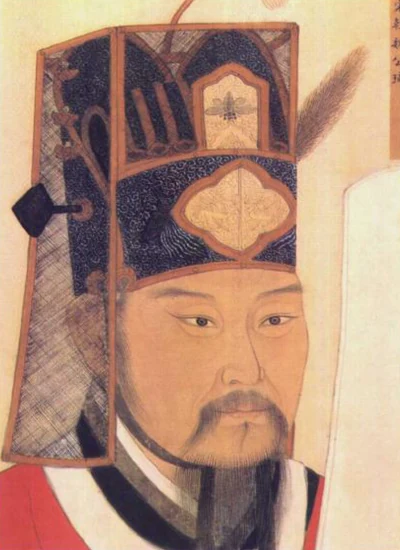
Biography
Family Background and Early Years
Han Qi came from a family with generations of official service. According to his epitaph and biographical account, the Han lineage traced its remote ancestry to the Han clan of the state of Jin in the Spring and Autumn period. His eighth-generation ancestor Han Fei served as a military-administrative clerk in Yizhou, and succeeding generations continued in office. From his great-grandfather Han Qiu onward, family burials were moved to Feng'an Village in Anyang County, Xiangzhou, and Han Qi therefore regarded Anyang in Xiangzhou as his native place. His father Han Guohua rose to Right Remonstrance Grandee and prefect of Quanzhou and was regarded as a diligent official whose biography was included in the national history.
Han Qi was born in the North Tower district of Quanzhou on the second day of the seventh lunar month of the first year of the Dazhong Xiangfu era, August 5, 1008, while Han Guohua served there as prefect. He was born to Han Guohua and a maid named Lianli. The *Gazetteer of Quanzhou Prefecture* records a local tradition that Han Qi was born at the North Tower. His father died when he was four, and several elder brothers raised him. As he grew older, he became self-reliant, ambitious, solemn, and sparing in speech, disliking childish play and showing exceptional learning.
Examination Success and Career as a Remonstrance Official
In 1027, the fifth year of the Tiansheng era, Han Qi placed second in the degree examination while still very young. He was appointed Assistant Director in the Directorate for Palace Buildings and assistant prefect of Zizhou, taking his mother Lady Hu with him. In 1030 she died and he left office for mourning. When the mourning period ended in 1032, he returned as Attendant to the Heir Apparent and was then appointed Assistant Minister of the Court of Imperial Sacrifices and given service in the Jixian Institute.
In the ninth lunar month of 1034 Han transferred to judicial officer of Kaifeng Prefecture and received official dress of the fifth rank. In the twelfth lunar month of the following year he became an official of the Bureau of Expenditures and received the title Erudite of the Court of Imperial Sacrifices. In 1036 he requested a local appointment and was named prefect of Shuzhou, but did not depart; instead, in the eighth lunar month he was retained as Right Remonstrance Official.
During three years in remonstrance service, Han spoke directly, criticized powerful figures, and recommended officials such as Du Yan and Fan Zhongyan. The source states that whenever he saw a matter that was not beneficial, he failed to remain silent, submitting more than seventy memorials, many of which the court accepted. His most famous was the 1038 memorial “The Offices of Chief Councilor and Assistant Councilor Are Not Held by the Right Men.” At a time of natural disasters and widespread displacement, chief councilors Wang Sui and Chen Yaozuo and Assistant Grand Councilors Han Yi and Shi Zhongli appeared unable to respond. Han denounced all four as mediocre and argued that the Song's eighty years of peaceful foundations could not be handed over to incompetent ministers to destroy. All four were removed on the same day, giving rise to the phrase that “one sheet of paper removed four councilors.” Han's name became famous in the capital. The eminent statesman Wang Zeng, who rarely praised others, called his memorial “incisive without being pedantic,” which strengthened Han's confidence.
In 1038 Han served with the acting rank of Minister of the Court of Imperial Sacrifices and Direct Academician of the Zhaowen Hall as an official receiving foreign envoys. He was later assigned duties related to examination candidates and joined the State Finance Commission in discussing the tea monopoly. That year he was appointed New Year's state envoy to the Khitan, the Liao dynasty, and traveled north. After returning, he participated in an economy review with the State Finance Commission and was promoted to Diarist of Activity and Repose and head of the Remonstrance Office.
Famine Relief in Sichuan and Defense against Western Xia
In 1039 Han was promoted to drafting office and placed in charge of the judicial review bureau. Severe drought in Sichuan had created large numbers of famine victims, so he was appointed investigative pacification commissioner for the Yi and Li circuits and granted official dress of the third rank. After reaching Sichuan, he first reduced taxes, dismissed corrupt and incompetent officials, and eliminated hundreds of redundant labor obligations. He then distributed all the grain in local Ever-Normal Granaries to poor people and established additional stations serving thick porridge. The historical account credits him with saving 1.9 million famine victims. People in Sichuan said gratefully, “The arrival of the commissioner has given us life anew.”
From 1038 onward, Li Yuanhao, formerly a ruler subordinate to Song, proclaimed himself emperor and founded Western Xia, openly challenging Song and making the Shaanxi frontier extremely tense. In 1039, just after Han returned from Sichuan, he submitted a detailed analysis of frontier defense and was appointed Pacification Commissioner of Shaanxi. Seeing heavy exactions and widespread poverty there, he ordered the burdens remitted.
In the first lunar month of 1040, Li Yuanhao besieged Yanzhou. Song commanders Liu Ping and Shi Yuansun were defeated and captured at Sanchuankou, and Fan Yong, who had been responsible for Yanzhou, was demoted. Han boldly recommended Fan Zhongyan, then exiled to Yuezhou on accusations of factionalism. In a memorial to Emperor Renzong he declared that if recommending Fan constituted partisan conduct that harmed the state, he himself should be punished together with his clan. He also defended the relatives of Liu Ping, who had been falsely accused. In the fifth lunar month Han, as Direct Academician of the Bureau of Military Affairs, and Fan Zhongyan were both appointed deputy commissioners for strategy, pacification, and campaigning in Shaanxi under Xia Song. Han directed Jingyuan Circuit and Fan directed Fuyan Circuit.
The three differed over strategy against Western Xia. Han advocated a hard offensive line and a decisive campaign. He argued that delay would exhaust finances, while dispersing troops across multiple fronts left each vulnerable; better to combine in one route, advance with momentum, and exploit the enemy's arrogance and complacency. Fan Zhongyan favored a prolonged defensive strategy, strengthening military preparations and attacking only when opportunity arose rather than penetrating deeply into enemy territory. Xia Song could not decide and sent Han and Yin Zhu to Kaifeng to present both plans for Emperor Renzong's decision. The emperor hoped for a single decisive solution and accepted Han's offensive proposal, ordering the Fuyan and Jingyuan armies to combine for an attack in the first lunar month of 1041. At Fan Zhongyan's request the expedition was postponed until warmer weather.
In the spring of 1041 Li Yuanhao offered a false peace before attacking. Han recognized the deception and ordered strict defense. In the second lunar month Li Yuanhao led an army said to number one hundred thousand against Weizhou and advanced toward Huaiyuan. Han urgently sent commander Ren Fu with eighteen thousand troops, with Sang Yi as vanguard, to meet the attack. Before their departure Han gave Ren detailed instructions: move around behind the Xia army, fight if conditions allowed, otherwise occupy strong ground, set an ambush, and cut the enemy's route of retreat. He repeatedly warned that disobedience would be punishable by death even if the campaign happened to succeed.
Ren Fu won a minor victory south of Zhangjiabao and then pursued the apparently fleeing Xia troops in search of greater merit. The Xia abandoned supplies along the road. Song troops, unaware of the plan, followed rapidly and lightly equipped to Haoshuichuan north of Weizhou. The Xia had placed several wooden boxes in the ravine; Song soldiers heard birds inside and hesitated. When Ren Fu arrived, he ordered the boxes opened, releasing more than a hundred pigeons that circled above the Song army. According to the source, this was the Xia signal to launch a converging attack. The exhausted Song troops had lacked food for three days and were surrounded from all directions. More than six thousand officers and soldiers, including Ren Fu, were killed in the resulting defeat.
When Han heard the news he immediately ordered a withdrawal. On the road several thousand fathers, brothers, wives, and children of the dead crowded before his horse, carrying old clothing and paper money to summon the spirits of the fallen. They cried that their relatives had followed the campaign commissioner Han to war and asked whether their spirits might now return with him. The sound of grief filled the area. Han covered his face, wept, and stopped his horse, unable to proceed.
Although Han had not personally commanded the battlefield, he could not escape responsibility for launching the operation rashly and selecting the wrong commander. The court investigated the defeat, removed Xia Song, and reassigned Han and Fan Zhongyan. Han was demoted to Right Remonstrance Official and prefect of Qinzhou; Fan became a Ministry of Revenue official and prefect of Yaozhou. In the tenth lunar month the court divided Shaanxi into Qin-Feng, Jingyuan, Huanqing, and Fuyan circuits, each with its own military authorities. Han concurrently commanded the horse and foot armies of his circuit and served as strategy, pacification, and frontier-campaign commissioner.
In the fourth lunar month of 1042 the court changed the frontier commanders' nominal ranks to observation commissioner. Fan Zhongyan and two others refused; Han alone accepted appointment as Observation Commissioner of Qinzhou. In the intercalary ninth lunar month Song forces were again defeated at Dingchuanzhai and commander Ge Huaimin was killed. Wang Yan, then responsible for Jingyuan military affairs, was demoted. In the eleventh lunar month the court restored Han's former authority and appointed him commissioner for strategy, pacification, and campaigning over the four Shaanxi circuits. He and Fan Zhongyan were stationed at Jingzhou and jointly guarded the western frontier.
Because both Han and Fan had long served on the frontier and enjoyed great reputations, local people sang: “With one Han in the army, the western bandits hear his name and lose their courage; with one Fan in the army, the western bandits hear his name and their hearts break with fear.”
The Qingli Reforms and Local Service
After Western Xia sought peace in 1043, Han returned to court as Deputy Military Affairs Commissioner and joined Fan Zhongyan, Fu Bi, and others in leading the Qingli Reforms. He actively supported Fan's ten-point memorial and helped promote measures to reform official administration, revise the examination system, and strengthen military preparedness. The reforms touched the interests of conservative groups and met strong opposition. In 1045 Fan Zhongyan and Fu Bi were successively pushed from court and the reform program collapsed. Han also requested an outside post and later governed Yangzhou, Yunzhou, Dingzhou, Bingzhou, and other places.
While at Bingzhou he recovered land that the Liao had encroached upon, erected stone markers to define the frontier, and strengthened defenses. He also sponsored water-control works, reduced taxation, and reorganized local administration, earning a strong reputation for governance.
Chief Councilor and Settlement of the Succession
In 1056 the court appointed Han State Finance Commissioner, but before he reached Bianjing the order was changed and he became Military Affairs Commissioner. In the sixth lunar month of 1058 he was appointed Participant in Determining Government Matters and Grand Academician of the Jixian Hall, serving as second chief councilor. In the intercalary eighth lunar month of 1061 he became the principal chief councilor as Grand Academician of the Zhaowen Hall and Overseer of the Compilation of the National History and was enfeoffed as Duke of Yi.
When Emperor Renzong died in 1063, Han served as commissioner for the imperial mausoleum and directed the funeral arrangements. After Emperor Yingzong ascended the throne, Han received the title Vice Director of the Chancellery and was advanced to Duke of Wei. Early in Yingzong's reign Empress Dowager Cao ruled from behind the screen and serious tension developed between emperor and empress dowager. Han mediated, urging Yingzong to observe filial conduct while also persuading the empress dowager to return authority. When she did so in 1064, Han was appointed Right Vice Director and enfeoffed as Duke of Wei.
In 1067 Emperor Shenzong ascended the throne. Han served as Acting Minister of Works concurrently Palace Attendant, one of the Three Excellencies, and as commissioner for Emperor Yingzong's mausoleum. After Yingzong's coffin was buried at Yonghou Mausoleum, Han voluntarily resigned from court. He was assigned the military commissions of Zhen'an and Wusheng together with an honorary chief-councilor title and placed in charge of Xiangzhou; his rank was advanced to Acting Minister over the Masses, Acting Grand Preceptor, and Palace Attendant. Han declined the dual military commissions on the ground that no court official had previously received such an appointment, and the court instead made him Military Commissioner of Huainan and administrator of Xiangzhou. Frontier issues later led to transfers to Yongxing Circuit and Daming Prefecture.
Opposition to the New Policies and Final Years
In 1069, the second year of the Xining era, Wang Anshi's New Policies began. As a senior statesman Han repeatedly submitted memorials opposing them. He particularly criticized the Green Shoots Policy and the service-exemption measures, arguing that they burdened ordinary people. Emperor Shenzong at one point responded that Han was indeed a loyal minister and that policies he had initially expected to benefit the people were causing unexpected harm; he questioned how urban wards could even receive Green Shoots loans and criticized commissioners for forcing them on people.
Han Qi died of illness in his native Xiangzhou on the twenty-eighth day of the sixth lunar month of the eighth year of the Xining era, August 12, 1075, aged sixty-eight. Emperor Shenzong personally composed the inscription “Meritorious Minister Entrusted by Two Reigns Who Settled the Succession,” posthumously appointed him Prefect of the Masters of Writing, granted him the posthumous title Zhongxian, and permitted him to be enshrined in Emperor Yingzong's ancestral temple. In 1196, the second year of the Qingyuan era, Emperor Ningzong of Song posthumously elevated Han to Prince of Wei.
His Lineage and His Home at Anyang
The Han had "a long genealogy": it began with Wuzi, who served Jin and was enfeoffed at Han, and took the name from the place; after Han fell his descendants scattered among the states, their gentry origin being Bolu, and the names and ranks of the line survive in the genealogical records, the first three generations being buried at Anyang, so that Han Qi was a man of Anyang. According to his conduct record, his eighth-generation ancestor Han Fei was a revenue officer of Yizhou; Han Fei's son Han Huan was a registrar of Dengzhou; Han Huan's son Han Quan was a man of no office who grew old at Bolu; and Han Quan had three sons, Yibin, Wencao and Cun. Han Yibin served as administrative secretary of the Chengde army and was a concurrent assistant of the heir and censor of the middle rank; and Yibin's son Han Changci was magistrate of Pocheng, and he was Han Qi's great-great-grandfather. Han Changci had one son, Han Qiu, who ended as magistrate of Yongji in Guangjin prefecture and was repeatedly given the posthumous honours of grand preceptor, grand secretary and president of the secretariat, and duke of Qi, and who was Han Qi's great-grandfather. Han Qiu's son, Han Qi's grandfather Han Gou, served this dynasty as an assistant of the heir and governor of Kangzhou, dying at his post, and was given the posthumous rank of grand preceptor, grand secretary, president of the secretariat and duke of Yan. His father Han Guohua was a remonstrating grand master and died at Jianzhou, being repeatedly given the posthumous ranks of grand preceptor, grand secretary, president of the secretariat and duke of Wei, "a toiling minister of his time, with a biography in the dynastic history"; he was buried in the fifth year of Qingli at Xin'an village in Anyang county, with Yin Zhu writing his epitaph and Fu Bi his spirit-way stele. From his great-grandfather down all were buried at Anyang, and so Han Qi was a man of Xiangzhou.
His Degree and the Seventy Memorials of His Time as Remonstrator
In the fifth year of Tiansheng, when Renzong first examined the presented scholars in person, Han Qi, then twenty, "stood second," and was made an assistant of the palace workshops and co-administrator of Zizhou; the next year his mother, the lady of Qin, died and he mourned beyond the rules; when the mourning was over he was made an assistant of the heir, then grand master of ceremonies, a member of the Hall of Worthies and keeper of the left treasury, then judge of the Kaifeng prefecture with the dress of the fifth rank, then a judge of the revenue division and a grand master of ceremonies by title. In the third year of Jingyou he asked for a provincial post and was to have Zizhou, but stayed and served as remonstrator of the right. At that time the chancellors Wang Sui and Chen Yaozuo with the assistant ministers Han Yi and Shi Zhongli "achieved little of note" in the secretariat, and Han Qi memorialized against them one after another so that all four were dismissed on the same day; he also asked that direct palace appointments be stopped and favouritism checked. Never silent where anything was amiss, he made clear gains and losses, the rectifying of discipline, the drawing near of the loyal and upright and the keeping off of the flattering and wicked his constant care, and presented more than seventy memorials in all. Wang Zeng, then chancellor, told him that if those who spoke did not speak sharply they had many fears and reservations and could not add to the sovereign's virtue, and that words like his were indeed pointed but not far-fetched; and Wang Zeng being then high in reputation and seldom given to praise, Han Qi was the more assured for hearing it.
His Relief Mission in Yili and the Relief of Shu
When Yizhou and Lizhou had famine for years, Han Qi was made a commissioner to survey and pacify them, with the dress of the third rank. Shu was reputed rich, producing gold, silk, fine gauze and brocade on which the central plain depended yearly, but the responsible offices took the occasion to exact taxes and labour beyond measure, burdening the commanderies, and set up buying offices to purchase the tribute goods without paying their worth; and Han Qi lightened and remitted these, drove out the greedy and incompetent officials, abolished seven hundred and sixty redundant labour posts, and provided gruel for more than a million nine hundred thousand starving people. The men of Shu said that the commissioner's coming had given them a second life.
The Defence of Shaanxi against Xia, the Disaster at Haoshuichuan, and the Peace of Qingli
On strategy against the Western Xia Han Qi and Fan Zhongyan differed: Han Qi held a hard line and urged attack and a decisive battle with the Xia army, thinking that delay would exhaust the finances and that to divide the forces among several roads would let them be beaten separately, whereas to "come out by one road and march with drums beating, taking the enemy in his pride and sloth, must break him"; Fan Zhongyan urged a long defence, striking when opportunity offered once the armament was strengthened. The court sent an envoy to press for action, and Han Qi too wished to strike first to master the rebels, but his whole office contended against it, and Yuanhao raided Zhenrong; Han Qi drew up plans of attack and defence and galloped in to present them, and Renzong wished to adopt the attack, but the executives objected, whereupon Han Qi said that although Yuanhao came with the whole strength of his state his host was no more than forty or fifty thousand, whereas the Song, with heavy forces on each road each keeping its own ground, had its strength divided and weak and could not hold whenever it met the enemy, so that if they came out by one road and marched with drums beating, taking the enemy in his pride and sloth, they must break him; and an edict was issued for the Yan and Jingyuan roads to march out together. Returning to camp, Han Qi found Yuanhao asking for a league, and said that to sue for peace without a treaty was a stratagem; and he ordered the generals to stand to arms, and the rebels did indeed attack beyond the mountains. He then gave all his troops to the general Ren Fu, ordering him to go from Huaiyuan city to Desheng stockade and come out behind the enemy, and if battle were not possible to hold strong ground and set ambushes to wait for their return; and at his setting out he warned him again and again and sent a proclamation renewing the terms, that whoever broke the orders would be beheaded even if he won merit. Ren Fu was lured by the enemy after all and perished at Haoshuichuan: several wooden boxes had been placed in the stream bed there, and the Song troops, hearing birds cry within, dared not touch them, but Ren Fu on arrival had them opened, whereupon more than a hundred pigeons flew out and circled above the Song army, this being the signal for the Xia to close in; and while the Song were still in doubt the Xia had surrounded them on four sides, and the Song troops, three days without food and worn out, were heavily beaten after hard fighting, more than six thousand officers and men including Ren Fu dying. Xia Song sent men to gather the scattered troops and found Han Qi's proclamation in Ren Fu's belt, showing that the fault was not his; and Han Qi too memorialized against himself, yet was stripped of one rank and made governor of Qinzhou, being restored soon after. Another account adds that Han Qi wished to advance by five roads against Pingxia and Fan Zhongyan would not have it, so that Han Qi sent Yin Zhu to Qingzhou to agree a date, and Fan Zhongyan said that their troops having just been beaten and the soldiers' spirit broken they should hold fast and watch events and not take light troops deep into the enemy's country, at which Yin Zhu sighed that in this he fell short of Han Qi, who used to say that in war one should first put victory and defeat out of one's reckoning, and Fan Zhongyan answered that once a great army moved ten thousand lives hung on it and it could not be put out of account; and Yin Zhu went back unable to move him, and Han Qi marched and camped at Haoshuichuan, where Yuanhao set an ambush and the army was destroyed and the general Ren Fu died. Han Qi came back in haste, and half-way the fathers, brothers, wives and children of the dead, several thousand of them, wailed at his horse's head, holding old clothes and paper money to call back the souls and crying that those who had gone out with the commissioner were dead and that the commissioner had come back — could their souls come back with him too; and the sound of their grief shook heaven and earth, and Han Qi, covering his face and weeping, checked his horse and could not go on. Earlier, when Fan Yong was censured and the people, alarmed, appealed to Han Qi as commissioner to keep him, Han Qi memorialized that Fan Yong was an old minister of the two offices who had worn himself out on frontier business and was honoured by the frontier people, and asked that he be kept to steady men's minds, adding that if it were held that Fan Yong's command was worthless and he must be replaced, then Fan Zhongyan, then governor of Yuezhou, should be summoned and given the post, for in a time of the sovereign's toil and anxiety he dared not keep silence for fear of appearances, and that if he were acting out of faction and harmed the state's business he should be executed with all his kin. Though the Xia won several victories their losses too were heavy, men were weary of war and resentment boiled, and Song and Xia passed into the long-drawn "peace of Qingli."
His Seven Points of Preparedness, Eight Points of Reform, and the Qingli Reform
In the fourth month of 1043 Han Qi and Fan Zhongyan were recalled to the capital together and both made vice commissioners of the privy council. Yuanhao, relying on the Qidan, was making endless demands, and the chancellor Yan Shu and others, weary of war, would have granted them all, which Han Qi firmly opposed, presenting in the seventh month his memorial on seven points of defence, holding the pressing tasks to be the clearing of the basis of government, attention to frontier plans, the promotion of talent, the preparation of Hebei, the securing of Hedong, the winning of the people's hearts, and the building of a capital at Luoyang; and he then set out eight points of reform — the choosing of generals, the clarifying of inspection, the enriching of revenue, the checking of favouritism, the advancement of capable officials, the removal of the incapable, care in appointing to office and the abolition of redundant stipends — saying that calumny would follow such measures and asking that they be entrusted to the ministers with full discretion; and the emperor approved them all. He was then sent to pacify Shaanxi, where he put down the rebels Zhang Hai and Guo Miaoshan, discharged all the weak and unfit among the guards, repaired the fortifications of the Yan road, and held that peace should not be granted until Xia restored all the land it had taken; and returning he set out four points on the northwest, holding that "good relations should be made a temporary expedient and war and defence the practical business," and asking that armour be repaired, weapons sharpened, the capital fortified and plans of attack secretly settled. His measures, taking the ordering of official discipline and the selection of talent as their substance, agreed in the main with the ten points Fan Zhongyan set out in the ninth month of that year, and struck at the ills of the time; and this reform, led by Fan Zhongyan with Han Qi and Fu Bi taking an active part, is known to later ages as the Qingli reform.
The Suppression of the Risings, the Relief of Shaanxi, and His Provincial Posts after the Reform Failed
Against the rising led by Zhang Hai, Guo Miaoshan and others Renzong sent Han Qi to pacify Shaanxi; he gathered the government troops of the northwest used to fighting in the hills and put the rising down quickly, and, the famine being severe, took decisive measures besides: sending officials to the prefectures and counties to distribute government grain to the starving, remitting all kinds of irregular taxes and labour service, examining officials and promoting the worthy while dismissing the worthless, and discharging more than ten thousand of the old and unfit from the army to reduce expenditure. Soon afterwards Fan Zhongyan and Fu Bi and the rest were all degraded and sent out of court; and Han Qi, being by temper straightforward and always speaking his mind on military and political matters, and though vice commissioner of the privy council in charge of military affairs, setting out the truth even in matters belonging to the secretariat, displeased some of his colleagues, but the emperor knew him and said that Han Qi was by nature upright; and when Fan Zhongyan and Fu Bi were degraded Han Qi came forward and argued the case on principle without result. He then set out thirteen reasons in support of Yin Zhu, the commander of the Jingyuan road, against the old general of Weizhou, Liu Hu, in the dispute over walling Shuiluo, which the court's opinion did not approve; and he asked to go out, being made a scholar of the Zizheng hall and governor of Yangzhou, then transferred to Yunzhou, the Chengde army and Dingzhou, with the added post of pacification commissioner, advanced to grand scholar and given the title of scholar of the Guanwen hall.
The Reforming of the Dingzhou Army, the Abolition of the Felling Ban, and the Land Recovered in Hedong
Dingzhou had long been held by military men, its soldiers insolent and its discipline slack. On arriving Han Qi set about reforming the army at once, using kindness and severity together: those of utterly evil conduct he had put to death, while those who fought to the death he rewarded richly. At first the Dingzhou troops, relying on their merit in pacifying Beizhou, demanded rewards and muttered, to the point of wanting to make a clamour under the city walls; and Han Qi, hearing of it, judged that if it were not dealt with there would be disorder, and drilled them under military law and put the worst to death, while for those who died in action he rewarded their families and registered their orphans and widows for continued rations, "severity and kindness going together"; and he also imitated the three ancient battle formations and trained them daily until the Zhongshan troops were the finest in Heshuo. When the court sent the Longmeng guards to garrison Baozhou and they did harm on the road, Han Qi on their arrival kept them all back and sent instead men already trained to the north, and he relieved and kept alive several million famine victims, for which an imperial letter commended him and the neighbouring circuits took him as their standard. Earlier Pan Mei, holding Hedong, had feared raids and had the people all move inward, leaving the frontier unploughed, so that north of Xin, Dai, Ninghua and Huoshan there was much waste ground; and Han Qi held that this was all good land and that to leave it unploughed was to give aid to the enemy, who would end by holding it all, and asked that a zone ten li from the northern boundary be closed and that archers be settled south of it to open land, so that nine thousand six hundred qing were brought under cultivation. Dingzhou bordered on Liao, and since the beginning of the Northern Song a "felling ban" had forbidden the cutting of the woods and the ploughing of the land to deny the enemy a road; and Han Qi memorialized that when the ban had been extended to the ploughlands of the near hills the frontier people had been thrown out of work and firewood had risen in price so that the enemy took the profit of the moment, that he had sent officers to survey the ground that might properly be closed, which lay fifty or sixty li from the enemy and could still give wide cover, and had fixed the closed area anew and posted notice that what was not forbidden might be cut; and the court followed him and abolished the felling ban, to the great convenience of the people of Dingzhou, and he further ordered that when the Qidan crossed the border to plunder the frontier officers might at any time kill them, which raised the frontier people's zeal for defence. At Bingzhou he learned that "among the hardships of the people of the prefectures and counties none is heavier than that of the village headmen," so that widowed mothers remarried, kinsmen separated, men gave away their land to escape the upper grade or even took their own lives to be reckoned as single adults, so that "the rich rest with something to spare while the poor are ruined one after another." From 1045 to 1056 he held provincial posts for eleven years and was much supported by the local people: in 1053, when he left Dingzhou for Bingzhou, "the men of Dingzhou all but blocked his way to prevent him from going," and he had to slip away alone by a side road, and when they learned of it they ran after him to see him off, so that "on the roads the soldiers and people wept in the fields."
The Equalizing of Land, the Guanghui Granaries, the Reform of the Pastures, and the Question of the Relief Granaries
In 1059 "the secretariat reported that the land tax was unequal in weight throughout the realm and asked for a general equalization," and officers of the bureaux of operations, of the capital and of military farms were sent out by roads to equalize the land; and Han Qi "chose officials to go to the several roads," which did much for the "equalizing of the people's taxes and the easing of their strength." In 1057, on his memorial, the court established the "empire-wide granaries of broad benefit" for social relief, collecting grain and storing it to help the aged, young, poor and sick who lived in the towns. In 1059 he also asked for the reform of the pastures, that the grazing grounds of the several offices and armies, except what was needed for pasture, should be let to farmers, and in Hebei alone three thousand three hundred and fifty qing were "given back to the people," yielding the state annually a hundred and seventeen thousand eight hundred odd shi of grain, thirteen thousand two hundred and fifty-one bolts of silk and a hundred and sixty-one thousand two hundred and thirty bundles of hides. At Yangzhou he learned that the local officials, pleading the army's needs, "borrowed half again of the people's regular tax and recorded the loan in no register," and holding this an unnamed exaction upon the people he asked that it be remitted. In 1045 the court ordered the "relief granaries" abolished and their stores transferred to the government granaries; and as the grain of these granaries had been collected over and above from the people to relieve the victims of disaster, Han Qi held that to transfer it free to the government granaries was plainly to plunder the people and would lose their trust, and memorialized the rights and wrongs of the case, asking that it be given to the ordinary-ever-normal granaries or distributed to the poor, so that what was taken from the people should be used for them; and the court adopted his advice.
The Question of the Succession and the Reconciling of the Two Palaces
The first great problem Han Qi met on entering the centre of government was the succession: Renzong's three sons had died young and no heir had been fixed, and from 1056 onwards the emperor was often ill, so that men were alarmed and the ministers memorialized one after another urging him to settle the succession and so secure the root, Bao Zheng and Fan Zhen most sharply of all; but the emperor took it little to heart, and five or six years passed with nothing decided. Han Qi, as chancellor, raised the matter again, holding that "the imperial heir is what the safety of the realm hangs on, and that in the past disorder has always come of a decision not taken early," and taking a moment when affairs were quiet he said that the emperor's years were high and no heir had been set up, and asked why he did not choose a worthy man of the imperial house and provide for the ancestral temple and the altars; but Renzong, still hoping for a son in the palace, gave no answer, and a daughter was born. One day Han Qi came in with the biography of Kong Guang in the History of the Han, saying that Emperor Cheng had no heir and set up his brother's son, that a sovereign of middling capacity could do it and how much more the emperor, and asking him to take the heart of the Song founder for his heart, and then nothing would be impossible; and with Zeng Gongliang, Zhang Sheng and Ouyang Xiu he pressed the matter hard. It happened that Sima Guang and Lü Hui both petitioned, and as Han Qi read out the two memorials and had not yet offered anything, the emperor suddenly said that he had long had the intention and asked who could be chosen; and Han Qi answered in alarm that this was not for men like himself to deliberate but must come of the emperor's own choice, and the emperor said that two boys had been brought up in the palace, that the younger was very simple and little better than foolish, and that the elder would do; and when Han Qi asked his name the emperor told him Zongshi, which was the former name of Yingzong, and Han Qi and the rest gave their strong support and the matter was settled. In the third month of 1063 Renzong died and Zhao Shu came to the throne as Yingzong, with the empress dowager Cao holding court behind the screen. Yingzong was not Renzong's own son, and wishing to accomplish something on the throne, while the empress dowager was more conservative in temper and certain eunuchs sowed discord, the two palaces fell out: Yingzong was suddenly taken ill and the empress dowager held court, and in his illness his conduct sometimes changed from its usual measure and he treated the eunuchs with little kindness, so that many about him were displeased and slandered him together. Han Qi and Ouyang Xiu reported business before the screen, and the empress dowager, sobbing, set out the whole matter; and Han Qi said that this was the nature of the illness and that when it was over it would not be so, and asked whether a mother could not bear with a son's sickness, and Ouyang Xiu also spoke tactfully, so that her temper softened. Some days later Han Qi saw the emperor alone, and the emperor said that the empress dowager treated him without kindness; and Han Qi answered that of the sage emperors and enlightened kings of antiquity there had been no few, and yet Shun alone is called greatly filial, and asked whether all the rest were unfilial, that for parents to be kind and the son filial was ordinary and not worth mention, and that only where the parents were not kind and the son did not fail in filial duty was there something to praise, but that he feared the emperor's service of her was not yet complete, since how could parents be unkind; and the emperor was much moved. When he recovered Han Qi asked that, for the rain-prayer, the emperor should go out in plain dress, and men's minds were set at rest.
The Puyi Dispute, His Handling of Xia at the End of Yingzong's Reign, and His Death
In 1064 the chancellor Han Qi and others memorialized that the authorities be ordered to deliberate on the ceremonies due to the prince of Puyi and the ladies of Qiaoguo, Xiangguo and Xianyou; an edict deferred the matter until the great mourning were over, and in the following year the ritual officers and those of the rank of attendant were ordered to deliberate, the Hanlin academician Wang Gui and others holding that the prince of Puyi being elder brother to Renzong the emperor should style him imperial uncle without a name. The secretariat further memorialized that by the Rites, the Ordinances and the edict on the five grades of mourning the son of another line calls both his predecessor and his own father father, and that the Han emperors Xuan and Guangwu had both styled their fathers imperial father, so that Wang Gui's proposal to style the prince of Puyi imperial uncle had no clear basis in the codes, and asked that the matter go to the secretariat with the three departments and the censorate. While it was under discussion the empress dowager issued a hand edict reproaching the executives, and an edict was issued saying that the deliberations differing it was suspended; the ritual officer Fan Zhen and others memorialized again, and from that time the censor Lü Hui and others impeached Ouyang Xiu for having first raised the heretical proposal and Han Qi, Zeng Gongliang and Zhao Gai for abetting it. In the ninth month of 1066 the Western Xia attacked Dashun city in force, and Han Qi proposed to stop the annual gift, cut off the border market and send an envoy to call them to account; the privy commissioner Wen Yanbo opposed it and some at court cited the wars with Xia in Renzong's time, but Han Qi judged that Liangzuo was a mad boy with none of Yuanhao's wisdom and that the frontier defence was far better than then, so that a sharp remonstrance would bring him to submit; and Yingzong acted on his advice and Li Liangzuo did indeed memorialize in apology, and the emperor looked at Han Qi and said that it was just as he had foreseen. In the winter of that year Yingzong fell gravely ill and the question of the succession came to the surface; and Han Qi said that the emperor had long not held court and that an heir should be set up early to settle the altars, to which Yingzong nodded, whereupon the prince of Ying was made heir. Under Shenzong, Han Qi having governed through three reigns, some murmured that he was overbearing, and the censor-in-chief Wang Tao impeached him for not attending the roll-call at the Wende hall, calling him domineering; Han Qi asked to retire and Shenzong dismissed Wang Tao instead. After the closing of the Yonghou tomb he would no longer enter the secretariat and firmly resigned, being made military commissioner of Zhen'an and Wusheng, minister of education and concurrently palace attendant, and governor of Xiangzhou; and at his audience Shenzong wept and said that if the palace attendant would go, the edict had already been issued, gave him a mansion in Xingdao ward and promoted his son Zhongyan to the palace library, Han Qi declining the two commissions and holding only Huainan. When Zhong E took Suizhou on his own authority and the west was disturbed, he was made governor of Yongxing and director of Shaanxi; and Han Qi said that frontier officers were acting wantonly and breaking the treaty to lay the ground of disorder, and asked that the two offices be summoned to decide at once. Taking leave, when Zeng Gongliang and others were reporting business and asked that Han Qi deliberate with them, the emperor summoned him and he said that he had formerly been a member of the government and ought to have deliberated, but that now he was a frontier officer and dared not take part; and he added that Wang Tao had called him domineering and that now the emperor was giving him the military power of Shaanxi, so that if another impeached him as Wang Tao had, his whole clan would be wiped out, to which Shenzong answered that the palace attendant did not yet know his mind. He had at first held that Suizhou should not be taken, but when the Xia lured Yang Ding to his death he said that since the rebels had done this Suizhou could not now be abandoned; and the privy council reproached him with his former view, and Han Qi set out his reasons fully and Suizhou was kept. On the twenty-fourth day of the sixth month of 1075 Han Qi died at sixty-eight; the night before, a great star fell at his seat of government and the horses in the stable were all startled, and Shenzong lamented in the park and wept bitterly, suspending court for three days, giving three thousand taels of silver and three thousand bolts of silk and setting the troops of the two rivers to build his tomb, and had his stele inscribed "the meritorious minister of two reigns' testament and the fixing of the succession"; he was given the posthumous rank of president of the secretariat and the name Zhongxian, and a place in the temple of Yingzong.