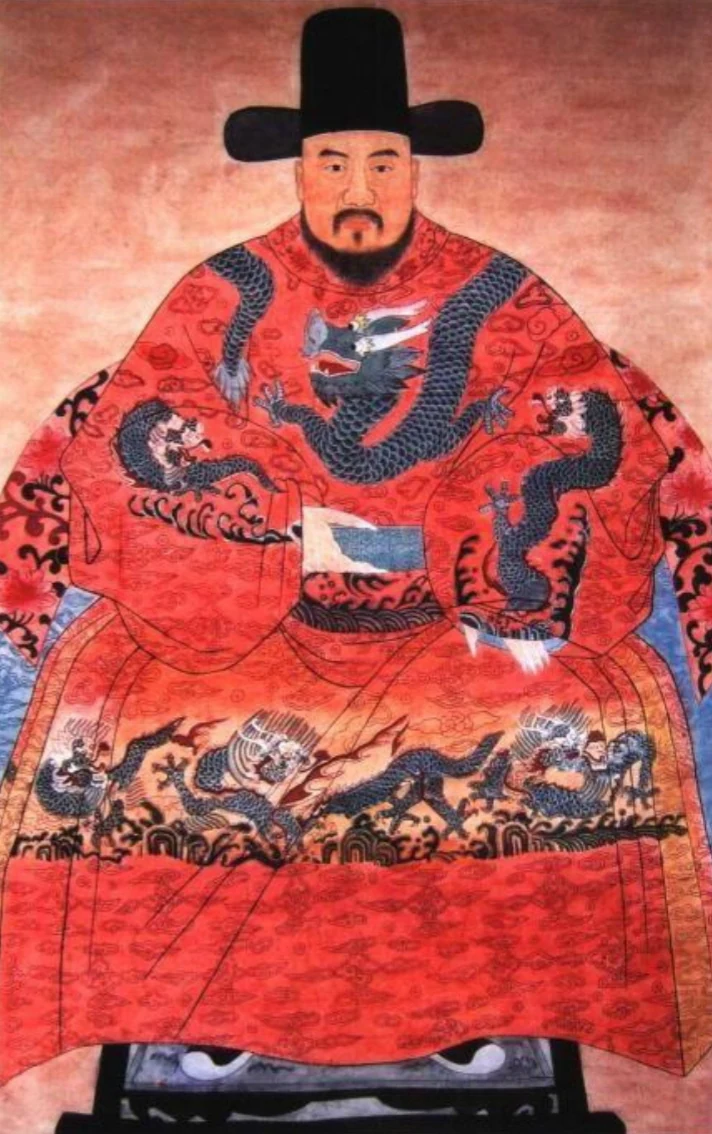
Biography
Family Background and Early Years Gao Gong's ancestral home was Hongtong, Shanxi. His ancestors moved to Gaolaozhuang village in Xinzheng, Henan to escape the warfare at the end of the Yuan. He came from an official family. His grandfather Gao Kui rose to become director of the Bureau of Forestry and Crafts in the Ministry of Works, and his father Gao Shangxian passed the jinshi examination in 1517(12th year of Zhengde, Ming) and eventually became vice minister of the Court of Imperial Entertainments. Gao received a strict family education from childhood. Sources say that he "was skilled at paired phrases at five and could recite a thousand characters at eight." He distinguished himself in the Classics; in 1528(7th year of Jiajing, Ming), he placed fifth in the Henan provincial examination and earned the juren degree. He then spent thirteen years without further success in the examinations before passing the jinshi examination in 1541(20th year of Jiajing), after which he was selected as a Shujishi in the Hanlin Academy and appointed compiler one year later. ### Lecturer to Prince Yu and the Succession Dispute In 1552(31st year of Jiajing), when Prince Yu Zhu Zaiji opened his residence for instruction in the classics, Gao Gong was among the first selected to lecture there. Crown Prince Zhu Zairui had died two years earlier and no new heir had yet been appointed. Prince Yu and his half-brother Prince Jing Zhu Zaizhen both lived in the capital. By order of succession, Prince Yu should have been made heir, but Emperor Shizong appeared to favor Prince Jing. With Prince Yu's future uncertain and speculation widespread at court, Gao moved in and out of the princely residence and offered him considerable support. During nine years there, Gao lectured on the classics, spoke directly and carefully, and gained Prince Yu's trust. Their relationship became both that of ruler and minister and of teacher and student. Prince Yu personally wrote phrases including "greatly enlightening," "cherishing the worthy," and "loyal and steadfast" as gifts to him. At the time, Senior Grand Secretary Yan Song and Xu Jie, the next-ranking grand secretary, were engaged in a power struggle. Gao Gong moved between them without visibly favoring either side. Both valued him partly because he served as Prince Yu's lecturer and was expected to rise in the future. On their successive recommendations, Gao was promoted in 1558(37th year of Jiajing) to Academician Lecturer in the Hanlin Academy. In 1560(39th year of Jiajing), he became Minister of the Court of Imperial Sacrifices and was placed in charge of the Imperial University. In 1565(44th year of Jiajing), after Prince Jing died in his fief and Prince Yu's position became secure, Gao was promoted to Minister of the Ministry of Rites and summoned into close court service. He also gained imperial favor through qingci ritual prayers and was granted a flying-fish robe. In March 1566(45th year of Jiajing, Ming), Xu Jie recommended him for entry into the Grand Secretariat as Minister of the Ministry of Rites concurrently serving as Grand Secretary of the Wenyuan Pavilion. ### Power Struggle with Xu Jie and First Removal After Gao Gong entered the Grand Secretariat, Emperor Shizong was spending long periods in the Western Park and secretariat business was sometimes neglected. Gao told Xu Jie, the Senior Grand Secretary, that as a senior statesman Xu could remain on regular duty, while he, Li Chunfang, and Guo Pu were willing to rotate daily through the secretariat to learn established procedures. On the 14th day of the 12th month of the 45th year of Jiajing in 1566, Emperor Shizong died and Zhu Zaiji succeeded him. Gao was advanced to Junior Guardian concurrently serving as Grand Guardian of the Heir Apparent. When Xu Jie drafted the succession edict, however, he consulted privately only with his student Zhang Juzheng and not with Gao, increasing Gao's resentment and deepening their estrangement. Gao regarded himself as an old servant of the new emperor and repeatedly opposed Xu, with Guo Pu supporting him, until Xu found the situation increasingly difficult to tolerate. In 1567(1st year of Longqing), Hu Yingjia, a supervising secretary in the Ministry of Personnel, had defended officials dismissed in an assessment and was himself removed from the registers after Gao Gong and Guo Pu discussed his case. Remonstrance officials believed Gao was taking revenge and submitted repeated impeachments; Ouyang Yijing attacked Gao especially forcefully. Gao suspected Xu Jie of directing the criticism and had censor Qi Kang impeach Xu, but Qi was instead dismissed. Criticism of Gao then came almost daily. Feeling insecure, Gao left office on the stated grounds of illness while holding the titles Junior Tutor concurrently serving as Grand Tutor to the Heir Apparent, minister, and Grand Secretary, and returned home in May 1567(1st year of Longqing, Ming). ### Return to Office and the Longqing Reforms Xu Jie retired in July 1568(2nd year of Longqing, Ming). The following year, Zhang Juzheng, then the second-ranking grand secretary, and the eunuch Li Fang helped petition for Gao Gong's recall. In December 1569(3rd year of Longqing), Gao received the order and traveled day and night through the severe winter cold to the capital. He resumed office as Grand Secretary while concurrently taking charge of the Ministry of Personnel. Hu Yingjia reportedly died after learning of Gao's return, and Ouyang Yijing died in dejection while traveling home after leaving office. Gao used students and close associates to circulate messages intended to reassure remonstrance officials, and tensions somewhat eased. While overseeing the Ministry of Personnel, Gao introduced a personnel-record system. Offices were given registers in which the merits and faults, home localities, and surnames of officials were recorded, summarized monthly and compiled annually, so that suitable people could be identified quickly when appointments were needed. He also memorialized that candidates from different examination routes should be employed alongside jinshi without rigid adherence to seniority qualifications and that those dismissed should be told the reasons. In frontier affairs, he proposed adding Vice Ministers of War to create a pool of future governors-general, carefully selecting ministry staff, and cultivating officials with frontier expertise. In August 1570(4th year of Longqing, Ming), the northern frontier was placed on alert. Gao made careful dispositions and Mongol forces did not invade. In October, Altan Khan's grandson Baya Ači, after a dispute with his grandfather, surrendered with his followers. Gao and Zhang Juzheng overcame opposition at court and supported Governor-General Wang Chonggu and Governor Fang Fengshi in accepting the surrender, helping bring about the Longqing Peace Agreement. In March 1571(5th year of Longqing), the Ming court invested Altan Khan as Prince of Shunyi, and in August authorized trade with him. A tributary and border-trade relationship between the Ming court and the Mongol Tatars gradually took shape, and the northern frontier became relatively peaceful for a time. During the fifth year of Longqing, Gao became Senior Grand Secretary. For his role, he was advanced to Junior Preceptor concurrently serving as Grand Preceptor of the Heir Apparent and minister, and was transferred to the post of Grand Secretary of the Jianji Hall. ### Later Years and Posthumous Honors In the first month of 1572(6th year of Longqing, Ming), Gao Gong, already titled Pillar of State, was promoted to Grand Secretary of the Zhongji Hall, and his exercise of power became increasingly domineering. In the fifth month, Emperor Muzong became critically ill and summoned Gao, Zhang Juzheng, and Gao Yi as guardian ministers entrusted with his final instructions. Holding Gao's hand, the emperor said, "I entrust the realm to you, sir." After Muzong died, Gao planned to mobilize the officials to expel Feng Bao, the Bingbi Eunuch of the Directorate of Ceremonial. Feng, however, secretly allied with Zhang Juzheng and struck first. On the 16th day of the sixth month, the empress dowager and the young emperor issued an edict condemning Gao for arrogating power and disregarding the ruler, ordering him back to his native place without delay. Sources say that when he heard the order his "face turned ashen" and "sweat suddenly poured down like rain, and he could not rise from the ground"; Zhang Juzheng, arriving from behind, helped him to his feet. Gao Gong died of illness at his home in Xinzheng on August 4, 1578(2nd day of the 7th month, 6th year of Wanli, Ming) and was buried north of the county seat. In 1579(7th year of Wanli), the court restored his former offices on the grounds that his role in accepting the surrender and bringing the northern enemy into tributary submission could not be forgotten. In 1602(30th year of Wanli), he was posthumously granted the title Grand Preceptor and the posthumous name Wenxiang. Shortly before his death, Gao wrote the four-volume *Last Words from the Sickbed*, recounting his claim that Zhang Juzheng had conspired with Feng Bao to seize the position of Senior Grand Secretary and portraying Zhang as sinister and ruthless.
How He Fell Out with Xu Jie
After entering the Grand Secretariat, at a time when Emperor Shizong had long dwelt in the Western Park and the business of the Secretariat was somewhat neglected, Gao Gong told the chief minister Xu Jie that he as an old servant of the state might attend regularly, while he himself with Li Chunfang and Guo Pu would take turns day by day to learn the precedents in the Secretariat. When Shizong died and Zhu Zaiji came to the throne, Gao Gong was advanced to junior guardian and grand guardian of the heir apparent; but when Xu Jie drafted the testamentary edict he "consulted only with Juzheng," without Gao Gong, whose mind was filled with resentment, and the rift between them grew. Afterwards, on the rewards to the army at the accession and on the emperor's deciding which ministers to keep or dismiss, Xu Jie did not follow Gao Gong's advice, and the estrangement deepened. When the supervising secretary of the bureau of personnel, Hu Yingjia, "suddenly memorialized" to save those dismissed in the review, the emperor reproved him for contradiction and referred the punishment to the grand secretaries; and Guo Pu said angrily that Yingjia had shown no conduct of a subject and should be made a commoner, while Xu Jie, glancing sideways at Gao Gong and seeing him angry, reluctantly agreed. The remonstrating officials therefore held that Gao Gong had driven Yingjia out for private resentment and memorialized against him in a body, the supervising secretary Ouyang Yijing attacking him most strongly; and Xu Jie, on Gao Gong's memorial of defence, drafted an edict of reassurance without much reproof of the accusers, at which Gao Gong was the angrier, and the two abused each other in the Secretariat, and when the censor Qi Kang impeached Xu Jie for Gao Gong, Qi Kang was dismissed. So the remonstrating officials attacked Gao Gong daily, the Nanjing censors even raising the matter in the supplementary review, and Gao Gong, ill at ease, took leave on grounds of illness as junior tutor, grand guardian of the heir apparent, minister and grand secretary, going home in the fifth month of the first year of Longqing. The histories say that "being favoured as the late emperor's old teacher, strong and upright and self-willed, and rather quick to gratify his resentments, he could not in the end keep his place."
His Reckoning with Xu Jie after His Recall, and His Doctrine of Employing Men
In the winter of 1569 Gao Gong was recalled as grand secretary with charge of the board of personnel. On taking office he "reversed everything Xu Jie had done," annulled all the posthumous honours and appointments given to those who had offended in the previous reign by testamentary edict, and memorialized at length that the ministers now debating affairs, sheltering under the edict, would exalt all who had been punished over the rites, so that the spirit of the offering emperor in the temple would have nothing to enjoy and the late emperor's spirit in heaven would have no peace of mind, and that the emperor entering the temple at the seasons could not face the two sages; and he held it improper. The emperor agreed. When the judicial officers proposed to try the alchemist Wang Jin and others under the law of a son who kills his father, Gao Gong memorialized again that a ruler dying by violence and not by a natural end had a name far from good, that the late emperor had reigned forty-five years and lived more than sixty, and that to say he was killed by Wang Jin was to slander him as having died unnaturally and would make later ages ask what kind of ruler he had been, and asked that the judges reconsider; and the emperor again agreed and commuted the sentence to garrison. The histories say that in his second term "he set himself to settle scores with Xu Jie, and all he said was meant to strike at Xu Jie and weight his guilt," and only the emperor's mildness prevented its being carried through. Xu Jie's sons and brothers being overbearing in their district, Gao Gong made the former prefect Cai Guoxi surveillance commissioner and had his sons registered and deported, "missing nothing that could press Xu Jie"; and only when Gao Gong left office were they released. In his memorial on Xu Jie he said that since his retirement Xu Jie had "greatly developed his estates and been insatiable for gain, opening shops in the capital thousands of li away, letting his sons seize and withhold tax monies in transit, so that his wealth came to equal the privy treasury and his power scorched the empire," and had even defied explicit decrees; and when afterwards Zhang Juzheng and Li Chunfang spoke for Xu Jie and Gao Gong saw that his position was lost, he turned generous and wrote to Xu Jie that henceforth he and Xu Jie should abandon their former enmity and renew their old friendship, that no one should be able to play on it again, and he wrote repeatedly to the officials of Songjiang to be lenient with Xu Jie's three sons and their household and to leave them some dignity, annotating Cai Guoxi's memorial with "too severe, have it retried" — at which Cai Guoxi felt himself sold, saying that Gao Gong had made him bear the ill will and taken the credit for mercy himself. In employing men, he "wished to know all men of ability and gave every department a register in which to record the worthy and the unworthy, with their native places and surnames, summarised monthly and reckoned yearly," so that "in sudden appointment he always got the right man"; thinking the frontier urgent, he asked for additional vice-ministers of war "as a reserve from which to choose grand coordinators," holding that "from vice-minister to grand coordinator, from grand coordinator to minister of war, with men exchanged between court and provinces, frontier talent would be ample"; and holding that war was "a specialised study, which none can meet at a moment's notice unversed," he argued that the training of ministers of war must begin with the bureau officers of the board of war, that these should be chosen carefully from men of resource and knowledge of soldiering and kept long in the post without transfer to other bureaux, that future frontier intendants, commanders and grand coordinators should all be drawn from among them, that men of the frontier regions should also be appointed as bureau officers, as the board of personnel distributed its appointments by province, so that their reports would not be at cross purposes, and that frontier prefectures and counties were too weighty in duty to be given to men of mixed origin or to exiles; all of which was approved and made standing ordinance. In his reviews at the board he "cross-checked widely, not relying only on documents for promotion and dismissal and not tying himself to any number, and always telling the dismissed the reason, so that all were convinced," and he memorialized that degree-holders and graduates be used alike without regard to seniority; he asked special commendation for the upright and able prefect Hou Bideng to encourage the rest, and pointed out that the offices of horse administration and salt administration, though named for ministers and commissioners, were treated as sinecures, losing men and ruining business, while the instructors and post-station officers were so low in rank and pay that distant posts were a hardship, so that they should be appointed near their homes out of consideration for their circumstances; and all was approved.
The Longqing Peace, the Southern Frontier, and His Driving Out of Colleagues
In 1570, when Altan's grandson Bayanachi came over, opinion at court was divided, most holding that the enemy's intentions were not to be guessed and that he could not rashly be taken in, but Gao Gong and Zhang Juzheng alike supported the grand coordinator Wang Chonggu and the grand coordinator Fang Fengshi in receiving him, memorializing to make Bayanachi a commander and to "provide him richly with clothes, food and service" in sincere treatment to win his heart; and Gao Gong ordered the frontier officers to have Bayanachi walk the streets in brocade with a fine carriage, a good horse and a great retinue, so that Altan, learning how well the court treated his grandson, was deeply moved and resolved on peace with Ming, asking for enfeoffment and trade. When the proposal raised a clamour like a boiling cauldron and the opposition argued that this frontier differed from Xuanhua and Datong and should not be opened to tribute and trade, Gao Gong drafted an edict of sharp reproof, and presently the three frontier commands of Shaanxi also opened markets. Within a few months the frontier was quiet, not one Mongol raided, "the people of the frontier put down the spear and took up the hoe, the beacon fires died and men could sleep in peace," and the two hundred years of warfare between Ming and the Mongol Tatar tribes was in substance ended. In the negotiations Wang Chonggu, who favoured the tribute and markets, asked to resign when impeached, and Gao Gong both upheld his advice at court and wrote to him from a sickbed, hoping he would "set his mind at ease and carry the matter through to the end, and not harbour further anxiety"; and when Fang Fengshi, having met Altan's men on the tribute business, was impeached for "passing messages to the enemy, speaking with him privately and leading him eastward to shift the harm onto a neighbouring command," Gao Gong refuted the charge forcefully. After the matter was settled he took thought for danger in peace, holding that one should "not rely on others not attacking me, but on my being unassailable; not rely on others not deceiving me, but on my being undeceived," and asked that every year picked and eminent ministers be sent out to inspect the frontier, reporting how much grain and money had increased, how many troops and horses, how much equipment, with credit equal to that for taking heads in battle if the figures rose and punishment for failure of opportunity if they merely held; the emperor approved, and the board of war drew up measures accordingly. On the southern frontier he corrected a false report from Guizhou: the new grand coordinator Ruan Wenzhong called on him before taking up his post, and Gao Gong explained that the native chief An Guoheng had been raised by wicked ministers, had killed An Xin for a private grudge, and that An Zhi, nursing revenge, accused and counter-accused with him, the grand coordinator favouring An Xin and An Zhi, so that An Guoheng in fear refused to submit; and he asked what rebellion was — an offence against the court — whereas here the barbarians were killing one another and what had that to do with the court, criticising those ministers who "bend all their strength to deceiving and concealing," who at first exaggerate the situation to claim merit and leave a loophole for the future and at last do all they can to make a rebellion out of it to prove what they said before, and asking whether that was loyal service to the state; he told Ruan Wenzhong to be calm and to charge only the crimes of revenge-killing and disobedience. Ruan Wenzhong, going to Guizhou and inquiring privately, found it exactly as Gao Gong had said; he published five measures, and An Guoheng, hearing that an officer had come to hear the case and not to subdue him by arms, said that he was a witness at the hearing and the officers would not dare kill him and that he could explain matters himself, and so drove out the wicked ministers and came to the provincial capital, agreeing to all five measures and offering thirty-five thousand taels in atonement; and before the court's officers arrived the trouble was settled. In Guangxi he likewise used Yin Zhengmao as governor-general of the two Guang, saying that he was greedy but could get things done. Within the court, his methods of removing colleagues were harsh: in the review of the censors he asked to sit with the censorate, and the minister Zhao Zhenji, then in charge of the censorate, differed somewhat; the supervising secretary Han Ji impeached him of partiality, and Zhao Zhenji, suspecting Gao Gong of prompting it, memorialized against Gao Gong, whom the emperor did not uphold but sent Zhao Zhenji into retirement, and Zhao Zhenji said as he went that in his charge of the censorate he had differed with Gao Gong only on the review, while of the rest, "the ruin of the law of appointment and the licence of wrongdoing, plain to eye and ear," he had not dared say a word and had failed his trust, and that as for Gao Gong, he might indeed be called overbearing, and asked that he be kept in the Secretariat at least but not suffered to hold great power long and plant partisans widely; and in that review twenty-seven were removed, all of them men Gao Gong disliked. In the eleventh month of 1571 his colleague Yin Shidan, at odds with Zhang Siwei, came into conflict with Gao Gong at the customary assembly and abused him to his face for driving out Chen, then Zhao, then Li and now himself, raising his arm to strike him, and Zhang Juzheng, trying to part them, was scolded too; and Yin Shidan was driven out. Soon afterwards the chief minister Li Chunfang, "judging that men like Gao Gong would never tolerate him," twice asked leave to go home, and when a Nanjing supervising secretary, divining Gao Gong's wish, memorialized against him, he pressed harder and was sent home with post-horses by decree. As for the ten copyists of the patent bureau who drafted the Secretariat's documents, they had been Xu Jie's subordinates, and when their long service was completed and they were due for promotion Gao Gong ignored them; and when they came to his door he smiled slyly and said that if he did anything he would not let them have the envy of dwarfs, and when the order came all ten were transferred to the frontier as granary commissioners.
The Regency, the Case of Feng Bao, and the Words from the Sickbed
In the fifth month of 1572, gravely ill, Emperor Muzong summoned Gao Gong, Zhang Juzheng and Gao Yi as his guardians, taking Gao Gong's hand and saying that he left the empire to him; and after Muzong died Gao Gong, taking warning from the eunuchs' monopoly of power in the emperor's youth, memorialized in articles asking that the authority of the directorate of ceremonial be curtailed and returned to the Secretariat, and had the supervising secretaries attack Feng Bao in a joint memorial while he drafted from within the order to expel him, sending word to Zhang Juzheng that they should together establish this unparalleled merit — and Zhang Juzheng "agreed to his face and privately told Feng Bao." Feng Bao complained to the empress dowager that Gao Gong was usurping power and could not be tolerated, and she nodded; and on the sixteenth day of the sixth month the ministers were summoned and the edicts of the two palaces and the emperor were read, Gao Gong supposing that Feng Bao would be expelled and hurrying in, only to hear his own crimes recounted and himself dismissed, the edict saying that he had monopolised government, seized the emperor's authority for himself and allowed the emperor no decision, so that "we three, mother and sons, are frightened and uneasy," and that Gao Gong must go home and live at leisure and not linger. Hearing it, Gao Gong "went the colour of dead ashes" with "sweat pouring down like rain, and fell and could not rise," and Zhang Juzheng raised him from the side, hired a mule cart and took him out by the Xuanwu gate; Zhang Juzheng and Gao Yi asked that he be kept, which was refused, and asked that he be allowed post-horses, which was granted. Earlier, when Muzong had just died, Gao Gong had wept in the Secretariat and said that a ten-year-old heir apparent could not govern the empire, and Feng Bao turned this against him by telling the two palaces that Gao Gong "called the heir apparent a ten-year-old child and asked how he could be a sovereign," at which the empresses were greatly shocked and the heir apparent changed colour when he heard it. After Gao Gong's departure Feng Bao's resentment did not abate: in the first month of 1573 a man named Wang Dachen, dressed as a palace servant, entered the Qianqing palace, was caught and sent to the Eastern Depot, and Feng Bao, wanting to destroy Gao Gong's clan by this means, plotted with Zhang Juzheng, had his own servant Xin Ru feed the man and put a knife in his sleeve, and had him say that Gao Gong bore a grudge and had sent him to kill the emperor; the man agreed at first, but at the joint interrogation by the imperial guard commander Zhu Xixiao and others he shouted that he had been promised wealth and was now being tortured, and asked where he had ever met old Gao, so that Zhu Xixiao in fear dared not proceed; and when the court ministers Yang Bo and Ge Shouli undertook to vouch for Gao Gong and Zhang Juzheng also pressed Feng Bao under the weight of opinion, Feng Bao's anger abated somewhat and he had the man silenced with lacquer wine and sent to the judges for beheading, so that Gao Gong escaped. In the seventh month of 1578 Gao Gong died at home in Xinzheng and was buried north of the county town; before his death he wrote four scrolls of Words Left from the Sickbed, recounting how Zhang Juzheng had colluded with Feng Bao to seize the chief ministry from him, and describing Zhang Juzheng as a man of sinister cruelty. After his death Zhang Juzheng asked that his offices be restored and that sacrifice and burial be given according to precedent, but the palace granted only half a burial and the sacrificial text still carried blame; and after a long time, when the court debated his merit, he was posthumously made grand tutor with the posthumous name Wenxiang and his heir Wuguan given the office of seal-keeper in the treasure office. His original tomb was two hundred and fifty metres north to south and about a hundred and fifty east to west, with a stone archway, a great gate, stone figures along the spirit path and a hall of sacrifice, of which only the plinth of the stele remains; and Xinzheng had a Gao Gong shrine whose gate bore the words "looked up to for ten thousand generations" and whose archway read "Shrine of the Ming pillar of state and grand tutor, Duke Wenxiang Gao," repaired by the magistrate Li Yonggeng in 1670 and ruined by 1958.