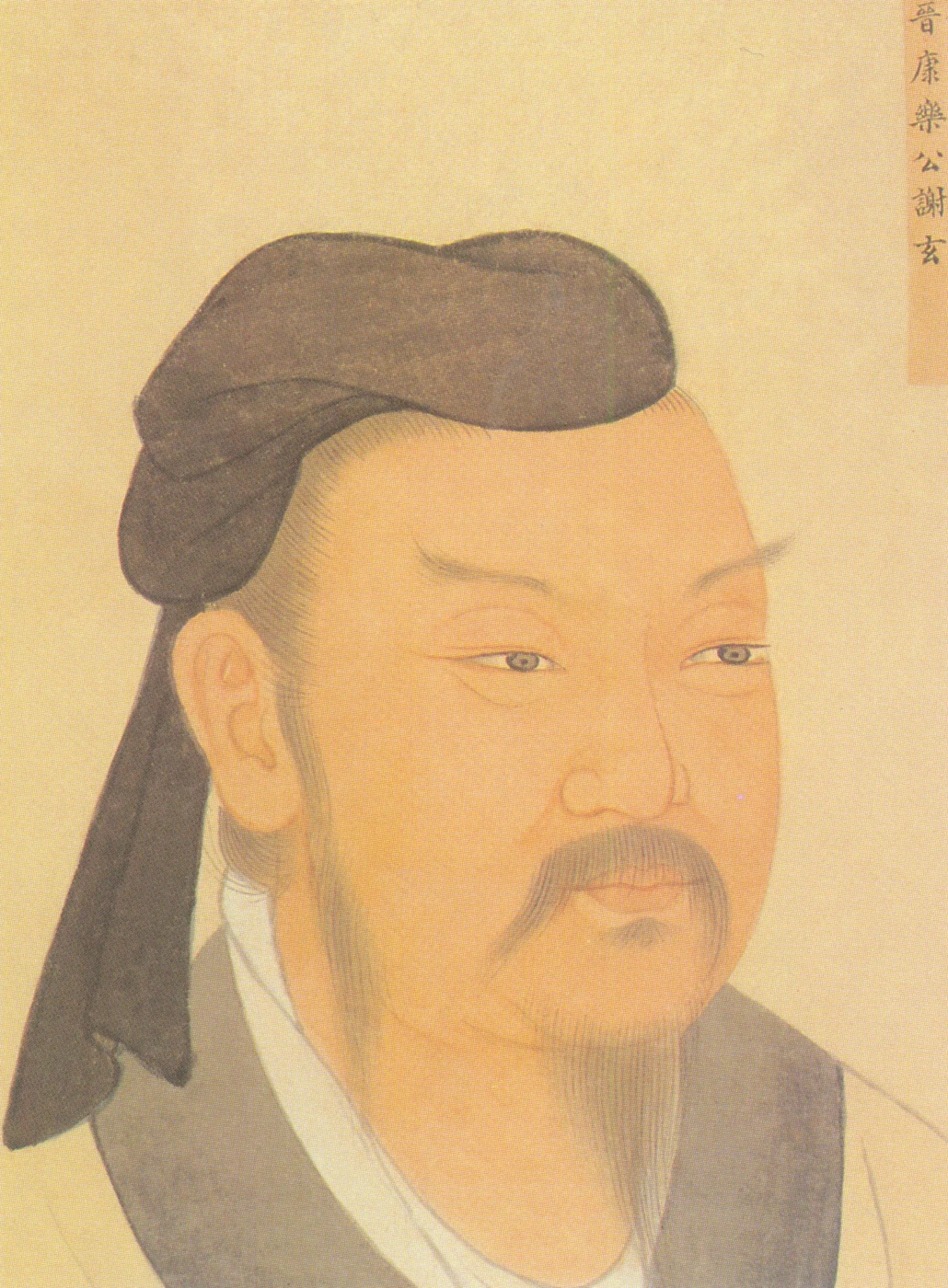
Biography
Family Background and Early Life
Xie Xuan was born into the Xie clan of Chen Commandery. By his time the family had become one of the great aristocratic houses of the south and lived in Kuaiji, present-day Shaoxing, Zhejiang. His grandfather Xie Pou served as Minister of Ceremonies; his uncle Xie An later became Grand Tutor of Eastern Jin; his father Xie Yi served as General Who Pacifies the West and governor of Yuzhou; and his mother Ruan Rong came from the Ruan clan of Chenliu and was related to the Western Jin notables Ruan Ji and Ruan Xian.
As a child Xie Xuan lived in retirement at Eastern Mountain with his uncle Xie An and was especially loved for his intelligence. Xie An once asked the younger members of the family why, although they did not necessarily need to enter politics, each should still become talented. No one answered at first. Xie Xuan replied that they should be “like fragrant orchids and jade trees, growing before the family steps.” Xie An was delighted. On another occasion Xie An asked which line of the *Book of Songs* he liked best. Xie Xuan cited the lines about willows swaying when one departed and snow falling on the return journey. Xie An preferred a line about grand plans and distant strategy. Later commentators, according to the source, often saw Xie Xuan's choice as revealing a more emotionally direct temperament.
After reaching adulthood, Xie Xuan displayed administrative ability but repeatedly declined court summons. Around 363, the first year of Xingning, he and Wang Xun were recruited by Grand Marshal Huan Wen and received favorable treatment. Huan Wen reportedly said that Xie Xuan possessed talent suitable for the halls of government. He later became army marshal under Huan Huo, General Who Conquers the West, concurrently administrator of Nanjun and supervisor of northern expeditionary forces.
Command at Guangling and the Beifu Army
In 377, the second year of Taiyuan, Former Qin under Fu Jian had become powerful and repeatedly threatened Eastern Jin's frontier. The court sought capable generals to resist external attack. Xie An disregarded accusations of favoritism and recommended his nephew Xie Xuan. Xi Chao, Gentleman of the Secretariat, had long been on poor terms with Xie Xuan but nevertheless praised the recommendation. He said Xie An was wise to risk public criticism by recommending a relative and that Xie Xuan would not fail him because he genuinely possessed rare talent. When others doubted this judgment, Xi Chao explained that he had served with Xie Xuan on Huan Wen's staff and had seen that Xie Xuan could assign people appropriately even in small matters; for that reason, he believed Xie Xuan would succeed.
The court summoned Xie Xuan and appointed him General Who Establishes Might, governor of Yanzhou, administrator of Guangling, and supervisor of military affairs north of the Yangzi. At his post he widely recruited tough and courageous men. Liu Laozhi of Pengcheng, He Qian of Donghai, Zhuge Kan of Langya, Gao Heng of Le'an, Liu Gui of Dongping, Tian Luo of Xihe, Sun Wuzhong of Jinling, and others were selected for their bravery. Xie Xuan appointed Liu Laozhi as a staff officer and placed him in command of elite vanguard troops. This force became known as the Beifu Army and, according to the source, was feared by Former Qin.
The Huainan Campaign
In 378, the third year of Taiyuan, Former Qin ruler Fu Jian sent Fu Pi, Duke of Changle, with seventy thousand infantry and cavalry to besiege Xiangyang, while Huan Chong resisted. The Eastern Jin court ordered Xie Xuan to levy laborers and soldiers from three provinces and sent He Qian, administrator of Pengcheng, to move along the Huai and Si rivers in support of Xiangyang. In 379, Fu Pi captured Xiangyang, and Former Qin general Peng Chao attacked Dai Lu, the Dragon-Soaring General stationed at Pengcheng.
Xie Xuan camped at Sikou with Gao Heng, governor of Dongguan, and General of the Rear He Qian. He wanted to inform Dai Lu secretly that reinforcements had arrived but could find no safe route. A junior officer, Tian Hong, volunteered to go and swam underwater toward the city but was captured near the walls. The enemy offered him a generous reward if he would tell the defenders that the southern relief force had already been destroyed. Tian Hong pretended to agree, but when he reached the city wall he shouted that southern reinforcements would soon arrive, that he had been captured while carrying the message, and that the defenders must hold firm. He was then killed.
Peng Chao had stored his supplies at Liucheng. Xie Xuan spread word that He Qian would attack Liucheng, prompting Peng Chao to return and protect the stores. He Qian quickly advanced and relieved Pengcheng. Peng Chao later resumed the southern advance and was joined by Ju Nan and Mao Dang from Xiangyang. With sixty thousand men, Peng Chao besieged Tian Luo, governor of Youzhou, at San'e. The court ordered Xie Shi to move by water toward Tuzhong, while Mao Anzhi and others headed for Tangyi. Xuyi then fell, Gao Mi administrator Mao Zao was killed, and Mao Anzhi and the others withdrew, alarming the court.
Xie Xuan therefore marched west from Guangling against Ju Nan and the others. He Qian occupied Baima, defeated the enemy, and killed the Qin commanders Du Yan and Shao Bao. Peng Chao and Ju Nan retreated. Xie Xuan pursued with He Qian, Dai Lu, and Tian Luo and defeated them again at Junchuan. Liu Laozhi destroyed a pontoon bridge and white boats, while Zhuge Kan and Li Du destroyed transport vessels. Ju Nan and his allies escaped only with their lives. The court sent a Palace General to reward Xie Xuan, promoted him to General of the Champion, added the governorship of Xuzhou, and returned him to Guangling. For his service he was enfeoffed as Marquis of Dongxing County.
The Battle of Fei River
In 383, the eighth year of Taiyuan, Fu Jian personally moved his army to Xiangcheng and claimed to command a force of one million. He sent Fu Rong, Murong Wei, Zhang Hao, Fu Fang, and others toward Yingkou, while Liang Cheng and Wang Xian camped at Luojian. Emperor Xiaowu of Jin appointed Xie Xuan vanguard commander and military commander over Xuzhou, Yanzhou, Qingzhou, Jinling in Yangzhou, and the Yan region in Youzhou. Together with his uncle Xie Shi, his cousin Xie Yan, Huan Yi, Tan Xuan, Dai Xi, Tao Yin, and others, Xie Xuan led an army of eighty thousand against the invasion.
Xie Xuan first sent Liu Laozhi, administrator of Guangling, with five thousand troops directly against Luojian. They won the opening engagement and killed Liang Cheng and Liang Cheng's younger brother Liang Yun. The Qin infantry and cavalry collapsed and fled toward the Huai River. Liu Laozhi pursued, captured Qin commanders Liang Ta, Wang Xian, Liang Ti, Murong Qushi, and others, and seized large amounts of military supplies.
Fu Jian advanced to Shouyang and arrayed his troops along the Fei River, preventing Xie Xuan's force from crossing. Xie Xuan sent a message to Fu Rong arguing that since Qin had marched deep into Jin territory but formed its line directly on the riverbank, it appeared unwilling to fight quickly. He proposed that Qin withdraw slightly so that the two armies could maneuver and watch one another at ease. Fu Jian's officers advised him simply to hold the Jin army on the opposite bank, but Fu Jian proposed allowing the Jin troops to cross and then crushing them in the water with hundreds of thousands of cavalry. Fu Rong agreed and ordered the Qin army to withdraw. Once the order was given, however, the formation fell into disorder and could not be restored.
Xie Xuan, Xie Yan, Huan Yi, and others crossed the Fei with eight thousand elite troops and fought south of the river. Fu Jian was struck by an arrow, and Fu Rong was killed in battle. The Former Qin army collapsed in flight; soldiers trampled one another and many drowned, so numerous that the source says the river was obstructed. The remnants fled through the night, abandoning armor and mistaking the sound of wind and cranes for pursuing Jin troops. Hunger, cold, and exposure caused further deaths. The Jin army captured Fu Jian's carriage decorated with mica, ceremonial clothing, weapons, equipment, and treasure, together with more than one hundred thousand cattle, horses, donkeys, mules, and camels.
After the battle, Emperor Xiaowu ordered Xie Xuan promoted to General of the Front with a provisional imperial tally, but Xie Xuan firmly declined. The court instead granted him one million cash and one thousand bolts of colored silk. To reassure the Huan clan, Xie An arranged for the governorships of Jingzhou and Jiangzhou to go to members of that family rather than Xie Xuan.
Northern Expedition into the Central Plains
After the victory at Fei River, Xie An memorialized that Fu Jian had just been defeated and that the opportunity should be exploited. Xie Xuan was made vanguard commander and, with Huan Shiqian, General of the Champion, advanced toward the Guo and Ying rivers to recover the old capitals. Xie Xuan moved to Pengcheng and sent staff officer Liu Xi against Former Qin's Yanzhou governor Zhang Chong at Juancheng. Zhang was driven off, and Liu Laozhi was left to hold Juancheng. After Yanzhou was pacified, Xie Xuan adopted the suggestion of officer Wenren Shi, built earthen dams across the Lüliang waters, and constructed seven weirs to facilitate transport, benefiting both military and civilian shipping. He then advanced into Qingzhou. Gao Su, governor of Huailing, led three thousand men toward Guanggu and forced Fu Lang, Former Qin governor of Qingzhou, to surrender.
In 384, the ninth year of Taiyuan, Xie Xuan attacked Jizhou. He sent Liu Laozhi and Ding Kuang to hold Qiao'ao, Guo Man to hold Huatai, and Yan Xiong across the Yellow River to establish a camp. Fu Pi, son of Fu Jian, sent Sang Ju to station at Liyang. Xie Xuan ordered Liu Xi to make a night attack, and Sang Ju fled. Fu Pi, alarmed, sought cooperation with Xie Xuan. Xie Xuan agreed and gave him two thousand *hu* of military grain. Teng Tianzhi, administrator of Jinling, crossed the Yellow River and occupied Liyang, and the regions of the Three Wei submitted to Eastern Jin. The source states that Eastern Jin thereby recovered its former territory south of the Yellow River and pushed the front north to the river itself. Xie Xuan was rewarded with military command over Xuzhou, Yanzhou, Qingzhou, Sizhou, Jizhou, Youzhou, and Bingzhou and was promoted to Duke of Kangle County.
Sima Daozi, however, dominated court politics and pushed aside Xie An. According to the source, he did not want Xie Xuan to accumulate further military achievement. On the pretext that the campaigns had lasted too long and the front needed consolidation, Xie Xuan was ordered to withdraw to Huaiyin. Disorder soon spread through Hebei and the northern expedition ended.
Later Years and Death
In the eighth lunar month of 385, Xie An died in Jiankang. Xie Xuan's elder brother Xie Jing also died around this time, and Xie Xuan's infant son died in the cradle. Grief-stricken, Xie Xuan petitioned to leave office, but the court refused.
In 387, the twelfth year of Taiyuan, Xie Xuan was summoned to become administrator of Kuaiji. Zhu Xu was made governor of Qingzhou and Yanzhou and replaced him at Guangling. Xie Xuan thereby lost command of the Beifu Army.
On the bingwu day of the first lunar month of the thirteenth year of Taiyuan, February 8, 388, Xie Xuan died while serving as administrator of Kuaiji at age forty-six. He was posthumously appointed General of Chariots and Cavalry with the privilege of opening an office with the same ceremonial as the Three Excellencies and received the posthumous title Xianwu.
Xie Xuan, courtesy name Youdu, was a native of Yangxia in Chenjun and came of the great Xie clan of the Eastern Jin. His father Xie Yi rose to be general of the west and governor of Yuzhou, and by Xie Xuan's time the family stood among the foremost of the Jiangnan gentry. Clever and quick to understand from boyhood, he was prized with his cousin Xie Lang by their uncle Xie An. When Xie An once admonished his nephews, asking why the sons of the house needed talents of their own when they had no part in public affairs, and no one answered, Xie Xuan said, "As with iris and jade trees, one wishes them to grow by the steps of the courtyard," and Xie An was delighted. The *New Account of Tales of the World* also records that when Xie An asked which line of the *Book of Songs* was best, Xie Xuan chose "When I set out, the willows were drooping"; Xie An preferred "Great plans settle the decree of fate, far-reaching schemes announced in season," and men read in the two answers a taste for feeling on one side and for statecraft on the other.
Grown, Xie Xuan showed the capacity to govern, and though summoned repeatedly he declined; he was later taken onto the staff of Huan Wen with Wang Xun and treated with honor, then served as aide to the general of the west, Huan Huo, as administrator of Nanjun and supervisor of the northern campaign. With the Former Qin at its height and raiding the frontier, the court called for able commanders to hold the north, and Xie An recommended his own nephew without regard for appearances. The palace secretary Xi Chao, long at odds with Xie Xuan, sighed on hearing it that Xie An had shown wisdom in recommending a kinsman against the crowd, and that Xie Xuan would not fail the recommendation, being a man of real ability; when others disagreed he said that he had served with Xie Xuan in Huan Wen's office and seen how he fitted men to their tasks down to the least detail, and so knew he would succeed. Xie Xuan was recalled and made general, governor of Yanzhou, administrator of Guangling and supervisor of military affairs north of the river.
In office he enlisted bold and hardy men, Liu Laozhi of Pengcheng among those chosen for valor, and made Liu his military adviser with command of the picked vanguard, which won every battle and was known as the Beifu army — the most important force of the Eastern Jin. In 383, when Fu Jian of the Former Qin marched south in force, Xie Xuan as vanguard commander with Xie Shi and Xie Yan shattered the Qin army at the Fei river, one of the celebrated victories of Chinese military history won by a smaller force; the phrases "every tree and blade of grass looked like a soldier" and "the wind and the cry of cranes" come from the accounts of that campaign. He campaigned north afterward and recovered Xu, Yan, Qing, Si and Yu, greatly extending the northern frontier of the Eastern Jin.
He resigned on grounds of illness and died in 388 at forty-six, granted posthumously the titles of chariot-and-cavalry general and opened office of the three excellencies with the name Xianwu. His grandson Xie Lingyun was the famous landscape poet of the Southern Dynasties, and the family's image of "iris and jade trees" has been quoted in poetry and prose ever since.
The organization of the Beifu army and Xie Xuan's method of choosing men are an important chapter in Eastern Jin military history. Most of those he enlisted were northern migrants and their descendants settled between the Huai and the Yangtze, men with a grievance for their lost homeland and strong fighting spirit; with Liu Laozhi as his adviser commanding the picked vanguard, they were known as the Beifu army, and Liu Laozhi, He Wuji and Liu Yu all came out of its ranks, the politics of the dynasty's last years shifting more than once with its allegiance. After the victory at the Fei he campaigned north and recovered Xu, Yan, Qing, Si and Yu, extending the northern frontier south of the Yellow River — one of the few advances the Eastern Jin ever made.
The position of the Xie family around the battle is likewise typical of aristocratic politics: Xie An directing from the center and Xie Shi, Xie Yan and Xie Xuan commanding the armies, they preserved Jiangnan in a single campaign and the Xies were named with the Wangs thereafter. Xie An died soon after, and Xie Xuan resigned on grounds of illness, the family's political weight declining with them. In later accounts of Eastern Jin military affairs, the founding of the Beifu army and the battle of the Fei river are counted as his two great achievements.
The course of the battle at the Fei river is recorded in some detail in the *Book of Jin*. In 383 Fu Jian marched south in great force, his main body reaching the Shouyang area, with a host said to number a million against the eighty thousand of the Eastern Jin. Xie Xuan sent an envoy to the Qin camp asking that the Qin army fall back a little to let the Jin cross and fight; Fu Jian meant to strike as the Jin were half across and agreed to withdraw, but once the Qin troops moved their order could not be kept, and Zhu Xu, a Jin general left in the Qin army after his capture, shouted from the rear that the Qin were beaten, throwing them into confusion while the Jin attacked with all their strength and broke them utterly. Fu Jian, himself wounded by an arrow, fled north of the Huai, and the Former Qin quickly fell apart.
Two proverbs come from Fu Jian's part in the battle: seeing the vegetation on Mount Bagong from the walls of Shouyang he took it for Jin troops — "every tree and blade of grass looked like a soldier"; and in his retreat he heard the wind and the cry of cranes and took them for pursuing Jin — "the wind and the cry of cranes." By defeating a host said to number a million with eighty thousand men Xie Xuan preserved Jiangnan for the Eastern Jin and with it the continuity of southern society and culture, and this is his most celebrated battle in military history.
After the battle of the Fei river Xie Xuan campaigned north and recovered Xu, Yan, Qing, Si and Yu, the Eastern Jin frontier briefly reaching south of the Yellow River; but the campaigns depended on Jiangnan for supply and men, and after Xie An's death the court turned conservative about war while Xie Xuan himself was plagued by illness. He died at only forty-six, and his descendants were still known for poetry and prose after the founding of the Liu Song.
In enlisting the Beifu troops at Guangling, Xie Xuan relied, besides Liu Laozhi, on such officers as He Qian, Zhuge Kan, Gao Heng, Liu Gui and Tian Luo, all chosen for valor and hardihood, and these men became the core of the Eastern Jin's military strength in its last years. After his death the Beifu army passed to Liu Laozhi and others, appearing repeatedly in the suppression of the rebellions of Sun En and Lu Xun and of Huan Xuan, until Liu Yu, himself of Beifu origin, controlled it as the armed basis for replacing the Jin with the Song. In that sense Xie Xuan created not merely an army but a variable in the politics of the dynasty's last decades.