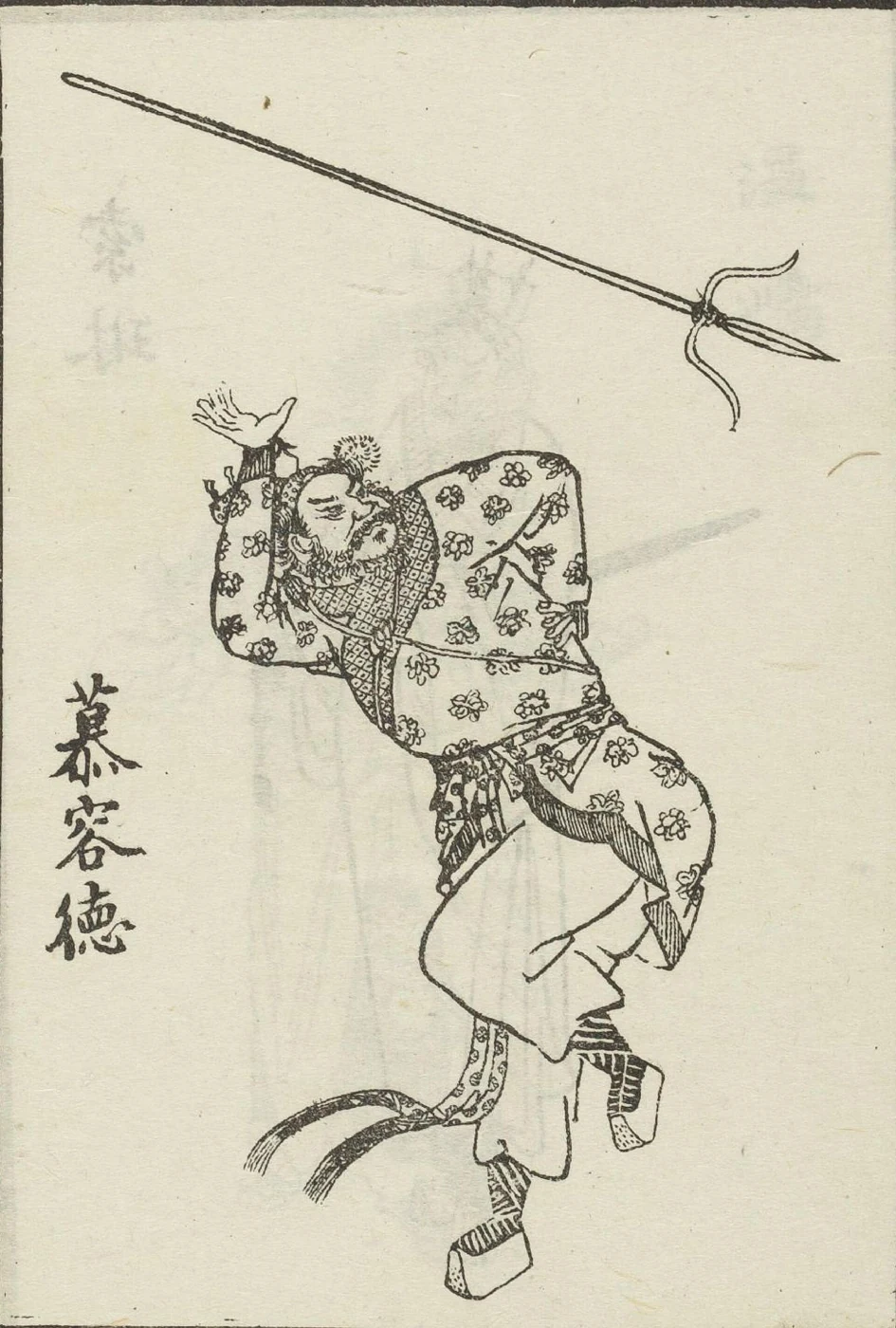
Biography
Family Background and Early Years
Murong De was born into the Murong branch of the Xianbei, one of the most prominent Xianbei ruling houses of the Sixteen Kingdoms. His grandfather Murong Hui was the founder of Former Yan and was posthumously honored as Emperor Wuxuan; his father Murong Huang, Emperor Wenming of Former Yan, expanded Former Yan's power across large parts of Liaodong and western Liaoning. Murong De was Murong Huang's youngest son, and his mother was Lady Gongsun, later Empress Dowager Gongsun. His elder brothers included Murong Jun and Murong Chui. Murong Jun succeeded their father as emperor of Former Yan, while Murong Chui became one of the most distinguished military commanders of the Sixteen Kingdoms.
According to the *Book of Jin*, before Murong De was twenty he already stood eight chi two cun tall, more than about 1.9 meters by the source's conversion, with an imposing appearance and a raised crescent-shaped double marking on his forehead. He read widely, was reserved and cautious in temperament, and possessed many talents. His appearance and learning made him stand out among the Murong princes.
After Murong Jun proclaimed himself emperor, Murong De was enfeoffed as Duke of Liang and served successively as Inspector of Youzhou and General of the Left Guard. Youzhou lay on Former Yan's northern frontier facing the steppe, and his service there gave him experience in both military command and administration. After Murong Wei succeeded to the throne, Murong De was re-enfeoffed as Prince of Fanyang, promoted to Administrator of Wei, and additionally appointed Cavalier Attendant-in-Ordinary. The Administrator of Wei governed the commandery in which Ye was located, one of Former Yan's most important southern centers, showing the trust Murong Wei placed in his uncle.
Senior Official of Former Yan and Service under Former Qin
During Former Yan, Murong De was known for far-sighted judgment. When Fu Jian's general Fu Shuang rebelled in the Shan region and Fu Liu raised troops at Fuhan in response, Murong De urged Murong Wei to seize the opportunity and attack Former Qin. His argument was forceful, and people of insight considered it a plan of great foresight, but Murong Wei did not adopt it. Murong Chui greatly valued his younger brother. The two often discussed major military and state affairs, and Murong De's opinions were consistently well judged. Murong Chui praised the growth of his judgment and insight and compared him to Lü Meng of Eastern Wu.
In 369, the fourth year of Taihe, Eastern Jin Grand Marshal Huan Wen led a northern expedition, winning rapidly and advancing toward Fangtou. As General for the Southern Campaign, Murong De fought together with Murong Chui and inflicted a major defeat on the Jin army in the famous Battle of Fangtou. After the battle, Murong Chui's great merit aroused suspicion and he was forced to defect to Former Qin. Murong De was implicated and dismissed from office.
In 370, the eleventh year of Jianxi, Former Qin destroyed Former Yan, and Murong De was moved with the imperial clan to Chang'an. Fu Jian did not mistreat him; instead he appointed him Administrator of Zhangye. After several years he was dismissed and returned home. Zhangye occupied a strategic position in the Hexi Corridor. Fu Jian's placement of Murong De there can be read within the source narrative as both employment and precaution.
The Fei River Upheaval and Joining Murong Chui
In 383, the nineteenth year of Jianyuan, Fu Jian mobilized the state for a southern invasion of Eastern Jin, and Murong De was appointed General Who Displays Might and accompanied the expedition. Before leaving, he left behind a golden knife when taking leave of his mother Lady Gongsun and his full elder brother Murong Na; this knife later became a crucial token in the Southern Yan succession. Former Qin's huge army was routed at the Battle of the Fei River. Fu Jian's favored consort Lady Zhang became separated and took refuge with Murong Wei. Murong Wei intended to escort her back to the capital, but Murong De strongly objected. He said that when King Zhuang of Chu destroyed Chen, he had followed Wu Chen's advice and cast aside Xia Ji; such an ominous woman could confuse a ruler, and women should not be approached during warfare. Former Qin's defeat, he argued, had occurred for this reason, and it would be best simply to pass her by. Murong Wei refused to listen, so Murong De rode away.
While the returning army was stationed at Xingyang, Murong De again advised Murong Wei. He said that King Goujian of Yue had once lived in humiliation at Kuaiji but ultimately destroyed Wu; sages acted according to the time, and therefore succeeded in every undertaking. Heaven, he argued, regretted the disorders it had caused and had therefore brought defeat upon Qin, so they should seize Qin's failure to restore their ancestral state. Murong Wei again did not accept the proposal. Murong De then followed Murong Chui to Ye.
In 384, the first year of Yanyuan, Murong Chui rebelled against Qin and established Later Yan. He appointed Murong De General-in-Chief of Chariots and Cavalry, restored him as Prince of Fanyang, placed him in the central court as a guardian and participant in major decisions, and later promoted him to Minister over the Masses. Murong De held an exceptionally high position in Later Yan and was one of Murong Chui's most trusted imperial kinsmen. At the time, Murong Yong occupied Zhangzi with an army of 100,000. Murong Chui consulted his ministers on a campaign against him, but they hesitated. Murong De rejected their doubts, cited Emperor Guangwu's urgent rescue during Su Mao's crisis, and strongly urged that Murong Yong be eliminated first. Murong Chui laughed and said: “The Minister over the Masses sees it exactly as I do. When two men are of one mind, their strength can cut metal. My decision is made.” He then launched the campaign against Murong Yong.
Defense of Ye and the Founding of Southern Yan
In 396, the eleventh year of Jianxing, Murong Chui, near death, instructed Crown Prince Murong Bao to entrust Ye to Murong De. After Murong Bao succeeded to the throne, he appointed Murong De Acting with Imperial Authority, Commander of Military Affairs in the six provinces of Ji, Yan, Qing, Xu, Jing, and Yu, Specially Advanced, General-in-Chief of Chariots and Cavalry, and Inspector of Jizhou; he also made him Colonel for the Southern Man and stationed him at Ye. Later Yan still appeared powerful, but it was in deep crisis: Tuoba Gui of Northern Wei had risen in the north and was watching Yan closely.
In 397, the first year of Long'an, Northern Wei launched a major attack on Yan. Later Yan suffered repeated defeats, its capital Zhongshan fell, and Murong Bao fled to Ji. Ye, defended by Murong De, became Later Yan's last barrier in the south. The Northern Wei general Tuoba Zhang attacked Ye. Murong De sent the Prince of Nan'an Murong Qing and others in a night attack and defeated the Wei troops. After the Wei army withdrew to Xincheng, Murong Qing and others requested permission to pursue. Assistant Administrator Han Zhuo explained four reasons why attack was inadvisable and three reasons against reckless movement. Murong De strongly approved, praising the proposal as a stratagem worthy of Zhang Liang and Chen Ping, and recalled Murong Qing. Northern Wei then sent the Duke of Liaoxi Helai Lu with cavalry to join Tuoba Zhang in surrounding Ye. Murong De sent staff officer Liu Zao to Later Qin emperor Yao Xing for assistance and addressed him with the greeting due an elder maternal brother, but Yao Xing's reinforcements never arrived. Murong De personally rewarded and reassured his soldiers. Grateful for his generosity, they were willing to fight for him. Then Tuoba Zhang and Helai Lu quarreled and secretly withdrew their forces separately. Tuoba Zhang's Major Sima Ding Jian brought his followers over in surrender. Murong De sent troops in pursuit, defeated the Wei army badly, and restored morale in Ye.
That same year, after Murong Bao fled north, Murong Xiang declared himself emperor at Zhongshan. Liu Zao returned from Yao Xing carrying a jade seal and secret prophetic writings sent by Later Qin's Grand Astrologer Gao Lu. There was also a children's rhyme: “A great wind rises and lifts the dust; eight wells and three knives will suddenly arise; the Four Seas boil and Zhongshan falls; only the virtuous man occupies the Three Terraces.” Murong De's ministers used these signs to urge him to take the throne, but he refused because Murong Bao's fate was still uncertain. Soon Murong Da arrived from Longcheng and reported that Murong Bao was still alive, so the proposal was dropped. Murong Bao later appointed Murong De Chancellor and concurrently Inspector of Jizhou, with authority to issue commands in the southern territories.
In 398, the second year of Long'an, Murong Chui's son Murong Lin came from Yitai to Ye and advised Murong De: Zhongshan had already fallen, so the Wei army would certainly exploit its victory to attack Ye. Although Ye had long accumulated grain, the city was too large to defend securely. It would be better to move the population south across the river, join the Prince of Luyang Murong He, hold Huatai, gather troops and grain, and wait for an opportunity. Murong He had already urged Murong De to move south. Murong De accepted the plan and led 40,000 households and 27,000 carts south from Ye. On the route they encountered a gale and boats sank. With Wei troops approaching, the people panicked and discussed withdrawing to Liyang. That night floating ice froze the river solid, allowing the army to cross throughout the night. When the Wei troops arrived the next morning, the ice had already broken apart, as if aided by divine forces. Murong De therefore renamed Liyang Ford “Heavenly Bridge Ford.”
After reaching Huatai, an auspicious star appeared between the Tail and Winnowing Basket lunar lodges, and a piece of white jade shaped like a seal was found in the Zhang River. Murong De then followed the precedent of Yanyuan, declared himself Prince of Yan, called the year his first year, proclaimed a general amnesty, established the offices of government, and founded Southern Yan. He appointed Murong Lin Minister of Works and concurrently Prefect of the Masters of Writing; Murong Fa as Central Army General; Muyu Ba as Left Vice Director of the Department of State Affairs; and Ding Tong as Right Vice Director of the Department of State Affairs. Earlier, Murong Lin had seen traces of a qilin at Hejian and interpreted them as an omen for himself. He now secretly plotted rebellion, but the plot was exposed and he was ordered to die. That summer, the Wei general Helai Lu led his followers in submitting to Murong De.
Proclaiming Himself Emperor at Guanggu and His Final Years
In 399, the third year of Long'an, Murong De moved his followers and capital to Guanggu (present-day Qingzhou, Shandong). In 400, the fourth year of Long'an, he formally proclaimed himself emperor, adopted Jianping as his era name, and changed his name to Murong Beide so that his subjects could avoid the imperial taboo on his personal name. He was then sixty-five, making him, according to the source text, the second-oldest person in Chinese history to ascend an imperial throne, after Wu Zetian, who became emperor at sixty-seven.
After becoming emperor, Murong De remained deeply concerned about his mother Lady Gongsun and his full elder brother Murong Na, who had been left in Chang'an. Not knowing that both had already died, in the tenth month of 401, the second year of Jianping, he sent Du Hong of Pingyuan to Chang'an to search for them. Du Hong said: “If I reach Chang'an and cannot learn the empress dowager's condition, I will go west to Zhangye and devote myself unto death.” He also asked that his father Du Xiong, then more than sixty years old, be appointed magistrate of their home county. Secretariat Director Zhang Hua opposed the request, but Murong De said that Du Hong sought his ruler's mother on behalf of his sovereign and income for his father out of filial duty, thus combining loyalty and filial piety; what fault was there in that? He appointed Du Xiong magistrate of Pingyuan. Du Hong reached Zhangye but was killed by bandits.
In 403, the fourth year of Jianping, Murong De's former subordinate Zhao Rong arrived from Chang'an and reported the deaths of Lady Gongsun and Murong Na. Murong De wailed until he vomited blood and thereafter was confined by illness, his health deteriorating sharply.
Murong De's sons had all been killed by Fu Chang during the Former Qin period, making the succession his greatest concern in old age. At this time Murong Chao, son of Murong Na, arrived carrying the golden knife Murong De had left when bidding farewell to his mother. Murong De allowed Murong Chao to inherit the title Prince of Beihai and later made him crown prince.
On November 17, 405, the wuwu day of the ninth month in the sixth year of Jianping, Murong Beide died and Murong Chao succeeded him. On the night of his death, more than ten coffins were carried out through the four city gates and secretly buried in mountain valleys. Thus he was not actually buried in the official tomb at Dongyang Mausoleum, and later generations did not know the location of his true burial place.
Family, Early Years and His Proposals in the Last Years of Former Yan
The Record of Jin describes Murong De as "not yet of age and already eight feet two inches tall, of noble and commanding appearance, with the double line of a sun-horn and crescent on his forehead; he read widely and was by nature clear and careful, a man of many accomplishments." Murong Jun, on usurping the title, made him duke of Liang and he served successively as governor of Youzhou and general of the left guard; after Murong Wei succeeded he was made prince of Fanyang, then governor of Wei, with the additional office of cavalier attendant-in-ordinary. In Former Yan's last years he already showed vision beyond his fellows: when Fu Jian's general Fu Shuang rebelled holding Shan and Fu Liu raised troops at Fuhan to join him, Murong De urged Murong Wei to "take the occasion and attack Jian, with words so vehement that men of judgment said he had far-reaching strategy," yet Murong Wei "in the end could not use it"; his elder brother Murong Chui thought highly of him and "discussed the great plans of war and state with him, his words always to the point," telling him that "your capacity has grown — you are no longer the A-meng of Wu." At the Fangtou campaign he and Murong Chui beat the Jin army as generals of the southern expedition; and when Chui fled to Fu Jian, Murong De was dismissed for complicity. When Murong Wei was defeated, he was moved to Chang'an, where Fu Jian made him governor of Zhangye, and after some years he was dismissed and went home.
One exchange at the defeat on the Fei river shows his uprightness best. Fu Jian having lost touch with his consort Lady Zhang, Murong Wei meant to escort her back, and Murong De said to him gravely: "Of old when Zhuang of Chu destroyed Chen, he took Wu Chen's advice and put away Xia Ji. This is an ill-omened woman who confuses a ruler; in war one does not bring a woman's gear, and the Qin defeat must come of this. You should cover your eyes and pass by — why escort her?" Murong Wei would not listen, and he "galloped off and left him." Bivouacking at Xingyang, he told Murong Wei again that "when Goujian lodged at Kuaiji he won Wu in the end; the sage acts with the times and a hundred ventures succeed. Heaven is repenting the disaster and has brought the Qin army low; we should seize the weakness to restore the altars of state," and again was not heeded, whereupon he followed Murong Chui to Ye — leaving an old lord of one surname for his own brother being his choice in an age of disorder.
Joining Murong Chui, the Decision to Attack Murong Yong, and the Defence of Ye
When Murong Chui took the title of king of Yan he made Murong De general of chariot and horse and again prince of Fanyang, "dwelling at the centre to guard it and taking part in deciding the government," and after a time chancellor. Murong Yong then held Zhangzi with a hundred thousand men, and when Murong Chui proposed a campaign "the ministers all doubted," but Murong De said: "The three ancestors laid up virtue and their songs are still in our ears, and so Your Majesty rose and all came together without plan, partly through your sage valour and partly through old affection, the men of Yan and Zhao being glad to be Yan's subjects. Now Yong has set up a false title and stirred up Chinese and barbarian alike, so that petty men run riot and the struggle for the deer never ceases; he should be destroyed first, to make men's hearing one." He added the example of Guangwu, who "hurried to the crisis of Su Mao and gave no thought to the weariness of the hundred officials," for "the crisis was urgent," and asked whether, since the art of war permits what cannot be helped to be used, the emperor could be spared from it. Murong Chui laughed and told his party that "the chancellor's view is mine; when two men are of one mind their sharpness can cut metal — my mind is made up," and followed his advice. On his deathbed Murong Chui "charged his son Bao to entrust Ye to De," and Bao, succeeding, made him commissioner with the staff of authority, commander of the military affairs of Ji, Yan, Qing, Xu, Jing and Yu, special advanced, general of chariot and horse, governor of Jizhou and colonel of the southern barbarians, to hold Ye, "abolishing the resident office and giving the commander full charge of the south."
At Ye he met two Wei sieges. When the Wei general Tuoba Zhang attacked Ye, he sent Murong Qing, prince of Nan'an, by night and beat him, and the Wei withdrew to Xincheng; when Qing asked to pursue, the assistant Han Zhan set out "four reasons the Wei may not be attacked and three why Yan should not move" — the Wei being an army far from home that profits by battle in the open, deep in our capital region and encamped on fatal ground, their vanguard beaten but their rear now firm, and their numbers greater than ours; while our own army fights on its own soil, and a failed attack would unsteady men's hearts, and the walls are not yet repaired so that the enemy cannot be met — all of them "things the strategists dread," so that "better to deepen the ditches and raise the ramparts and wait at ease," for they "carry grain a thousand li, have nothing to plunder in the fields, and in time their three armies will exhaust their supplies." Murong De called Han Zhan's words "the plans of Zhang Liang and Chen Ping" and recalled Qing. Later the Wei sent the duke of Liaoxi, Helai Lu, with cavalry to invest Ye with Tuoba Zhang; Murong De sent his aide Liu Zao to beg help of Yao Xing, and none came, "and the host was greatly afraid," whereupon he "feasted the soldiers himself and treated them with great kindness, and men were moved by his grace and glad to die for him"; and when Zhang and Lu fell out and slipped away by night, and Zhang's marshal Ding Jian came over with his men saying Zhang's army was worn out and could be beaten, Murong De sent troops who broke Zhang's army, "and men's hearts were steadied."
The Move South to Huatai, the Title of King of Yan, and the Taking of Qing and Qi
When the Wei entered Zhongshan, Murong Bao fled to Ji, and Murong Xiang usurped the title at Zhongshan; and it happened that Liu Zao came from Yao Xing, whose astronomer Gao Lu sent his nephew Wang Jinghui with Liu Zao to bring a jade seal and esoteric prognostics, saying that "the virtuous flourish and the virtueless perish; the virtuous receives heaven's mandate, and the weak becomes strong again," with a ballad of "a great wind rising and lifting the dust, eight wells and three knives suddenly appearing; the four seas boil and Zhongshan falls, and only the virtuous man holds the three terraces." His ministers therefore urged Murong De to take the title, and he "refused," and only when Murong Da came from Longcheng to Ye saying Bao was still alive did the discussion stop. Murong Lin, fleeing to Ye, advised him that "Zhongshan being lost, the Wei will surely press on to Ye, whose walls are too large to hold though the stores are full, and men's minds are unsteady; before the Wei come, carry your host south across the river to the prince of Luyang and hold Huatai, gathering troops and grain and waiting for the opening — that is the best plan," and in 398 he took forty thousand households with twenty-seven thousand carts from Ye toward Huatai. Wind sank his boats and the Wei were close, and "the host was afraid and proposed to fall back on Liyang," when "that night the floating ice froze together, and the army crossed by night, and at dawn, when the Wei came, the ice had broken again, as if by a spirit"; he therefore renamed Liyang ford the Heaven Bridge ford. At Huatai "a bright star appeared in Wei and Ji" and white jade shaped like a seal was found in the Zhang river, and so he declared a first year, proclaimed an amnesty and set up his offices, with Murong Lin as minister of works and president of the secretariat. Afterwards Murong Lin plotted revolt, was discovered and ordered to die, and the Wei general Helai Lu came over with his men; and Murong Bao, fleeing south from Longcheng, sent the eunuch Zhao Si to summon Murong Zhong to receive him, Zhong having been the first to urge Murong De to take the throne and hating the errand, so that he arrested Zhao Si and galloped word to Murong De. Consulting his officers on receiving Bao, Murong De heard the attendant Zhang Hua say that "in an age of contention none but a hero can rise, and in a time of armies no coward can succeed; should Your Majesty tread a woman's kindness and cast away heaven's gift, once your authority goes your head will not be safe"; and he answered that "I would take by force and hold by compliance after the ancients, but my way is not yet sufficient, and so I waver midway," and with tears sent Muyu Hu with several hundred braves north with Zhao Si, "proclaiming an escort but in truth to kill Bao" — while Bao, knowing of his regency, fled north, and Muyu Hu, finding nothing, brought Zhao Si back. Wishing then to employ Zhao Si for his knowledge of the statutes, Murong De was refused with the plea to "return to my lord and show my small fidelity," and with the reproach that he "could not lead the princes in upholding the royal house but took advantage of the collapse of the root to do what Zhao Lun did," whereupon Murong De in anger had him killed.
Afterwards Fu Guang, brother of Fu Deng, brought his tribe to submit and was lodged at Qihuobao; and when, with "Mars in the well of the east," men said Qin would revive, Fu Guang styled himself king of Qin and beat Murong De's general Murong Zhong — Murong De having "newly made Huatai his capital, between Jin and Wei, with less than ten cities and no more than tens of thousands of men." He left Murong He to hold Huatai and led troops himself, killing Fu Guang. But the senior secretary Li Bian, having first urged Murong He to receive Murong Bao and been refused, brought the Jin army to Guancheng to raise revolt in the rear, and being pressed, killed Murong He and surrendered Huatai to the Wei; Murong De meant to attack it, but "his officers' and men's families were all within the city," and Han Fan advised that he "should first hold one region as the base of a Guanzhong and then gather strength to take it," so he desisted; afterwards Murong Yun killed Li Bian and brought out more than twenty thousand of the officers' and men's families, "and the three armies rejoiced." On where to go, Zhang Hua urged Pengcheng and Murong Zhong and others Huatai, but Pan Cong said: "Huatai lies open on four sides and is no dwelling for an emperor; it borders great Wei to the north and strong Qin to the west... Pengcheng is broad and empty of people, level and without defences... but Qing and Qi are rich soil, called the Eastern Qin, two thousand li square with more than a hundred thousand households, strong on four sides and rich by the sea — a country for the use of arms... And Guanggu, which Cao Yi built, has steep mountains and rivers and suffices for an imperial capital." The monk Lang Gong confirmed it by the stars, and Murong De, delighted, led his army south, "and all the counties of northern Yanzhou submitted," and he "inquired after the aged, allowed no private plunder, so that the people were at peace and wine and cattle lined the roads." He then sent Murong Zhong against Bilii Hun, prefect of Qijun: "more than a hundred thousand of the people of Xu and Yan came over, and from Langya northward more than forty thousand came out to welcome him"; the defender Ren An abandoned his city, Pan Cong was posted at Ju, and Zhang Ying, who had written insolent proclamations for Bilii Hun, answered calmly that "Hun's having me is like Han Xin's having Kuai Tong," at which Murong De "at first approved his words and afterwards had him killed," and so entered Guanggu.